Yellowstone National Park bison slaughter has begun – please take action to stop it!


http://ecowatch.com/2014/02/13/yellowstone-wild-bison-slaughter/
Yellowstone National Park shipped 20 of America’s last wild bison to slaughter yesterday morning. Twenty-five bison were captured Friday in the Stephens Creek bison trap, located inside the world’s first national park. After being confined in the trap for five days, 20 of the bison were handed over to the Confederated Salish and Kootenai Tribes, who are required to slaughter them under a controversial agreement between the tribes and the Park. Five bison remain locked in the trap as of Wednesday afternoon.
Nearly three hundred wild bison were rounded up at Wind Cave National Park, SD, for the annual cull in 2005. Photo credit: National Parks Service
Yellowstone plans to slaughter between 600 and 800 bison this winter, according to park spokesman Al Nash. “We’re going to seek opportunities to capture any animals that move outside the park’s boundaries,” he said. Yellowstone has set a “population target,” or objective, of 3,000 to 3,500 animals.
The current buffalo population numbers approximately 4,400 (1,300 in the Central Interior and 3,100 in the Northern range). The Central Interior subpopulation also migrates north into the Gardiner basin and has not recovered from the last Park-led slaughter in 2008 that killed over half of the Central Interior buffalo. The government’s “population target” makes no distinction for conserving subpopulations in this unique buffalo herd.
Each year, officials execute the Interagency Bison Management Plan that forcibly prevents wild bison’s natural migration with hazing, capture, slaughter, quarantine and hunting. Photo credit: Buffalo Field Campaign
According to Dan Brister, Executive Director of Buffalo Field Campaign (BFC), “This number was politically derived to limit the range of wild buffalo and has no scientific basis. It does not reflect the carrying capacity of the buffalo’s habitat in and around Yellowstone National Park.”
This is the first time Yellowstone has turned bison over to the tribes under the slaughter agreements. According to James Holt, a Nez Perce Tribal Member and a member of BFC’s board, “It is disheartening to see tribes support these activities.”
“Buffalo were made free, and should remain so,” Holt said. “It is painful to watch these tribal entities take such an approach to what should be the strongest advocacy and voice of protection.”
“It is one thing to treat their own fenced herds in this manner, it is quite another to push that philosophy onto the last free-roaming herd in existence,” Holt continued. “Slaughter Agreements are not the answer.”
Buffalo fall through ice during a hazing operation in 2006. Photo credit: Buffalo Field Campaign
Brucellosis is the reason used by Yellowstone to justify the slaughter of wild bison. There has never been a documented case of wild bison transmitting the livestock disease to cattle. Other wildlife, such as elk, also carry brucellosis and are known to have transmitted it, yet they are free to migrate, and even commingle with cattle with no consequence.
Year after year, Yellowstone and Montana officials executing the ill-conceived Interagency Bison Management Plan forcibly prevent wild bison’s natural migration with hazing, capture, slaughter, quarantine and hunting. Millions of U.S. tax dollars are wasted annually under activities carried out under the IBMP.
The wild bison of the Yellowstone region are America’s last continuously wild population. Like other migratory wildlife, bison cross Yellowstone’s ecologically insignificant boundaries in order to access the habitat they need for survival. During 2007-2008 more than 1,300 wild bison were captured in Yellowstone National Park and shipped to slaughter.
A dead bison is lifted off the ground near Gardiner, MT, April, 2011. Photo credit: Stephany Seay/ Buffalo Field Campaign
Nearly 7,200 wild bison have been eliminated from America’s last wild population since 1985. Bison once spanned the North American continent, but today, fewer than 4,400 wild bison exist, confined to the man-made boundaries of Yellowstone National Park and consequently are ecologically extinct throughout their native range.
[This is just north of Yellowstone, where wolves should be allowed to take care of the elk “problem”…]
BILLINGS — Cattle ranchers in the Paradise Valley asked the Fish and Wildlife Commission on Thursday to extend the season for lethal elk removals in the area to May 15 and to pay for fencing to keep elk out of feeding and calving areas.
The controversial proposals were drawn up by a subcommittee of the upper Yellowstone watershed group as a way to reduce the transmission of the disease brucellosis from infected elk to cattle during the spring, which is when brucellosis is spread through contact with aborted fetal tissue from infected animals.
Fish, Wildlife and Parks currently has a policy to pay for fencing materials to block wildlife from raiding haystacks. The fencing supplies are provided to landowners who allow public hunting.
In what has been deemed the designated surveillance area for brucellosis around Yellowstone National Park, FWP allows elk hazing and fencing to help landowners from Jan. 15 through June 15. Lethal elk removals are allowed through April 30, but the number of elk killed is limited to 10 each time. Hunters on a roster are called to remove the elk.
Defending idea
Although admitting the fencing proposal is “a little scary” because it lacks details about the type of fencing and costs, Paradise Valley rancher Druska Kinkie told the commission the finer details would be worked out by the landowner and Fish, Wildlife and Parks to address specific situations on different properties. Each project would be unique.
“The goal is not to stop elk but to get them to take a different route,” she said.
Eric Liska, the Department of Livestock’s brucellosis program veterinarian, supported the proposals, noting that landowners have only two tools to fight brucellosis infection: vaccination of their livestock, which isn’t 100 percent effective, and keeping their livestock separated from elk during the spring.
Wildlife groups opposed
The proposal immediately came under fire from people attending the meeting or listening in.
Park City resident J.W. Westman said the Laurel Rod and Gun Club was opposed to the proposals, placing the blame for spread of the disease on some ranches that provide a safe harbor for elk during the hunting season. He also pointed to the surrounding states of Idaho and Wyoming which have elk feedgrounds where disease is more easily spread as being at the root of the problem.
Kathryn QannaYahu, a Bozeman environmentalist, said such measures seem extreme and possibly expensive and said the risk of brucellosis transmission from elk to cattle is only .00024 percent.
“This is about depopulating, removing a forage competition ungulate from the landscape, sportsmen’s dollars subsidizing their socialized agriculture and game ranching,” she wrote in an email.
Working groups rapped
Others expressed concern that the group making the proposal contains no members of sporting groups, hunters or other members of the public to provide a balanced recommendation.
“These working groups have become more or less dysfunctional,” said Bill O’Connell, a Bozeman-area farmer who was once a member of a similar group in the Madison Valley.
Mark Albrecht, a Bozeman veterinarian and member of the statewide elk working group, agreed the local working groups need help. He also said that if the department decides to extend the season for lethal elk removals, an environmental assessment should be conducted. He said that without studying the issue, FWP could be promoting more elk abortions caused by stressing the animals. If that were the case, the agency would be increasing the risk of transmission by trying to remove more elk.
“Let’s not forget the science,” Albrecht said.
Public’s chance
Fish and Wildlife Commission chairman Dan Vermillion, who lives in Livingston, supported the Paradise Valley landowners for coming forth with recommendations to address the problem. He noted that some of the ranches where infection has occurred were open to public hunting, that elk numbers are within FWP’s objectives and that the elk causing problems aren’t showing up during the hunting season, but arrive in March.
But he also expressed concerns about the methods landowners proposed and the difficulty of solving an issue when Wyoming and Idaho continue to congregate elk on feedgrounds during the winter.
“It’s now time for Montanans to weigh in,” Vermillion said, noting that proposals will come before the commission again at its April 10 meeting. Comments will be taken until March 21.
“Let us know what you think, because this is huge,” he said.
Conservationists protest after panel recommends ending bears’ endangered-species listing.
by Lauren Morello 21 January 2014
http://www.nature.com/news/yellowstone-grizzlies-face-losing-protected-status-1.14561
For the US government, the grizzly bears of Yellowstone National Park in Wyoming embody a stunning success story: a population resurgent after 40 years of protection under the Endangered Species Act. More than 700 bears now roam the region, up from 136 in 1975, when the grizzly (Ursos arctos horribilis) was listed as threatened after decades of deadly clashes with ranchers, hunters and park visitors. But the US Fish and Wildlife Service is now expected to lift the legal safeguards, after a government advisory panel of wildlife officials endorsed delisting the bear last month.
Conservation groups have pushed back, saying that the government has underestimated the threat that climate change poses to the bears’ food supply, especially stands of whitebark pine. As the Yellowstone region has warmed, mountain pine beetles and blister rust fungus — once thwarted by the cold, dry climate — have devastated the trees, depriving grizzlies of energy-rich pine nuts. Moreover, say conservationists, invasive fish have crowded out native cutthroat trout in Yellowstone Lake at the heart of the park, reducing another important food source for the bears.
“We have an unprecedented situation with deteriorating foods, and an ecosystem that is unravelling,” says Louisa Willcox, the Northern Rockies representative at the Center for Biological Diversity in Livingston, Montana. The centre was one of several groups that sued the US government in 2007, following an earlier attempt to delist the bear. After two years, a district-court judge restored protection, citing concerns about the declining whitebark pine and its effect on the bears’ diet.
A report delivered in November by the US Geological Survey’s Interagency Grizzly Bear Study Team describes a resilient and healthy bear population that has adapted to the loss of pine nuts by eating more elk and bison, keeping fat stores at levels that allow the bears to survive and reproduce. For Christopher Servheen, a biologist who oversees grizzly-bear recovery efforts at the Fish and Wildlife Service in Missoula, Montana, that is not surprising. “Bears are flexible,” he says. “It’s easier to say what they don’t eat than what they do eat.”
But other researchers suspect that the change carries a steep price. “Eating meat is hazardous on all fronts,” says David Mattson, an ecologist at Yale University in New Haven, Connecticut. A reliance on meat heightens the risk that adult bears will come into contact with humans, including livestock owners and hunters seeking elk, he says. For young bears, it may increase the frequency of potentially deadly interactions with aggressive adult male bears and wolves.
Critics also argue that the government is basing its decisions on flawed population estimates. A study published last July suggests that the government’s figure of 741 bears is inflated (D. F. Doak and K. Cutler Conserv. Lett. http://doi.org/q3d; 2013). The number of survey flights used to count bears has tripled since the mid-1990s, but, the study argues, the model used to extrapolate population figures from the flights’ tallies does not account for increased observation time. Further distortion may arise because the model assumes that female bears will reproduce consistently throughout their 30-year lives, with no decrease in fertilityas they age.
Mattson says that population estimates have in the past jumped by more than 100 bears when the statistical method has shifted. “There is no clean and simple way to estimate the size and trend of the Yellowstone population,” he says.
But those criticisms are rejected by Frank van Manen, a wildlife biologist with the US Geological Survey in Bozeman, Montana, who led the diet study. Observation time has increased, he says, but so has the grizzly bears’ range (see ‘Home on the range’), which cancels out any observer bias from increased search hours. And although the government’s official estimate of the population did jump from 629 to 741 bears this year, van Manen says that the new number is better. That is in part because the revision takes into account a 2011 demographic study of bear survival rates based on radio-collar tracking data — the first such study since 2002 — that gives biologists more confidence in their population surveys.
Servheen says that if the government were to decide to pursue delisting, as many expect, the decision would not be announced until late spring at the earliest. At that point, the Fish and Wildlife Service would open a 60-day public-comment period to seek reaction.
But even that is unlikely to be the last word on the grizzlies: conservation groups are already gearing up to sue. Perhaps the only point on which the US government and its opponents agree is that there will be more legal wrangling over the Yellowstone bears’ future. “It’s sad that it’s come to this,” says Servheen. “What it should be is a celebration.”
Nature 505, 465–466 (23 January 2014) doi:10.1038/505465a
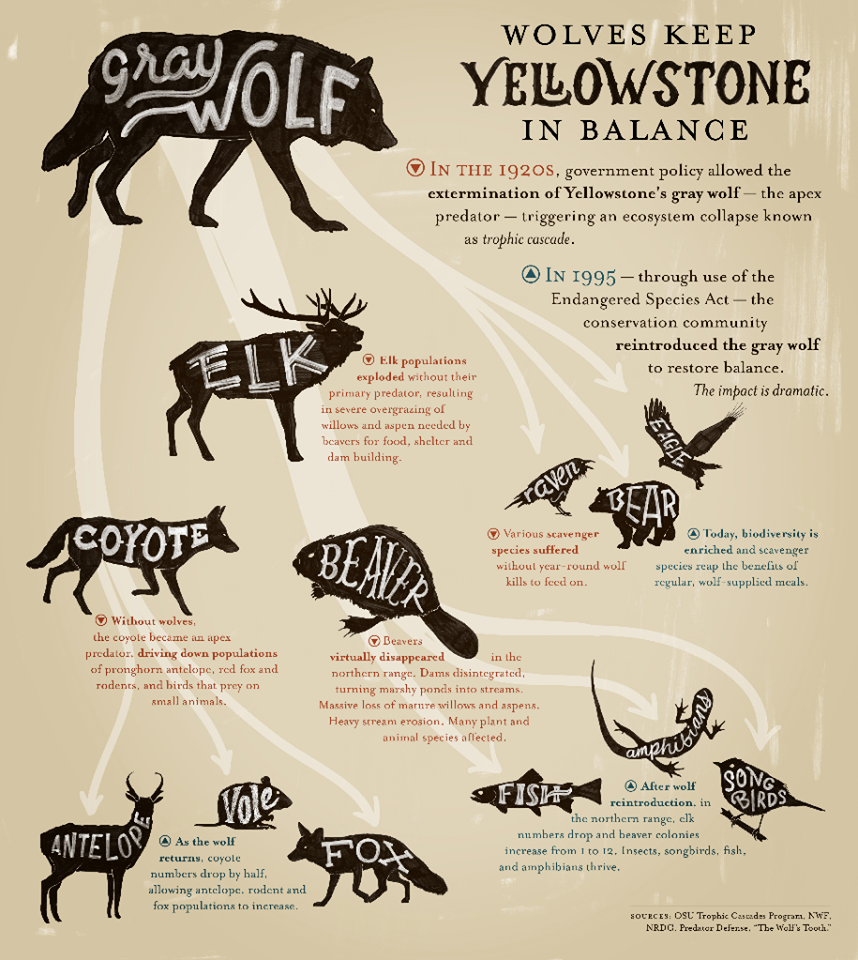
How do wolves play an important role in ecosystem balance? There is a huge body of research that points to this and it is constantly growing. Here is a very user-friendly graphic from EarthJustice illustrating this very point. Click hear for full-sized graphic.
Montana’s gray wolf season around the town of Gardiner ends 30 minutes after sunset Thursday after hunters filled a four-wolf quota in the area near Yellowstone National Park.
Montana Fish, Wildlife and Parks spokesman Ron Aasheim says the closure applies to both hunting and trapping in Wolf Management Area 313. That’s one of two areas near Yellowstone where hunting has been restricted following requests from federal park officials.
The only other place in Montana with restrictions on how many wolves can be shot is west of Glacier National Park, where there’s a two-wolf quota.
Hunters statewide have reported shooting 106 wolves since the season began Sept. 7. Wolf hunting ends March 15.
Trappers have taken three wolves so far, in a season that began Sunday and runs through February 28…..
Missoula Independent
News/Opinion November 14, 2013
Pack Pride by Marybeth Holleman
The U.S. Fish and Wildlife Service’s decision to delist gray wolves nationwide is flawed because it’s based on the total number of wolves, a statistical approach that, according to wolf biologist Gordon Haber, is “ecological nonsense.”
Haber spent over 43 years observing Alaska’s wild wolves, mostly in Denali National Park, before dying in a plane crash while tracking wolves. To locate wolves, he snowshoed, skied and flew in winter; he backpacked and hiked in summer. He endured temperatures 50 below zero, blizzards, thunderstorms, mosquitoes, and the risk of grizzly and moose attacks. Few modern biologists have such unassailable experiential authority.
Haber’s take-home message was this: You can’t manage wolves by the numbers. You can’t count the number of wolves in an area and decide whether it’s a “healthy” population, because what really counts is the family group, or pack, as some still call it.
“Wolves are perhaps the most social of all nonhuman vertebrates,” wrote Haber. “A ‘pack’ of wolves is not a snarling aggregation of fighting beasts, each bent on
fending only for itself, but a highly organized, well-disciplined group of related individuals or family units, all working together in a remarkably amiable, efficient manner.”
Haber devoted his career to studying intact family groups, especially the Toklat wolves of Alaska. First made famous by Adolph Murie’s 1944 The Wolves of Mount McKinley, the Toklats rank with Jane Goodall’s chimpanzees as the two longest-studied mammal social groups in the wild.
Wolves go to great lengths to stay with family; when important members are lost, families can disintegrate and remaining individuals often die. Haber knew this firsthand after an alpha female wolf, who, after her mate was killed in a botched government darting study, died of starvation, alone. Relocated wolves travel hundreds of miles to return home. And the first wolf seen in California in 90 years, OR7, has never stopped moving: He’s searching for a mate, for family.
Left unexploited (that is, not killed) by humans, wolves develop societies that are astonishingly complex and beautifully tuned to their precise environment. Once, Haber observed the Toklat wolves moving their den because heavy winter snow had decimated the moose population; a week before pupping, the wolves shifted to another den closer to caribou. He also recorded unique hunting methods, among them moose hunting by the Savage River family that he called “storm-and-circle.”
Family groups develop unique and highly cooperative pup-rearing and hunting techniques that amount to cultural traditions, though these take generations to mature and can be lost forever if the family disintegrates. After the entire Savage River family was shot illegally in the winter of 1982-’83, Haber never saw the storm-and-circle technique again.
A healthy wolf population is more than x number of wolves inhabiting y square miles of territory. The notion that we can “harvest” a fixed percentage of a wolf population corresponding to natural mortality rates and still maintain a viable population misses the point. According to Haber, it’s not how many wolves you kill, it’s which wolves you kill.
Natural losses typically take younger wolves, whereas hunting and trapping take the older and more experienced wolves. These older wolves are essential because they know the territory, prey movements, hunting techniques, denning sites, pup rearing—and because they are the breeders. Haber observed this many times: Whenever an alpha wolf was shot or trapped, it set off a cascade of events that left most of the family dead and the rest scattered, rag-tag orphans.
It happened again in April 2012. A trapper dumped his horse’s carcass along the Denali National Park boundary, surrounded it with snares, and killed the pregnant alpha female of the most-viewed wolf group in Denali. With her death, the family group had no pups, and it disintegrated, shrinking from 15 to three wolves. That summer, for hundreds of thousands of park visitors, wolf-viewing success dropped by 70 percent.
This is not unique to Alaska. In 2009, Yellowstone National Park’s Cottonwood group disappeared after losing four wolves to hunting, including both alphas. In 2013, the park’s Lamar Canyon family group splintered when the alpha female—nicknamed “rock star”was shot.
So it’s never about numbers. It’s about family. A wolf is a wolf when it’s part of an intact, unexploited family group. Wolves are no longer endangered when these groups have permanent protection, and when we manage according to this essential functional unit. If we leave wolves alone, we’ll be the ones to benefit.
The government has extended the comment period for delisting gray wolves from Endangered Species Act protection to Dec. 17, 2013. Go to regulations.gov and click on Gray wolf: Docket N. (FWS-HQ-ES-2013-0073).
________________________________________
Marybeth Holleman is a contributor to Writers on the Range, a service of High Country News (hcn.org). With Gordon Haber, she is the author of Among Wolves: Gordon Haber’s Insights into Alaska’s Most Misunderstood Animal. She also runs the blog Art and Nature (artandnatureand.blogspot.com) and lives in Anchorage, Alaska.
From Nature Notes: 2012 wolf management, by the numbers
During 2012, at least 1,674 gray wolves, in 321 packs, lived in the states of Washington, Oregon, Montana, Idaho and Wyoming. Going by states, Montana had 625 wolves in 147 packs, Idaho had 683 wolves in 117 packs, Wyoming had 277 in
43 packs, Washington had 43 in 7 packs, and Oregon had 46 in 7 packs. No packs are known in Utah or Nevada. This population for the Northern Rockies has fallen approximately 7 percent from the 2011 population. “… the wolf population may be stabilizing at some yet undetermined lower equilibrium based on natural carrying capacity in suitable habitat and human social tolerance,” according to the U.S. Fish and Wildlife Service’s document “Rocky Mountain Wolf Recovery 2012 Interagency Annual Report” report.
Total confirmed livestock depredations by wolves during 2012 were 194 cattle, 470 sheep, six dogs, three horses and one llama. From 2007 through 2011, an average of 191 cattle depredations occurred each year, while an average of 339 sheep have been killed. These depredations were committed by 99 wolf packs. In livestock control actions, 231 wolves were killed, which is about 9 percent of the minimum number of wolves.
During 2012, Montana hunters and trappers removed 175 wolves, Idaho took 329 and Wyoming took 66 wolves. Idaho’s take amounted to about 30 percent of their wolf population. In total, 861 wolves were killed in human-caused mortality in the Northern Rockies, about 34 percent of the total minimum number of known wolves.
The minimum delisting goal has been to maintain 300 wolves, including 30 breeding pairs in Montana, Idaho and Wyoming, for three consecutive years. This has been exceeded in the Northern Rockies since 2002.
During 2012, federal funding amounted to $3,345,618 for wolf monitoring, management, control and research. State and private compensation programs spent $564,558 to compensate livestock producers for depredations.
— — —
This data comes from the U.S. Fish and Wildlife Service’s document “Rocky Mountain Wolf Recovery 2012 Interagency Annual Report” and is the most recent summary available.
http://www.jhnewsandguide.com/article.php?art_id=10393
State laws keeps data about legally killed wolves secret.
By Mike Koshmrl, Jackson Hole, Wyo.
October 16, 2013
Hunters have reported killing five wolves in a Wyoming hunt area that abuts Yellowstone National Park’s Lamar Valley, raising fears a park pack has been crippled.
Wolf watchers in the Lamar Valley — perhaps the most famous place on Earth to spot a Canis lupus in the wild — fear the worst: that the animals killed were members of the Lamar Canyon Pack. It had 11 members at the end of last year.
One wolf advocate says he sought the identity of the wolves killed in area two from the Wyoming Game and Fish Department but didn’t get any answers.
“They’re hiding behind their statute that says they can only release so much information, which is a bogus excuse,” said Marc Cooke, president of Wolves of the Rockies. “They might as well face the reality that there’s a good possibility that wolves killed were from Yellowstone.”
It’s impossible to say if one or more of the five wolves killed over a span of three days last week were Lamar Canyon Pack wolves, Wyoming Game and Fish Department officials said.
“There’s no way to know, we just don’t have that information,” Game and Fish spokesman Alan Dubberley said.
Because none of the animals killed wore radio collars, pinpointing their pack identity is impossible, Dubberley said. It’s also illegal to say precisely where the five wolves in hunt area two, located northeast of Cody, were killed, he said.
The wolves, all killed between Thursday and Sunday, included two males and three females, the spokesman said.
The weekend’s harvest pushed area two one over its 2013 hunt quota of four wolves. Last year, eight wolves were allowed to be killed in area two. Statewide the quota has also been slashed in half — from 52 to 26.
An estimated 277 wolves inhabited Wyoming, including Yellowstone and the Wind River Reservation, at the end of 2012. That’s nearly double the 150 wolves required by the U.S. Fish and Wildlife Service, which removed federal protections from the predators last year.
Dave Hallac, Yellowstone’s Center for Resources chief, said that he heard word of the wolf harvests near the park boundary from Game and Fish on Monday.
“They simply let us know there is a reasonable possibility those wolves could be from the Lamar Canyon Pack,” Hallac said. The Lamar Canyon Pack, which contains no radio collared animals, had been documented recently outside of the park, he said.
Game and Fish officials said they were unaware of the communication with Yellowstone.
In fall 2012 Wyoming’s Lamar Canyon Pack attracted international attention when wolf 832F, the pack’s world-famous alpha female, was killed by a hunter during Wyoming’s inaugural regulated hunt. That fall the pack fractured, with some animals returning to Yellowstone and some joining the Hoodoo Pack, which also roams Wyoming wolf hunt area two.
By the time hunting seasons closed, 12 Yellowstone National Park wolves had been legally killed in Wyoming, Idaho and Montana.
Natural deaths, run-ins with humans and hunting combined to cut Yellowstone’s wolf numbers by about a quarter.
Wildlife safari guide Howard Goldstein said his business took a hit this summer because the Lamar wolves were harder to find and more wary.
“We get a lot of people who come specifically to see wolves,” said Goldstein, who operates out of Jackson. “Those people are buying guides, buying binoculars, getting hotels.
“They’re generating a tremendous amount of income for communities around Yellowstone,” he said.
Goldstein, like Cooke, lamented not knowing the identities of the wolves killed over the weekend.
“We don’t know if it’s the Lamar Canyon Pack or the Hoodoo Pack, because the state won’t tell us anything,” Goldstein said.
Goldstein called for the state to be more open with the wolf watching community.
“I can understand not giving us the names, addresses and the phone numbers of the hunters who killed the wolves,” Goldstein said, “but to literally give us no information other than the number of wolves killed and the district they were killed in is not OK.”
Wyoming state law restricts what Game and Fish officials can say about any wolf that’s been legally killed.
Details such as age, coloration, breeding status and location are to be kept secret. This fall the state began sharing the sex of animals killed. The statute was established to protect the wolf hunters’ identities.
The law states: “Any information regarding the number or nature of wolves legally taken within the state of Wyoming shall only be released in its aggregate form and no information of a private or confidential nature shall be released without the written consent of the person to whom the information may refer. Information identifying any person legally taking a wolf within this state is solely for the use of the department or appropriate law enforcement offices and is not a public record.”
Game and Fish officials are forward about the restrictive nature of the statute in terms of information dissemination.
“We’re under pretty strict regulations about what we can and can’t say,” Game and Fish large carnivore manager Dan Thompson said.
Pack affiliation for the wolves recently killed in area two will be included in the 2013 gray wolf annual report. The 2012 annual report was released this April, three months after the hunt ended.
Cooke said he wasn’t pleased to have a lengthy wait ahead to find out whether or not the wolves were Lamar Canyon pack animals.
He called for Montana and Wyoming to cut back on already-reduced quotas in hunt areas near Yellowstone’s boundaries.
“Hunters have the whole state to operate in if they want to go kill wolves,” the Wolves of the Rockies president said.
“Wildlife watchers don’t have that luxury,” Cooke said. “We need to give them that luxury.”