Hypocrisy: Thy Name is Wisconsin

dvoight09's avatarWisconsin Wildlife Ethic-Vote Our Wildlife

Page #23 of Scott Walker’s Book, “Unintimidated, A Governor’s Story and a Nation’s Challenge”

“As conservatives, we believe that as many decisions as possible should be pushed down to the local level. This is not only a matter of efficiency, it is fundamental to our freedoms.”

From the Merriam-Webster Dictionary:

hy·poc·ri·sy

noun \hi-ˈpä-krə-sē also hī-\ the behavior of people who do things that they tell other people not to do : behavior that does not agree with what someone claims to believe or feel

According to the quote above from Governor General Walker’s fable book he believes that decisions should be made at the “local level” to protect our “freedoms.” If that is the case then why did Walker just sign into law a bill that takes away all local government control when it comes to bow hunting within city limits?

A bill signed Thursday by Gov. Scott Walker will…

View original post 684 more words

Stop the Salmon, Idaho Coyote and Wolf Derby

Petition by
Alan Brown Keystone, CO

Predator derbys are a shame to this great nation. We made a mistake with Wolves before and now we are doing it again. Have we learned nothing from our past? Don’t let a small minorty decide the fate of America’s wild predators.

Sign petition here: http://www.change.org/petitions/stop-the-salmod-idaho-coyote-and-wolf-derby

1504081_10151720580422554_1839644173_n

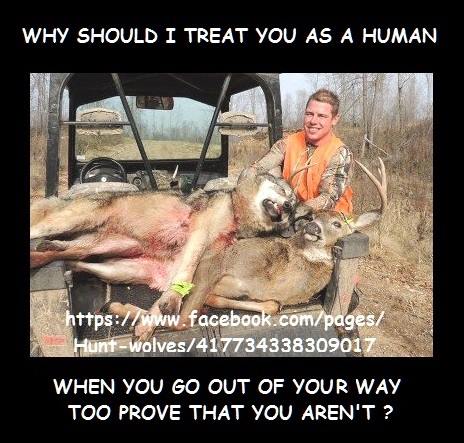
Now They’re Planning a Coyote AND Wolf Hunting Contest in Idaho!!!!

1504081_10151720580422554_1839644173_n

Competitive hunting of wolves, coyotes in Idaho sparks outcry

Laura Zuckerman

Reuters

7:14 p.m. CST, December 11, 2013

SALMON, Idaho (Reuters) – The first statewide competition in decades to hunt wolves and coyotes in Idaho has sparked outrage among wildlife conservationists, who condemned it as “an organized killing contest.”

The so-called coyote and wolf derby is slated for the weekend of December 28-29 in the mountain town of Salmon, Idaho, where ranchers and hunting guides contend wolves and coyotes threaten livestock and game animals prized by sportsmen.

The tournament offers cash and trophies to two-person teams for such hunting objectives as killing the largest wolf and the most female coyotes. Children as young as 10 will be welcomed to compete in a youth division.

Idaho opened wolves to licensed hunting more than two years ago after assuming regulation of its wolf population from the federal government.

But Idaho Department of Fish and Game wolf manager Jason Husseman said the upcoming event is believed to be the first competitive wolf shoot to be held in the continental United States since 1974, when wolves across the country came under federal Endangered Species Act protections.

The wolf, an apex predator that once ranged throughout North America, had by then been hunted, trapped and poisoned to the brink of extinction in the lower 48 states.

Wolves in the Northern Rockies, including Idaho, and in the western Great Lakes were removed from the federal threatened and endangered species list in recent years as their populations climbed and federal wildlife managers declared them recovered. The Obama administration earlier this year proposed removing most wolves nationwide from the list.

The upcoming derby is being sponsored by Idaho for Wildlife, a nonprofit whose aim is “to fight against all legal and legislative attempts by the animal rights and anti-gun organizations” to impose restrictions on hunting or guns, according to the group’s website.

When contacted by telephone on Wednesday about the event, organizer and Idaho big-game outfitter Shane McAfee said media inquiries were not welcome.

Similar contests tied just to coyotes – allowed to be shot on sight as nuisances in much of the U.S. West – have prompted protests in recent years in states such as New Mexico, where many ranchers and hunters endorse the competitive hunts.

Lynne Stone, director of the Boulder-White Clouds Council, an Idaho conservation group, called the planned wolf-coyote derby “an organized killing contest.”

“Stacking up dead animals and awarding children for killing them has no place in a civilized society,” she said.

But Barbara Soper, whose 11-year-old daughter has registered to team with an adult hunter for the Idaho competition, said she and her husband are all for it.

“It’s my daughter’s first big adventure, and she thinks it’s awesome,” Soper said.

(Reporting by Laura Zuckerman; Editing by Steve Gorman and Lisa Shumaker)

Copyright © 2013, Reuters

How the Grinch Stole Hunting Season

….It’s that time of year again….


Every hunter

Down in Hunt-ville

Liked hunting season a lot…

But the Grinch,

Who lives just North of Hunt-ville,

Did NOT!

The Grinch hated hunting! The whole hunting season!

Now, please don’t ask why. There are many good reasons.

It could be because hunter’s heads aren’t screwed on quite right.

It could be, perhaps, that their belts are too tight.

But I think that the most likely reason of all

May be that their hearts (and other parts) are two sizes too small.

“They’re cleaning their guns!” the Grinch snarled with a sneer.grinch

“Tomorrow is hunting season! It’s practically here!”

Then he growled, with his Grinch fingers nervously drumming,

“I MUST find a way to keep hunting season from coming!”

For, tomorrow, he knew…

…All the Hunt-girls and boys

Would wake up bright and early. They’d rush for their toys!

Their rifles, their shotguns—all things that destroy!

And then! Oh, the noise! Oh, the noise! Noise! Noise! Noise!

That’s one thing he hated! The NOISE! NOISE! NOISE! NOISE!

Then they’d carve up the body of some unfortunate beast,

Which was something the Grinch couldn’t stand in the least!

And they’d feast! And they’d feast!

And they’d FEAST! FEAST! FEAST! FEAST!

I MUST stop hunting season from coming!

…But HOW?”

Then he got an idea!

A brilliant idea!

THE GRINCH

GOT A WONDERFUL, BRILLIANT IDEA!

“I know just what to do!” The Grinch laughed in his throat.

And he made a quick Santy Claus hat and a coat.

And he chuckled, and clucked, “What a great Grinchy trick!

With this coat and this hat, I’ll look just like Saint Nick

And I’ll slide down their chimneys, empty bags in my fist,

AND I’LL STEAL ALL THEIR FUCKING AMMO!”

Must Read Article of the Day: “Animal Cruelty is the Price We Pay for Cheap Meat”

The Paw Report / Serpent Club's avatarThe Paw Report

An impressive report, “Animal Cruelty is the Price We Pay for Cheap Meat” has just been published in Rolling Stone. It contains graphic images and video and details the brutal lives and deaths our “food” animals on our factory farms have to suffer. The facts in the article are eye-opening:

  • 500 million tons of factory-farm animal waste generated each year;
  • 35,000 miles of rivers and streams across 22 states reporting polluted waterways caused by farm-animal excretement;
  • 9 billion broiler chickens, 113 million pigs, 33 million cows and 250 million turkeys raised and killed for food each year.

And that’s just beginning.

View original post 396 more words

Journey–The Lone Wolf

Beckie Elgin, Freelance Writer's avatarWolves and Writing

It was revealed on Monday that over the weekend, Journey, Oregon’s wandering wolf, crossed the border into California once again. He didn’t stay long before returning to the Southern Cascades of Oregon. Karen Kovacs, Wildlife Program Manager with the California Department of Fish and Wildlife reported that the wolf was following migrating deer and elk.

Dispersal is a normal behavior for wolves, although few travel as far or for as long as Journey. He has gone over 3,000 miles since leaving the Imnaha pack in the northeast corner of Oregon in September of 2011. I remember that time well. I left the same area a few weeks behind him after attending a rural writing retreat along the Imnaha River. Driving home, I watched for OR 7 (he hadn’t earned the name Journey yet) as I made the long trip back to southern Oregon. I didn’t see him of course, but…

View original post 749 more words

Letter Annihilates “America’s Pest Problem”

The following letter from a friend and fellow blogger/photographer, Ingrid Taylar, completely annihilates Time Magazine’s recent anti-wildlife article, “America’s Pest Problem…

Coyote Photo©Jim Robertson

Coyote Photo©Jim Robertson

Dear Editor:

David von Drehle’s piece, “America’s Pest Problem,” barely touches on the crux of the issue which is our own exponentially growing population combined with our gluttonous appetite for land and resources, all of which present wild animals with fewer options. He describes our ecological role in heroic terms, without delving into the much more complicated morass of human intrusion. We encroach on wild spaces, sterilize formerly complex habitats with subdivisions and lawns, raze and trample forests to provide grazing lands for cattle, pollute water sources with our industrial production of food and materials, poison critical plants like milkweed out of existence for Monarch butterflies and bees, build roadways through critical migration corridors, produce trash to the degree that there is no feasible way to dispose of it all, plasticize the oceans, and so forth. But what conclusion does von Drehle derive? That we kill too rarely. It takes a lot of gall to argue for lethal methods against wildlife as a solution when we are, in fact, the most damaging and lethal ecological presence ourselves, literally altering our ecosystems and forcing other species to survive and seek out food sources within the realm of hazards and limitations we impose.

To present the issue as simplistically as David von Drehle does is lazy journalism. The piece ignores important environmental considerations while also leaving out the known problems with lethal control. He doesn’t grapple, for instance, with the paradox that despite unregulated and often brutal killing and trapping of animals like coyotes, their populations explode nonetheless. He ignores the biological principles which suggest that killing meso predators leaves gaping niches which are then filled by even more animals. He engages fear mongering over the presence of apex predators, not seeming to fully grasp that animals like wolves help balance our ecosystems more effectively than any human management plan. He doesn’t mention, for instance, the concept of trophic cascades, where healthy wolf populations lead to numerous benefits for plants and animals which now thrive because of this restored balance. At the same time, he leaves out information about state wildlife programs which actually work to keep deer abundant for hunting purposes, or which promote habituation by allowing hunting over bait. He makes little issue of the fact that populations of feral pigs in many cases were encouraged for sport hunting. These are but a few examples that point to a much murkier underbelly and even a deliberate complicity by humans in these problems.

There are success stories about urban and suburban coexistence with wildlife that don’t involve mass slaughter. Marin County in California is one such place, replacing lethal predator control with creative ideas about managing our lives, our needs, our farms and our lands in the context of a more compassionate, progressive and sound ethic toward wildlife. Von Drehle argues for an archaic, 19th century model of wildlife “management” which drastically underestimates what we can achieve through more thoughtful and advanced paradigms of understanding and conflict resolution. Von Drehle says it’s time for a new perspective on hunting and wildlife control in the 21st century. On this, I agree. What he misses, however, is that better models do exist and are being improved based on our increased scientific awareness of wild animals and their inherent value. Instead, he looks backward for answers, to an era and an ethic when killing and exploitation were the applied solutions for almost all issues involving wildlife. As a species and as individuals, we are much better than this. But you’d never know it from this article.