Sport Hunter Who Murdered Mother Cougar Lauded by Press

Hunter kills cougar, rescues newborn kittens

Posted 5:26 p.m. yesterday

More on this
Baker City Herald

By JAYSON JACOBY, Baker City Herald

BAKER CITY, Ore. — The mistake was unavoidable, but Todd Callaway didn’t stop to worry about his reputation as a hunter whose integrity is beyond reproach.

He just wanted to save the three cougar kittens.

And he did.

Callaway, 64, is both a hunter and a retired wildlife biologist for the Oregon Department of Fish and Wildlife’s (ODFW) Baker City office.

When he realized that the cougar he shot and killed on Thursday was a lactating female, he immediately started following the animal’s tracks in the snow, hoping to find its den and, possibly, kittens.

He found the den.

His flashlight beam showed three tiny kittens, each weighing about two pounds.

Callaway, who was hunting in the Lookout Mountain unit east of Baker City, called his former employer, ODFW.

The three kittens were taken to Baker City, where first a local veterinarian, and then Justin Primus, ODFW’s assistant district wildlife biologist, cared for them.

“(Primus) fed them every four hours,” said Brian Ratliff, the district wildlife biologist.

Ratliff estimates the kittens (also known as cubs) — two females and one male — are about two weeks old. Although their eyes were open, they were still covered with a film and the kittens were in effect blind, he said.

The kittens almost certainly would not have survived even one day without their mother, Ratliff said.

Cougars can have litters at any time of the year. Bearing young during winter can actually be advantageous for the cats, Ratliff said, because their main food source — deer — tend to be concentrated during winter, making it easier for the mother to find her own meals while nursing her kittens.

On Friday, Primus drove the three kittens to The Dalles, where he met another ODFW employee who transported the trio to the Oregon Zoo.

The kittens’ final home, though, will be the North Carolina Zoo in Asheboro, N.C., said Michelle Schireman, who has worked at the Oregon Zoo for 18 years and who also serves as the species coordinator for cougars for the Association of Zoos and Aquariums.

Schireman said she works closely with ODFW veterinarian Colin Gillin in cases when animals are orphaned.

Gillin called her on Thursday after learning that the kittens had been rescued in Baker City.

Schireman, through her work with the Association of Zoos and Aquariums, said she’s also in touch with zoos across the country and knows which facilities are looking for particular species.

In the case of the North Carolina Zoo, it had two male cougars in its exhibit, both about 18 years old.

One of the cougars died recently, and the other is in poor health, Schireman said.

“I had been in touch with the zoo and they were willing to take as many as three cubs,” Schireman said.

“Whenever possible I try to keep siblings together.”

She said the three kittens are in good health, and she expects they will be flown to North Carolina within a month or so.

“We’ve been feeding them every four hours, and when I came in for the early morning feeding today they looked really good,” Schireman said Monday.

Callaway was not allowed to keep the adult cougar because state law prohibits hunters from killing a female cougar that is accompanied by kittens that still have spots.

An Oregon State Police officer warned Callaway but did not issue a citation.

Ratliff said that’s not surprising because Callaway’s mistake was not only inadvertent, but also basically impossible to avoid.

The reason, Ratliff said, is that because the kittens are so young they had never left the den, which means there were no small cat tracks in the snow to alert hunters to the presence of kittens.

As for the adult female, it’s impossible at a distance to distinguish between a male and a female cougar, much less to determine that a female is lactating, Ratliff said.

Callaway said the cougar was running when he shot it.

After shooting the adult cougar, Callaway “did everything perfectly,” Ratliff said. “He did more than a lot of hunters would have done.”

Schireman said that during her 18-year tenure at the Oregon Zoo she has helped place 105 orphaned cougar cubs, counting the three from Baker County.

A majority of those animals were rescued in a state other than Oregon, she said.
http://www.wral.com/hunter-kills-cougar-rescues-newborn-kittens/13299097/

“Endangered” Hunter Auctioned off to Save Species

Believing the spin that “hunters are an endangered species,” trophy-hunter hunting group, the Sahara Club, a conservation group dedicated to preserving the hunter herd for future generations of trophy-hunter hunters to harvest, auctioned off asuccessful anti-hunt chance to hunt an aging, expendable hunter to raise funds for their cause. Taxidermy services will also be awarded to the winning bidder. Proceeds will be used to enhance hunter habitat for the species known taxonomically as Homo huntsman horribilis and will go towards funding more logging roads to allow access for their trucks and four-wheelers, as well as building more conveniently located gas station/mini-marts, taverns and mobile home parks.

Biologists blame a long history of inbreeding for the decline in hunter fertility and viability. When asked about the ethics of hunting down and killing this unfortunate individual, a Sahara Club spokesman stated, “Overall I think it will be a good thing. While it may bad for this individual hunter, it is in the interest of conservation of the hunter species.” If the auction idea proves to be a success, the group plans to hold similar events for loggers, ranchers, commercial fishermen and other resource extractors also said to be endangered species by industry spin doctors.

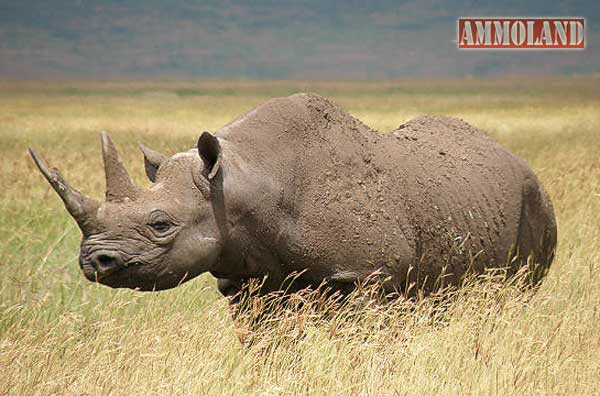
Individuals chosen to be hunted down and harvested can thank the Safari Club for recently coming up with the idea of auctioning a rhino trophy hunt on an endangered black rhinoceros.

______________________

(This has been another installment in EtBG’s “Headlines We’d Like to See.”)


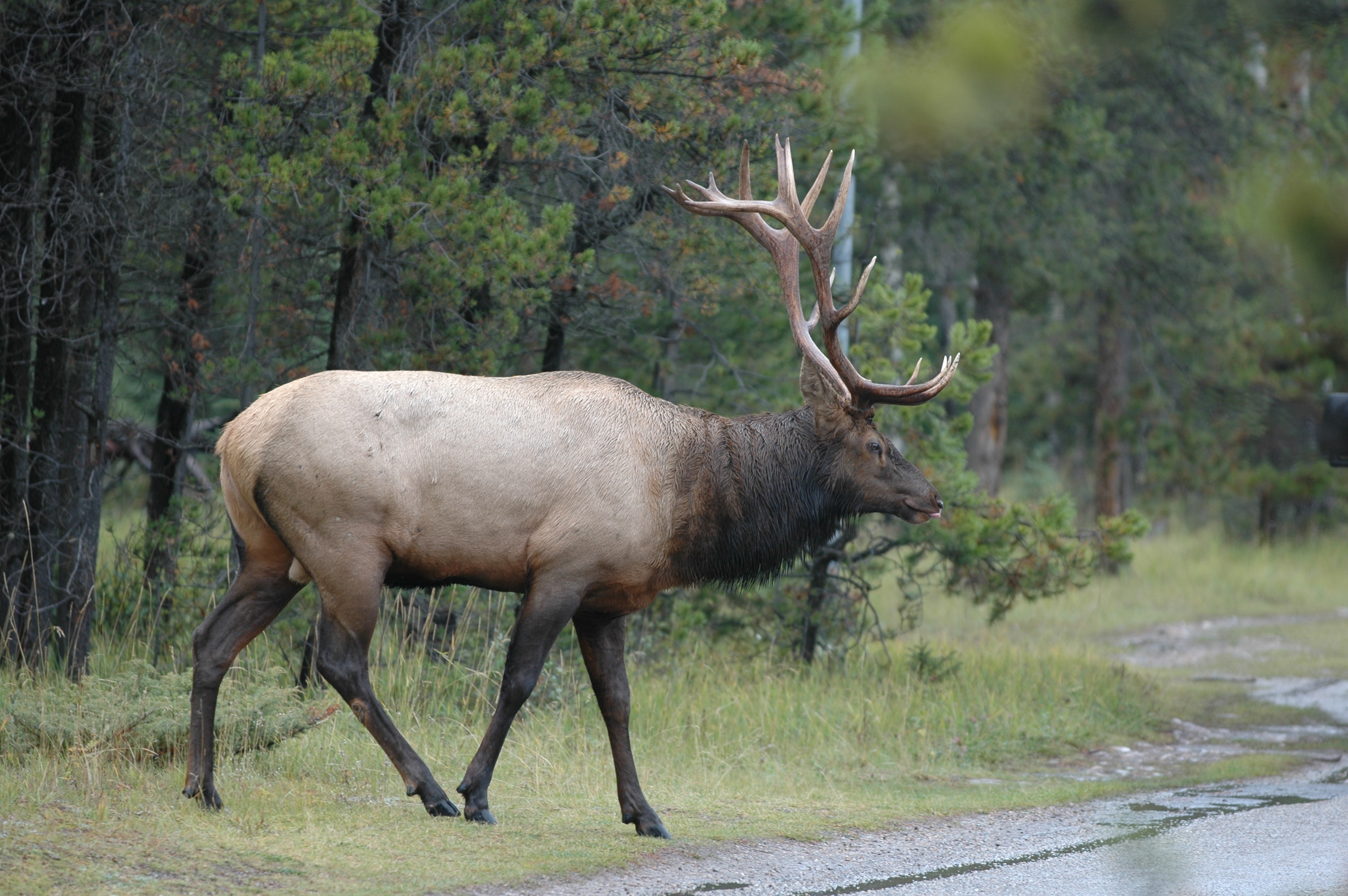
3 Vehicles Hit Herd of Elk, Media Fails to Mention Elk Casualties

The Associated Press hit a new low in reporting on an animal-related issue from a completely anthropocentric point of view. Here’s how they reported on a recent tragedy involving a group of migratory animals who dared to venture across a deadly strip of pavement created exclusively for automobiles:

http://www.komonews.com/news/local/3-vehicles-hit-herd-of-elk-on-Hwy-12-near-Satsop-240096581.html

SATSOP, Wash. – Three vehicles crashed into a large herd of elk crossing Highway 12 Monday night in Grays Harbor County at Satsop.

State troopers responded to the scene at about 9 p.m. after receiving a report of multiple collisions with an elk herd.

The Washington State Patrol says no drivers were injured in the crashes, but their vehicles didn’t fare so well.

A 2000 Dodge Dakota pickup was totaled in the crash. A 1997 Ford pickup and a 2001 Ford Expedition were damaged and had to be towed away.

Text and Wildlife Photography ©Jim Robertson, 2013. All Rights Reserved

Text and Wildlife Photography ©Jim Robertson, 2013. All Rights Reserved

_____________

And that’s it. That’s the entire extent of the article. Absolutely no mention of how well the elk herd fared.

I saw an elk get hit in the highway on Christmas night a few years back. The SUV that struck her had just passed me and somehow did not see the elk standing squarely in the middle of the road. The elk was sent into the air and landed on the opposite side of the road. No one in the vehicle was hurt, but I’m sure the owner was cursing the poor animal he ran into because she dented his car.

To the press, non-humans don’t even rate a mention, except perhaps as a “road hazard.”

On that note, here’s something I wrote back in April, 2012:

Road Hazard?

Driving to work early the other morning, I came within inches of hitting a bull elk who decided, at the last minute, to run across the highway right in front of me. Fortunately no one else was on that lonely stretch of road at the time, for if I hadn’t stomped on the brakes and cranked the wheel to the left, we would probably both be dead. I saw up close and personal how hitting an animal as large as that could do lethal damage. But the experience did not change my attitude on whether migratory wildlife should be considered a road hazard.

There’s no doubting the fact that we humans—in our full metal jacketed projectiles, lumbering headlong 60 mph through the former wilderness—are the real hazards. We’re the ones breaking nature’s rules by inventing machines that can go so fast they can put an end to anyone they run into. But, we drive like we’re saying, “We have important places to go—everyone else beware or be damned! No lowly animal better get in our way!”

If this incident had proven fatal for us, I would have wanted my epitaph to read: “I’m sorry beautiful creature. There’s nowhere I had to be that was worth the risk of ending your precious life.”

15 ways atheists can stand up for rationality

http://www.salon.com/2014/01/11/15_ways_atheists_can_stand_up_for_rationality/

Atheists need to assert ourselves! Here’s how
by Jeffrey Tayler

I’ve often wondered how the term “New Atheism” gained such currency. It is a misnomer. There is nothing new about nonbelief. All of us, without exception, are born knowing nothing of God or gods, and acquire notions of religion solely through interaction with others – or, most often, indoctrination by others, an indoctrination usually commencing well before we can reason. Our primal state is, thus, one of nonbelief. The New Atheists (most prominently Richard Dawkins, Sam Harris and the late Christopher Hitchens) have, in essence, done nothing more than try to bring us back to our senses, to return us to a pure and innate mental clarity. Yet their efforts have generated all manner of controversy. Far outnumbered, and facing a popular mindset according kneejerk respect to men (yes, mostly they are men) of faith — reverends, priests, pastors, rabbis, imams and so on – the New Atheists have by necessity explained their views with zeal, which has often irked the religious, who are accustomed to unconditional deference. Even some nonbelievers who, again thanks to custom, consider religion too touchy a subject to discuss openly have been riled.

We atheists, however, need to buck up, assert our rationality, and change the way we deal with the religious, with everyday affronts delivered (at times unknowingly) by believers, with the casual presumptions that historically have tended to favor the faithful and grant them unmerited respect. A lot is at stake. Religion is a serious matter, reaching far beyond the pale of individual conscience and sometimes translating into violence, sexism, sexual harassment and assault, and sundry legal attempts to restrict a woman’s right to abortion or outlaw it altogether, to say nothing of terrorism and war. Now is the time to act. Polls – see here and here – show the zeitgeist in the United States is turning increasingly godless, that there are more atheists now than ever before (surely thanks in part to the efforts of the New Atheists). Most of Europe entered the post-faith era decades ago. Americans need to catch up.

I propose here a credo for atheists – concrete responses to faith-based affronts, to religious presumption, to what Hitchens called “clerical bullying.” (I’ll deal below with the three monotheistic, Abrahamic religions, but what I say applies to other confessions as well.) The faithful are entitled to their beliefs, of course, but have no inherent right to air them without expecting criticism. Religion should be subject to commonsense appraisal and rational review, as openly discussible as, say, politics, art and the weather. The First Amendment, we should recall, forbids Congress both from establishing laws designating a state religion and from abridging freedom of speech. There is no reason why we should shy away from speaking freely about religion, no reason why it should be thought impolite to debate it, especially when, as so often happens, religious folk bring it up on their own and try to impose it on others.

Herewith, some common religious pronouncements and how atheists can respond to them.

1. “Let’s say grace!”

No, let’s not. When you’re seated at the family dinner table and a relative suggests clasping hands, lowering heads and thanking the Lord, say “No thanks. I’m an atheist. So I’ll opt out.” Nonbelievers have every right to object when being asked to take part in superstitious rituals; in fact, if children are present, they are morally obliged to do so. Courteously refusing to pray will set an example of rational behavior for the young, and contribute to furthering the atheist zeitgeist.

2. “Religion is a personal matter. It’s not polite to bring it up.”

No, religion is fundamentally collective, and since time immemorial has served societies in fostering union, but also in inciting xenophobia and violence (especially against “unchaste” women and “impure” minorities), often on a mass scale. Nonbelievers need to further advance the cause of rationality by discussing it openly; doing so, as uncomfortable as it may be at times, will help puncture the aura of sanctity surrounding faith and expose it for what it is.

3. “You’re an atheist? I feel sorry for you.”

No, please rejoice for me. I fear no hell, just as I expect no heaven. Nabokov summed up a nonbeliever’s view of the cosmos, and our place in it, thus: “The cradle rocks above an abyss, and common sense tells us that our existence is but a brief crack of light between two eternities of darkness.” The 19th-century Scottish historian Thomas Carlyle put it slightly differently: “One life. A little gleam of Time between two Eternities.” Though I have many memories to cherish, I value the present, my time on earth, those around me now. I miss those who have departed, and recognize, painful as it is, that I will never be reunited with them. There is the here and now – no more. But certainly no less. Being an adult means, as Orwell put it, having the “power of facing unpleasant facts.” True adulthood begins with doing just that, with renouncing comforting fables. There is something liberating in recognizing ourselves as mammals with some fourscore years (if we’re lucky) to make the most of on this earth.

There is also something intrinsically courageous about being an atheist. Atheists confront death without mythology or sugarcoating. That takes courage.

4. “If you’re an atheist, life has no purpose.”

A purpose derived from a false premise – that a deity has ordained submission to his will – cannot merit respect. The pursuit of Enlightenment-era goals — solving our world’s problems through rational discourse, rather than though religion and tradition – provide ample grounds for a purposive existence. It is not for nothing that the Enlightenment, when atheism truly began to take hold, was also known as the Age of Reason.

5. “If you abolish religion, nothing will stop people from killing, raping and looting.”

No, killing, raping and looting have been common practices in religious societies, and often carried out with clerical sanction. The catalogue of notorious barbarities – wars and massacres, acts of terrorism, the Inquisition, the Crusades, the chopping off of thieves’ hands, the slicing off of clitorises and labia majora, the use of gang rape as punishment, and manifold other savageries committed in the name of one faith or another — attests to religion’s longstanding propensity to induce barbarity, or at the very least to give it free rein. The Bible and the Quran have served to justify these atrocities and more, with women and gay people suffering disproportionately. There is a reason the Middle Ages in Europe were long referred to as the Dark Ages; the millennium of theocratic rule that ended only with the Renaissance (that is, with Europe’s turn away from God toward humankind) was a violent time.

Morality arises out of our innate desire for safety, stability and order, without which no society can function; basic moral precepts (that murder and theft are wrong, for example) antedated religion. Those who abstain from crime solely because they fear divine wrath, and not because they recognize the difference between right and wrong, are not to be lauded, much less trusted. Just which practices are moral at a given time must be a matter of rational debate. The “master-slave” ethos – obligatory obeisance to a deity — pervading the revealed religions is inimical to such debate. We need to chart our moral course as equals, or there can be no justice.

6. “Nothing can equal the majesty of God and His creation.”

No need to inject God into this. “Creation” is majestic enough on its own, as anyone who has gazed into the Grand Canyon or the night sky already knows. While paddling a pirogue down the Congo, at night I often marveled to the point of ecstasy at the brilliance of the stars, the salience of the planets against the Milky Way – just one of the many quasi-transcendental experiences I have had as an atheist globetrotter. The world is a thing of wonder that requires no faith, but only alert senses, to appreciate.

7. “It is irrational to believe that the world came about without a creator.”

No, it is irrational to infer an invisible omnipotent being from what we see around us. The burden of proof lies on the one making supernatural claims, as the New Atheists have tirelessly pointed out. But here again the New Atheists are really doing nothing novel. Almost 200 years ago, the British poet Shelley, in his essay “The Necessity of Atheism,” noted that “God is an hypothesis, and, as such, stands in need of proof: the onus probandi rests on the theist.” This was clear to him even before we had mapped the human genome, discovered the Higgs boson, or even invented the telegraph.

8. “I will pray for you to see the light.”

Not necessary, but do as you like. Abraham Lincoln noted that, “What is to be, will be, and no prayers of ours can arrest the decree.”

9. “If you’re wrong about God, you go to hell. It’s safer to believe.”

Pascal’s wager survives even among people who have never heard the name of the 17th-century French philosopher and mathematician. Leaving aside whether blatant self-interest would please a god demanding to be loved unconditionally, which god will save us from hell? The god of Catholicism? Judaism? Islam? Doctrines of all three Abrahamic faiths prohibit entry into paradise for adherents of rival confessions.

10. “Religion is of great comfort to me, especially in times of loss. Too bad it isn’t for you.”

George Bernard Shaw noted that, “The fact that a believer is happier than a skeptic is no more to the point than the fact that a drunken man is happier than a sober one. The happiness of credulity is a cheap and dangerous quality.” A few shots of vodka will do for me, and are more to the point.

After the passing away of his son, Lincoln, in dire need of solace, nevertheless remarked that, “My earlier views of the unsoundness of the Christian scheme of salvation and the human origin of the scriptures, have become clearer and stronger with advancing years and I see no reason for thinking I shall ever change them.”

10. “As you age and face death, you will come to need religion.”

Perhaps in dotage anything is possible, but this turn of events is unlikely. Aging and the prospect of dying by no means enhance the attractiveness of fictitious comforts to come in paradise, or the veracity of malicious myths about hellfire and damnation. Fear and feeblemindedness cannot be credibly pressed into service to support fantastic claims about the cosmos and our ultimate destiny.

Whether one would even consider turning to religion in advanced years has much to do with upbringing, which makes all the more important standing up to the presumptions of the religious in front of children. One would regard the Biblical events – a spontaneously igniting bush, a sea’s parting, human parthenogenesis, a resurrected prophet and so on – that supposedly heralded God’s intervention in our affairs as the stuff of fairy tales were it not for the credibility we unwittingly lend them by keeping quiet out of mistaken notions of propriety.

11. “You have no right to criticize my religious beliefs.”

Wrong. Such a declaration aims to suppress free speech and dialogue about a matter influential in almost every aspect of our societies. No one has a right to make unsubstantiated assertions, or vouch for the truthfulness of unsubstantiated assertions on the basis of “sacred” texts, without expecting objections from thinking folk.

12. “Jesus was merciful.”

If he existed – and there is still, after centuries of searching, no proof that he did – he was at times a heartless prophet of doom for the sinners he supposedly loved, commanding those who failed to give comfort to the poor to “depart . . . ye cursed, into everlasting fire, prepared for the devil and his angels.”

13. ”You can’t prove there’s no God.”

Correct, at least epistemologically speaking. Reasonable atheists, “New” and old, would not argue with this. Richard Dawkins, for example, has told audiences that he is nominally an agnostic, since proving that something does not exist is impossible. He claims to be an atheist “only” in the sense that he is an “a-leprechaunist, an a-fairiest, and an a-pink-unicornist.” The evidence for God, fairies and leprechauns, he remarked, “is equally poor.”

14. “My religion is true for me.”

A soppy, solipsistic and juvenile declaration and cop-out bordering on the delusional and contradicting Christianity and Islam, neither of which recognize the other, and both of which espouse universalist pretensions. You will not find a scientist who will say, “quantum physics is true for me.” No one would have trusted Jonas Salk if he had promoted the efficacy of his polio vaccine as “true for him.”

15. “Don’t take everything in the Bible literally.”

Not taking the Bible (or other texts based on “revealed truths”) literally leaves it up to the reader to cherry-pick elements for belief. There exists no guide for such cherry-picking, and zero religious sanction for it.

I’m not counseling incivility — but arm yourself with the courage of your rationalist convictions and go forth. We will all be better off for it.

Jeffrey Tayler
Jeffrey Tayler is a contributing editor at The Atlantic.

1450979_10151664623727554_134905332_n

‘Carnivore cleansing’ is damaging ecosystems, scientists warn

http://www.theguardian.com/environment/2014/jan/09/carnivore-cleansing-damaging-ecosystems

Extermination of large predators such as wolves and bears has a cascading effect on delicate ecological balance

·  theguardian.com, Thursday 9 January 2014 19.00 GMT


Carnivore extermination damaging ecosystems : Hunters skin a wolf.

Hunters skin a wolf killed in a forest in the Ukraine. Humans have waged a long-standing war with large carnivores that kill livestock and threaten rural communities. Photograph: Vasily Fedosenko/Reuters

A plea to restore populations of some of the world’s most dangerous animals has been made by scientists who claim the loss of large carnivores is damaging ecosystems.

More than three-quarters of the 31 species of large land predators, such as lions and wolves, are in decline, according to a new study. Of these, 17 species are now restricted to less than half the territory they once occupied.

Large carnivores have already been exterminated in many developed regions, including western Europe and eastern United States – and the same pattern of “carnivore cleansing” is being repeated throughout the world, said scientists.

Yet evidence suggests carnivores play a vital role in maintaining the delicate balance of ecosystems which cannot be replaced by humans hunting the animals they normally prey on.

“Globally, we are losing our large carnivores,” said lead researcher Prof William Ripple, from the department of forest ecosystems and society at Oregon State University in the US.

“Many of them are endangered. Their ranges are collapsing. Many of these animals are at risk of extinction, either locally or globally. And, ironically, they are vanishing just as we are learning about their important ecological effects.”

Humans have waged a long-standing war with large carnivores that kill livestock and threaten rural communities.

But the international team from the US, Australia, Italy and Sweden called for a global initiative to conserve large predators.

The scientists suggested it could be modelled on the Large Carnivore Initiative for Europe, an expert group affiliated with the International Union for the Conservation of Nature (IUCN). It is committed to helping European predators including the wolf, lynx and brown bear reoccupy many of their former habitats.

Prof Ripple and his colleagues focused on seven key species whose ecological impact has been extensively studied – the African lion, leopard, Eurasian lynx, cougar, grey wolf, sea otter and dingo.

A review of the evidence showed how the decline of cougars and wolves from Yellowstone and other North American national parks led to an increase in browsing animals such as deer and elk.

This in turn had a cascading effect, disrupting vegetation growth and upsetting populations of birds and small mammals.

Studies of the European lynx, Australian dingo, lions and sea otters have shown similar effects, said the researchers whose findings were reported in the journal Science.

Lynx were strongly linked to the abundance of roe deer, red fox and hare, while in Africa the loss of lions and leopards had coincided with a dramatic increase in olive baboons, which threaten farm crops and livestock.

In the waters of south-east Alaska, a decline in sea otters hunted by killer whales had led to a rise in sea urchins and the loss of kelp beds.

Ecosystems had responded quickly where large carnivores had been returned to their former habitats, said Prof Ripple. Two examples were the reintroduction of wolves in Yellowstone and the Eurasian lynx in Finland.

“I am impressed with how resilient the Yellowstone ecosystem is,” said the professor. “It isn’t happening quickly everywhere, but in some places, ecosystem restoration has started there.”

The classic concept of predators being harmful is outdated, the scientists claimed.

Prof Ripple added: “Human tolerance of these species is a major issue for conservation. We say these animals have an intrinsic right to exist, but they are also providing economic and ecological services that people value.

“Nature is highly interconnected. The work at Yellowstone and other places shows how one species affects another and another through different pathways. It’s humbling as a scientist to see the interconnectedness of nature.”

Disruption of large carnivore populations had led to crop damage, altered stream structures, and changes to the abundance and diversity of birds, mammals, reptiles and invertebrates, said the scientists.

By keeping herbivores in check and allowing woody plants to flourish and store more carbon, carnivores also acted as a buffer against climate change.

The researchers accepted that getting human communities to accept the reintroduction of large carnivores was a “major sociopolitical challenge”.

They wrote: “It will probably take a change in both human attitudes and actions to avoid imminent large carnivore extinctions. A future for these carnivore species and their continued effects on planet Earth’s ecosystems may depend on it.”

http://www.theguardian.com/environment/2014/jan/10/rapid-loss-of-top-predators-a-major-environmental-threat

Wolves Work Hard For Their Dinner…..

Nabeki's avatarHowling For Justice

Wolves don’t carry AR-15 assault rifles, drive expensive rigs, ATV’s or snowmobiles. They don’t use traps, snares, bows, poison, bait or wounded animal calls to catch their prey. Wolves are fed by their feet (Russian Proverb). They use their wits, incredible stamina and sense of smell as pack members join together in cooperation to feed their family. They may travel twenty to forty miles to find food, longer if necessary. Even then, their hunting success rate is low, just one in ten wolf hunts results in a meal. Can you imagine how hard life is for them under the best of conditions? Now they face even greater obstacles to stay alive. Hunted and demonized, by an unrelenting campaign to drive them back to extinction in the lower 48.

Howl for them, we are their voice!

===

Posted in: Biodiversity, gray wolf, Wolf Wars

Video: Courtesy YouTube, Wolf Hunting – Attenborough -Life…

View original post 20 more words

Black Rhino Auctioned for $350K in the Name of Conservation

black-rhino

http://www.psychologytoday.com/blog/animal-emotions/201401/black-rhino-auctioned-350k-in-the-name-conservation

by Marc Bekoff

Should we kill in the name of conservation? Individual animals are not disposable commodities

We live in a troubled and wounded world in which humans continue to dominate and to relentlessly kill numerous nonhuman animals (animals).

A Texas hunting club recently auctioned off an endangered black rhino purportedly to save other black rhinos and their homes in Namibia. The Dallas Safari Club says, “Namibian wildlife officials will accompany the auction winner through Mangetti National Park where the hunt will occur, ‘to ensure the correct type of animal is taken.'” This is not a very comforting thought.

This sale, in which an animal is objectified and treated like a disposable commodity, raises many questions about how we try to save other species. One major question is, “Should we kill in the name of conservation?” People disagree on what is permissible and what is not. My take and that of compassionate conservation is this is not an acceptable trade-off. (Please see “Ignoring Nature No More: Compassionate Conservation at Work”, Ignoring nature no more: The case for compassionate conservation, and a Forbes interview for more on compassionate conservation.) The life of every individual matters.

The world is in dire need of healing and we must revise some of the ways in which we attempt to coexist with other animals. Some of these methods center on heinous ways of killing them “in the name of conservation” or “to foster coexistence”. Compassionate conservation stresses that the life of every individual matters and trading off an individual for the good of their own or another species is not an acceptable way to save species. And, there doesn’t seem to be much evidence that it works in any significant way.

Black rhinos do indeed find themselves trying to avoid humans out to kill them, but in Namibia only 10 rhinos have been killed since 2006. Of course, this is 10 too many, but far fewer than have been killed in neighboring South Africa where around 1000 were killed in 2012 alone.

“To destroy nature is not to conserve nature. To mount the head of a wild animal in your trophy room is not conservation, it is repugnant.”

The above quotation comes from an essay in examiner.com called “Must conservation of wildlife including killing wildlife”. It was based on a 60 Minutes report titled “Hunting animals to save them?” While it dealt with wildlife ranches in Texas where people can pay a small fortune to kill various animals in canned hunts, it does raise important questions about killing in the name of conservation. Some other valuable snippets worth deep consideration include:

“If we want to conserve a population of, for instance, people native to a particular section of our country, would we kill a few to conserve the others? Isn’t that saying the group is more important than the individual? Isn’t it saying the individual gives up his or her rights to life because he or she belongs to a particular group, a particular species?”

“Each life—human animal and nonhuman animal—is an individual with an individual personality. Take a group of purebred puppies, for example—they may all look the same but they aren’t. They are their own individual beings with individual traits and personalities. Wildlife are individuals with their own individual traits and personalities. To say one is more deserving to live than another, in the name of conservation, bastardizes the word.”

Killing animals to save others sets a bad example and a regrettable precedent and is not the way to foster peaceful coexistence. When people say they kill animals because they love them this makes me feel very uneasy. I’m glad they don’t love me.

Cruelty can’t stand the spotlight and it is important that news about the sorts of activities discussed above be widely disseminated and openly discussed. That major media is covering them is a step in the right direction.