Permit to hunt black rhino in Namibia sells for $350,000

Stacey's avatarOur Compass


Please note that there are no petitions to sign or letters to send. This hunt will go on. The only thing you can do to protest this atrocity is to go vegan: be a friend to all animals and refuse to use them in any manner. If everyone were vegan, hunting would be a relic.

SourceDallas News

A permit to hunt an endangered African black rhino has sold for $350,000 at a closely watched auction that’s been criticized by wildlife and animal rights groups.

The Dallas Safari Club and the African nation of Namibia auctioned the permit Saturday to raise money for efforts to protect the black rhino.

Safari Club spokesman Steve Wagner confirmed the sale of the permit at the closed-door event. He declined to name the buyer.

The auction has drawn howls from critics, including wildlife and animal rights groups, and the FBI last week said it…

View original post 764 more words

Bob Barker Says Dallas Safari Club’s Black Rhino Auction Is A ‘Cheap Thrill’

http://keranews.org/post/bob-barker-says-dallas-safari-club-s-black-rhino-auction-cheap-thrill

By

Credit The Price Is Right/Facebook
Bob Barker recently returned to “The Price Is Right” to celebrate his 90th birthday.

Bob Barker, the legendary game show host, has chimed in on the Dallas Safari Club’s black rhino auction that’s taking place this weekend. He wants the club to call off the event.

The club hopes to raise as much as $1 million to protect the rare black rhino by auctioning off the right to hunt one. But the auction has kicked up international controversy. Club members have been receiving death threats, and the FBI is investigating. (Update: On Saturday, the rhino hunt permit was sold for $350,000, the Associated Press reported.)

Friday afternoon, PETA released a letter from Barker, who hosted “The Price is Right” for 35 years. He’s also an animal rights advocate. (You remember his classic sign-off, right?: “Help control the pet population. Have your pets spayed or neutered.”)

The rhino to be hunted is an old bull that’s past the point of helping sustain the herd. This is the sixth such auction in Namibia, but the first to be held outside the country. The Dallas Safari Club says 100 percent of the money raised will go toward conservation efforts.

But in his letter, Barker says it is “presumptuous to assume that this rhino’s life is no longer of any value.”

“The rhino that your organization reportedly has in its crosshairs is an older ‘non-breeding’ male who has apparently been deemed expendable,” Barker wrote. “As an older male myself, I must say that this seems like a rather harsh way of dealing with senior citizens.”

Barker continues:

“Just because you’re ‘retired’ doesn’t mean you don’t have anything more to offer. In fact, I personally feel that I’ve accomplished a great deal since I quit my day job. Surely, it is presumptuous to assume that this rhino’s life is no longer of any value. What of the wisdom that he has acquired over the course of a long life? What’s the world coming to when a lifetime’s experience is considered a liability instead of an asset?

The Safari Club’s executive director, Ben Carter, recently spoke with KERA about his group’s efforts. Listen to that conversation here.

Here’s Barker’s full letter, provided by PETA:

I am writing to ask you to call off your planned auction of a chance to kill an endangered black rhino in Namibia. The rhino that your organization reportedly has in its crosshairs is an older “non-breeding” male who has apparently been deemed expendable. As an older male myself, I must say that this seems like a rather harsh way of dealing with senior citizens.

I can certainly sympathize with this animal’s plight (and I would think that many of your older members could as well). How many seniors have been written off simply because they have a certain number of birthdays under their belts? But just because you’re “retired” doesn’t mean you don’t have anything more to offer. In fact, I personally feel that I’ve accomplished a great deal since I quit my day job. Surely, it is presumptuous to assume that this rhino’s life is no longer of any value. What of the wisdom that he has acquired over the course of a long life? What’s the world coming to when a lifetime’s experience is considered a liability instead of an asset?

There are only about 5,000 black rhinos still alive in Africa. What kind of message does it send when we put a $1 million bounty on one of their heads? These animals are endangered for that very reason: money. What makes you any better than the poachers who kill rhinos to feed their families? At least, they are honest about their less noble motives. You try to dress up greed under the guise of “conservation.”

True conservationists are those who pay money to keep rhinos alive—in the form of highly lucrative eco-tourism—as opposed to those who pay money for the cheap thrill of taking this magnificent animal’s life and putting his head on a wall.

If you want someone’s head to go on a wall, pick mine. I will happily send you an autographed photo to auction off instead. My mug may not fetch as much money as that of a dead rhino, but at least we’ll all live to enjoy another sunrise in our sunset years.

Sincerely,

Bob Barker

Don’t Miss the Premier Episode of Black Sheep Robertson: “Revenge of the Ducks”

Tune into NDC’s newest reality series starring Exposing the Big Game’s Jim Robertson, the black sheep of the duck dynasty. You’ll learn true respect for wild ducks and geese, who are featured living as they naturally do along with their wetland brethren on Black Sheep Robertson’s sprawling sanctuary, in peace and harmony as God intended.

No animals are harmed during the filming of this program, unlike on Duck Dynasty, which is all about hurting and killing. And rest assured, although Jim is a compassionate man who would no sooner blast a duck than he would members of the camo-clad clan, he is an atheist so you won’t have to endure any cheesy, half-assed references to salvation and all that stuff.

On the premier episode, you’ll get a behind-the-scenes look at the special breeding facility where giant, mutant man-eating mallards are being fitted with armor outerwear and readied for their release into nearby hunter recreation areas and “sportsmen’s” playgrounds.

(If this sounds shocking, consider that as I write this I’m hearing the recurrent noise of shotgun blasts, resulting in the wounding and deaths of untold numbers of ducks and geese.)
______________________
(This has been another installment in EtBG’s “Headlines We’d Like to See.”)

Also See: I’m Not One of those Duck Dynasty Douchebags             

And: Expressing My Freedom of Speech 

Text and Wildlife Photography ©Jim Robertson, 2014. All Rights Reserved

Text and Wildlife Photography ©Jim Robertson, 2014. All Rights Reserved

Save the Wolves: Support the Rights of All Animals

Here’s another timely post worth reblogging…

Exposing the Big Game's avatarExposing the Big Game

Make no mistake, I love wolves as much as just about anyone; yet some people practically worship them, putting them above any other species except perhaps whales and dolphins. To be sure, wolves are sacred, but there are folks who think of them as hyper-sentient—the great Northern furred land-dolphin, if you will.

I’m not for a minute denying wolves’ intelligence or adherence to an almost human-like social caste system, but I can’t get behind campaign slogans such as “Real hunters don’t hunt wolves.” I call bullshit on that. Real hunters hunt wolves, coyotes, elk, deer, prairie dogs, pigeons, pronghorn, bears, cougars, raccoons— anything and everything that moves or has ever moved. Hell, they’d probably hunt whales and dolphins if it weren’t for the Federal Marine Mammal Protection Act. Most hunters just want a target and a trophy, they don’t really care what species it is.

Granted, some hunters are more…

View original post 421 more words

Silly Humans, Carrion is For Carnivores

Exposing the Big Game's avatarExposing the Big Game

Never before in the history of mammals have seven billion large, terrestrial, meat-eating members of one species ever single-handedly laid waste to so much of the Earth’s biodiversity. Human carnivorousness is killing the planet one species at a time, one ecosystem after another; one bison at a time, one wolf after another.

Every time you order a steak or grill a hamburger, you legitimize bison and wolf culling for the sake of livestock growers. If you really want to save the wolves and the bison, go vegan! And urge your friends and family and neighbors and co-workers to do the same.

Tell it to the world—it’s time to leave the predating to the predators!

Human beings can live much healthier on a plant-based diet, as their primate cousins always have. True carnivores, such as wolves, coyotes, cougars, marine mammals or members of the weasel family have to eat meat to survive…

View original post 44 more words

As Predators Vanish, Ecosystems Thrown Off Balance: Scientists

‘Ironically, they are vanishing just as we are learning about their important ecological effects’

  – Sarah Lazare, staff writer

African Leopard in Etosha National Park, Namibia (Photo: Patrick Giraud / Wikimedia Creative Commons)A steep decline in large predators is threatening endangered species and disrupting ecosystems from the tropic to the arctic, scientists warn.

Over 75 percent of the 31 large carnivore species—including lions, dingoes, wolves, otters, and bears—face shrinking numbers, according to a Friday report in the journal Science. Of these, 17 species now live in less than half of the ranges they previously occupied.

Human extermination, as well as a reduction in habitat and prey, are creating “hotspots” of decline, found the scientists—who reviewed studies and singled out the ecological effects of 7 large predators facing steep decline. While southeast Asia, southern and eastern Africa and the Amazon face dwindling numbers, much of western Europe and the eastern United States have already exterminated the huge bulk of their large predators.

“Globally, we are losing our large carnivores,” said William Ripple, lead author of the paper and a professor in the Department of Forest Ecosystems and Society at Oregon State University. “Many of them are endangered,” he said. “Their ranges are collapsing. Many of these animals are at risk of extinction, either locally or globally. And, ironically, they are vanishing just as we are learning about their important ecological effects.”

This decline is throwing off the balance of ecosystems across the globe, say the scientists.

The decrease of cougars and wolves in national parks in North America, including Yellowstone, leads “to an increase in browsing animals such as deer and elk. More browsing disrupts vegetation, shifts birds and small mammals and changes other parts of the ecosystem in a widespread cascade of impacts,” according to a summary of the findings.

In some areas of Africa, a plummet in lion and leopard populations has led to an increase in olive baboons, which take a toll on human crops and livestock, the scientists find.

The scientists—who hail from Australia, Italy, Sweden, and the United States—document similar effects across the globe.

“Human tolerance of these species is a major issue for conservation,” Ripple said. “We say these animals have an intrinsic right to exist, but they are also providing economic and ecological services that people value.”

“Nature is highly interconnected.”

http://www.commondreams.org/headline/2014/01/10-2

No Surprise: Utah Farm Bureau urges delisting of wolves

528624c939a88_preview-620

http://www.heraldextra.com/news/local/utah-farm-bureau-urges-delisting-of-wolves/article_9c0648fa-a703-5f47-9bbe-be1d55a5400b.html

by Caleb Warnock

“The Endangered Species Act, if you look at the numbers, is a colossal failure,” said Leland Hogan, president of the Utah Farm Bureau Federation, in the latest issue of Utah Farm Bureau News magazine.

There are no wolves in Utah, but that doesn’t put a damper on the debate over their potential future in the state, should they ever appear here.

The federal government has oversight of all gray wolves in the U.S. because they are listed as endangered species. Now the feds are proposing to delist gray wolves and turn their management over to states, which in Utah would likely make it legal to shoot wolves, should they cross the border.

Because wolves prey on livestock, there is no love lost between the creatures and the Farm Bureau.

There has only been a single confirmed wolf sighting in Utah’s modern history. On November 30, 2002, a wolf from Yellowstone’s Lamar Valley was captured in Morgan County and returned to Yellowstone.

Since that day, there “have been a few border incursions, as extreme northern Utah is not far from Wyoming wolf range,” said John Shivik of the Division of Wildlife Resources, who oversees the management of large predators in Utah. “There is no evidence, however, that wolves have taken up residence in Utah.”

Hogan and the Farm Bureau are calling the Endangered Species Act a waste of taxpayer cash. In the UFB article, he calls wolves both “sinister” and “marauding.”

“Since its enactment in 1973, only about 20 out of nearly 2,000 endangered or threatened species — about 1 percent of the total — have been declared recovered, despite spending hundreds of millions of taxpayer dollars,” said Hogan in UFB magazine. “The draft rule being proposed by the agency would remove the gray wolf from the Endangered Species List in the continental 48 states and turn over wolf management to the states. We support the Service’s proposal to delist the gray wolf; however, we do not support listing the Mexican wolf as an endangered subspecies. In addition, Utah Farm Bureau calls on the federal government to turn management of wolves to the states.”

The Farm Bureau is not alone in its ideas for wolf management. The leadership of the Utah Division of Wildlife Resources, Gov. Gary Herbert and Utah’s congressional delegation “have repeatedly requested delisting throughout Utah,” said Shivik.

As for the Mexican wolf, their “core population did not range farther north than central Arizona and New Mexico, and Utah maintains that Mexican wolf recovery areas should not include any parts of Utah,” Shivik said.

The Mexican wolf is a unique subspecies that occurred in Mexico and parts of the southwestern United States.

Even when wolves are sighted in Utah, the state maintains some skepticism, based on experience.

“Coyotes and domestic dogs are often confused with wolves on the landscape, especially after news reports cause interest in the subject,” said Shivik. “Some people have hybrid or domestic dogs that very strongly resemble wolves, which adds to the confusion too. Division biologists receive hundreds of reports every year, but less than 3 percent are even potentially wolves.”

So if you think you saw a wolf, should you, well, cry wolf?

“If it is near a town, or not particularly afraid of humans, it may be best to call the local animal control officers,” said Shivik.

Meat-eaters versus carnivores: Is your diet killing wolves?

http://www.csmonitor.com/Science/2014/0110/Meat-eaters-versus-carnivores-Is-your-diet-killing-wolves

Most most large land carnivore populations are in decline. A report from Oregon State University suggests that livestock production is partly to blame.

By             , Staff writer / January 10, 2014

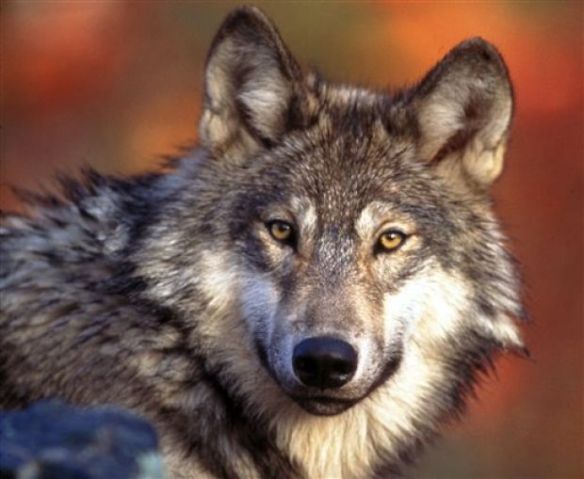
A gray wolf poses for a photo at  the Wildlife Science Center in Forest Lake, Minn., in 2004. Twenty-three wolves were killed in the Upper Peninsula during Michigan’s first wolf hunt in four decades, the state reported on Jan. 1, 2013.  Dawn Villella/AP/File

The world’s fanged animals are rapidly losing ground to humans, reports a study in the journal Science, thanks in part to the spread of livestock farming.

Of the 31 largest species of land carnivore (including the Giant panda, a rare herbivore in the Carnivora order), 23 are in population decline, the authors report. One, the red wolf, is critically endangered, and eight more are considered likely to go extinct throughout all or most of their natural range.

“Globally, we are losing our large carnivores,” says William Ripple, an Oregon State University ecologist who was the paper’s lead author.

Human infringements on these animals are numerous – including the fur industry and many forms of traditional medicine – but the report gives a special nod to “human carnivory.” To support a global rise in per-capita meat-eating, livestock farming continues to expand, shrinking and fragmenting natural habitats in the process. And when cramped predators adapt by preying upon livestock, some ranchers go to extreme measures to keep them away, such as strapping pouches of neurotoxins to the necks of grazing lambs, or calling upon the United States Department of Agriculture to shoot down predators from government helicopters.

“Global livestock production continues to encroach on land needed by large carnivores, particularly in the developing world, where livestock production tripled between 1980 and 2002,” reports the study.

But if our very food production brings us to blows with other meat-eaters, surely we need the land at least as much as they do. Why should we privilege wolf and puma habitat over farmland?

“Human tolerance of these species is a major issue for conservation,” says Mr. Ripple. “We say these animals have an intrinsic right to exist, but they are also providing economic and ecological services that people value.”

According to these scientists, there is every reason to protect carnivores – and not only the species, but the individuals themselves. For one thing, animals’ intrinsic value may dwell in individuals’ capacities for pain, pleasure, learning, and social relationships, all qualities which these megafauna have in spades.

“Because we’re aware and self-aware, we have a well-being that can be helped and harmed by our actions,” explains Bill Lynn, a research scientist at Clark University‘s George T. Marsh Institute, who is an expert on ethics and predator management.  “With respect to carnivores, they too are aware and self-aware. They, too, have a well-being that can be helped or harmed by our actions.”

“Thus,” adds Mr. Lynn, “how human beings relate to wildlife and the environment, are of direct moral concern.”

Many large carnivores are also considered to be keystone predators, who play crucial roles within their ecosystems – roles that are shaped by the size, metabolic demands, sociality, and hunting tactics, of each individuals.

“Each one of them becomes more important because there’s fewer of them,” explains Ripple.

The gray wolf, for example, whose fate has become the subject of ongoing policy debates after its extirpation from much of Western Europe, the US, and Mexico, is the top US predator of deer, after humans. In North America‘s now-wolfless areas, deer populations are nearly six times higher than elsewhere, which has led to drastic changes in plant communities, as well as increases in automobile collisions. And sea otters have been shown to keep North American kelp populations healthy and well distributed, by limiting the growth of sea urchin colonies.

Both of these ecological functions – protecting woodland foliage and aquatic kelp – are vital for keeping the earth’s carbon sequestered safely in plant tissues (and out of the atmosphere), notes the study, suggesting that charismatic carnivores actually play a vital role in keeping global warming at bay.

In view of this and other important “ecosystem services,” the authors have called for the creation of a Global Large Carnivore Initiative modeled after an existing European initiative which aims “to maintain and restore, in coexistence with people, viable populations of large carnivores as an integral part of ecosystems and landscapes.”

Such a body could establish carnivore reserves, suggests Ripple, and improve the enforcement of international wildlife laws.

“Ideally, discussions regarding potential decreases in both human fertility rates and per-capita meat consumption would be part of a long-term strategy for overcoming these concurrent challenges,” suggests the report. “It will probably take a change in both human attitudes and actions to avoid imminent large-carnivore extinctions.”

“These are some of the world’s most revered and iconic species. Ironically, they are also some of the most threatened,” says Ripple. “I think in the end, to preserve these large carnivore species, it comes down to humans having tolerance to live with them.”

Large carnivore decline puts humans at risk

http://www.nbcnews.com/science/cry-wolf-large-carnivore-decline-puts-humans-risk-study-says-2D11880999

copyrighted Hayden wolf walking

by John Roach

A few years after wolves were reintroduced to the Northern Rockies in 1995, fifth-generation Montana rancher Rick Jarrett gave up on the parcel of federal land near Yellowstone National Park that he grazed for 20 years. The carnivores harassed his cattle so much that they stopped gaining weight. Skinny cattle don’t sell.

“It wasn’t worth being there anymore,” he told NBC News. To turn a profit, he now confines his livestock to several thousand acres on and around his ranch in Big Timber, where his cattle and sheep are free to pack on the pounds — for now. The wolves, he said, will eventually get there, too.

While Jarrett is bitter about having to live with wolves, such coexistence is increasingly necessary if the world hopes to reverse a downward spiral of its largest carnivores such as wolves as well as lions, tigers, and bears, according to a review study published Thursday in the journal Science.

As the carnivores decline, ecosystems and food chains that humans depend on for survival are unraveling and, in many cases, adding to the economic woes of everyone from farmers to ecotourism companies.

“We should be thinking of ourselves in the end because if enough important species go extinct and we lose enough ecosystem services and economic services, then humanity will suffer,” William Ripple, an ecologist at Oregon State University in Corvallis and the study’s lead author, told NBC News.

What to do? Ripple and 13 colleagues from around the world found that more than three quarters of Earth’s largest carnivores are in population declines. Most occupy only a fraction of their historic ranges and more than half are threatened with extinction.

 The paper’s main finding is familiar to wildlife conservationists — large carnivores are in trouble — but pays scant attention to the most important problem: “What are we going to do about it?” Craig Packer, an ecologist at the University of Minnesota who was not involved with the study, told NBC News.”I think that is a huge challenge.”

Finding solutions is complicated, Ripple noted. The study, he said, is meant to illustrate the plight of carnivores and what humans stand to lose if the creatures go extinct — information that could steer policy via, for example, a global committee focused on carnivore conservation.

In the paper, the researchers argue that humans are ethically obligated to conserve large carnivores — the animals have an intrinsic right to exist on planet Earth. They then back the argument with examples of the way the role carnivores play in the ecosystem help humans.

In Africa, for example, loss of leopards and lions has translated to an increase in baboon populations, which in turn are raiding farmers’ livestock and crops for food. “In extreme cases, the farm family needs to keep their children home to guard the crops instead of go to school,” Ripple said.

Other benefits of carnivores noted in the study include control of deer, elk, and moose populations, which in turn keep forest plants healthy for other critters, limit erosion, and enhance water quality. Parks full of wolves and bears also attract tourists, whose dollars boost local economies.

Wolf-specific tourism in Yellowstone National Park, the paper notes, brings in $22 to $48 million per year.

What’s more, the scientists add, regions where carnivores keep other animal populations in check are full of plants that soak up carbon from the atmosphere, helping to slow global climate change. Jarrett, the Montana rancher, doubted such arguments would foster better feelings toward wolves.

“Granted carbon sequestration is important,” he said, “but the benefit we are going to get from wolves … is so insignificant it isn’t even funny.”

Legitimate fears The reality, noted Packer, who is an expert on human-carnivore interactions and deeply involved in African lion conservation, is that humans naturally fear these animals, often for good reason.

“You cannot expect somebody living in rural Africa or rural Asia to risk being eaten by a lion or a tiger so that your moral sense is gratified back in California or Texas or New York,” he said. “Conservationists need to recognize that there are legitimate reasons why people want to get rid of these animals.”

To reduce human predation on lions, Packer advocates the controversial use of patrolled and maintained fences that serve as a physical barrier between people and wildlife.

Ultimately, he said, the conflict among humans about our relationship with carnivores comes down to emotion versus intellect. While arguments such as carnivores’ ability to buffer ecosystems against climate change are “interesting,” in the end, he said, emotion usually wins.

“You have to find ways that people feel safe and that people benefit economically.”

John Roach is a contributing writer for NBC News.