
Growth for the Sake of Growth?
Image
3

This video is a little dated, filmed about five years after wolves were reintroduced to Yellowstone but already their effects on rivers and the environment were being felt!!
===
Video: Courtesy YouTube
Posted in: Biodiversity, gray wolf
Tags: Trophic cascades, Yellowstone National Park, gray wolves
As you’ve probably heard by now, Washington’s scenic Methow Valley, up in the North central portion of the state, is on fire. Big time. The title of the attached U.S. News article, “Mother Nature is Winning Here,” hit the nail on the head. What started out two days ago as 4 small fires covering 18,000 acres has mushroomed almost overnight to a monstrous 240,000 acre inferno, capable of gobbling up any town that tries to stand in its way.
photo Copyright Jim Robertson
I lived in the Methow for 20 some years, in a cabin in the heart of the Lake Chelan Sawtooth range, nestled on the eastern edge of the North Cascades mountains. My wife grew up in the valley; my brother and his wife still live there.
It was there that I learned to really respect the power of wildfires. I was working on a trail crew for the U.S. Forest Service. When we were sent on “controlled” burn on the Gold Creek Ridge near the now infamous town of Carlton I saw just how quickly an out of control fire can spread.
Being a “controlled” burn, it was planned for the spring when conditions aren’t nearly as dry as they are this time of year. We were using drip torches to set off slash piles. One big pile was next to the edge of a flagged “unit,” next to an unlogged slope. The guy working on that pile got carried away, so a couple of us went over to help keep his fire from spreading. We started frantically pulling slash off the unburned slope and tossing it out of reach of the flames. But the effort was too late; one worker who stopped to take a break saw the flames reach across the flag line behind us. He yelled, “Get out of there, you guys.” We turned to see the fire move over our fire line and into the brush and trees outside the unit. Luckily we hurried out of the fire’s path. Within seconds, the flames reached the crowns of the trees and the fire shot uphill and blackened the entire slope before we could even think about trying to get ahead of it and slow its progress…

‘MOTHER NATURE IS WINNING HERE’: Wildfire destroys about 100 homes in central Washington
By NICHOLAS K. GERANIOS and GENE JOHNSON, Associated Press
PATEROS, Wash. (AP) — A fire racing through rural north-central Washington destroyed about 100 homes, leaving behind smoldering rubble, solitary brick chimneys and burned-out automobiles as it blackened hundreds of square miles in the scenic Methow Valley.
Friday’s dawn revealed dramatic devastation, with the Okanagan County town of Pateros, home to 650 people, hit especially hard. Most residents evacuated in advance of the flames, and some returned Friday to see what, if anything, was left of their houses. There were no reports of injuries, officials said.
A wall of fire wiped out a block of homes on Dawson Street. David Brownlee, 75, said he drove away Thursday evening just as the fire reached the front of his home, which erupted like a box of matches.
“It was just a funnel of fire,” Brownlee said. “All you could do was watch her go.”
Next door, the Pateros Community Church appeared largely undamaged.
The pavement of U.S. Highway 97 stopped the advance of some of the flames, protecting parts of Pateros.
Firefighters poured water over the remnants of homes Friday morning, raising clouds of smoke, steam and dust. Two big water towers perched just above the town were singed black by the flames. The fire consumed utility poles from two major power lines, one feeding Pateros and the other feeding the towns of Winthrop and Twisp to the north.
Gov. Jay Inslee said about 50 fires were burning in Washington, which has been wracked by hot, dry weather and lightning. Some 2,000 firefighters were working in the eastern part of the state, with about a dozen helicopters from the Department of Natural Resources and the National Guard, along with a Washington State Patrol spotter plane.
Inslee said that the state was rapidly training about 1,000 additional National Guard troops and active duty military could be called in as well.
“This, unfortunately, is not going to be a one-day or one-week event,” he said.
The Methow Valley, about 180 miles northeast of Seattle, is a popular area for hiking and fishing. Sections of several highways were closed.
“There’s a lot of misplaced people, living in parking lots and stuff right now,” said Rod Griffin, a fly-fishing guide who lives near Twisp. “The whole valley’s in disarray.”
He described long lines for gasoline, with at least one gas station out of fuel, and said cellphone towers must have been damaged as well because there was very little service.
In Brewster, 6 miles to the south, a hospital was evacuated as a precaution. The smoke was so thick there Friday it nearly obscured the Columbia River from adjacent highways. The smoke extended all the way to Spokane, 150 miles to the east.
Jacob McCann, a spokesman for the fire known as the Carlton Complex, said it “ran quite a bit” Thursday and officials were also able to get a better handle on its size. It blackened 260 square miles by Friday morning, up dramatically from the prior estimate of 28 square miles.
“Mother Nature is winning here,” Don Waller, chief of Okanogan County Fire District 6, told The Wenatchee World newspaper.
The county sheriff, Frank Rogers, said his team counted 30 houses and trailers destroyed in Pateros, another 40 in a community just outside the town at Alta Lake, and about 25 homes destroyed elsewhere in the county of about 40,000 people.
More: http://www.usnews.com/news/us/articles/2014/07/18/growing-wildfire-empties-washington-town
This gallery contains 10 photos.
For the past few days, while watching the Tour de France cycling race on NBCSN, there have also been advertisements for their series called Shark Hunters that premieres today, as if it’s a sport. Their tagline is “The sharks are on the hook and there’s money on the line.”
A description of the program is: “The documentary-reality series features three East Coast shark tournaments – each more than a quarter century old – and highlights five captains battling against each other, the sharks, rough conditions and the Atlantic. Anglers from all over the world venture to the Northeast Atlantic to compete. Approximately 630 boats will have a collective six days to catch the biggest shark.”
If you can bear watching the horrific torture to which sharks are subjected and humans joyously celebrating their interminable pain then this series is for you. In an earlier essay called “Sharks and Humans: A Much Needed Corrective” I noted that sharks are highly sentient beings who suffer just like our companion animals and there are people who have been attacked by sharks and are now advocates for these most amazing animals. For more on how to interact safely with sharks read about Dr. Erich Ritter’s Shark School.
Marc Bekoff’s latest books are Jasper’s story: Saving moon bears (with Jill Robinson; see also), Ignoring nature no more: The case for compassionate conservation (see also), and Why dogs hump and bees get depressed (see also). Rewilding our hearts: Building pathways of compassion and coexistence will be published fall 2014. (marcbekoff.com; @MarcBekoff)
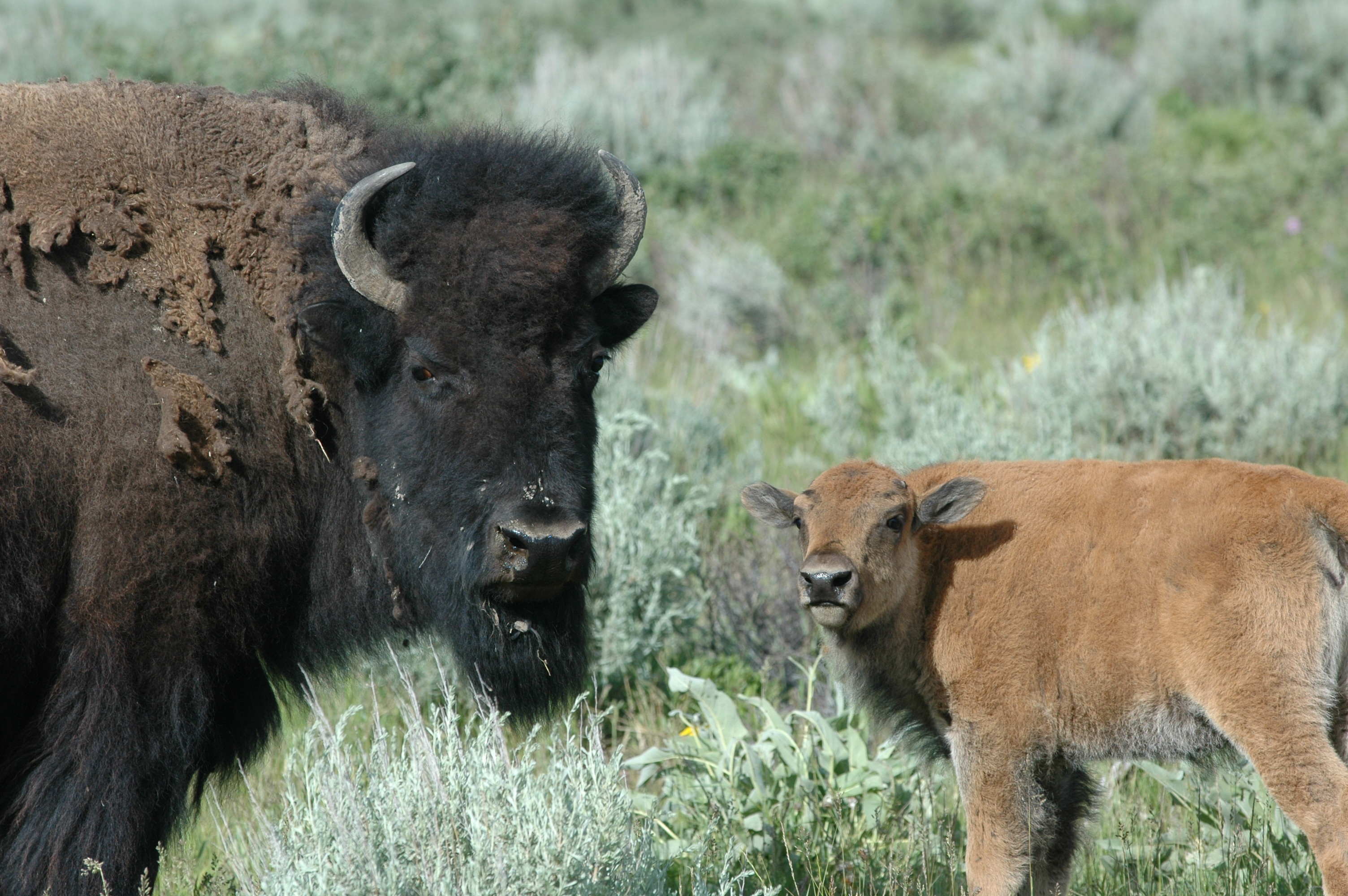
Divided public comment starts rescheduled bison meeting
by LAURA LUNDQUIST, Chronicle Staff Writer The Bozeman Daily Chronicle | 0 Comments
BILLINGS – The group charged with exploring the possibility of a free-roaming bison herd in Montana has hard work ahead, according to many eastern Montana ranchers attending a Fish, Wildlife & Parks meeting.
“This is a pipe dream of somebody’s,” said Greg Oxarart of the South Phillips County Grazing District. “You as a panel — do you want bison in your backyard? Not many people do. I hope you take that into consideration. You have a tough job ahead of you.”
FWP Director Jeff Hagener created the group to brainstorm where and how a free-roaming bison herd could be created in Montana.
Several of the 50 people in the audience carried signs stating “No free-roaming bison” and wore buttons bearing red X’s over a bison. Most were from Phillips and Valley counties, which contain the C.M. Russell Wildlife Refuge and the American Prairie Reserve.
Some had attended the first meeting of the discussion group in Lewistown in September. That meeting produced a list of guiding principles for any future plan, including respecting private property rights and managing bison as “wildlife” through a FWP management plan.
The group was scheduled to have its second meeting in Lewistown in April. But after receiving a number of heated emails and phone calls, Hagener canceled the Lewistown meeting at the last minute.
Some people were concerned by a series of events involving Yellowstone bison, including a court ruling that bison in quarantine remain wildlife, but a main complaint was that no time had been scheduled during the meeting for public comment.
On Monday, Hagener said no comment had been scheduled because the informal group was created for discussion and would not make any decisions. He also emphasized that the group had nothing to do with the management of Yellowstone bison.
“We are allowing public comment because a lot of the members of the group thought it was appropriate to have that,’” Hagener said. “Hopefully, we’ll come to a result that’s gone through a process with a lot of public opportunity, and we’ve allowed the public to be involved all the way along.”
Facilitator Ginny Tribe opened the public comment session with the reminder that any resulting plan would have a “no action” alternative where the state would not create a free-roaming herd.
“This group has already agreed on some of these principles so keep that in mind when you make your comments,” Tribe said.
Even so, comment ranged from vehement opposition to any bison to a proposal of the exact location on the CMR Wildlife Refuge where FWP should put 1,200 bison.
Dyrck Van Hyning displayed maps of the Southerland Bay region along the northern shore of the Fort Peck Reservoir in the CMR Refuge and said the 33,000 acres could house up to 1,200 bison, based upon the Bureau of Land Management’s grazing guide of 24 acres per cow.
“There’s no private land. There’s natural boundaries. This would be a good place for a pilot project that could start small,” Van Hyning said.
A Department of the Interior report on U.S. bison herds, released a few weeks ago, named the CMR Refuge as a good site for the transplant of bison but categorized future management as highly complex because of the resistance from nearby ranchers.
Hagener said the DOI would not move to put bison on the CMR Refuge without coordinating with the state of Montana.
That assurance didn’t assuage Phillips County ranchers, who cited concerns about property and fence damage, competition for grazing resources, the loss of livelihood and brucellosis. Some were worried about losing grazing allotments on the refuge.
Craig French of Phillips County said the meeting might not be about Yellowstone bison but ranchers can’t ignore the Yellowstone situation.
“If it was in my power to do so, I would hold these people responsible and throw them in jail for cruelty to the animals and mismanagement of the land,” French said. “At least we agree that things need to be grazed. We’re arguing over what should graze.”
Jim Posewitz of Helena also argued for the animals but said people have a moral responsibility to recover a species that they almost eliminated in the late 1880s.
“What happened in Montana is shameful. We have become the bone yard of a continent,” Posewitz said. “Will this be the point in Montana history where we become committed to finishing the wildlife restoration legacy?”
Sheep rancher Becky Weed of Belgrade said that bison and Montana cattle ranchers shared one trait that could serve as common ground for resolution: both need natural functioning ecosystems.
“It’s up to this group to try and explain to each other why the bison issue and the long-term cattle ranching issues are really one and the same,” Weed said. “This is a plea to the ranchers and to the environmentalists to understand why we all have a vested interest in seeking some kind of resolution to this.”
Following public comment, the group started problem-solving exercises to develop some recommendations by the end of Tuesday.
Yellowstone National Park rangers stopped traffic so a few wolves could cross the road and one of them snatched a road cone to play with 😎
Wolves are wild dogs, who have playful natures, so it’s not surprising but very endearing ❤
===
Video: Courtesy YouTube
Posted in: gray wolf
Tags: gray wolf, playful nature, road cone, Yellowstone National Park

Warning: Humor in bad taste and not really anything to joke about.


 Exposing the Big Game