200+ Yellowstone Bison Sent to Slaghter

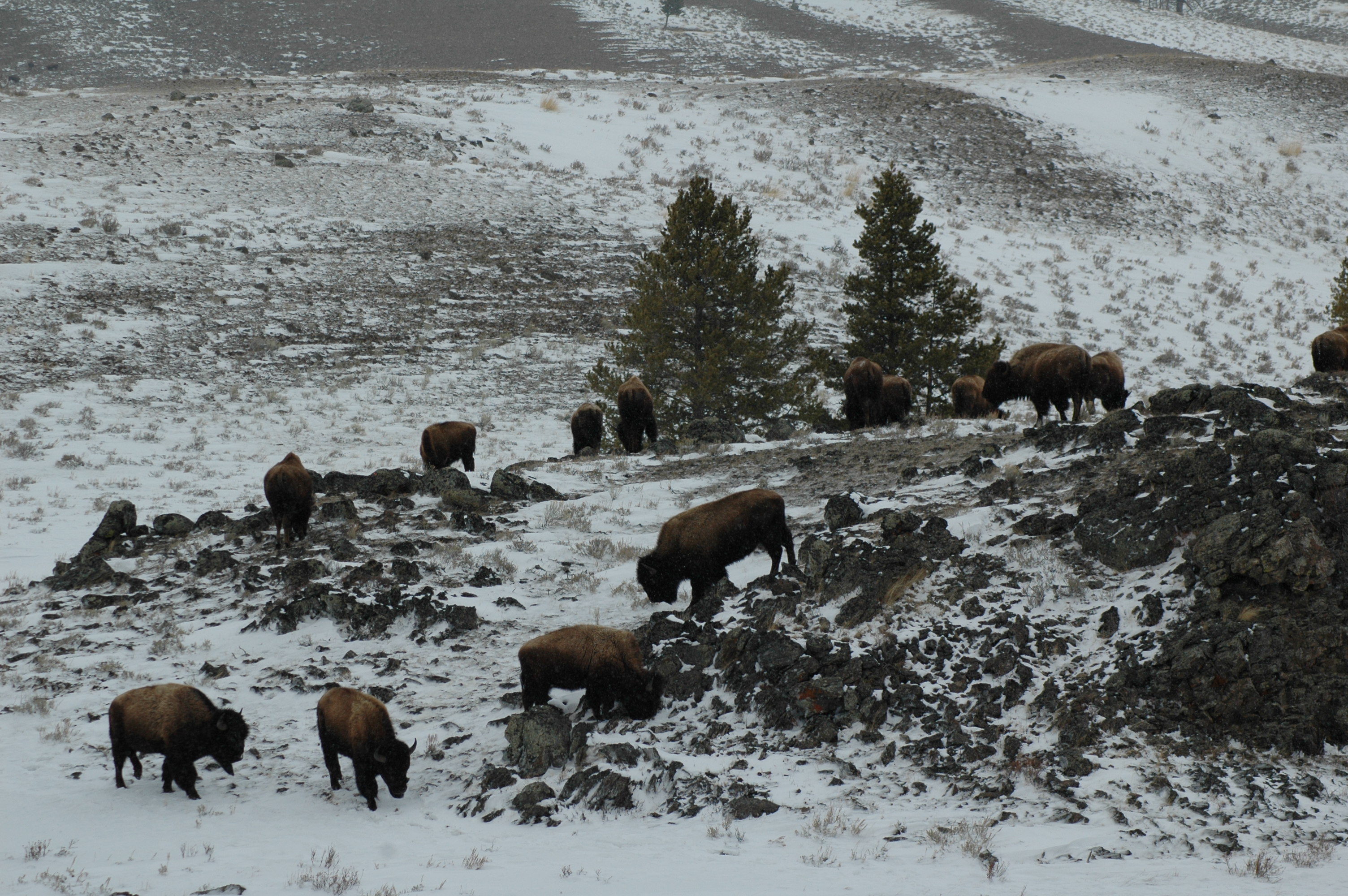
Photo Copyright Jim Robertson

Photo Copyright Jim Robertson

http://www.msn.com/en-us/news/us/at-least-200-yellowstone-bison-have-been-sent-to-slaughter-conservation-group/ar-AA8wPh0

Yellowstone National Park has shipped at least 200 bison near the park boundary with Montana to slaughter as the famed tourist destination seeks to reduce a herd by 900 animals this winter, a U.S. conservation group said on Friday.

A park spokesman, Al Nash, could not immediately confirm how many bison may have been handed over to tribal partners and taken to slaughter. But he said 162 bison had been captured and placed into a holding facility as of a week ago.

The Buffalo Field Campaign, which opposes the culling and has been monitoring it, said the bison had been dispatched to slaughter since Wednesday, and anticipated that 55 more could be sent on Monday.

The culling plan allows the bulk of bison marked for death to be transferred to Native American tribes for slaughter and a certain number of the wandering buffalo to be killed by hunters.

The strategy is designed to address worries by ranchers that bison infected with the bacterial disease brucellosis, which can cause miscarriages in cattle, could transmit it to their herds, potentially threatening Montana’s brucellosis-free status.

The plan this winter to reduce the bison population to 4,000 from 4,900 comes as conservation groups are seeking federal protections for a herd that is a top attraction for the 3 million annual visitors to a park that spans parts of Wyoming, Montana and Idaho.

Buffalo Field Campaign spokeswoman Stephany Seay called the culling practice “the brutal abuse and slaughter of the only wild population of buffalo remaining in this country.”

The iconic hump-backed animals once roamed by the tens of millions west of the Mississippi until hunting campaigns reduced their numbers to the fewer than 50 that found safe harbor at Yellowstone in the early 20th century.

The Buffalo Field Campaign said that roughly another 100 bison have been killed by hunters outside the park in Montana, while Nash, citing state officials, put that number lower, at 70.

Nash said the park usually engages in culling in winter, when bison migrate to lower elevations in search of food. Federal and state officials on horseback have been capturing animals along the park boundary, both inside and outside the park.

Conservationists petitioned the U.S. Fish and Wildlife Service last year to provide federal safeguards for the Yellowstone herd, contending it was the only free-roaming band in the country to retain its genetic integrity.

(Reporting by Eric M. Johnson in Seattle; Editing by Sandra Maler)

It’s All a Game: New Tags Allow Wolf-Pelt Transport To Canada

USFWS Helps to Market Wolf Pelts: ‏

http://fwp.mt.gov/news/newsReleases/fishAndWildlife/nr_0722.html

Fish & Wildlife

Wed Jan 21 10:57:00 MST 2015

With the recent approval from the U. S. Fish & Wildlife Service, Montana wolf hunters and trappers who harvest wolves will now obtain internationally recognized pelt tags to allow for the export of wolf pelts directly out of country, usually to Canadian fur auction houses.

Montana’s CITES wolf-pelt tags were obtained under the Convention on International Trade in Endangered Species, an international agreement between governments. Its aim is to ensure that international trade in specimens of CITES-listed wild animals and plants does not threaten their survival.

“This is a big change from the past couple of years in terms of hunter and trapper harvest opportunity to sell wolf pelts,” said Brian Giddings, statewide furbearer coordinator for Montana Fish, Wildlife & Parks in Helena.

Any hunter or trapper who harvests a wolf taken during the 2014-2015 season—Sept. 6, 2014 through Feb. 28, 2015—can now have it tagged with a CITES pelt tag.

As a condition of CITES approval, however, no prior season harvested wolf can receive a CITES tag, Giddings said.

Additionally, Montana’s wolf CITES tags cannot be used for any other method of mortality such as road-killed, federal Wildlife Services’ control action, landowner/livestock control, or incidental take. Nor can CITES tags be used for wolves taken on Tribal lands.

Hunters and trappers have strict reporting requirements. Upon the harvest of a wolf, hunters and trappers must call 1-877-FWP-WILD—1-877-397-9453—within 24 hours to file a report. Wolf pelts must be tagged within 10 days of harvest.

State tags issued earlier this hunting and trapping season can be replaced with the new wolf CITES tags by contacting the nearest FWP regional office. Once one receives a wolf CITES tag the old state-issued wolf tag can be removed and discarded.

For more information on CITES wolf-pelt tags contact your nearest FWP office.

To learn more about Montana’s wolf hunting season, visit FWP online atfwp.mt.gov. Click “Hunting Guides” and choose Wolf.

Featured Image -- 7624

50-foot section of failed Montana oil pipeline was exposed on bed of Yellowstone River near site of spill

Bob Berwyn's avatarSummit County Citizens Voice

Cleanup hampered by icy conditions

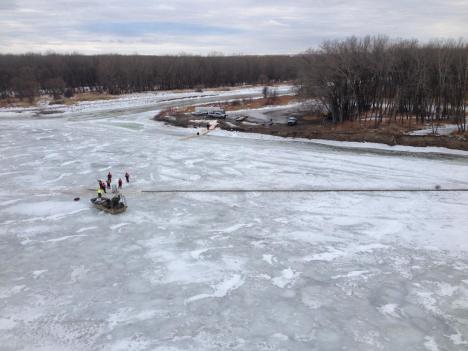
Cleanup crews try to contain oil from a pipeline spill in the Yellowstone River, near Glendive, Montana. Photo courtesy EPA. Cleanup crews try to contain oil from a pipeline spill in the Yellowstone River, near Glendive, Montana. Photo courtesy EPA.

Staff Report

FRISCO — Sonar surveys show that the failed Poplar Pipeline in Montana is exposed on the river bed for approximately 50 feet near the site of a breach that may have spilled as much as 50,000 gallon of oil into the Yellowstone River.

After the spill, oil sheens were spotted on the river as far as 60 miles downstream, according to the EPA. Residents in the town of Glendive, a few miles from the spill, were warned not to drink their tap water after testing found traces of oil in the town’s water supply, but after additional testing, the town’s drinking water system was deemed safe on Jan. 23.

According to the EPA, the bottom of the river bed is about one…

View original post 222 more words

Environment: Oxygen-depleted dead zones caused by reservoirs killing endangered fish embryos

Bob Berwyn's avatarSummit County Citizens Voice

jb Pallid sturgeon embryos are dying in the dead zones of the Missouri River. Photo via Nebraska Games and Parks Commission.

‘We’re basically talking about a living dinosaur that takes 20 years to reach sexual maturity and can live as long as the average human in the U.S.’

Staff Report

FRISCO — A river fish whose genetic lineage goes back ten of million years has survived dramatic climate shifts and other earth-changing events, but may not be able to persist through the age of dam-building.

Oxygen-depleted dead zones between dams in the upper Missouri River Missouri River are preventing pallid sturgeon from reproducing, and there’s no sign things will get better, at least not without a little help from humans.

View original post 715 more words

Global warming: Satellite images show dramatic, rapid thinning and acceleration of Svalbard ice cap

Bob Berwyn's avatarSummit County Citizens Voice

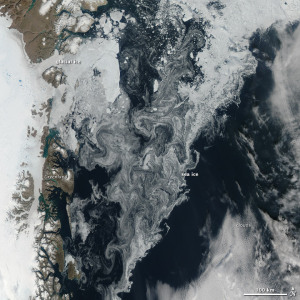
sdfg Ice in the Greenland Sea, via NASA Earth Observatory.

Austfonna ice field has thinned by more than 150 feet in just 3 years

Staff Report

FRISCO — If sudden changes on a small island in the Svalbard Archipelago are any indication, then the Greenland Ice Sheet could be in big trouble as the Arctic warms up.

Satellite images show that the Austfonna ice cap has thinned by more than 50 metres since 2012 — about one sixth of its original thickness — and that the ice is flowing 25 times faster than just a few years ago.

Scientists analyzing the data said they’re not exactly sure why the ice cap has changed so suddenly, but noted that the island is smack in the middle of one of the fastest-warming areas on the planet.

View original post 381 more words