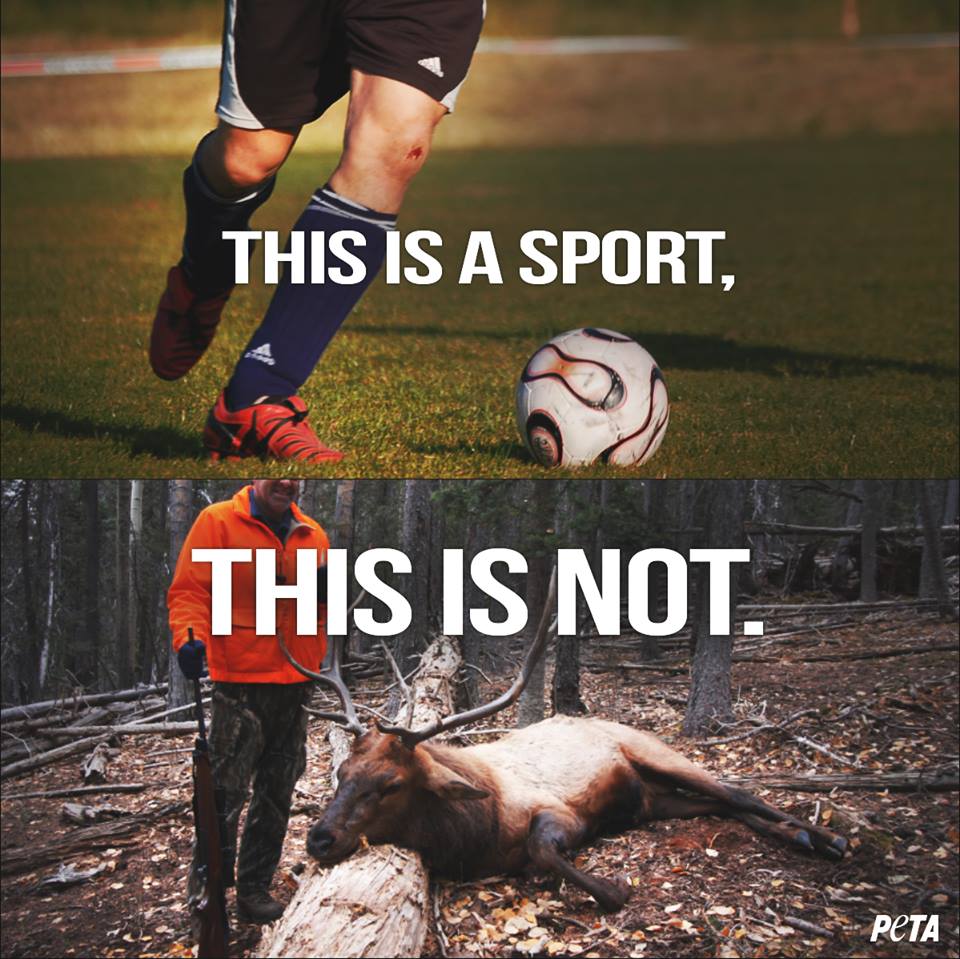
Exposing the Big Game

Forget Hunters' Feeble Rationalizations and Trust Your Gut Feelings: Making Sport of Killing Is Not Healthy Human Behavior

Exposing the Big Game

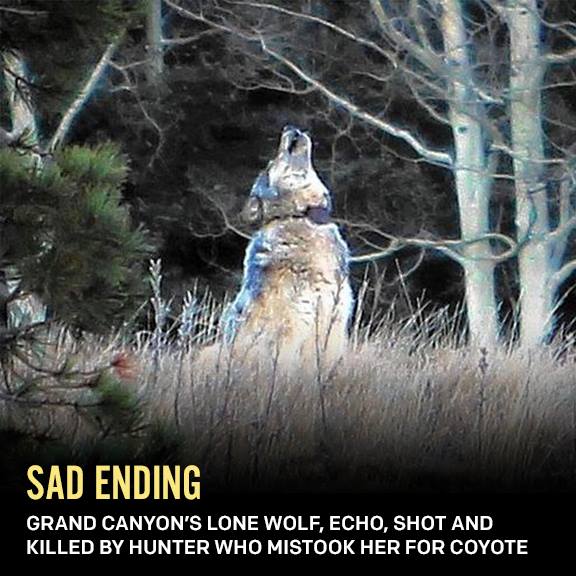
It’s Official: Wolf Killed in Utah Was Animal From Rare Arizona Sighting

http://abcnews.go.com/Technology/wireStory/mistakenly-killed-wolf-animal-rare-arizona-sighting-28890684

A gray wolf that was shot by a hunter in Utah was the same one spotted in the Grand Canyon area last year, federal wildlife officials said Wednesday.

The 3-year-old female wolf — named “Echo” in a nationwide student contest — captured the attention of wildlife advocates across the county because it was the first wolf seen in the Grand Canyon in 70 years.

The U.S. Fish and Wildlife Service did DNA tests to confirm the wolf killed in late December by a Utah hunter who said he thought he was shooting a coyote was the same one that was seen roaming the Grand Canyon’s North Rim and nearby forest in October and November, said agency spokesman Steve Segin.

Geneticists at the University of Idaho compared DNA taken from the northern gray wolf killed in southwestern Utah with scat samples taken from the wolf seen near the Grand Canyon last fall.

The hunter who killed the wolf called Utah state officials in December and said he mistook the wolf for a coyote, said Utah Division of Wildlife Resources spokesman Mark Hadley. The man, whose name was not released, said he didn’t realize his mistake until he came up on the dead animal. In Utah, anybody can hunt coyotes.

The state handed over its initial findings of what happened to U.S. Fish and Wildlife, Hadley said. That investigation is ongoing and could take weeks or months to complete, Segin said. It’s not clear yet what penalties the hunter could face for killing the animal.

Wolves are protected in Utah under the Endangered Species Act.

Wildlife advocacy groups have called the wolf’s death heartbreaking and say they want the hunter prosecuted. They said the animal could have helped wolves naturally recover in remote regions of Utah and neighboring states.

“Wolves and coyotes are distinguishable if one pauses for a second before pulling a trigger,” said Michael Robinson with the Center for Biological Diversity. “There are consequences for pulling the trigger when you don’t know what you’re aiming at. It’s important to have justice for this animal.”

Wolves and coyotes often have similar coloring, but wolves are usually twice as large as coyotes, said Kim Hersey, mammal conservation coordinator with Utah Division of Wildlife Resources. Wolves also have longer legs, bigger feet and rounder ears and snouts, she said.

But, Hersey says how well a person could distinguish between the two would depend on the lighting, the distance and how much experience a hunter has comparing the two animals.

The wolf had worn a radio collar since January 2014.

Wolves can travel thousands of miles for food and mates. Gray wolves had been spotted as far south as Colorado until the Arizona wolf was confirmed. Gray wolves last were seen in the Grand Canyon area in the 1940s.

In recent years, the Fish and Wildlife Service lifted protections for the wolves in the Northern Rockies and western Great Lakes. But a federal judge recently reinstated the protections after wildlife advocates in Wyoming sued.

The Center for Biological Diversity has documented 11 cases since 1981 where hunters told wildlife officials they had shot a wolf thinking it was a coyote.

10906075_10155034869550301_2511370178161460178_n

For California Salmon, Drought

For California Salmon, Drought
And Warm Water Mean Trouble

With record drought and warming waters due to climate change, scientists are concerned that the future for Chinook salmon — a critical part of the state’s fishing industry — is in jeopardy in California.

by alastair bland

Gushing downpours finally arrived in California last month, when December rains brought some relief to a landscape parched after three years of severe drought.

But the rain came too late for thousands of Chinook salmon that spawned this summer and fall in the northern Central Valley. The Sacramento River, running lower than usual under the scorching sun, warmed into the low 60s — a temperature range that can be lethal to fertilized

Chinook salmon

Pacific Northwest National Lab
Chinook, the largest species of Pacific salmon, need cool waters to reproduce.

Chinook eggs. Millions were destroyed, and almost an entire year-class of both fall-run Chinook, the core of the state’s salmon fishing industry, and winter-run Chinook, an endangered species whose eggs incubate in the summer, was lost.

The disaster comes on the heels of a similar event the previous autumn. It is also reminiscent of ongoing troubles on northern California’s Klamath River, where diversion of water for agriculture has at times left thousands of adult Chinook — the largest species of Pacific salmon — struggling to survive in water too shallow and warm to spawn in.

Now, scientists — who are observing increasing human demand for water, genetic decline of hatchery-reared salmon, and climate change models predicting intensified droughts — are concerned that the Chinook salmon will be unable to tolerate future river conditions and will all but vanish from California’s landscape.

Robert Lackey, a professor of fisheries at Oregon State University, Corvallis, says that as the climate continues to warm, “salmon at the southern edge of their range will be the first to go.” Lackey doubts any

Historically huge salmon runs could be reduced to almost nothing before the end of the century.

Pacific salmon species will go fully extinct soon, and in Alaska, Russia, and other northern regions he expects populations to remain relatively strong. But farther south, where rising water temperatures will reach or exceed the limits of the salmon’s physiological tolerance, Lackey predicts historically huge runs will be reduced to almost nothing before the end of the century.

Just two centuries ago, as many as two million Chinook spawned in the Central Valley each year. The fish headed from the Pacific into San Francisco Bay, and at the confluence of the valley’s two big rivers, about half turned north into the Sacramento River system while the rest went south into the San Joaquin River, seeking the cool headwaters where they would lay and fertilize their eggs.

In this large valley — where the Mediterranean climate is friendly to desert-loving crops like pistachios, figs, and olives — salmon may seem out of place. Yet they thrived here. That’s because some of the highest mountains in North America flank the Central Valley — the Sierra Nevada along the eastern side and the Cascades at the north end. These ranges are buried in snow most winters, and through the summer and fall meltwater gushes into the lowlands below, providing the cold flows Chinook salmon require to successfully spawn.

The 19th-century flood of miners and settlers to California rapidly changed the ecosystem. Mining destroyed watersheds while overfishing dented the huge salmon runs. Then, in the 20th century, came the extensive systems of dams and canals built for agriculture. Reservoirs filled. So did the irrigation canals, and in the western San Joaquin Valley, a region naturally too arid to support intensive farming, vast orchards proliferated. The salmon fared poorly, though. The dams blocked the way to their historic spawning grounds and in some cases dried out rivers. In the San Joaquin, salmon vanished. On the Sacramento and its tributaries, populations hung on, though mostly because of artificial propagation in hatcheries.

Today, climate change is emerging as the next great threat to California’s remaining salmon runs. Peter Moyle, a fisheries biologist at the University

The mountain snowpack that has made life possible for salmon runs in California is expected to retreat.

of California, Davis, says the mountain snowpack that has made life possible for salmon runs in the state will retreat in the coming decades, as average temperatures escalate. Just a few spring-fed streams, he says, may remain cold enough year-round to support spawning.

This fall, scientists and environmentalists got a glimpse of what snowpack loss could mean for salmon statewide. Shasta Lake, its inflow from tributaries greatly diminished, dropped, while its waters warmed. Most years, even after a long, hot summer, cool water is available at the bottom of the reservoir, where an intake system draws the water through Shasta Dam and into the Sacramento River downstream. But by October of 2014, the water was 61 degrees, top to bottom, according to Jim Smith of the U.S. Fish and Wildlife Service.

“There was no cold water available,” he says.

Tens — possibly hundreds — of thousands of salmon laid and fertilized their eggs through the autumn before any rain fell. “It would be a miracle if we had much survival in the river,” Moyle says.

Another autumn spawning disaster had occurred a year earlier, during the driest year in California’s recorded history. Government officials, hoping to ration reservoir water for later agricultural use, abruptly lowered the outflow from Shasta Lake in the midst of the largest spawning event the

Sacramento and San Joaquin Rivers

California Dept. of Fish and Wildlife
Chinook salmon historically headed inland from the Pacific Ocean and up either the Sacramento or San Joaquin rivers to spawn.

Sacramento had seen in years. The river, teeming with 20-to-40-pound fish, shrank by half its volume. Thousands of salmon nests, or redds, were left high and dry.

Even the remote Klamath River, which flows into the sea just south of Oregon in a region of rain-drenched forest, is not immune to drought and thirsty farms. Last summer, the diversion of Klamath basin water to the Sacramento Valley, compounded by a year with virtually no rain, caused the dewatering of the Klamath during a large salmon run. Thousands of adult Chinook almost died in lukewarm water before the U.S. Bureau of Reclamation, persuaded by Native American tribal leaders and environmentalists, reluctantly allowed more water to flow into the river, saving the fish. The action helped avoid a repeat of the kill in 2002, when sun-warmed waters caused a disease outbreak that killed roughly 34,000 adult fish.

The Klamath’s problems will get worse with climate change and increasing river temperatures, says Rebecca Quiñones, a U.C. Davis researcher who has extensively studied the Klamath ecosystem. “All the climate models show that the main stem of the [Klamath] river is going to be really

Some conservationists say hatchery production is making Chinook salmon more vulnerable to warming trends.

inhospitable to salmon,” Quiñones says.

Hatcheries in the Klamath and Sacramento basins produce most of the salmon that head out into the Pacific and are caught by fishermen off the California coast. But these facilities may now be causing more problems than they’re solving. For one thing, hatchery production is making Chinook salmon more vulnerable to warming trends, according to Jacob Katz, director of salmonid restoration initiatives with the group California Trout. He says hatcheries have traditionally harvested the very first salmon to swim through their processing rooms. In doing so, they have selected for a fall-run population that returns on the early end of the spawning season — exactly when waters may be warm and low, especially in the future.

Meanwhile, hatchery inbreeding and the elimination of natural selection is stripping the Chinook salmon genome of its evolutionary assets, Moyle says. The result is a domesticated animal not well suited to survive in a natural environment. Eventually, Moyle warns, hatchery fish will be so incompetent at finding food, evading predators, and finding their way back upriver to spawn that, even with tens of millions of them released each year, the Central Valley returns will diminish beyond hope. Hatcheries, without enough returning adults to provide sufficient eggs, will be forced to shut down. “This may take years, but the trajectory is there,” Moyle warns.

Today, in the Central Valley, juvenile salmon face multiple threats. In the Sacramento-San Joaquin delta, irrigation pumps draw the fish off their migration routes and into remote backwaters. Non-native bass and catfish, which are proliferating in the delta (and whose futures look bright in the warming waters), wait in ambush at reed clusters and pier pilings.

If rain falls at the right time, fast-moving torrents can wash the salmon safely out to sea; but in dry years, they drift slowly and precariously through the delta, and most perish before ever touching saltwater. Indeed, even critics of the hatcheries recognize that, were they to shut down, a fishing industry worth more than a billion dollars would collapse almost instantly.

Some scientists believe the Central Valley could still support a large, naturally spawning salmon population if the river system were restored to

Federal officials are considering a plan to trap adult salmon downstream and truck them upstream of Shasta Dam.

some semblance of its original state. Drained wetlands along the Sacramento River’s floodplains would need to be reconnected to the main channel, and dams would need to be operated to ensure that cold water always flowed downstream. In some cases, Moyle notes, dams could actually help salmon, since deep reservoirs would be the most reliable sources of cold water.

However, even outflow from the 500-foot depths of Shasta Lake will probably be too warm most years for endangered winter-run Chinook to spawn. To save this run from vanishing, the National Marine Fisheries Service is considering a long-term plan of trapping adult salmon downstream and trucking them upstream of Shasta Dam each winter so they can spawn where they did historically, in cool, high-elevation waters. The program — which Moyle calls a “desperation measure” — would also require trucking the juveniles back downstream in August.

Prospects for the Sacramento’s spring-run Chinook may be even worse. Most of the fish spawn in Butte Creek, a small tributary in the low hills just south of Mount Lassen. Each summer, this watershed is baked by the sun, and in the future, without reliable snowmelt from Lassen, successful spawning may not be possible here.

Along the West Coast of North America, the future for Chinook salmon looks bleak in the face of rising water temperatures. A study published in

ALSO FROM YALE e360

The Ambitious Restoration of
An Undammed Western River

Elwha Dam restoration

With the dismantling of two dams on Washington state’s Elwha River, the world’s largest dam removal project is almost complete. Now, in one of the most extensive U.S. ecological restorations ever attempted, efforts are underway to revive one of the Pacific Northwest’s great salmon rivers.
READ MORE

December in the journal Nature Climate Change predicts that Chinook salmon will likely experience “catastrophic” population losses by 2100 due to warming river temperatures. Lackey says collective compromises in water use and lifestyle choices in the American West must be made before West Coast salmon, now reduced on average to less than five percent of their pre-Columbian numbers, can rebound. He doubts Americans are willing to pay this price. “Everywhere that we’ve seen economic development and [human] population growth, salmon runs have crashed,” Lackey says.

Moyle thinks that salmon could rebound, but only with the long-term cooperation of the water agencies that played a lead role in the loss of fish and habitat to begin with.

“California only has so much water available,” Moyle says. “Now, we are going to have to decide how we want to use our resources.”

http://e360.yale.edu/feature/for_california_salmon_drought_and_warm_water_mean_trouble/2834/

Exposing How Elephants Have Their Spirits Systematically Crushed in Captivity

http://www.care2.com/causes/exposing-how-elephants-have-their-spirits-systematically-crushed-in-captivity.html

Exposing How Elephants Have Their Spirits Systematically Crushed in Captivity

Would interacting with a captive elephant still bring you joy if you knew the animal suffered extreme abuse and manipulation? If you have interacted with a captive elephant, chances are that the massive animal has gone through the tortuous process of Phajaan, or having her spirit broken, in order to make her more docile and open to human interaction.

How to Break an Elephant’s Spirit

One Green Planet explains Phajaan, as it’s known in Asia (or “crushing” in the United States), and how it makes elephant rides in the Asian tourism industry possible.

Phajaan begins when elephants are the most vulnerable. Baby elephants are forced into crates similar to gestation crates that we abhor seeing pigs in. While the baby elephant is being starved, he is also:

  • Tied from his feet with rope that will graduate to chains
  • Forced to have his limbs stretched
  • Beaten with sharp objects
  • Verbally abused and constantly yelled at
  • Mutilated through bull hooks that are used to “stab the head, slash the skin and tug the ears.”

Phajaan is relentless for many weeks until the elephant finally breaks. Heart of Ganesh explains that baby elephants are also denied medical attention during the crushing, and many will die during the process.

In case you’re wondering, circuses employ almost identical crushing methods. Paws for the News reports how elephant crushing is rampant in more captivity situations: elephants “begging in the streets, the ones in trekking camps, breeding camps, tourist camps, and zoos. At least more than half of them have gone through the Phajaan.”

Mahout Manipulation

Phajaan has a secret weapon to seal the deal, and he’s known as a mahout. The use of an elephant handler, or mahout, is arguably the most effective part of Phajaan.

The mahout sweeps in to “save” the elephant; they are not active participants in the Phajaan torture. They are the first person to bring the tortured and starved animal food and water. Mahouts also release elephants from the original gestation-like crates. A mahout will work and bond with only one elephant for his entire career. When a mahout retires, his relative will take over his mahout duties. Elephants are emotionally and mentally intelligent animals that thrive on social bonds, and mahouts are the only bonds that come close in the captive Asian tourism industry.

The Consequences of Exploiting Elephants

But wild spirits can never truly be broken. We keep seeing captive elephants in circuses and in the tourism industry retaliate:

  • In 1992, People reports how a usually calm circus elephant named Kelly became “frighteningly enraged” while she was giving five children and a mother a ride.
  • The Seattle Times reports how in 1994, a zoo elephant named Kenya “picked him [a zoo patron] up and smashed him to the ground, then tried to gore him with her tusks.”
  • In late 2014, The Independent reports how an elephant in Thailand ran off with a mother and her 9-year-old daughter from Russia on his back after he trampled his handler to death.

There’s also a major health concern that should limit our interactions with captive elephants, and it’s the spread of tuberculosis. In 2013, Maine took the extreme measure of banning elephants from entering the state because of the health threat.

Help End Elephant Exploitation

Despite the obvious evidence that elephants and captivity do not mix, many are determined to ride it out as long as possible. For example, an action plan is being drawn out to curb elephant attacks during festivals in an Indian state, says Manorama Online.

We don’t need an action plan to stop captive elephant attacks; we need an action plan to end elephant captivity. Money talks, and industries that exploit elephants listen, so don’t fund elephant exploitation. Heart of Ganesh offers more ideas on how you can help end elephant exploitation.

________________________________

Speaking of animals in captivity, see: http://news.discovery.com/animals/ice-cream-shop-bear-150210.htm  ,and hear what they would say if they could talk:

10530913_1570877459795781_2533557188593059886_n

Whales, fed up with being fished, take revenge on fishermen

BBC.com

what a moby dick

Whales, fed up with being fished, take revenge on fishermen

http://grist.org/list/whales-fed-up-with-being-fished-take-revenge-on-fishermen/?utm_source=newsletter&utm_medium=email&utm_term=Weekly%2520Feb%252010&utm_campaign=weekly

Humans! For centuries you hunted my kind, stabbed us with your little toothpicks, stripped us of our tasty, tasty blubber, and then, probably, danced merry jigs on our corpses. In an act of true hubris, you even wrote it all down.

Well, joke’s on you, because we’re smart fuckers and now we’re getting our revenge — best served cold-as-Arctic-waters, where sperm whales have learned to strip the fish right off of fishermen’s lines. From the BBC:

This giant animal’s deft trick was filmed for the first time by a group of scientists based in Alaska … It shows a sperm whale using its long jaw to create tension on the line, which in turn snaps fish off the hooks. This feeding behaviour is called depredation and experts think it is learned by the whales.

“I don’t know how to quantify their intelligence but their effectiveness is almost perfect,” says Stephen Rhoads, a boat skipper who has been fishing in the area for 20 years.

Damn straight it is. You think we’d bother to dive and catch our own fish when you are basically unspooling miles of free buffet each time you let out all that longline? In short: You trippin’, particularly if you think we are leaving you with any black cod (our fave!).

The scientists hope to eventually tag 10 individuals – known as the ‘bad boys’ – who are seen around boats most often. One of the most regular visitors has even earned the name Jack the Stripper after being seen nine out of the last 10 years in the same part of the Gulf.

‘Strips’ to his friends — but fishermen, it should go without saying, are not his friends.

120 sperm whales have been observed, all of which are male, scientists estimate there may be 235 in total. Up to 10 whales have been seen around fishing boats, which is unusual as adult males usually hunt on their own and could also point towards depredation being socially transmitted between whales.

They also discovered that the whales, who hunt using echolocation, are alerted to the fact fishing is taking place by the sound of boat engines shifting gear as the crew haul in the catch, this can be detected from several miles away.

Maybe if you humans weren’t so effing loud, we’d leave some cod for you. (Ha! Just kidding.) But no — you have to stomp all over the place, broadcasting your wretched presence.

“Now the tables have turned, whaling is banned, and sperm whales are returning and learning to take on fishermen in bold and surprising ways – and so far there is very little the fishermen can do about it.

I only have one question left for you pathetic buffoons: You need some ice for that burn? Too bad, because we’re running out of that, too. (And that’s also your fault, morons.)

Sincerely,

A Whale

Petition to UN: sue Panthera.org, WWF.org ,Safari Club International,Dallas Safari Club

United Nations: sue Panthera.org, WWF.org ,Safari Club International,Dallas Safari Club

This petition is awaiting approval by the Avaaz Community
United Nations: sue Panthera.org, WWF.org ,Safari Club International,Dallas Safari Club
813 signers. Let’s reach 1,000

Why this is important

A petition for the UN to sue Panthera.org, WWF.org ,Safari Club International and Dallas Safari Club,Craig Packer and Colleen Berg for deliberate lying and exaggerating lion populations in Africa for the money they get from lion trophy hunting.
Posted February 4, 2015

The Wolf In Our Heads…Understanding Canis Lupus

Nabeki's avatarHowling For Justice

February 26,2010

Who is the wolf?  So much has been written about this magnificent animal yet do we really know the wolf?  We can recite facts about them. They mate for life, they’re smart, playful, their lives are structured around family. Wolves can knock off  fifteen to twenty-five miles in one clip without breaking a sweat, they can reach 40 miles an hour when chasing prey. Their wanderlust drives them to explore new places, to investigate, they are curious. Wolves love to move, they are perpetually in motion when awake.

Pack life is ordered, every wolf  has a place. Usually only the alpha pair (mothers and fathers) will breed but not always.  The famed Hog Heaven Pack, who was slaughtered by Wildlife Services in 2008, had twenty-seven members and TWO breeding females.  The year they were killed they produced 15 pups, all gunned down with the rest of the pack, in that grim November.

The idea that wolves fight for top dog position in the…

View original post 1,699 more words

Are humans to blame for the mammoth’s demise? Hunting caused numbers to plunge 30,000 years ago, study claims

  • Researchers in Germany have found that hunting significantly depleted mammoth populations in Western Europe around 30,000 years ago
  • They studied the bones of mammoths, horses and reindeer
  • Analysing isotopes ruled out climate change as a cause of population cuts
  • All but a few isolated populations died out 20,000 to 10,000 years ago 

They found that woolly mammoth numbers declined, but that climate conditions as well as food and water supplies for the giant herbivores remained stable.

The woolly cousins of modern elephants roamed northern Eurasia and North America beginning 300,000 years ago, but some 10,000 to 20,000 years ago, all but a few of the isolated island populations disappeared. 

By studying bones, researchers found that numbers of woolly mammoths declined, but that climate conditions as well as food and water supplies for the giant herbivores remained stable, indicating that hunting is the main cause. A depiction of a hunting party using a pitfall trap is shown

Read more: http://www.dailymail.co.uk/sciencetech/article-2945630/Are-humans-blame-mammoth-s-demise-Hunting-caused-numbers-plunge-30-000-years-ago-study-claims.html#ixzz3RMczSqj6
Follow us: @MailOnline on Twitter | DailyMail on Facebook

End the Iditarod

http://www.all-creatures.org/alert/alert-20150209.html
Action Alert from All-Creatures.org

FROM

SledDogma.org
February 2015

ACTION

Iditarod season is upon us again – March 7, 2015

Go here and Write to Iditarod sponsors and supporters

INFORMATION / TALKING POINTS

Sled Dogma: Reality Bites believes that a tethering ban on a federal level is necessary to significantly improve conditions for the sled dogs associated with commercial mushing. Currently commercial sled dog operations are exempt from federal regulations under a “working dog” exclusion.

Please watch Dream an Iditarod Dream (with links to other videos). This video shows the living conditions of the Iditarod “participants” when they’re not “racing”.

See for yourself the conditions in which commercial sled dogs in Alaska are forced to live. These animals are located on a property deep in the woods with no residence on site — they are left alone to fend for themselves without any human supervision besides a daily distribution of food and water.

sled dogs

sled dogs

sled dogs

In the fall in Alaska, Iditarod “training” begins:

sled dogs
“Trainer” in ATV…

sled dogs
One way to transport dogs to “race” venues

For more information, images and videos, visit I Hurt A Dog.com and SledDogma.org


Return to Action Alerts

Stop the “Sportsmen’s Act”

From HSUS.org

The dreaded so-called “Sportsmen’s Act” is back.

Yet again, a small faction of wealthy trophy hunters is pressuring your elected officials to allow the importation of threatened polar bear trophies from Canada. They also want to open millions of acres of public lands to10368479_10152532154104586_2706872192299860162_n sport hunting and commercial trapping, without evaluating possible implications on animals, habitat and Americans who enjoy our nation’s wild spaces. They are also fighting to keep pumping tons of toxic lead ammunition into the environment, poisoning the land and wildlife, even when non-lead ammo is readily available.

Please make a brief, polite phone call today to your Senators and urge them to OPPOSE S. 405, the Sportsmen’s Act, and protect our wildlife and wildlands.

Wildlife needs strong voices like yours to stand up for them. After you call, don’t forget to send a follow-up message»