Another Sign of Climate Change: Warm weather causes partial collapse at Big Four Ice Caves

Big Four Ice Caves
http://www.komonews.com/news/local/Warm-weather-causing-danger-at-Big-Four-Ice-Caves-303681501.html
By KOMO Staff Published: May 13, 2015 
GRANITE FALLS, Wash. — The Big Four Ice Caves are in their “most dangerous state” due to unseasonably warm weather, U.S. Forest Service officials say.

Parts of the cave have collapsed and the Forest Service says people should stay on the trail and not go into the caves. The Big Four Ice Caves are a popular hiking destination in the Mt. Baker-Snoqualmie National Forest.

“The cave is in a condition that we would normally not see until at least September,” said Matthew Riggen, lead field ranger with the Forest Service.

Even during seasons with normal temperatures, the caves are prone to falling rocks and ice.

In 2010, 11-year-old Grace Tam was killed at the caves by falling ice.

Tam was standing on an ice field with her family when the accident happened.

Tam’s family has worked with the Forest Service to install a memorial near the caves.

[I used to hike in and around the Big Four Ice Caves. Soon they’ll have to erect a memorial for the ice caves themselves.]

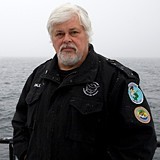
Paul Watson: Costa Rica Trying ‘To Imprison Me For Saving Sharks’

https://www.thedodo.com/paul-watson-costa-rica-petition-1133526041.html

Thank you — 20,000 signatures in just three days is a good start. I need your help to send a strong message to the Costa Rican government that the continued pursuit of the bogus charge against me needs to stop; this is a politically motivated charge.

In 2002, at the request of Guatemalan authorities, Sea Shepherd stopped an illegal shark-finning operation by a Costa Rican-flagged fishing boat well inside the territorial waters of Guatemala. The boat was not damaged and no one was hurt. The entire confrontation was filmed by Rob Stewart as he was making the film “Sharkwater.”

The Sea Shepherd vessel Farley Mowat had two independent film crews and 35 crewmembers onboard as witnesses. The fishing boat with eight fishermen and without cameras presented no evidence backing up their charges. When I arrived in Costa Rica, I was charged with eight counts of attempted murder. We presented our witnesses and our video evidence to the court. The charges were dismissed and I was given clearance to depart from Costa Rican waters; I did so, and heard nothing more about this incident until 10 years later, when I landed in Germany in 2012. There, in Frankfurt, I was detained on a Costa Rican warrant for the charge of alleged “shipwreck endangerment.”

No one was injured nor was property damaged, and yet Japan and Costa Rica managed to place me on the INTERPOL Red List — a list meant for serial killers and war criminals. Japan wants me for alleged “conspiracy to trespass on a whaling ship.”

The government’s own charge contradicts itself; the official accusation states that the incident took place in international waters, yet the same accusation gives the exact coordinates at which the incident took place, and that position is well within the territorial waters of Costa Rica.

You have to wonder why a government that conveniently lost the evidence for the trial of the narco-poacher killers of sea turtle conservationist Jairo Mora Sandoval is spending so much money and making such an effort to imprison me for saving sharks from poachers?

If you have not already done so, please take a few moments to sign and share the petition at the link below for me, provided in both English and Spanish. It will be presented to the government of Costa Rica.

Thank you, Merci, Gracias and Mahalo.
— Captain Paul Watson

Please sign and share the petition here.

Judge won’t block plan to kill cormorants

PORTLAND, Ore. (AP) — A judge has refused to block a plan to shoot more than 10,000 double-crested cormorants in the Columbia River estuary.

The plan was released earlier this year by the U.S. Army Corps of Engineers. It wants to stop cormorants from eating millions of baby salmon.

Conservation groups sought a preliminary injunction. They say hydroelectric dams — not cormorants — are the main threat to salmon. The groups filed suit in April against the Corps, the U.S. Fish and Wildlife Service, and the Wildlife Services agency in the U.S. Department of Agriculture.

The Corps said Wildlife Services will manage the killing.

The plan also calls for destroying 26,000 nests on East Sand Island.

The decision came Friday from U.S. District Judge Michael Simon.

In a separate but related project, Fish and Wildlife will take up to 50 double-crested cormorants at the mouth of the Umpqua River.

The collection effort is part of ongoing research to study the diet of double-crested cormorants in estuaries.

Oregon has a permit from the U.S. Fish and Wildlife Service that allows for limited kill of double-crested cormorants, which are protected under the federal Migratory Bird Treaty Act.

Fish and Wildlife also will be doing a project looking at the potential use of low-power hand-held lasers to scatter cormorants from feeding and roosting sites.

Laser-based hazing will be ongoing on a trial basis at several coastal locations.

Speak Out For Sea Lions

131

Imagine if you were killed for eating your standard diet? That’s what’s happening to sea lions living below the Bonneville Dam in waters between Oregon and Washington. They are being branded and killed by wildlife officials for eating a negligible number of salmon and steelhead.

But the decline in salmon and steelhead numbers is not caused by the sea lions—it’s caused by humans. It’s just that the sea lions are the ones who pay the price. Please read on…

In less than one week, inexcusable negligence and lack of oversight by the Oregon Dept. of Fish and Wildlife (ODFW) has resulted in the brutal deaths of three sea lions. The first of last week’s deaths occurred on May 1 when two sea lions were crushed to death after an ODFW trap “malfunctioned.” Nine sea lions “accidentally” became imprisoned in one trap at some point during the night and by morning two of them were dead. The deaths this week are just the most recent instances.

This was the second such reported instance of “malfunctioning” trap doors slamming shut, leaving the animals imprisoned to suffer slow and torturous deaths. In 2008 an unattended trap malfunctioned and six sea lions became trapped in a cage where they died from prolonged exposure to extreme summer heat. At that time, ODFW claimed they implemented “new protocols” to prevent unattended traps from closing, including magnetic locks requiring a code to hold the doors open. We can see how well that worked.

The second death in the last week happened on May 5, in what ODFW calls a “freak accident”–a stellar sea lion drowned after becoming entangled in cables at the Bonneville Dam’s trap site. This death occurred while trapping was suspended, pending consultation with NOAA (National Oceanic National Oceanic and Atmospheric Administration) and the project’s Institutionalized Animal Care and Use Committee regarding the crushing deaths just four days prior.

So even with traps shut down, the program manages to kill and abuse marine mammals!

Please immediately call/email the wildlife officials listed below and let them know these incidents are not accidents and cannot be continually attributed to equipment malfunction. Ask them to shut down this project immediately because there is a clear history of negligence and lack of oversight. It wouldn’t hurt to remind them that the real cause for the decline in salmon and steelhead is not the insignificant number of fish eaten by sea lions—it’s due to degraded habitat, dams blocking migration routes, and over-fishing.

Thank you for speaking out!

ODFW Director: Curt Melcher, 503-947-6044

ODFW Marine Mammal Program Coordinator: Robin Brown, 541-757-5245, 503-947-6200, robin.f.brown@state.or.us

NOAA Division Manager: Garth Griffin, 503-230-5400

WDFW Director: Jim Unsworth, 360-902-2700, director@dfw.wa.gov

WDFW Marine Mammal Coordinator: Steve Jeffries, 253-589-7235

Travel Scene: Global warming opens Northwest Passage to pleasure cruises

Mon Oct 6, 2014.

Global warming and the resultant melting of parts of the Arctic icecap have opened a new world of travel — a 900-mile, 32-day luxury cruise with fares starting at $20,000.

Crystal Cruises, one of the world’s top-rated cruise lines, has announced that one of its ships, the Crystal Serenety, will traverse the fabled Northwest Passage on this Pacific-to-Atlantic voyage, beginning from Seward, Alaska, through the north part of mainland Canada and the Arctic Ocean to New York City.

<iframe id=”50cba8a6e2b30″ name=”50cba8a6e2b30″ src=”http://d.oxsng.com/w/1.0/afr?auid=264272&cb=INSERT_RANDOM_NUMBER_HERE” frameborder=”0″ scrolling=”no” width=”300″ height=”250″><a href=”http://d.oxsng.com/w/1.0/rc?cs=50cba8a6e2b30&cb=INSERT_RANDOM_NUMBER_HERE” ><img src=”http://d.oxsng.com/w/1.0/ai?auid=264272&cs=50cba8a6e2b30&cb=INSERT_RANDOM_NUMBER_HERE” border=”0″ alt=””></a></iframe>

Crystal says it will be the first luxury cruise ship to make this voyage, following the route that Norwegian explorer Roald Amundson discovered some 100 years ago.

Crystal, in press releases, says the journey, in August 2016 will be on “a mystical Pacific-Atlantic sea route far beyond the Arctic Circle that for centuries captured the imagination of kings, explorers and adventurers.”

Part of the reason that the Northwest Passage captured so many imaginations for many centuries, according to Bloomberg Businessweek, was that it was choked with ice and impossible to navigate. But climate change has set off a scramble to control the now-accessible shipping routes and mineral rights.

The Crystal Serenity, Bloomberg says, is simply following the wake of the freighters that are already plying the Arctic.

Climate-change tourism will offer something greatly different than a usual journey. The cruise, notes Bloomberg, will offer passengers kayaking and tundra treks, up-close sightings of polar bears, narwhals, musk oxen and caribou.

“These are encounters,” notes the newsletter, with the inhabitants and distinctive elements of the world that climate change —- the same thing that’s allowing the cruise to take place — is threatening.

Crystal bills the trip as a “once-in-a-lifetime expeditionary voyage that marries extreme wilderness adventure with unsurpassed luxury voyage.” It adds that cruisers “will bear witness to breathtaking landscapes that few have ever seen, from spectacular glaciers to towering fjords and experience nature that is truly wild.”

The cruise line says that two years of extensive planning has gone into the itinerary, balancing days at sea with scheduled ports of call. Designed to be flexible, the cruise will incorporate unplanned “expedition days,” when favorable weather conditions allow. These treks will be led by veteran explorers.

All told, a team of 14 experts, including scientists and an Arctic guide, will be aboard. Ports of call include remote areas of the Canadian Arctic such as Ulukhaktok, Northwest Territories and Cambridge Bay in Nunavut.

The cruise sails from Aug. 16 to Sept. 17, 2016. Prices start at $19,975 double occupancy and cabins are on sale.

Crystal’s web site, at crystalcruises.com/NWP-FAQs, offers more information.

Plans set for new Mexico City airport

If you’ve flown into Mexico City’s airport — and we have — you will know that a new airport is needed, and one apparently is on the way.

A new $9.2 billion facility is planned that will quadruple the capacity of the current Benito Juarez Airport. The nation’s president, Enrique Pena Nieto has described the project as Mexico’s largest infrastructure addition in recent years and called it “Mexico’s gateway to the world.”

Travel Weekly reports that the airport will be built on 11,400 acres of federally owned land adjacent to the existing airport and the plan is to handle up to 120 million passengers a year — four times the capacity of the existing facility.

The design of the structure will be unique: The soaring vaulted terminal and lightweight glass and steel structure will be designed in the form of a giant X. No date has been set for the start of the project.

BEVERLY HILLS, CA - FEBRUARY 10:  Actor Leonardo DiCaprio attends the 86th Academy Awards nominee luncheon at The Beverly Hilton Hotel on February 10, 2014 in Beverly Hills, California.  (Photo by Kevin Winter/Getty Images)

One of the actors in “Titanic”

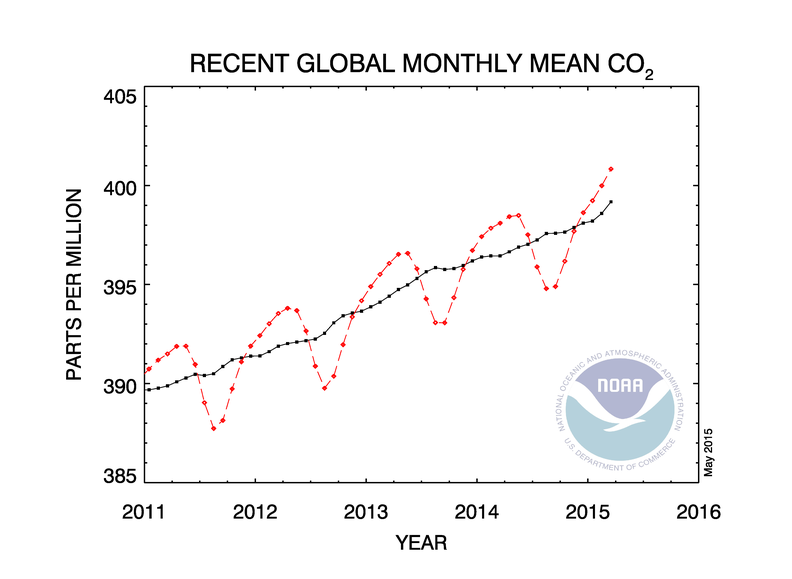
Greenhouse Gas Benchmark of 400 pps Reached

co2_trend_gl

http://research.noaa.gov/News/NewsArchive/LatestNews/TabId/684/ArtMID/1768/ArticleID/11153/Greenhouse-gas-benchmark-reached-.aspx

Greenhouse gas benchmark reached

Global carbon dioxide concentrations surpass 400 parts per

million for the first month since measurements began

Wednesday, May 06, 2015

For the first time since we began tracking carbon dioxide in the global atmosphere, the monthly global average concentration of this greenhouse gas surpassed 400 parts per million in March 2015,  according to NOAA’s latest results.

“It was only a matter of time that we would average 400 parts per million globally,” said Pieter Tans, lead scientist of NOAA’s Global Greenhouse Gas Reference Network. “We first reported 400 ppm when all of our Arctic sites reached that value in the spring of 2012. In 2013 the record at NOAA’s Mauna Loa Observatory first crossed the 400 ppm threshold. Reaching 400 parts per million as a global average is a significant milestone.

Measuring greenhouse gases

Measuring greenhouse gases (NOAA)

“This marks the fact that humans burning fossil fuels have caused global carbon dioxide concentrations to rise more than 120 parts per million since pre-industrial times,” added Tans. “Half of that rise has occurred since 1980.”

The International Energy Agency reported on March 13 that the growth of global emissions from fossil fuel burning stalled in 2014, remaining at the same levels as 2013. Stabilizing the rate of emissions is not enough to avert climate change, however. NOAA data show that the average growth rate of carbon dioxide concentration in the atmosphere from 2012 to 2014 was 2.25 ppm per year, the highest ever recorded over three consecutive years.

NOAA works with partners around the world to make sustained measurements of atmospheric gases.These data are used in analyses that aid our understanding of climate change and provide information to help decision-makers address the challenges facing our planet.

NOAA bases the global carbon dioxide concentration on air samples taken from 40 global sites. NOAA and partner scientists collect air samples in flasks while standing on cargo ship decks, on the shores of remote islands and at other locations around the world. It takes some time after each month’s end to compute this global average because samples are shipped from locations for analysis at NOAA’s Earth System Research Laboratory in Boulder, Colorado.

“We choose to sample at these sites because the atmosphere itself serves to average out gas concentrations that are being affected by human and natural forces. At these remote sites we get a better global average,” said Ed Dlugokencky, the NOAA scientist who manages the global network.

Dlugokencky said he expects the global average will remain above 400 ppm through May, the time of year when global carbon dioxide concentrations peak due to natural cycles on top of the persistent rising greenhouse gases. Decaying plant matter and soil organisms give off carbon dioxide gas all year long, but the dormant period in plant growth allows the respiration of carbon dioxide to dominate during those months. Carbon dioxide levels drop back down as plants begin to bloom, using carbon dioxide for photosynthesis in late spring and summer.

James Butler, director of NOAA’s Global Monitoring Division, added that it would be difficult to reverse the increases of greenhouse gases which are driving increased atmospheric temperatures. “Elimination of about 80 percent of fossil fuel emissions would essentially stop the rise in carbon dioxide in the atmosphere, but concentrations of carbon dioxide would not start decreasing until even further reductions are made and then it would only do so slowly.”

More on carbon dioxide concentrations can be found online.

As Casualties Mount, Scientists Say Global Warming Has Been “Hugely Underestimated”

http://www.truth-out.org/news/item/26909-as-casualties-mount-scientists-say-global-warming-has-been-hugely-underestimated

Dahr Jamail | As Casualties Mount, Scientists Say Global Warming Has Been “Hugely Underestimated” Monday, 20 October 2014 11:07
Written by 
Dahr Jamail By Dahr Jamail, Truthout | Report

As we look across the globe this month, the signs of a continued escalation of the impacts of runaway anthropogenic climate disruption (ACD) continue to increase, alongside a drumbeat of fresh scientific studies confirming their connection to the ongoing human geo-engineering project of emitting carbon dioxide at ever-increasing rates into the atmosphere.

A major study recently published in New Scientist found that “scientists may have hugely underestimated the extent of global warming because temperature readings from southern hemisphere seas were inaccurate,” and said that ACD is “worse than we thought” because it is happening “faster than we realized.”

As has become predictable now, as evidence of increasing ACD continues to mount, denial and corporate exploitation are accelerating right along with it.

Climate Disruption Dispatches

The famed Northwest Passage is now being exploited by luxury cruise companies. Given the ongoing melting of the Arctic ice cap, a company recently announced a 900-mile, 32-day luxury cruise there, with fares starting at $20,000, so people can luxuriate while viewing the demise of the planetary ecosystem.

This, while even mainstream scientists now no longer view ACD in the future tense, but as a reality that is already well underway and severely impacting the planet.

It is good that even the more conservative scientists have come aboard the reality train, because a recent National Oceanic and Atmospheric Administration-led (NOAA) study published by the Bulletin of the American Meteorological Society has provided yet more evidence linking ACD with extreme heat events.

To provide perspective on how far along we are regarding runaway ACD, another recent study shows that the planet’s wildlife population is less than half the size it was four decades ago. The culprits are both ACD and unsustainable human consumption, coupling to destroy habitats faster than previously thought, as biodiversity loss has now reached “critical levels,” according to the report. More than half of the vertebrate population on the planet has been annihilated in just four decades.

Let that sink in for a moment before reading further.

Meanwhile, the situation only continues to grow grimmer.

NASA announced that this August was the hottest globally since records began in 1880. Days later, NOAA confirmed this and added that 2014 is on track to become the hottest year on record.

Shortly thereafter, NASA announced that this September was the hottest since 1880.

And emissions only continue to increase.

Global greenhouse gas emissions rose this last year to record levels, increasing 2.3 percent.

The effects of all these developments are especially evident in the Arctic, where sea ice coverage reached its annual minimum on September 17, continuing a trend of below-average years. According to the NASA-supported National Snow and Ice Data Center, Arctic sea ice coverage this year is the sixth lowest recorded since 1978.

Equally disconcerting and symptomatic of the aforementioned, 35,000 walruses crowded onto land near the Northwest Alaska village of Point Lay late last month, when they couldn’t find their preferred resting grounds of summer sea ice.

Earth

The European Space Agency announced that, due to billions of tons of ice loss, a dip in the gravity field over the Western Antarctic region has occurred, making even gravity itself the latest casualty of ACD.

A recent analysis of 56 studies on ACD-related health problems revealed that increasing global temperatures and extreme weather events will continue to deleteriously impact human health on a global scale.

On a micro-scale, another report showed how Minnesota’s warming (and increasingly wetter) climate is escalating the risk of new diseases in the area, according to the Minnesota Climate Change Vulnerability Assessment.

Further north, warming temperatures continue to disrupt the fragile ecological balance in the Canadian Arctic, which is warming faster than most of the rest of the planet. Canada’s minister for natural resources provided a new report detailing the impact ACD is having on that country’s forests, which are being impacted “faster than the global average.”

In neighboring Alaska, summer heat and invasive insects are taking a similar toll on interior Alaska birch trees, according to experts there.

Wildlife populations continue to struggle to adapt to the dramatic changes wrought by ACD. In California, one of the largest populations of state-protected Western pond turtles in the southern part of that state is struggling to survive as its habitat, a natural two-mile long lake, has become a smelly, severely alkaline death trap due to drought and fires there.

More: http://www.truth-out.org/news/item/26909-as-casualties-mount-scientists-say-global-warming-has-been-hugely-underestimated

Mankind’s Last Days

10405311_308608659330466_3235603653435958062_nThe other day a friend asked me, “How do you keep your head above it all? You do so much, and your immersion in the dark side of information and events is so deep. I’ve seen most of what can be seen, I think. But even still, I have to periodically recharge with temporary absences from the info stream. It’s so disheartening and yet if you’re a person who cares, you just can’t dig your head in the sand. It’s my most challenging thing in this life — striving for a balance between my mental well-being and my commitment to our fellow beings.”

First, I can understand anyone who finds this all too much on a daily basis. I guess I get through it by choosing my battles and knowing that by not eating animals I’m not so much a part of what’s happening to them. Sometimes I have to step back from the fray and look at it all through the lens of deep ecology. Earth has survived far worse than the toxic attack of the human fly speck that’s currently plaguing her and gone on to flourish, as she certainly will again once the anthropogenic onslaught is over.

Consider this blog a chronicle of mankind’s last days. What were humans thinking when they took this incredibly beautiful, fragile, planet down—in the name of greed, selfishness, arrogance, sport or self-esteem?

Some of the articles I post might seem unrelated, off-topic or out of place when examined alone. But they are all part of the bigger picture which someday may be viewed by a higher intelligence who comes across it in their quest to know just how one species—out of so many—thought they had the right to exploit all others, carte blanc, under the narcissistic delusion that non-human lives on Earth had no rights at all.

Whether or not mankind survives the assault they’re putting the planet through is a non-issue for me. Personally, I hope they don’t. They do not deserve a second chance to rule this vibrant, watery orb any more than they deserved the first chance to steal Nature, abuse and forever change her.

But why all this on an anti-hunting blog? Because hunting, and ultimately meat-eating, is where humans first started screwing things up. For a plant-eating primate to leave the trees, take weapon in hand, turn carnivorous and claim the planet and everything that walks, crawls, swims or flies as their own was a recipe for disaster.

As the same friend so aptly put it, “I do wish we didn’t have to share the planet with persons whose empathy muscles are so undeveloped.”