A Giant Glob of Deadly Algae Is Floating off the West Coast

A Giant Glob of Deadly Algae Is Floating off the West Coast

From the air, the Pacific algal bloom doesn’t look like much of a threat: a wispy, brownish stream, snaking up along the West Coast. But it’s causing amnesia in birds, deadly seizures in sea lions, and a crippling decline in the West Coast shellfish industry. Here’s what you need to know about it, from what this bloom has to do with the drought to why these toxins could be a real threat to the homeless.

“These are the highest levels of toxicity we’ve ever seen,” says one expert.

What’s causing it? The culprits are single-celled, plant-like organisms called pseudo-nitzschia, a subset of the thousands of species of algae that produce more than 50 percent of the world’s oxygen through photosynthesis. They’re a hardy variety usually found in cool, shallow oceans, where they survive on light and dissolved nutrients, including silcates, nitrates, and phosphates. “They’re sort of like the dandelions of the sea,” says Vera Trainer, who manages the Marine Biotoxin Program at the Northwest Fisheries Science Center in Seattle. “They’re always there in some low numbers, just waiting for nutrients to be resupplied to the ocean’s surface.” In most years, blooms in the eastern Pacific are contained near “hot spots” that dot the West Coast—relatively shallow and sheltered places like California’s Monterey Bay or the Channel Islands. They usually flare up in April or May as trade winds cycle nutrient-rich waters from offshore depths to the coast in a process called “upwelling,” but they fade after only a few weeks.

Why is it sticking around so long? The jury’s still out, but scientists are beginning to get a clearer idea. These past few years have been “incredibly weird” in the northeast Pacific, says Nate Mantua, a research scientist at the National Oceanic and Atmospheric Administration’s Southwest Fisheries Science Center in Santa Cruz. He points to the same “ridiculously resilient ridge” of high pressure that’s been causing the historic drought in the western United States: This pressure also resulted in a pool of exceptionally warm water in the Pacific (known as “the blob”), with little weather to disperse it. Those conditions, along with prevailing winds and colder currents that ferry nutrients back to the coast, seem to be supplying the algae with a seemingly endless feast.

That makes the source of this bloom different from its cousin in the Gulf of Mexico, where fertilizers flowing from as far as Iowa are feeding a zone of algae that’s as large as New Jersey. “We’re seeing them in relatively pristine waters of the US West Coast,” Trainer explains, though she adds runoff and sewage discharge may be playing some role in the blooms off Southern California.

So just how big is this thing? Bigger than researchers have ever seen: a patchy stream that stretches from Southern California up along the Alaskan coast. The hot spot blooms that appear each spring are merging for the first time, Trainer explains. Though the combined mass has ebbed and flowed over the past four months, it hasn’t let up; her team finds algae each time they journey out to sea, with no signs of abatement soon. And it’s also unusually potent. “These are the highest levels of toxicity we’ve ever seen,” says Raphael Kudela, a professor of ocean sciences at the University of California-Santa Cruz. “It’s a truly extraordinary phenomenon.”

Levels of chlorophyll, viewed from space, indicate where algae is present in the waters of the Pacific. NOAA

How deadly are these “dandelions”? The algae produce a compound called domoic acid, a type of amino acid that leads to a condition commonly known as “amnesic shellfish poisoning” in humans. Shellfish and some small fish, like sardines and anchovies, feed on the algae and concentrate the toxin in their flesh. When animals further up the food chain—like birds—eat those fish and shellfish, the domoic acid seeps into the bloodstream and eventually the brain, where it attacks cells in the hippocampus, the brain’s command center for memory and learning. The result: amnesia-stricken birds that will repeatedly fly into windows, and sea lions that writhe on the shore, plagued by seizures. Both are symptoms of rapidly firing neurons in the hippocampus, which will eventually burn out and kill the animal. Beaches have been littered with dead fish, birds, and sea lions up and down the Pacific coast since May—all the way up to Alaska, where NOAA is investigating the deaths of fin whales in connection with the toxin.

More: http://www.motherjones.com/environment/2015/08/heres-everything-you-need-know-about-deadly-algae-california-coast


Climate change denier Rupert Murdoch just bought National Geographic, which gives grants to scientists

Climate change denier Rupert Murdoch just bought National Geographic, which gives grants to scientists

The National Geographic magazine has been a nonprofit publication since inception in 1888, but that ends today. The long-running American publication becomes very much for-profit under a $725 million dollar deal announced today with 21st Century Fox, the entertainment company controlled by the family of Rupert Murdoch.

Murdoch is a notorious climate change denier, and his family’s Fox media empire is the world’s primary source of global warming misinformation. Which would be no big deal here, I guess, were it not for the fact that the National Geographic Society’s mission includes giving grants to scientists.

Or had you forgotten? Here’s a refresh for you, a fun little interview with Murdoch on his climate change views.

From today’s deal coverage in WaPo:

The partnership, which will also include the National Geographic cable channel and the National Geographic Society’s other media assets, will be called National Geographic Partners. Fox will own 73 percent of the partnership, and Washington-based National Geographic Society will own the balance. Fox will pay $725 million to the Society for its stake in the partnership. This will push the Society’s endowment to more than $1 billion.

Let the “National Geographic Covers Designed by Rupert Murdoch” Photoshop Wars begin.

More coverage: New York Times, Variety.

20-year Nat Geo vet Declan Moore becomes CEO. Gary Knell, president-CEO of the Society, will serve as the first chairman. Buried in the press announcement:

“The value generated by this transaction, including the consistent and attractive revenue stream that National Geographic Partners will deliver, ensures that we will have greater resources for this work, which includes our grant making programs that support scientists and explorers around the world,” Knell said. “As media organizations work to meet the increasing demand for high quality storytelling across multiple platforms, it’s clear that the opportunity to grow by more closely aligning our branded content and licensing assets is the right path. We now will have the scale and reach to continue to fulfill our mission long into the future. The Society’s work will be the engine that feeds our content creation efforts, enabling us to share that work with even larger audiences and achieve more impact. It’s a virtuous cycle.”

So Rupert Murdoch will be to some large extent controlling a $1 billion organization whose stated mission includes giving grants to scientists.

Rupert Murdoch is a raging asshole, but he is also a very much on-the-record climate change denier. A climate change denier with now even more power and influence over science grants in the United States.


Dentist Walter Palmer Returns to Work With Police Escort Amid Cecil the Lion Protests

http://abcnews.go.com/US/dentist-walter-palmer-returns-work-police-escort-amid/story?id=33602439

Palmer returned to his dental clinic in Bloomington, Minnesota, with a police escort at around 7 a.m. today.

A few protesters gathered outside his office and yelled “Extradite Palmer,” saying he should face punishment in Zimbabwe.

The dentist was named in late July as the hunter who killed Cecil, a lion that had been fitted with a GPS collar as part of research for Oxford University. Palmer has said he did not know he was killing a beloved animal when he followed his hunting party guide, and he believed he acted legally. The 13-year-old Cecil was the biggest dominant male black-maned lion in Hwange National Park in Hwange, Zimbabwe.

Today, Bloomington Police Deputy Chief Mike Hartley said police will keep a presence at Palmer’s office for as long as they are needed, mostly to manage blocking off the street for media. There were about 10 officers on the premises this morning. Hartley said he is not concerned for Palmer’s safety at this point, and Palmer has employed his own security.

Zimbabwean authorities have reportedly paused an effort to extradite Palmer due to possible fears that doing so would hurt Zimbabwe’s hunting business, the Associated Press reported. The Zimbabwean professional hunter who helped Palmer was charged with “failure to prevent an illegal hunt,” while the man whose property on which the killing took place faces a charge of allowing the hunt to occur on his farm without proper authority. They allegedly lured the lion out of the national park with an animal carcass.

11892112_1656581097897064_2430590251208988900_n

Comparative Psychological Criminal Profile of Walter Palmer and Robert Hansen

Although one never saw the light of day again (former bakery-shop owner Hansen died in an Alaskan prison in 2014) and one may never see the inside of a courtroom, there are numerous similarities between serial killer/trophy hunter Robert Hansen and dentist/trophy hunter Walter Palmer:

  • Both were family men, well-liked and successful in small business
  • Both were avid sport hunters (though thus far Dr. Palmer‘s chosen “trophies” were taken only from the legal, non-human side of the imaginary great divide that separates worthy life forms from fair “game.”)
  • Both “sportsmen” Walter Palmer and Robert Hansen enjoyed the challenge of bow hunting (presumably to prolong the agony for their prey)
  • Both needed to constantly to refresh their “trophies” in an obsessive effort to boost their flagging self-esteems (after all, how much macho pride can be derived from being a baker…or a dentist?)
  • Both serial killers objectified and thought nothing of the lives or the suffering of their many innocent victims, whom they failed to recognize as vastly superior in intrinsic value
  • Conversely, perhaps they did recognize their value and envied them for it
  • When accused, neither apologized to those whom their crimes affected, but instead cared only of how the accusations affected them
  • Both were narcissistic psychopaths
  • Both deserve whatever punishment they got or eventually get

Whether or not he broke enough hunting laws to warrant extradition back to Zimbabwe for a trial is all that seems to matter to Dr. Palmer. The fact that Cecil had a name and a radio tracking collar didn’t help the doctor’s legal case. But as with any psychopathic serial killer, his overwhelming sense of entitlement keeps him from seeing the fundamental wrong in his murderous ways.


6-4Hansens-trophy-goatImage result for walter palmer trophy room]


Woman Sprints In To Save Fox As Hunters Scream At Her

https://www.thedodo.com/woman-rushes-save-fox-1330092433.html?utm_source=The+Dodo+Newsletter&utm_campaign=fa102935b6-09_06_2015_NL&utm_medium=email&utm_term=0_4342b46fc5-fa102935b6-125298189

There’s simply nothing classy about fox hunting, a bloody tradition that uses dogs to tear foxes limb from limb.

While a ban on the cruel sport has been in place for a decade, it’s hard to enforce, and no one knows how many foxes are still killed each year.

But some animal activists in the U.K. are taking the law into their own hands, using whatever means they can to intervene on behalf of the defenseless animals hunted down despite the law protecting them.

Moving footage from 2012 shows the determination of a woman who couldn’t stand the cruelty.

Facebook/Leon Vegano Animal Sanctuary

The hunters sit astride horses in the fox hunting tradition, while their trained dogs do their dirty work.

Facebook/Leon Vegano Animal Sanctuary

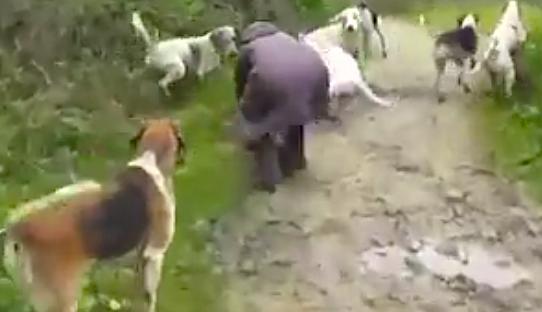
The hounds are zeroing in on a tiny fox when a woman sprints towards them. She starts screaming at the dogs to get them to stand back.

Facebook/Leon Vegano Animal Sanctuary

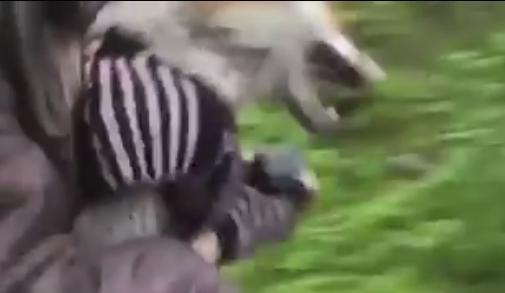
She throws her own body on the fox and brings the shaking animal into her arms.

As she runs away with the fox, the hunters shout at her from their horses: “Leave it!”

Facebook/Leon Vegano Animal Sanctuary

Watch her beautiful act of bravery here: