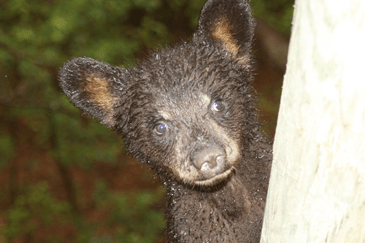
Patricia Randolph’s Madravenspeak: Starting a bear tribe to protect our bears

dvoight09's avatarWisconsin Wildlife Ethic-Vote Our Wildlife

image

“Wisconsin has one of the largest black bear populations in the country and high hunter success rates — this combination makes it a great place to hunt.” ~ Dave MacFarland, Wisconsin Department of Natural Resources carnivore specialist

In his new book “Tribe: On Homecoming and Belonging,” award-winning journalist Sebastian Junger makes the point that humans evolved to bond together in crisis. We are tribal and need each other. He discusses his ideas in this YouTube video.

At this point of history, it would behoove us to realize we are all in this challenge of climate crisis and biodiversity destruction together. We need all the life of this world. We are the only species with the power to destroy all that is. We need to make shared purpose in survival, with less than half of wildlife left on earth.

Any and all who are interested in protecting bears are invited to…

View original post 810 more words

Blumenauer Introduces Legislation to Reduce Unsafe, Inhumane Trapping

U.S. press release: For once the NRB listened to the citizens. There is a first time for everything.

Washington, DC – Today, U.S. Representative Earl Blumenauer (OR-03) introduced the Limiting Inhumane Federal Trapping (LIFT) for Public Safety Act, legislation to reign in unsafe and inhumane trapping on public lands and by public officials.


Countless pets and wild animals are injured and killed each year in body-gripping traps such as leg and foothold, Conibear, and snare traps. Despite the existence of viable non-lethal alternatives, body-gripping traps are used by federal agencies, state and local governments, private entities, and individual trappers to catch creatures for their fur, keep animals away from livestock and crops, and even for recreational purposes. Unfortunately, these traps often subject captured animals to excruciating pain for hours or even days, before they eventually die from dehydration, injuries, or predation, or when the trapper eventually finds them. Additionally, these traps are indiscriminate in their victims, and while intended for certain species or “problem animals,” they may capture – and even kill – companion animals if hidden along popular trails or waterways. Humans also risk being inadvertently caught in poorly placed traps, or attack from distressed captured animals they try to free.


“We’ve seen too many concerning examples of wild animals suffering and pets falling victim to body-gripping traps. It’s disgusting such inhumane traps are so widely used,” said Representative Blumenauer. “With many effective non-lethal methods that can be used in place of these cruel traps, the federal government should not and cannot continue to endorse their use.”


Wildlife Services, a federal agency notorious for its secrecy and use of inhumane animal management techniques, is responsible for the death or capture of thousands of animals per year in cruel body-gripping traps, often used as a first resort. Wildlife Services also advises and enters into contracts and cooperative agreements with state and local governments, as well as with private entities, to kill animals using these traps. Other federal agencies, too, allow or use body-gripping traps to control animal species – too often without attempting or requiring more humane and non-lethal control options first.

The LIFT for Public Safety Act acknowledges the inhumane nature of body-gripping traps and takes a two-pronged approach to severely restricting use of these traps to protect public safety and reduce animal suffering:


  • First, the bill prohibits officials and contractors of the U.S. Departments of Agriculture and Interior – including Wildlife Services and agencies like the Forest Service, Bureau of Land Management, and Fish & Wildlife Service – from using or recommending the use of these inhumane traps.
  • Second, it prohibits use of these traps on land managed by the U.S. Departments of Agriculture and Interior, such as National Forests, Bureau of Land Management land, and National Wildlife Refuges.


The legislation contains limited exceptions for certain lands, the protection of endangered species, and the control of invasive species, while promoting transparency and requiring use and documentation of non-lethal methods first.

The Profanity of the Profanity Peak Wolf Pack Massacre

By George Wuerthner

The recent killing of six members of the Profanity Peak wolf pack in NE Washington in retribution for the loss of a few cattle is emblematic of what is wrong with public land policy. As I write, trappers are out to kill the remaining pack members – including 4-month old pups.

What is significant about the destruction of this pack is that the Profanity Peak wolves roamed national forest lands. These are our lands. They belong to all Americans and are part of our national patrimony.

Currently private commercial businesses such as the livestock industry are allowed to use public lands if they do not damage, degrade and impoverish our public lands heritage. Clearly the killing of this pack violates that obligation and responsibility.

What is particularly egregious about the on-going slaughter of the Profanity Pack is that it was essentially a preventable conflict. Had the rancher, whose cows invaded the wolf pack’s territory, been required to use other public lands, or better yet, simply lease private pasture, there would have been no livestock losses, hence wolf deaths.

Placing cows on top of a wolf pack territory is analogous to, and irresponsible as leaving picnic baskets or coolers out in a campground. In most national parks, if you leave a cooler or other food available to bears, you are fined for this careless behavior. We don’t blame the bear if it happens to eat that food. But when it comes to the livestock industry, we essentially allow four-legged picnic baskets to roam at will on our lands, and should a predator – be it a coyote, cougar, bear or wolf – kill one of those mobile picnic baskets, we don’t hold the rancher responsible, we kill the public wildlife.

This represents the wrong priorities.

We expect different behavior from people using public resources. I can, and do, mark up and highlight passages in books that I own in my personal library, but it would be inappropriate for me to mark up or otherwise damage books in a public library.

In a similar manner, we should expect different consequences for livestock owners who willingly use public lands (at almost no cost I might add) for their private commercial interests. In this case and others like it across the public lands of the West, we should expect ranchers utilizing public lands (our lands) to at the least accept any losses from predators that may occur while they are using public property. And if conflicts continue, we should remove the livestock, not the wolves or other predators.

It’s important to note that the mere presence of livestock negatively impacts wolves whether they are shot or otherwise killed.

Domestic livestock consume forage that would otherwise support the native prey of wolves, like elk. So more domestic animals means fewer elk.  In essence, domestic livestock grazing public lands are compromising the food resources of public wildlife so that ranchers can turn a private profit.

Worse for wolves, especially wolves confined to a den area because of pups, as was the case in the Profanity Peak Pack, when domestic cattle are moved onto our public lands, it creates a social displacement of elk. In other words, elk avoid areas actively being grazed by livestock. If the livestock are grazing lands near a den site, then the wolves automatically have fewer elk to take and must travel further to find their dinner.

Who can blame the wolves if they take the most available prey—which is often domestic livestock. Robert Weilgus, a Washington State University professor, studying the Profanity pack noted that cattle were placed near the den site, or as he was quoted in a Seattle Times article as saying the cattle were released “right on top of the den”.

Some commentators, including Washington State University tried to discredit Wielgus suggesting the cattle were released about four miles away. What that demonstrates is either their ignorance of wolf biology or a not so-veiled attempt to confuse the public. If you are a wolf where regular daily hunting exclusions of 20-30 miles are common, four miles is a short romp. It is essentially “right on top” of the wolves.

If you place cattle within a dozen miles of a wolf pack you are essentially putting the livestock “right on top” of the wolves. And if the presence of cattle forces native prey like elk to abandon the area, can anyone blame the wolves if they resort to killing a domestic animal once in a while?

The loss of the Profanity Peak Pack has occurred on the same grazing allotment where another wolf pack was destroyed in 2012. This begs the question of whether any livestock grazing should be permitted in this area. It is obviously good wolf habitat—except of course for the presence of domestic animals. The only realistic long-term solution is to retire the grazing allotment. Either transfer the cattle to another portion of the public lands or, better yet, simply pay the rancher with a voluntary permit retirement to close the allotment and permanently remove the livestock.

George Wuerthner is an ecologist who has been studying predators for four decades. He serves on the Science Advisory Board of Project Coyote and is the author of 38 books including Welfare Ranching, Wildfire: A Century of Failed Forest Policy, Energy: The Delusion of Endless Growth and Overdevelopment, Thrillcraft, and Keeping the Wild.

Possible Record Methane Spike at Barrow, Alaska — What Does it Mean?

robertscribbler's avatarrobertscribbler

There’s no avoiding it — climate change is a controversial subject; a threat that should unify us all that, due to reticence, denial, fear, and a basic lack of understanding, is instead often quite divisive. But among the subjects that stand out as real fodder for acidic controversy, the issue of methane feedbacks from the global climate system — the oceans, thawing permafrost, and especially the Arctic — is one of the worst. There’s a noted tendency to either downplay or overplay risks. Though this polarization is likely fed by the general mysteriousness and complexity of the subject, its potential existential nature also feeds into the heat that methane feedback-related discussions tend to draw.

It all makes one hope for improved discussion on the subject. Given the fact that catastrophic methane feedback appears unlikely (but would have a high overall impact if it did emerge), it’s probable that the subject…

View original post 1,263 more words

It’s Looking Like We’ll Never See Another Month Below 400 ppm CO2 Again

robertscribbler's avatarrobertscribbler

The truth is, when I was born, atmospheric CO2 levels were around 300 ppm. Today — maybe even this week — will be the last time anyone alive experiences a level below 400 ppm, and no one born in the coming century or even longer will ever see less than 400 ppm again. That is a deep, deep observation, with ramifications for our children and for every future generation. — Peter Gleick during November of 2015

*****

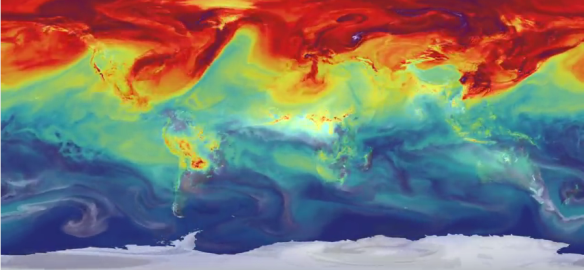
nasa-model-co2-earths-atmosphere

(NASA model visualization of CO2 in the Earth’s atmosphere. Image source: NASA.)

I just want to take a moment to tell you something that’s pretty important. You are now an alien. You’ve been made an alien by fossil fuel burning. And you’re now living in, breathing, a heat-trapping atmosphere that’s entirely alien to your species. Sometimes races of creatures suffering such habitat changes are capable of surviving the environmental shifts that inevitably…

View original post 591 more words

Patricia Randolph’s Madravenspeak: Legislators promote wolf kill in defiance of science

dvoight09's avatarWisconsin Wildlife Ethic-Vote Our Wildlife

image

“We know we are confronting the wildlife establishment but it is our duty to give the public our best scientific assessment of what happened to their wolves.” ~ Adrian Treves, UW-Madison, in an interview with Isthmus, May 10, 2016 

In 2013, Wisconsin citizens polled 8 to 1 in favor of protecting wolves from a trophy hunt.

Despite public sentiment, state Sen. Tom Tiffany, R-Hazelhurst, and Rep. Adam Jarchow, R-Balsam Lake, are planning a September wolf summit to attempt to circumvent the Endangered Species Act. Their agenda is to expand killing of wolves, essential creatures that are critically endangered.

Both of these hunting activists have Democratic challengers in the fall election. Jeff Peterson, Jarchow’s challenger, lays out Jarchow’s overall destructive record here. Peterson co-founded the Wisconsin Green Party in 1988 and says: “I believe that wolves have an important place in our ecosystem, including as a check on…

View original post 894 more words

Urge Hillary Clinton to remove Salazar from her transition team

Voters for Environmental Protection and Wildlife Conservation
 see: Change.org

Salazar is a bad choice for wildlife and the environment
Hillary Clinton has picked former Secretary of the Interior Ken Salazar to head her transition team preparing for her Presidency if she wins. The transition team is a small group of advisors responsible for setting the groundwork for important decisions, which includes selecting executive branch appointments. As the former head of the Interior Department, Salazar is sure to have a great deal of influence on the selection of the next Secretary of the Interior and other positions with wildlife and environmental responsibilities. Therefore, the people making these decisions would be very likely to have positions, opinions, and loyalties similar to those of Salazar himself.

This is very bad news for wildlife and the environment. Salazar’s actions and statements reveal a strong bias against wildlife and protection of natural resources and in favor of such groups as ranchers and oil executives. For example, during his tenure at Interior, and since then, he:

– delisted vulnerable wolves from the endangered species list early in his tenure

– later delisted wolves in Wyoming where wolves are treated as vermin

– refused endangered species protection to polar bears whose habitat is threatened

– consistently sided with the interests of ranchers vs wildlife on public land issues

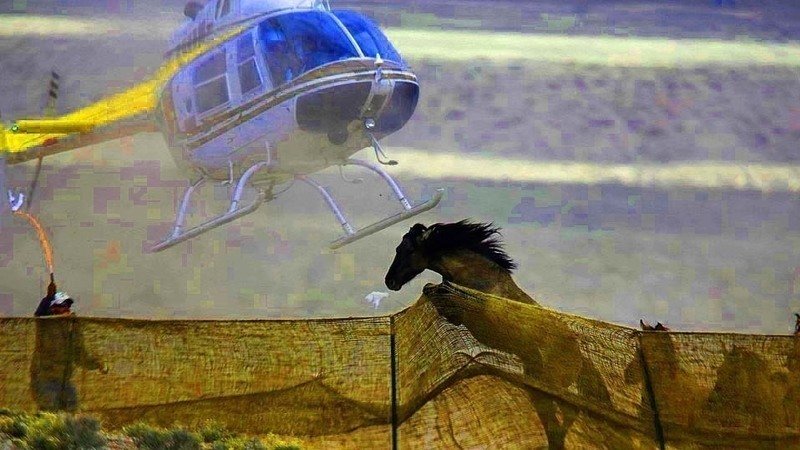
– accelerated rates of cruel roundups of horses and sale to known slaughterers

– rejected reasonable humane solutions to wildlife problems in favor of cruel and lethal methods

– developed vast areas of public wildlife habitats for energy production, including gas and oil

– defended the safety of fracking for oil and gas and joined industry in opposing the anti-fracking initiatives in Colorado

– promoted the XL pipeline

TAKE ACTION NOW

FIRST: Sign the petition and circulate it to as many people as you can.

THEN:  strengthen the message:

1. Call Hillary’s campaign office at 646-854-1432, and urge her to remove Salazar from her transition team. Phone calls have major impact.

2. Go to Hillary’s Contact Us form https://www.hillaryclinton.com/forms/contact-us/ and copy our petition letter at the link below and paste it into the Message section, or just write a brief message urging Hillary to remove Salazar from her transition team, and send her a direct message.

THANK YOU!

Voters for Environmental Protection and Wildlife Conservation

Animal Rights Would Suffer Under Trump

http://www.newsmax.com/CMSPages/GetFile.aspx?guid=f0159776-6f7f-4fe2-ad6b-3932843951c6&SiteName=Newsmax&maxsidesize=600

Image: Animal Rights Would Suffer Under Trump

Eric Trump, center, speaks during a campaign rally for his father and Republican presidential candidate Donald Trump, left, with his brother, Donald Trump Jr. (Isaac Brekken/AP)

By Kathleen Parker
Wednesday, 07 Sep 2016

The animal kingdom will have lost one of its staunchest defenders when the Oval Office is abandoned by Barack Obama, who through a series of critical, administrative rule-makings has done more to protect animals than any other president in recent memory.

This will be especially devastating if Donald Trump replaces him — not only because of his sons’ lust for hunting exotic game but also because his recently announced agriculture advisory committee includes several active opponents of animal protection policies.

By now, many will have seen the photographs circulating on social media of Eric Trump and Donald Jr. displaying their trophy kills. One shows the two young men posed with a leopard they killed in Africa. Another shows Junior holding the tail of an elephant, which he appears to have just sliced off with the knife in his other hand, and another of him lounging against the lifeless hulk of a Cape buffalo bull.

A fourth photo shows the brothers’ smiling faces framed between the horns of a magnificent waterbuck.

If these snapshots were intended to capture the rapture of proud manhood, they missed their mark. Trump’s spawn aren’t Maasai warriors, suffice it to say. But even the Maasai have stopped killing lions to prove themselves, thanks to conservationists, and now determine leadership according to who jumps highest — evidence that one can easily jump a rival’s fence when raiding cows.

When asked about his sons’ bloody hobby, Trump demurred except to say that his sons are excellent marksmen. Trump prefers golf, he said, and he obviously limits trophy collecting to women.

Junior, meanwhile, says he’d like to head the Department of the Interior, which, among other things, oversees trophy hunting imports. Under Obama, elephant trophies from Tanzania and Zimbabwe were halted and African lions were listed as threatened. What would a trophy-hunting Trump do with such protections?

Meanwhile, the Republican nominee’s anti-animal animus may be gleaned from his choice of agriculture advisers, which the Humane Society Legislative Fund has called a “rogues gallery” of anti-animal welfare activists. (Disclaimer: My son works for the Humane Society.)

Foremost is Forrest Lucas, billionaire founder of Protect the Harvest, an organization focused on fighting the Humane Society and opposing any legislation aimed at restricting cruel animal practices in the production of meat, dairy, and eggs.

But such humane propositions are viewed by Lucas’ group as unnecessarily restrictive to business, limiting our freedoms and attacking our all-too-American culture. Among the “traditions” the harvest group has sought to protect are circuses, illustrated on the organization’s website with a photo of elephants absurdly parading in a conga line on their hind legs. Thanks to animal activists and enlightened spectators, Ringling Bros. and Barnum & Bailey recently retired its elephants from the ring to the lasting deprivation of no one.

Lucas and Co. have also opposed efforts to establish felony-level penalties for malicious cruelty against dogs, cats and horses, even fighting standards for dogs in commercial puppy mills.

Also on the committee is Iowa Gov. Terry Branstad, who has the distinction of being the first governor to sign into law an “ag-gag” measure that punishes whistleblowers, giving factory farmers free rein over animal welfare and worker safety. The bill’s sponsor, former Iowa state Rep. Annette Sweeney, is also a Trump adviser.

Another adviser, former Nebraska Gov. Dave Heineman, vetoed a bill to end the sport hunting of mountain lions and has defended factory farming practices that many happy omnivores find reprehensible, including the use of battery cages and gestation crates.

Adviser and Iowa factory farmer Bruce Rastetter is reported to be a leading candidate to become Trump’s agriculture secretary. His brother is CEO of a company that builds large-scale hog facilities as well as gestation crates for breeding sows. Which way Trump leans — animal welfare or business profits — doesn’t seem to be in question.

Let’s just say that his selection of advisers, coupled with a cavalier attitude toward his sons’ big-game hunting, bodes ill for animals and the protections so many Americans find both reasonable and desirable.

I guess it’s all in how you define freedom. Personally, I’d like to see how high these merciless profit-warriors and trophy hunters can jump — not as a prelude to leadership but rather to the ever-popular flying leap.

Breaking News at Newsmax.com http://www.newsmax.com/Parker/animal-rights-protection-eric-trump/2016/09/07/id/747115/#ixzz4JgjYWuGO
Urgent: Do You Back Trump or Hillary? Vote Here Now!


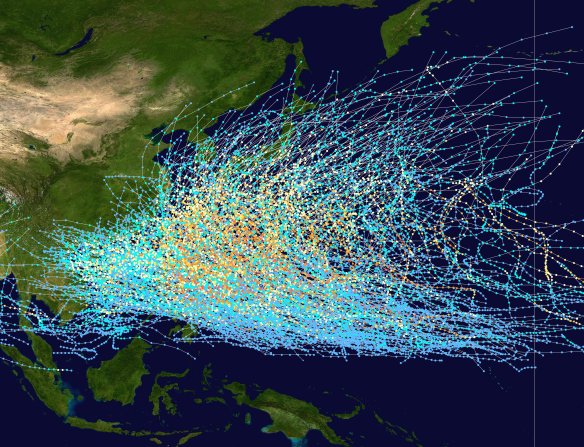
New Study: Climate Change Has Doubled the Number of Category 4 and 5 Storms Striking East and Southeast Asia

robertscribbler's avatarrobertscribbler

The atmospheric-ocean heat engine. It’s a pretty simple mechanism for pumping up the power of storms. But as simple as it is, the results can be devastating when this engine gets revved up by human-forced climate change, according to a new study released Monday in Nature Geoscience.

The Heat Engine in Action

As the ocean surface warms, it heats the local atmosphere. This generates an updraft that pushes higher and higher into the air above. Heat also causes water at the ocean surface to evaporate. This evaporated water is borne up on the winds and air currents rising above the heating water. A low-pressure system forms and the water vapor condenses into clouds which ultimately become thunderstorms. The Coriolis effect gives it all a nudge and the storms and clouds start to spin…

pacific_typhoon_tracks_1980-2005

(Pacific Ocean typhoon paths from 1980 through 2005. A new study shows that the destructive…

View original post 676 more words

What’s Swimming in the Open Water Near the North Pole These Days?

robertscribbler's avatarrobertscribbler

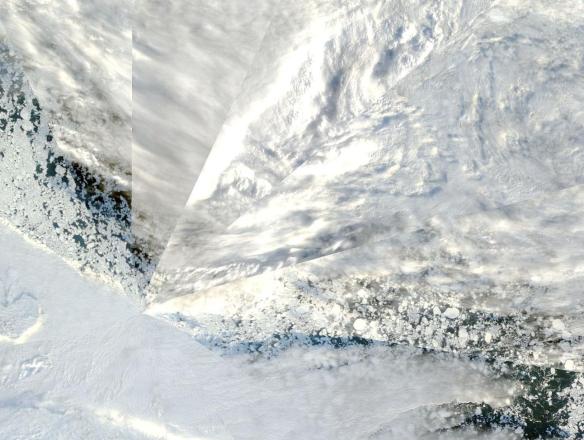
Globally, it’s been a record-hot year. But nowhere has seen so much anomalous warmth during 2016 as the Arctic. As melt season draws to a close, some dramatic effects are now becoming visible in the NASA satellite shots. Large regions near the North Pole are losing their white covering of sea ice and showing the telltale blue-black of open water:

north-pole-open-water

(Large areas of open water are visible near the North Pole in this LANCE MODIS satellite shot.)

The above image, provided by NASA, shows the Northern Hemisphere polar region on September 5, 2016. To get some sense of the size of this region of low-concentration sea ice, the bottom edge of this capture represents approximately 300 miles. For a point of reference, the North Pole can be seen where the lines of the satellite image frames converge in the lower left-hand side of the capture.

All throughout this satellite shot…

View original post 349 more words