Exposing the Big Game

Forget Hunters' Feeble Rationalizations and Trust Your Gut Feelings: Making Sport of Killing Is Not Healthy Human Behavior

Exposing the Big Game

Whales reached huge size only recently

http://www.bbc.com/news/science-environment-40032372
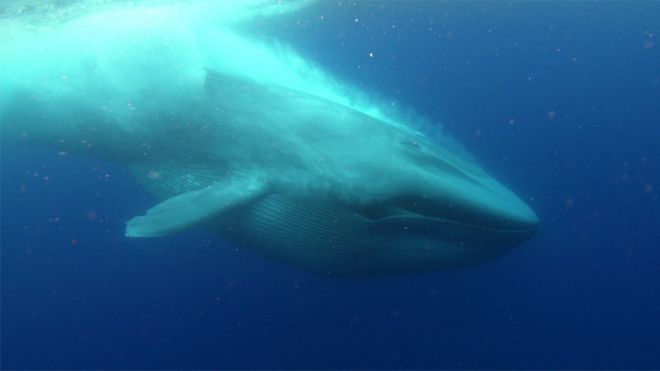
WhaleImage copyrightSILVERBACK FILMS/BBC
Image captionBeing big means they can maximise the opportunities where they exist

Blue whales are the biggest animals that have ever existed on Earth but they only recently* got that way.

This is the extraordinary finding from a new study that examined the fossil record of baleens – the group of filter feeders to which the blues belong.

These animals were relatively small for most of their evolutionary existence and only became the behemoths we know today in the past three million years.

That is when the climate likely turned the oceans into a “food heaven”.

Favoured prey – such as krill, small crustaceans – suddenly became super-concentrated in places, allowing the baleens with their specialised feeding mechanism to pig-out and evolve colossal forms.

“The blue whales, the fins and bowheads, and the right whales – they are among the most massive vertebrates to have ever lived,” explained Nick Pyenson from the Smithsonian’s National Museum of Natural History in Washington DC, US.

“Some of the dinosaurs were longer, but these big whales even outweighed the largest dinosaurs. And isn’t that surprising? People kind of think of gigantism as being a fact of the geologic past. But here we are, living in the time of giants on Planet Earth,” he told BBC News.

*Whales have been around for about 50 million years – a blink of the eye in the 4.6-billion-year history of the Earth.

Dr Pyenson is publishing the new research – conducted with Graham Slater from the University of Chicago and Jeremy Goldbogen from Stanford’s Hopkins Marine Station – in a journal of the Royal Society called Proceedings B.

It is based on a deep analysis of the Smithsonian’s extensive collection of cetacean bones, and in particular of whale skulls which are a good indicator of overall body size.

The team estimated the lengths of 63 extinct species, including some of the very earliest baleens that swam in the oceans more than 30 million years ago. And combined with data on modern whales, this investigation was then able to establish the evolutionary relationships between whales of different sizes.

What emerges from the research is a picture showing not only that gigantism is a recent phenomenon but that this bigness arises independently in the different baleen lineages.

The smaller whale species that had previously persisted start to go extinct within the last three million years, right at the same time as the giants begin to appear.
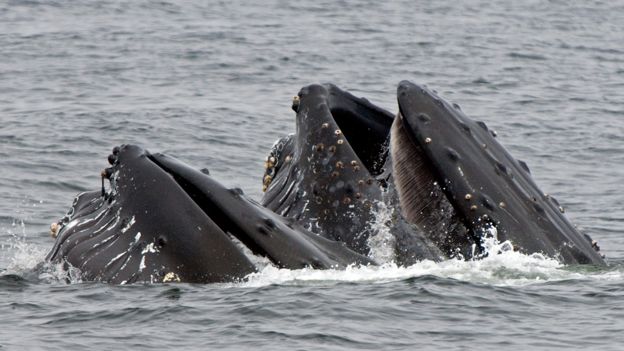
Lunge feedingImage copyrightGETTY IMAGES
Image captionThe baleen plates that hang from the upper-jaw filter prey from a gulp of seawater

It all points to a major shift in the environment and the team suggests the best explanation is the onset of ice ages at the end of the warm Pliocene Epoch, the beginning of the Pleistocene.

The existence of major ice sheets would have restructured the oceans, changing the way water and nutrients were distributed.

“This period sees some dramatic changes, including the closure of the Panamanian isthmus, shutting off connection between the Atlantic and Pacific,” explained Dr Slater.

“Ice sheets in the north develop a lot of cold water that sinks and is then transported around the globe. And what you get are intense upwellings that bring that nutrient-rich cold water back to the surface. That allows algae to go crazy and that allows krill to feed and to form really dense aggregations.”

It is not the abundance of prey per se that favours large baleens, but rather the prey’s patchy, concentrated nature. And with their filter-feeding system of eating, the big whales are able to take maximum advantage.

“They can travel from one feeding zone to the next very efficiently because their big size means their ‘miles per gallon’, their MPG, is very high. And they seem to know precisely the right time to turn up at these feeding grounds,” Dr Slater added.
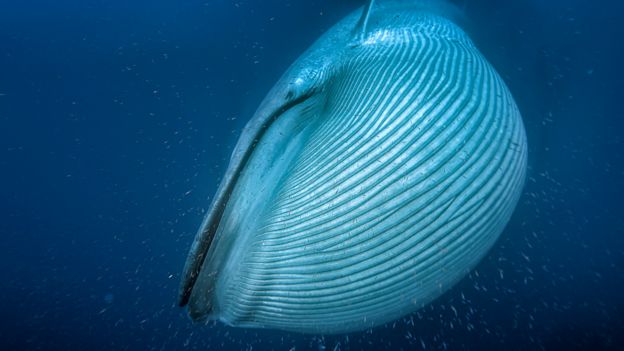
WhaleImage copyrightSILVERBACK FILMS/BBC
Image captionBlue whales can reach over 30m in length, although this is rarely seen nowadays

Two points are worth noting. First, commercial whaling in the last century decimated baleen populations and very probably removed most, if not all, of the ultra-giants out there. Few blues now exceed the 30m lengths that were often recorded at processing factories.

Thanks to the international moratorium on whaling, the true giants could yet return. But this raises the second issue: the changing climate.

If the experts are right, we are heading back towards the Pliocene. Increased carbon dioxide levels in the atmosphere could well see global temperatures in the next century that are three or four degrees warmer than they are today. This would almost certainly trigger further ocean changes.

“We’re playing with the dials on ‘Spaceship Earth’,” commented Dr Pyenson.

“We don’t know how things are going turn out, especially for these food resources which may or may not be persistent in space and time. There are some baleens that we think might be more flexible. Gray whales, for example, appear to have a very broad feeding range; blue whales not so much – they really need their krill.”
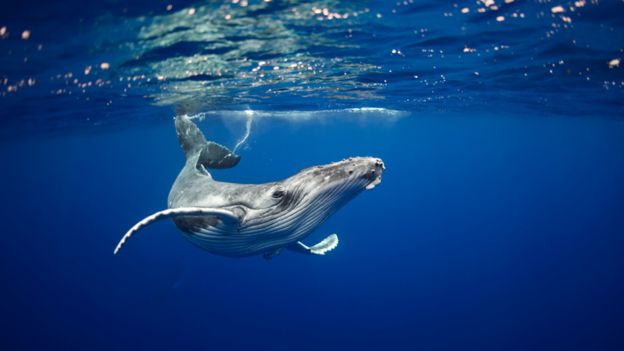
HumpbackImage copyrightMARIA TERESA LARA
Image captionWhat will happen to the oceans if the global climate returns to the Pliocene?

Richard Sabin is the curator of marine mammals at London’s Natural History Museum.

He called the research “compelling and important” and also highlighted the ecological knife-edge on which some of these animals must live: “There are 90 or so cetacean species. They’re a very diverse group and some of them are very specialised.

“So, you have creatures like the river dolphins that use echo-location to find their prey and the blue whales that are very specialised feeders with their krill. These animals have evolved within systems that they now depend on remaining stable.”

London’s NHM is about to make its blue whale skeleton the star attraction of a remodelled entrance hall.

The near-4.5-tonne specimen has been hung from the ceiling in a lunge-feeding pose, mouth open.

The display is under wraps for the moment, but a big unveiling is promised in the next few weeks.

“The visualisations that we released give you an idea, but they don’t really do it justice. She looks spectacular. You get so many different perspectives from the different angles, and you get a real sense not just of her size but of her dynamism as well.”

London’s Natural History Museum will also stage a new exhibition on whales to coincide with the unveiling.

Hunting Big Game: Why People Kill Animals for Fun

Hunting Big Game: Why People Kill Animals for Fun

Theodore Roosevelt poses near a dead elephant he killed during an African safari between 1909 and 1910.

Credit: Everett Historical

He fired with his gun’s right barrel, “the bullet going through both lungs,” and then with the left, “the bullet entering between the neck and shoulder and piercing his heart,” Roosevelt wrote. A third volley from another member of the hunting party brought down the great animal, “just thirteen paces from where we stood,” according to Roosevelt.

A black-and-white image of the aftermath shows Roosevelt in what was a common pose for him: standing alongside the lifeless body of a creature that he had hunted and killed. [In Photos: Endangered and Threatened Wildlife]

More than 100 years later, thousands of people each year still visit wild spaces across Africa with guns in hand. They apply for permits to recreationally hunt big animals, many of which — leopards, lions and elephants, to name just a few — represent threatened or endangered species.

And the “sport” is not without risks for human hunters — on May 19, a hunter in Zimbabwe was crushed to death by an elephant after the animal was shot by another member of his hunting party. So what motivates people to hunt these animals for pleasure, and to proudly display the bodies or body parts of their prey as precious trophies?

The slaughtering of large, dangerous animals as a spectacle dates back thousands of years, with records from the Assyrian empire (about 4,000 years ago to around 600 B.C.) describing kings that boasted of killing elephants, ibex, ostriches, wild bulls and lions, according to a study published in 2008 in the journal Bulletin of the American Schools of Oriental Research.

These hunts were carefully orchestrated and conducted for the amusement of royalty and as demonstrations of their strength, Linda Kalof, a professor of sociology at Michigan State University, told Live Science in an email.

“Ancient canned hunts were spectacular displays of royal power and dominance, and always took place with the king’s public watching from the sidelines,” Kalof said. “A successful hunt requires the death of unrestrained wild animals — animals who are hostile, shun or attack humans, and are not submissive to human authority.”

Even today, acquiring trophy animals is a way of displaying power, Kalof noted. In some African countries, where big-game hunting and trophy display are expensive forms of entertainment practiced predominantly by white men, hunting recalls ideologies that are deeply rooted in colonialism and patriarchy, Kalof said.

And then there’s the money involved. Legal hunting, which is conducted under the supervision of government agencies and official guides, involves expensive permits and is limited to specific animal populations and only in certain areas. Illegal poaching, on the other hand, circumvents all regulations and targets animals regardless of their age, sex, or endangered status.

The price tag attached to legal big-game hunting is considerable, once you tally up the costs of travel and lodging expenses, state-of-the-art equipment, local guides, and hunting permits. Government-sanctioned hunting is a booming enterprise in some African countries, with visiting hunters spending an estimated $200 million annually, The New York Times reported in 2015.

And when American dentist Walter Palmer notoriously shot a 13-year-old lion named Cecil in Zimbabwe in July 2015, he purportedly spent approximately $54,000 just on permits for the privilege.

In other words, people who hunt recreationally — and share photos of their trophies — are broadcasting that they can support lavish habits, biologist Chris Darimont, a professor in the Department of Geography at the University of Victoria in British Columbia, told Live Science in an email.

American anthropologist Osa Johnson and Jerramani, her African guide (right) pose with two dead lions in East Africa, in April 1930. With them are three Eagle Scouts who won a national Boy Scout competition to go on safari with the Johnsons in 1928, later writing the book 'Three Boy Scouts in Africa'. From left to right they are Robert Dick Douglas, Doug Oliver and David Martin.

American anthropologist Osa Johnson and Jerramani, her African guide (right) pose with two dead lions in East Africa, in April 1930. With them are three Eagle Scouts who won a national Boy Scout competition to go on safari with the Johnsons in 1928, later writing the book ‘Three Boy Scouts in Africa’. From left to right they are Robert Dick Douglas, Doug Oliver and David Martin.

Credit: Topical Press Agency/Getty Images


In a study on contemporary trophy hunting behavior, published in March 2016 in the journal Biology Letters, Darimont and his co-authors investigated whether evolutionary anthropology could provide answers about motives for recreational hunting. They suggested in their findings that men use hunting to send signals about their fitness to rivals and potential mates, noting that even subsistence hunters (those who kill animals for food) targeted animals that were more challenging for them to catch, simply to let others know that they could afford to take that risk.

“The inference is that they have the physical and mental characteristics that allow them to behave in a costly way and absorb those costs,” Darimont said.

And by sharing images of their trophies on social media, hunters can now trumpet messages about their personal wealth and social status to a global audience, he added. [Black Market Horns: Images from a Rhino Bust]

But there’s yet another side to the recreational hunting story: Some hunters argue that the money spent on their hobby is funding important conservation work. When hunters pay thousands of dollars to government agencies for the privilege of hunting certain types of wildlife in designated zones, portions of those costs can be invested in federal programs and community efforts to preserve animals living in protected areas – and even safeguard them against poaching, according to the World Wide Fund for Nature (WWF).

“In certain limited and rigorously controlled cases, including for threatened species, scientific evidence has shown that trophy hunting can be an effective conservation tool as part of a broad mix of strategies,” the WWF states on its website.

Because legal hunting provides local jobs and revenue, it can work as a deterrent against poaching and helps to conserve ecosystems, professional hunter Nathan Askew, owner of an American company that leads hunting safaris for “dangerous game” in South Africa, Tanzania, Botswana and Mozambique, explained in a Facebook post.

“The positive economic impact brought about by hunting incentivizes governments, landowners and companies to protect the animals and their habitats,” Askew said.

A black rhino (<i>Diceros bicornis</i>) in Etosha National Park, Namibia.

A black rhino (Diceros bicornis) in Etosha National Park, Namibia.

Credit: Fabian Plock/Shutterstock


By demonstrating that wildlife has economic value, hunting can actively engage local communities in efforts to stop poachers and preserve wild spaces that might not otherwise be maintained for wildlife, a representative of the hunting organization Safari Club International (SCI), told Live Science in an email.

Hunting under government supervision can also preserve the health of animal populations in the wild by weeding out individuals that are less fit. In Namibia, for example, black rhinos are listed as critically endangered, with only 5,000 individuals remaining in the wild. Yet the Namibian government maintains an annual hunting quota of five post-breeding males, to stimulate population growth by allowing younger males to breed, the SCI representative explained. [A Crash of Rhinos: See All 5 Species]

“Not only does the black rhino hunting benefit rhino population growth, it also generates hundreds of thousands of dollars in revenue that by law has to be put toward rhino conservation in Namibia. Therefore, hunting provides a direct cash benefit to rhino conservation that tourism can’t provide,” the representative said in a statement.

However, recent studies suggest that modern hunters may be overestimating their contributions to wildlife conservation. Not all countries that support recreational hunting are transparent about where that income goes, and it can be uncertain how much — if any — is actually benefiting African communities or conservation efforts.

A report that the Democratic staff of the House Committee on Natural Resources (a congressional committee of the U.S. House of Representatives) issued in June 2016 suggested that income from hunting in African countries such as Zimbabwe, Tanzania, South Africa and Namibia, from which the greatest number of hunting trophies are imported into the U.S., was not meeting conservation needs.

“In assessing the flow of trophy hunting revenue to conservation efforts, we found many troubling examples of funds either being diverted from their purpose or not being dedicated to conservation in the first place,” the report’s authors wrote.

Danish novelist Isak Dinesen (pseudonym of Baroness Karen Christence Blixen-Finecke) posing with dead lions and a rifle on a safari in Kenya, circa 1914.

Credit: Hulton Archive/Getty


Other experts have also questioned hunting’s usefullness as a tool for conservation. In fact, when it comes to lions, “trophy hunting adds to the problem,” Jeff Flocken, North American director for the International Fund for Animal Welfare, wrote in August 2013, in an opinion column for National Geographic.

Flocken argued that trophy hunting weakens the African lion gene pool because the most desirable trophy kills are young, healthy males. Removing them from the population means that their DNA won’t contribute to the next generation of lions. Killing young males also destabilizes their prides, and can result in more lion casualties as rival males compete to take their place, he wrote.

But perhaps most importantly, he added, legalized recreational hunting derails conservation efforts by simply devaluing the lives of the hunted animals.

“It’s a message that won’t be heard as long as it is common and legal to kill lions for sport,” Flocken said in the article. “Why should anyone spend money to protect an animal that a wealthy American can then pay to go kill?”

Original article on Live Science.

Wisconsin teen killed in hunting accident

Exposing the Big Game's avatarThe Extinction Chronicles

http://www.ironmountaindailynews.com/news/business/2017/05/wisconsin-teen-killed-in-hunting-accident/

TOWN OF WHITESTOWN, Wis. (AP) — Authorities say a 17-year-old boy has died after he was accidentally shot by a friend while hunting in Vernon County.

Sheriff’s officials say the boy and his 15-year-old friend were going turkey hunting on private land in the Town of Whitestown Sunday. When the two got out of the vehicle, a pistol held by the younger boy discharged, striking the older boy in the side and chest area. He was pronounced dead at the scene.

Sheriff John Spears says both teens are from the Ontario area.

View original post

Yellowstone wolf family tree and genealogy available online

BILLINGS, Mont. (AP) — Her parents may have been killed by her mate and his family. Her daughter was shot. Now she’s dead and her killing is under investigation.

Although the details may sound like the story line for a soap opera, a Shakespearean play or even the historical dirty deeds of Europe’s competing monarchies, it’s actually the tale of one of Yellowstone National Park’s well-known wolves — the white alpha female of the Canyon pack. Now, details of the park’s individual wolves and their inter-relatedness can be found in one place: online at Ancestry.com, a website formerly reserved for rooting out human family trees.

“People love their wolves,” said Jim Halfpenny, the founder of the Yellowstone Wolf Genealogy Family Tree.

That’s a sentiment Yellowstone officials have recognized, as well.

“I am amazed at the interest level in Yellowstone wolves,” said biologist Doug Smith, who leads the Yellowstone Wolf Project. “It’s insatiable.”

He noted that questionnaires distributed by the park in the early 2000s revealed that about 300,000 come to Yellowstone hoping to see wolves. Park interpreters annually talk to anywhere from 30,000 to 50,000 people a year about wolves.

It’s easy to see why there’s such an interest, Smith told The Billings Gazette.

“If you come to Yellowstone and put in a few days, you can see a wolf — and that’s pretty remarkable.”

The popularity of his genealogy charts became apparent to Halfpenny, a Gardiner-based biologist, after he started recording the lineage of Yellowstone’s wolves when they were first reintroduced to the park in 1995 and 1996.

“Through the years I’ve produced these laminated charts, selling about 4,000 a year,” he said. Now folks can order them online.

He updates the data yearly, using information gathered from multiple sources, including the Yellowstone Wolf Project. That’s no small task considering there can be more than 100 wolves scattered across the park’s 2.2 million acres (890,308 hectares) each year. At their population peak there were more than 170 wolves inside Yellowstone.

“We started out trying to do it by volunteers, and it was too overwhelming,” Halfpenny said.

So using a Kickstarter project to fund development — 273 people contributed more than $26,000 — Halfpenny was able to “put online the lives, pedigrees and genealogy of the Yellowstone wolves for access of all fans,” according to the website. The digital information is “enormous in scope and the first of its kind in the world.”

Those interested can go to www.wolfgenes.info to learn more about the project. Perusing Ancestry.com requires the payment of a membership fee. The information is also now available on a cellphone app allowing wolf devotees to carry the data with them into the field.

Smith said he hadn’t been able to check out the website yet but noted that building family trees and genealogy for wolves that have never been captured and had their DNA tested — such as the white alpha female from the Canyon pack — means some of the data isn’t scientifically valid. Each year about 40 percent of Yellowstone’s wolves are captured and have DNA samples taken.

“For scientific purposes, this probably is not the place to go,” Smith said. “For avid wolf watchers this is great. And he’s probably right most of the time.”

But the park has to be more conservative in its approach to linking individuals, he added.

Halfpenny admitted that observations by even hardcore wolf watchers are sometimes incorrect. For example, a wolf spotted in 2007 was believed to be a female. When found dead it turned out the wolf was a male.

Although the stories of known wolves are presented on the website, Halfpenny said it is the “interconnections that are just amazing” to him.

Take the earlier mentioned alpha female of the Canyon pack as an example. She was found seriously injured inside the park near Gardiner on April 11.

Park officials euthanized the white wolf because her injuries were so severe.

A necropsy later revealed she had been shot. Two $5,000 rewards, one from the National Park Service and another from a private group, have been offered for information leading to the arrest and conviction of the wolf’s killer.

Even before her tragic death, the 12-year-old wolf had led a life worthy of an epic poem. Two years after being born into the Hayden pack her parents were killed by the rival Mollie’s pack. This is known as intraspecific mortality, when wolves kill wolves, and accounts for about 42 percent of all wolf deaths in Yellowstone — more than any other single factor.

The white female is believed to have later bred with an unknown black wolf from Mollie’s pack — the same wolves that had killed her parents.

For some reason the white alpha female’s first pairing didn’t last, and she found a new mate, who also was a member of the Mollie’s pack — 712M. Together with another Mollie’s male in 2008 they formed the Canyon pack in the center of the park.

It took two years for the Canyon pack to successfully raise a litter of three pups past a year old. One would later become the white alpha female of the Wapiti Lake pack who would eventually displace her own parents from their Canyon pack homeland.

In 2011 the Canyon pack produced two more pups, one of which was a female that seemed especially enamored with her father, earning her the nickname Daddy’s Girl. At age 2 this female wolf was shot by a rancher north of Gardiner.

“In 2016 this amazing alpha pair produced two more pups in their new denning area at the advanced ages of 11 and 10 (the Canyon Alpha Female was the older of the two),” according to the Yellowstone Wolf Genealogy site. “2016 also represented another milestone: the Canyon Alpha Female and 712M had been together as an alpha pair for eight years, making them the longest mated pair on record for Yellowstone wolves.” The female is believed to have given birth to at least 13 pups over the course of her life.

There’s rarely a happy ending in a wolf’s short life, though. Rejected by her own pack this past winter, the alpha female was seen roaming the Gardiner area alone, sometimes feeding on roadkill. Her mate, “712M was last seen in January 2017 just east of Mammoth Hot Springs. He would be 11 years old in April 2017,” the website noted.

The oldest known wolf in Yellowstone, 478F, lived to age 12.5. The average lifespan for park wolves is two to three years.

“I’m fascinated with it, following the family lines,” Halfpenny said.

The intrigues include female wolves mating with their fathers, grandfathers and even brothers.

“There are all sorts of complexities to this,” he said.

For each wolf recorded on the website there is a life story to be read, as well as facts and a photo gallery if shots are available. Adapting such complex family relations to a website was a challenge since the Ancestry.com formula was set up for humans who give birth to about one offspring a year, not 4.4 a year, which is the average litter size for Yellowstone wolves.

“So we had to work around problems like that,” Halfpenny said.

He compared the information to tracking the Smith family tree for all of North America.

Controversial study suggests earliest humans lived in Europe – not Africa

Controversial new research suggests that modern humans evolved from apes in the Eastern Mediterranean — not from ancestors in Africa, as long believed by the majority of scientists.

The researchers’ bold, potentially paradigm-shifting claims were published in two studies Tuesday in the journal PLOS One.

The researchers base their arguments on analysis of two Graecopithecus freybergi ape fossils, a lower jaw found in Greece and an upper premolar found in Bulgaria, dating back 7.24 and 7.175 million years, respectively.

The team argued that several dental features from these fossils — in particular, partially fused premolar roots on the lower jaw fossil— make a convincing case that the Graecopithecus freybergi is the earliest known human ancestor. Scientists have seen partially fused premolar roots in several fossils throughout the human lineage.

If the fossils mark the earliest moment of humans’ differentiation, it would significant change the human origin story. The researchers believe these fossils are several hundred thousand years older than the ancient hominin known as Sahelanthropus, a 6- to 7-million-year-old pre-human which was unearthed in Chad.

However, the study has been met with widespread skepticism from other experts in the field.

Critics say that the research is not strong enough to undercut the widespread consensus that evidence shows hominins originated in African and migrated north.

“The idea that hominins (human ancestors, defined largely by upright posture, the predominance of bipedal walking, and small canine teeth in both males and females) first emerged in Europe has little to support it,” paleoanthropologist Richard Potts, who leads the Smithsonian Institution’s human origins program, told CBS News over email. Potts was not affiliated with the study.

The researchers did little to back up the claim that a “fairly isolated place in southern Europe” could have been home to an ancestor of the African hominin, Potts said.

He criticized the researchers’ claim that the Graeco fossil’s canine root reduction clearly indicates the Graeco’s status as an early hominin, arguing the researchers did not have enough contextual evidence to draw real conclusions from the single canine root (for instance, there was no canine crown to accompany the root).

“I really appreciate having a detailed analysis of the Graecopithecus jaw – the only fossil of its genus so far.  But I think the principal claim of the main paper goes well beyond the evidence in hand,” Potts said.

Speaking to The Washington Post, anthropologist Susan C. Antón echoed Potts’ skepticism. The long line of later hominins found in Africa suggests “an African origin,” Antón, who teaches at New York University, said.

Jay Kelley, a paleontologist at Arizona State University’s Institute of Human Origins, also questioned the researchers’ conclusion that the fused premolar roots strongly indicate a connection to hominins. Fused tooth roots are not a constant feature across different hominin fossils, he told The Washington Post.

The team behind the new research included scientists from Germany, Bulgaria, Greece, Canada, France and Australia.

Pope-Trump meeting agenda: Climate change, terrorism

Exposing the Big Game's avatarThe Extinction Chronicles

http://www.cnn.com/2017/05/24/politics/trump-pope-francis-vatican-city/

“Thank you. I won’t forget what you said,” Trump told Pope Francis, before leaving the Pope’s private study after a half-hour private meeting.
Neither Trump nor the Pope revealed what their conversation entailed, but readouts from the White House and the Vatican highlighted terrorism, climate change and peace as agenda items covered.
Secretary of State Rex Tillerson, briefing reporters on Air Force One after the meeting, said terrorism and climate change came up. He said the Vatican’s secretary of state raised climate change and encouraged Trump to remain in the Paris agreement.
Tillerson said the President “hasn’t made a final decision,” and likely will not until “after we get home.”
In a statement, the Vatican said only that the two men discussed “the promotion of peace in the…

View original post 458 more words

BC Govt Plans a New Independent Wildlife Agency Managed by Guide Outfitters, Trophy Hunters, Trappers

Valhalla Wilderness Society

Box 329, New Denver, British Columbia, Canada V0G 1S0
Phone: (250) 358-2333, Fax: (250) 358-2748, E-mail: vws@vws.org, Web: http://www.vws.org

18 May 2017
Call for action

BC Government wants to establish a new independent wildlife agency managed by hunters, trappers and guide outfitters Valhalla Wilderness Society was appalled when the BC government announced in late March that it intends to establish a new independent wildlife agency (https://news.gov.bc.ca/releases/2017FLNR0037-000783 ) “as part of its long-standing commitment to healthy wildlife populations.” The proposed “independent” agency is a thinly disguised attempt by the BC government to privatize wildlife management. Equally concerning and outrageous is that this agency was cooked up with at least the following 5 organizations, the BC Wildlife Federation, the BC Guide Outfitters Association, the BC Trappers Association, the Wild Sheep Society of BC and the Wildlife Stewardship Council with whom the BC government has signed a memorandum of understanding (MOU). These organizations whose members include hunters, trappers and guide outfitters who guide (trophy) hunters fully support the proposed agency whose mandate appears ironically to be “the growth of wildlife in British Columbia.”

At the announcement, Bill Bennett, then MLA East Kootenay and Minister of Mines and Energy,
explained the need for a new agency as follows: “Government is afraid to manage wolves, for example,are afraid to manage grizzly bears in some cases because of the politics of that. Hopefully, an agency that is separate from government can make decisions that are in the best long-term interest of wildlife and just forget about the politics and do what is best for the animals.”

http://www.summit107.com/news/east-kootenay-news/new-independent-wildlife-group-to-takeover-

bc-government-operations/. Bill Bennett has left BC enough of a devastating legacy with the
Mount Polley mine tailing pond failure which continues to pollute Quesnel Lake.
2
The past president of the BC Wildlife Federation welcomed the announcement of the proposed agency by stating: “I think it’ll put more positive aspect into managing wildlife and getting away from the precautionary principles and get back to real numbers and managing wildlife the way it should be.” The government press release reports that the proposed agency will be funded with start-up funds of $5 million but “subsequently would be supported by hunting licence revenues of $9 million to $10 million each year.”
Valhalla Wilderness Society calls on all members to express their opposition to this outrageous scheme to not only privatize wildlife management in BC but to place it in the hands of hunters, trappers and guide outfitters. Notwithstanding the poor job the BC government has been doing in terms of “growing wildlife”, wildlife should be managed by government. The above-mentioned special interest groups lack the technical expertise to make wildlife decisions based on scientific evidence and are even unwilling to apply the precautionary principle, which- in the face of climate change -, is needed more than ever. The proposed agency can not be held accountable to the public like an elected government, especially as agency members will no doubt be gagged by mandatory confidentiality agreements. Nor can it be bound by the domestic and international legal obligations, such as the Canada-BC Species at Risk Agreement, that bind the Province directly or indirectly through the federal government`s signing of international legal treaties.
The proposed agency does not represent the majority of British Columbians and the fake “public
consultation” process that the BC government has set aside $200,000 for when the mandate,
stakeholders and funding have already been decided is an utter waste of tax payers’ money. Wild
management should not be reduced to the management of species which hunters, trappers and guide outfitters’ clients like to kill: a broad ecosystem approach is needed to ensure that BC’s “wildlife grows” and their habitat is protected. Last but not least, funding for wildlife management should not be contingent on hunting license revenue or on other funding from special interest groups. Please take the time to email John Horgan, leader of the NDP, Andrew Weaver, leader of the BC Green Party, and Christy Clark, leader of the BC Liberals, demanding that:
 this proposed agency be shelved and the MOU terminated with immediate effect. Wildlife
management must remain the responsibility of the BC government;
 all wildlife management decisions by government must be made on the basis of scientific evidence guided by the precautionary principle and on a broad ecosystem level, which would automatically remove politics from the decision-making process the $200,000 set aside for so-called “public” consultation on this proposed agency whose establishment has been set in motion by special interest groups be used for restoration of mountain caribou habitat;
documents and meeting minutes with the above-mentioned organizations and others involved in
the establishment of this proposed agency be immediately released to the public.

Contact details:
John Horgan, NDP Party leader
Room 201, Parliament Buildings
Victoria, BC, V8V 1X4
Tel: 250 387-3655
Email: oppositionleader@leg.bc.ca
Andrew Weaver, Green Party leader and MLA
Room 027C, Parliament Buildings
Victoria, BC, V8V 1X4
Tel: 250-387-8347
Email: andrew.weaver.mla@leg.bc.ca
Christy Clark, BC Liberal leader
Parliament Buildings
Victoria, BC, V8V 1X4
Tel: 250-387-1715
Email: Christy.clark.mla@leg.bc.ca

Factory Farms Put Climate at Risk, Experts Say in Urging World Health Officials to Speak Out

Exposing the Big Game's avatarThe Extinction Chronicles

https://insideclimatenews.org/news/22052017/factory-farms-cafos-threaten-climate-change-world-heath-organization

In a letter, 200 experts called on the next director-general of the World Health Organization to confront the role factory farming plays in climate change.

Georgina Gustin

BY GEORGINA GUSTIN

MAY 22, 2017

Concentrated animal feeding operations, or CAFOs, have expanded to meet the rising global demand for meat, but they also bring concerns about health and climate. Credit: Jeff Vanuga/USDA/Getty Images

Roughly 200 experts in disciplines from nutrition to animal welfare are calling on the World Health Organization to take a more serious look at the impact of industrial livestock production on human health and the climate.

In a letter sent Monday, the group—which includes former New York Timesfood writer Mark Bittman and environmentalist Bill McKibben—appealed to the WHO, asking that its next director-general work “to reduce the size and number of factory farms.” The WHO’s World Health Assembly got underway Monday, and the body will…

View original post 601 more words

Two Chinese cities close poultry markets after H7N9 bird flu infections

Exposing the Big Game's avatarThe Extinction Chronicles

https://thehimalayantimes.com/health/two-chinese-cities-close-poultry-markets-h7n9-bird-flu-infections/

REUTERS

China will shut poultry markets in certain districts of two cities after H7N9 bird flu infections were detected, state media reported on Sunday, the latest incidents in this year’s more severe outbreak of the virus.

A 44-year-old man who sold poultry at a farmers market in southwestern Sichuan province’s Zigong city was diagnosed with H7N9, China News Service reported. Local authorities announced a one-month halt to poultry markets in the city’s Ziliujing district from midnight on Monday.

Separately, a 74-year old man who had visited poultry markets in Shandong province’s Binzhou city was also diagnosed with H7N9, China Central Television reported. Binzhou authorities will temporarily halt poultry markets in three of its districts.

Bird flu can jump from poultry to humans. Human cases of bird flu have been unusually…

View original post 44 more words

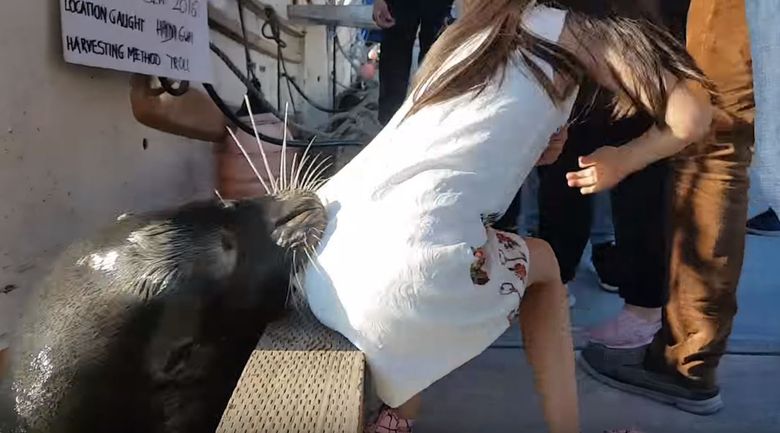
Family of girl snatched by sea lion lambasted for ‘reckless behavior’

“You wouldn’t go up to a grizzly bear in the bush and hand him a ham sandwich,” said an official suburban Vancouver’s Steveston Harbour, where the now-famous incident occurred over the weekend.

The terrifying video of a sea lion snatching a little girl off the edge of a dock and yanking her into murky British Columbia seawater last week is buzzing across the internet and social media today — and drawing some critical insights.

Michael Fujiwara, a college student from Vancouver, B.C., captured the video Saturday at the Steveston Fisherman’s Wharf in the Vancouver suburb of Richmond. It shows the large male sea lion suddenly lurching and pulling the girl into the water, with a man jumping in after the child to save her. There reportedly were no injuries.

Robert Kiesman, chair of the Steveston Harbour Authority, lambasted the girl’s family for reckless behavior, telling the CBC News that signs posted at the popular tourist destination warn people not to feed the sea mammals that frequent the area.

“You wouldn’t go up to a grizzly bear in the bush and hand him a ham sandwich, so you shouldn’t be handing a thousand-pound wild mammal in the water slices of bread,” Kiesman said.

“And you certainly shouldn’t be letting your little girl sit on the edge of the dock with her dress hanging down after the sea lion has already snapped at her once. Just totally reckless behavior.”

Danielle Hyson, a senior marine-mammal trainer at the Vancouver Aquarium, explained to The Vancouver Sun that the animal forewarned of his aggressive behavior.

“You saw him kind of initially lunge out of the water and give a little huff. That’s what we would call an aggressive precursor,” she told The Sun. “So he’s letting the people know that he’s starting to get frustrated. And in that situation, the people should have backed off right away.”

Hyson noted that male California sea lions are powerful animals that can weigh more than 200 kilograms — about 440 pounds.

The powerful animals have big eyes and whiskers that seem cute, she noted.

“They look like they’re water dogs, but they absolutely are not,” Hyson said. “They can do a lot of damage.”

Fujiwara, the college student who shot the video, said in a story carried by NBC News the girl and her family were dumbstruck by the attack.

“They were pretty shaken up,” he said. “Her family were just in shock.”

The family had been feeding the sea lion breadcrumbs, which is probably what attracted the animal to the crowd, Fujiwara said.

“It initially jumped up to the girl to read her, I guess,” he said. “And then it came back up a second time, but this time grabbing the girl by the waist and dragging her down into the water.”

In Washington, the state’s Department of Fish and Wildlife does not keep records on sea-lion attacks, department spokesman Craig Bartlett said in an email Monday.

Sea lions typically only bite when they feel threatened or cornered, according to various news reports. They sometimes also go after the same fish people do, resulting in close encounters.

“I’ve seen reports of sea lions stealing fish from anglers on the Columbia River, but I can’t recall anyone actually being injured,” Bartlett said.

While he knew of no known attacks of people in Washington, Bartlett pointed to a 2013 news report about sea lions that have attacked and eaten dogs at Westport.

But commercial and sports fishermen occasionally have reported attacks by sea lions and seals.

A sea lion caught in a Russian commercial fishing vessel’s net was videotaped tossing a fisherman across the boat deck.

In January, an Alaska fisherman was attacked by a Steller sea lion “heavier than a grand piano” when it jumped onto his fishing boat, slammed him into the deck and tried to drag him into the water, according to the Alaska Dispatch News.

And in 2015, a sea lion bit onto the hand of a sport fisherman as he posed with a yellowfin tuna on his boat off San Diego, pulling the man overboard.

“After 15 seconds, I thought I was going to die,” Dan Carlin, the fisherman, later said in an interview with The Associated Press. “I continued to struggle, but thought this is the way I was going to die. It was unbelievable to me.”

But deadly attacks by seals or seal lions are apparently rare.

The fatal attack of a British scientist snorkeling in Antarctica in 2003 was believed to be the first deadly leopard-seal attack on a human at the time, according to National Geographic.

On Monday, tourists and the curious crowded on to Steveston Fisherman’s Wharf to catch a glimpse of the child-snatching sea lion despite warnings to keep a safe distance.