Target: Ola Elvestuen, Member of Norwegian Parliament
Goal: Thank Norway for ending government subsidies to support seal slaughter, thereby sparing countless lives.
For centuries, numerous boats have ventured up north from Norway to kill seals for personal profit. However, this marks the first year that not a single Norwegian boat set sail to kill innocent seals.
Seals are incredibly social animals and can live up to 30 years in the wild. However, many seals do not make it to this age or even to adulthood, as they have traditionally been shot or clubbed to death for their fur, meat and blubber. Thankfully, Norway is now one less country participating in these cruel practices. Sign this petition and thank Norway for no longer supporting seal slaughter, thereby sparing countless animals from unnecessary pain and death.
PETITION LETTER:
Dear Mr. Elvestuen,
This is the first hunting season where not one single Norwegian boat set sail to…
The evolutionary biologist talks about becoming a vegetarian, Brexit, Donald Trump and, inevitably, God
Tom Whipple, Science Editor
May 13 2017, 12:01am, The Times
Richard Dawkins’ application of logic applies right down to his socks, which he refuses to waste time matchingCHRIS MCANDREW FOR THE TIMES
Is this what it was like, Richard Dawkins wonders, for ordinary people in Nazi Germany? “There’s a kind of laziness if you live in a society where things are just accepted. People might have been vaguely uneasy about what was going on in Germany but also thought, ‘Oh well, everyone else is doing it’.”
What crime is it that he thinks that we, like Germans in the 1930s, are blind to? It is, perhaps, a surprising one from him: the crime of eating meat. Dawkins, 76, is not known for being a woolly, liberal, tofu-eater. He is better known for his espousal of red-in-tooth-and-claw evolutionary logic and, even more so, for his three million-selling atheist book The God Delusion. Speaking from his Victorian Gothic house…
BEIJING — Chinese authorities have banned dog meat sales at the country’s
notorious Yulin dog-eating festival, two U.S. nonprofit organizations
reported Wednesday in what animal rights advocates are calling a victory.
The annual festival in Yulin — a prefecture-level city in southwest China’s
Guangxi region — has in recent years emerged as a lightning rod for animal
rights activism, granting the sleepy city a degree of global infamy.
Activists say thousands of dogs — some of them abducted pets — are
slaughtered at the festival each year; they’re served alongside lychees and
grain alcohol to mark the summer solstice.
The Yulin government has banned the city’s dog meat vendors from selling
the meat for one week starting June 15, the U.S.-based Duo Duo Animal
Welfare Project and Humane Society International (HSI) said in a joint
statement, citing unidentified local contacts. The 10-day festival is
slated to begin June 21.
The following essay is reprinted with permission from The Conversation, an online publication covering the latest research.
On April 19 of this year, five major wildlife protection groups petitioned the United States Fish and Wildlife Service to list the giraffe (Giraffa camelopardalis) as an endangered species. As the petition asserted, “the giraffe has suffered a major reduction in population size across its range primarily due to habitat loss, commercial overutilization, and severe poaching, and such decline continues unabated.”
If the Fish and Wildlife Service agrees to list the giraffe, a set of legal tools will become available to protect this iconic species. But how would listing in the U.S. help this African mammal, whose population numbers in the wild have dipped below 100,000?
EXTINCTION IS FOREVER
While extinction can be a natural process, the current rate of extinction is anything but. Scientists estimate that at least 99 out of 100 species extinctions in the world today are the result of human action. Although people rarely intend to drive species into oblivion, as with the giraffe, they do so through the destruction of habitat, poaching and legal hunting. As the petition notes, “[g]iraffes once occupied much of the savanna and savanna woodlands of Africa…. [It] has undergone a 36 to 40 percent population decline over the past 30 years.”
More than a century ago, scientists began to notice the disappearance of once prominent species around the world. TheAmerican passenger pigeon, the Carolina parakeet and the Great Auk—once well-established in North America—disappeared. Other species like the American bison and many kinds of whales had once played central roles in important ecosystems but had been reduced to small remnant populations.
“If the biota, in the course of aeons, has built something we like but do not understand, then who but a fool would discard seemingly useless parts? To keep every cog and wheel is the first precaution of intelligent tinkering.”
What would you say to a child who saw a giraffe in a book and asked where giraffes lived? Would you be comfortable saying they’re all gone?
ROOTS OF REGULATION
In 1964, the International Union for the Conservation of Nature (IUCN) began tracking the conservation status of species on its “Red List.” Although the IUCN provides information only about the status of species, this is the first step in helping to limit extinction because it allows conservation efforts to be directed where they’re most needed.
A few years later in the United States, the federal government began keeping an official list of species in danger of extinction—what we call endangered species—and species likely to become endangered within the foreseeable future—threatened species.
The Endangered Species Act (ESA), passed in 1973, goes further than just identifying imperiled species. Under its terms, listed species are protected from actions “authorized, funded or carried out” by the federal government that may jeopardize their continued existence or adversely affect their essential habitat. Species members are also protected from direct harm by any person. Commerce in species protected by the ESA is generally a crime.
The purpose of the ESA is the “conservation” of protected species. In practice, that means bringing the species back to the point where it no longer requires the protection of the ESA. The law’s goal is not to preserve tiny populations on the brink of extinction but to recover species populations that are resilient enough to survive the bad luck which is so often part of living on the planet.
Listing is the public, administrative process whereby a species can become entitled to protection under the Endangered Species Act. It centers around one question: Is this creature or plant in danger of extinction? At the listing stage, the federal government can consider only scientific evidence in making its decision. Anyone can initiate the listing process via petition.
Evidence suggests the ESA works. A recent report in the Endangered Species Bulletin noted that of the 78 species first listed under the federal precursor to the Endangered Species Act in 1967, only four have been officially declared extinct after half a century. Many others, such as the California condor, the grizzly bear and the whooping crane, have seen remarkable recovery progress. Some, including the bald eagle, have even been removed from the list.
There are now 1,382 species of animals listed under the Endangered Species Act as threatened or endangered; 711 live largely within the borders of the United States. For these species, the federal Endangered Species Act can help preserve habitat, require “consultation” on projects that need federal approval and make most hunting illegal.
AMERICAN LISTING FOR AN AFRICAN ANIMAL
The giraffe, of course, is not native to the United States. How would ESA listing help it? The habitat destruction and overharvesting that threaten the giraffe aren’t happening within U.S. borders.
The answer lies in the role the United States plays in buying and selling giraffe parts. According to a U.S. Fish and Wildlife Service database, over the past decade Americans imported more than 21,000 giraffe bone carvings, more than 3,000 skin pieces and 3,744 hunting trophies. If many people want giraffe parts, the demand can be too high for survival of the species. Heightened demand for giraffe products can encourage people to hunt illegally—for example, taking more giraffes than limits allow or hunting in places where it is not permitted.
An international treaty, the Convention on International Trade in Endangered Species of Wild Fauna and Flora (1973), known by its acronym, CITES, also addresses this problem. Countries that are party to the treaty meet periodically to list species that are threatened due to international trade. The treaty has two appendices for listing species: Appendix I results in an almost complete ban on commercial international trade; Appendix II requires all international trade in that species be monitored and subject to permits. The giraffe is not currently listed on either of the CITES appendices, but this does not prevent individual countries—such as the United States—from deciding to limit imports.
Around the world, markets for species parts are sometimes driven by traditional uses—things like carving ivory or using certain animal parts in traditional medicines. New uses fuel demand too; think of newly wealthy businessmen in Vietnam consuming rhino horn mixed with water or alcohol to show how rich they are. Sometimes, the two can converge: An increase in consumption of shark fin soup has been tied to a traditional celebration dish being served by more people as China’s middle class grew.
Listing on the ESA would require the federal government to limit imports of giraffe parts into the United States and would therefore help curtail global demand. The ESA cannot ensure habitat protection or require other countries to take affirmative conservation action to protect the giraffe. But listing in the U.S. would limit one important threat in which Americans do play a role.
Please Sign Our Petition to Uphold European Law Against Denmark’s Collaboration With the Faroese to Unlawfully Slaughter Pilot Whales and Dolphins.
On May 8th, with the formal support of 27 Members of the European Parliament, Sea Shepherd Nederland officially submitted a request to the European Commission (EC) to start infringement proceedings against Denmark for facilitating the slaughter of pilot whales and other cetaceans in the Faroe Islands. SIGN the petition and ask the EC to take action: bit.ly/2rdZEM0
In events known as ‘grindadráps’, Danish officials, including police, navy, and customs representatives, assist the Faroese by ensuring they can drive hundreds of pilot whales and other cetaceans into bays, where, while screaming in terror, their spinal columns are ruthlessly sliced, filling the bays full of blood. #OpBloodyFjords#OpGrindini#OpGrindStop
“As citizens from around the world we are horrified that
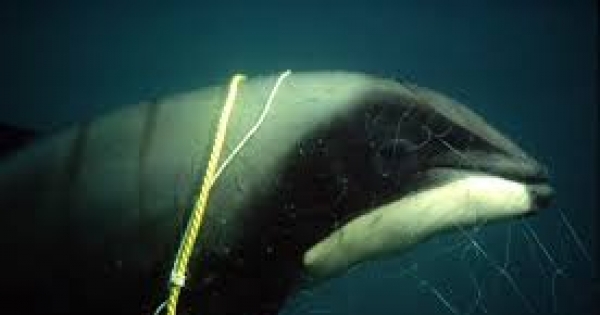
Maui’s Dolphin could vanish from the face of the earth, we urge you to establish and enforce an immediate, permanent ban on deadly gillnet fishing in New Zealand. As there are only 43 Maui’s left, we call on you to do all you can to save this beautiful species from extinction before it’s too late.”
More information:
Maui’s are known as Hobbits of the sea, they are diminutive aquatic mammals that look like mini‐dolphins ‐‐ and there’s only 43 of them left! But if we act fast, we can still stop this beautiful species from vanishing forever.
They’re dying because they get trapped in “gillnets” and drown, also they are caught by Commercial fishers as by catch. But New Zealand government refuses to save these iconic dolphins.
An Arizona biologist believes that their sounds should be considered language — and that someday we’ll understand what they have to say.
Con Slobodchikoff and I approached the mountain meadow slowly, obliquely, softening our footfalls and conversing in whispers. It didn’t make much difference. Once we were within 50 feet of the clearing’s edge, the alarm sounded: short, shrill notes in rapid sequence, like rounds of sonic bullets.
We had just trespassed on a prairie-dog colony. A North American analogue to Africa’s meerkat, the prairie dog is trepidation incarnate. It lives in subterranean societies of neighboring burrows, surfacing to forage during the day and rarely venturing more than a few hundred feet from the center of town. The moment it detects a hawk, coyote, human or any other threat, it cries out to alert the cohort and takes appropriate evasive action. A prairie dog’s voice has about as much acoustic appeal as a chew toy. French explorers called the rodents petits chiens because they thought they sounded like incessantly yippy versions of their pets back home.
On this searing summer morning, Slobodchikoff had taken us to a tract of well-trodden wilderness on the grounds of the Museum of Northern Arizona in Flagstaff. Distressed squeaks flew from the grass, but the vegetation itself remained still; most of the prairie dogs had retreated underground. We continued along a dirt path bisecting the meadow, startling a prairie dog that was peering out of a burrow to our immediate right. It chirped at us a few times, then stared silently.
“Hello,” Slobodchikoff said, stooping a bit. A stout bald man with a scraggly white beard and wine-dark lips, Slobodchikoff speaks with a gentler and more lilting voice than you might expect. “Hi, guy. What do you think? Are we worth calling about? Hmm?”
Slobodchikoff, an emeritus professor of biology at Northern Arizona University, has been analyzing the sounds of prairie dogs for more than 30 years. Not long after he started, he learned that prairie dogs had distinct alarm calls for different predators. Around the same time, separate researchers found that a few other species had similar vocabularies of danger. What Slobodchikoff claimed to discover in the following decades, however, was extraordinary: Beyond identifying the type of predator, prairie-dog calls also specified its size, shape, color and speed; the animals could even combine the structural elements of their calls in novel ways to describe something they had never seen before. No scientist had ever put forward such a thorough guide to the native tongue of a wild species or discovered one so intricate. Prairie-dog communication is so complex, Slobodchikoff says — so expressive and rich in information — that it constitutes nothing less than language.
That would be an audacious claim to make about even the most overtly intelligent species — say, a chimpanzee or a dolphin — let alone some kind of dirt hamster with a brain that barely weighs more than a grape. The majority of linguists and animal-communication experts maintain that language is restricted to a single species: ourselves. Perhaps because it is so ostensibly entwined with thought, with consciousness and our sense of self, language is the last bastion encircling human exceptionalism. To concede that we share language with other species is to finally and fully admit that we are different from other animals only in degrees not in kind. In many people’s minds, language is the “cardinal distinction between man and animal, a sheerly dividing line as abrupt and immovable as a cliff,” as Tom Wolfe argues in his book “The Kingdom of Speech,” published last year.
Slobodchikoff thinks that dividing line is an illusion. To him, the idea that a human might have a two-way conversation with another species, even a humble prairie dog, is not a pretense; it’s an inevitability. And the notion that animals of all kinds routinely engage in sophisticated discourse with one another — that the world’s ecosystems reverberate with elaborate animal idioms just waiting to be translated — is not Doctor Dolittle-inspired nonsense; it is fact.
Like “life” and “consciousness,” “language” is one of those words whose frequent and casual use papers over an epistemological chasm: No one really knows what language is or how it originated. At the center of this conundrum is a much-pondered question about the relationship between language and cognition more generally. Namely, did the mind create language or did language create the mind? Throughout history, philosophers, linguists and scientists have argued eloquently for each possibility. Some have contended that thought and conscious experience necessarily predate language and that language evolved later, as a way to share thoughts. Others have declared that language is the very marrow of consciousness, that the latter requires the former as a foundation.
In lieu of a precise definition for language, many experts and textbooks fall back on the work of the American linguist Charles Hockett, who in the 1950s and ’60s proposed a set of more than a dozen “design features” that characterize language, like semanticity — distinct sounds and symbols with specific meanings — and displacement, the ability to speak of things outside your immediate environment. He acknowledged that numerous animal-communication systems had at least some of these features but maintained that only human language boasted them all. For those who think that language is a prerequisite for consciousness, the unavoidable conclusion is that animals possess neither.
To many biologists and neuroscientists, however, this notion smacks of anthropocentrism. There is now a consensus that numerous species, including birds and mammals, as well as octopuses and honeybees, have some degree of consciousness, that is, a subjective experience of the world — they feel, think, remember, plan and in some cases possess a sense of self. In parallel, although few scientists are as ready as Slobodchikoff to proclaim the existence of nonhuman language, the idea that many species have language-like abilities, that animal communication is vastly more sophisticated than Hockett and his peers realized, is gaining credence. “It’s increasingly obvious just how much information is encoded in animal calls,” says Holly Root-Gutteridge, a bioacoustician at the University of Sussex. “There’s now a preponderance of evidence.”
In the 1990s, inspired in part by Slobodchikoff’s studies, the primatologist Klaus Zuberbühler began investigating monkey vocalizations in the dense and cacophonous forests of the Ivory Coast in Africa. Over the years, he and his colleagues discovered that adult male Campbell’s monkeys change the meaning of their screeches by combining distinct calls in specific sequences, adding or omitting an “oo” suffix. Krak exclusively warns of a leopard, but krak-oo is a generalized alarm call; isolated pairs of booms are a “Come this way!” command, but booms preceding krak-oos denote falling tree branches. Studies of songbirds have also uncovered similar complexity in their communication. Japanese great tits, for example, tell one another to scan for danger using one string of chirps and a different set of notes to encourage others to move closer to the caller. When researchers played the warning followed by the invitation, the birds combined the commands, approaching the speaker only after cautiously surveying the area. In the South Pacific, biologists have shown that humpback-whale songs are neither random nor innate: rather, migrating pods of humpback whales learn one another’s songs, which evolve over time and spread through the ocean in waves of “cultural revolution.” And baby bottlenose dolphins develop “signature whistles” that serve as their names in a kind of roll call among kin.
With the help of human tutors, some captive animals have developed especially impressive linguistic prowess. Dolphins have learned to mimic computer-generated whistles and use them as labels for objects like hoops and balls. A bonobo known as Kanzi communicates with a touch-screen displaying hundreds of lexigrams, occasionally combining the symbols with hand gestures to form simple phrases. And over the course of a 30-year research project, an African gray parrot named Alex learned to identify seven colors, five shapes, quantities up to eight and more than 50 objects; he could correctly pick out the number of, for instance, green wooden blocks on a tray with more than a dozen objects; he routinely said “no,” “come here” and “wanna go X” to get what he desired; and on occasion he spontaneously combined words from his growing vocabulary into descriptive phrases, like “yummy bread” for cake.
Slobodchikoff’s studies on prairie dogs have long hovered on the periphery of this burgeoning field. Unknown to Slobodchikoff, around the same time that he began recording prairie-dog alarm calls in Flagstaff, Peter Marler, the renowned animal-communication expert and one of Slobodchikoff’s former professors, was working on a similar study, one that would eventually redefine the field. In the spring of 1977, Marler sent Robert Seyfarth and Dorothy Cheney — a young husband-and-wife duo of primate scientists — to Amboseli, Kenya, to study the alarm calls of small silver-haired monkeys known as vervets. Earlier research had hinted that vervet monkeys produced different vocal warnings for different predators: a kind of bark to warn of a leopard; a low-pitched staccato rraup for a martial eagle; and a high-pitched chutter for a python. Seyfarth and Cheney decided to further investigate these findings in a controlled field experiment.
The two scientists hid a loudspeaker in the bushes near different groups of vervets and played recordings of their alarm calls, documenting the monkeys’ responses. Even in the absence of actual predators, the recordings evoked the appropriate escape strategies. Leopard-alarm calls sent monkeys scampering into the trees. When they heard eagle-alarm calls, they looked up and took cover in the bushes. In response to the warning for snakes, the primates reared up on their hind legs and scanned the ground. Contrary to the consensus of the time, the researchers argued that the sounds animals made were not always involuntary expressions of physiological states, like pain, hunger or excitement. Instead, some animals systematically used sounds as symbols. In both academia and the popular press, vervet monkeys became celebrated mascots for the language-like abilities of animals.
While the vervet research won acclaim, Slobodchikoff’s remained frustratingly sidelined. Marler, Seyfarth and Cheney worked for the well-staffed and moneyed Rockefeller University in New York; Slobodchikoff conducted his studies on a shoestring budget, compiling funds from the university’s biology department, very occasional grants and his own bank account. Slobodchikoff did not collect enough data to formally present his research at a conference until 1986. And it was not until 2006 that he published a study with the same kind of playback techniques that Cheney and Seyfarth used in Kenya, which are essential to demonstrating that an animal comprehends and exploits the variation in its calls. Although many scientists attended Slobodchikoff’s talks at conferences and spoke with him about his research in private, they rarely referenced his studies when publishing their own. And despite a few news stories and nature documentaries, prairie dogs have not secured a seat in public consciousness as a cognitively interesting species.
It did not take long for Slobodchikoff to master the basic vocabulary of Flagstaff’s native prairie dogs. Prairie-dog alarm calls are the vocal equivalent of wartime telegrams: concise, abrupt, stripped to essentials. On a typical research day, Slobodchikoff and three or four graduate students or local volunteers visited one of six prairie-dog colonies they had selected for observation in and around Flagstaff. They usually arrived in the predawn hours, before the creatures emerged from their slumber, and climbed into one of the observation towers they had constructed on the colonies: stilted plywood platforms 10 feet high, covered by tarps or burlap sacks with small openings for microphones and cameras. By waiting, watching and recording, Slobodchikoff soon learned to discriminate between “Hawk!” “Human!” and so on — a talent that he says anyone can develop with practice. And when he mapped out his recordings as sonograms, he could see clear distinctions in wavelength and amplitude among the different calls.
He also discovered consistent variations in how prairie dogs use their alarm calls to evade predators. When a human appeared, the first prairie dog to spot the intruder gave a sequence of barks, which sent a majority of clan members scurrying underground. When a hawk swooped into view, one or a few prairies dogs each gave a single bark and any animal in the flight path raced back to the burrow. (Slobodchikoff suspects that, because of a hawk’s speed, there’s little time for a more complex call.) The presence of a coyote inspired a chorus of alarm calls throughout the colony as prairie dogs ran to the lips of their burrows and waited to see what the canine would do next. When confronted with a domestic dog, however, prairie dogs stood upright wherever they were, squeaking and watching, presumably because tame, leashed dogs were generally, though not always, harmless.
Something in Slobodchikoff’s data troubled him, however. There was too much variation in the acoustic structure of alarm calls, much more than would be expected if their only purpose was to distinguish between types of predator. Slobodchikoff arranged for various dogs — a husky, a golden retriever, a Dalmatian and a cocker spaniel — to wander through a prairie-dog colony one at a time. The recorded alarm calls were still highly variable, even though the intruders all belonged to the same predator class. “That led me to think, What if they are actually describing physical features?” Slobodchikoff remembers. What if, instead of barking out nouns, prairie dogs were forming something closer to descriptive phrases?
To find out, he became a participant in his own experiment. Slobodchikoff and three colleagues paraded through two prairie-dog colonies dressed in either jeans and white lab coats, or jeans and variously colored shirts: blue, gray, orange, green. The prairie dogs produced highly similar alarm calls for each person in the lab coat, except for one especially short researcher. But they chirped in very different ways for most of the different colored shirts. In a related experiment, three slender women differing in height by just a bit meandered through a prairie-dog habitat dressed identically except for the color of their T-shirts. Again the animals varied their calls. And in another study, prairie dogs changed the rate of their chirping to reflect the speed of an approaching human.
If prairie dogs had sounds for color and speed, Slobodchikoff wondered, what else could they articulate? This time, he and his colleagues designed a more elaborate test. First they built plywood silhouettes of a coyote and a skunk, as well as a plywood oval (to confront the prairie dogs with something foreign), and painted the three shapes black. Then they strung a nylon cord between a tree and an observation tower, attached the plywood figures to slotted wheels on the cord and pulled them across the colony like pieces of laundry. Despite their lack of familiarity with these props, the prairie dogs did not respond to the cutouts with a single generalized “unknown threat” call. Rather, their warnings differed depending on the attributes of the object. They unanimously produced one alarm call for the coyote silhouette; a distinct warning for the skunk; and a third, entirely novel call for the oval. And in a follow-up study, prairie dogs consistently barked in distinct ways at small and large cardboard squares strung above the colony. Instead of relying on a fixed repertory of alarm calls, they were modifying their exclamations in the moment to create something new — a hallmark of language Hockett called “productivity.”
Press release from BC Nature – for immediate release
Nature-lovers across BC are expressing concern over a proposed new method for managing wildlife in the province. Speaking on behalf of BC Nature, the federation of naturalist clubs across BC, president Dr. Alan Burger said “Our members are alarmed by recent statements by government ministers indicating that wildlife management might be handed over to an external agency supported by special interest groups, specifically hunters and guide- outfitters”. This model of wildlife management will undoubtedly work against the interests of the vast majority of British Columbians, added Burger.
Recent statements by Ministers Steve Thomson (Forests, Lands and Natural Resources Management) and Bill Bennett (Energy and Mines) suggest that, if the BC Liberals win this election, much wildlife management will be handed over to an independent agency, funded in part by hunting and fishing licences. Both ministers made these statements while flanked by members of the BC Wildlife Federation, the influential hunting and fishing advocacy group. It is well known that BCWF has long been lobbying the government for a greater say in wildlife management, citing the millions of dollars paid in hunting and fishing licences as the reason for greater input.
“This proposal is flawed at several levels” stated Burger. First, the economic argument is false. Hunting and fishing licences are an important source of revenue and BC Nature agrees that there should be a greater share contributed to wildlife management. But, there is much greater input to the BC economy from the non-consumptive users of wildlife – the tourism and wildlife-watching industry, people selling binoculars, camera gear, field guides, outdoor gear etc. and, most importantly, the vast majority of British Columbians that spend money traveling and camping to simply enjoy seeing animals alive in the wild.
BC has not undertaken research recently to investigate the economic benefits of wildlife- watching, but in neighbouring Washington the research shows that wildlife-watching contributes five times the economic benefit ($1.5 billion) that hunting does. A study in 2006 by the US Fish and Wildlife found that over 71 million Americans spent nearly $45 billion on retail sales while observing, feeding or watching wildlife in the US. Canadians are likely to spend even more per capita. Wildlife viewing is a growing business and BC is becoming a world-class destination for this highly sustainable activity.
Second, the proposed method for implementing wildlife management is flawed. There is no doubt that much more money is needed to enhance wildlife and ecosystem management, secure critical habitat and deal with the increasing impacts of industrial and human footprints in our province. Habitat loss, in particular, is a huge issue across many ecosystems in B.C. But this needs to be done by government and not through some external agency, which might be heavily biased towards consumptive users of wildlife. The B.C. Fish and Wildlife Branch and related departments within the provincial government have a long and proud history of serving the people of this province. They haven’t always made the right decisions and their hands are often tied by the political goals of the ruling party, but
they are professional, accountable to the electorate, can bring in expertise and resources from other government departments and outside consultants, and remain independent of powerful lobby-groups like the BCWF. “This new proposal verges on privatization of our wildlife management” said Burger.
Proponents of this new wildlife management plan indicate that it will follow the model of the Freshwater Fisheries Society of BC, which currently manages recreational fishing as well as freshwater hatcheries in B.C. “There is a fundamental difference between recreational fishing and terrestrial wildlife management”, continued Burger, who taught wildlife ecology at UVic for many years, “Wildlife, like mammals and birds, is enjoyed for many more reasons and in a much wider range of habitats and locations, than the fish taken by recreational fishing. One cannot equate the two management scenarios”.
Third, the words of the two ministers and the enthusiastic endorsement of the hunting lobby indicates that there is a very real risk of wildlife management in BC being more narrowly focused on big game. This is a retrograde step, because the BC government has been slowly moving towards a more scientifically sound ecosystem-based approach, giving appropriate value to the 99% of organisms that are not game animals. This proposal pulls out one component of our ecosystems (big game) and plans to manage it separately. Nature is not compartmentalized. We cannot manage one aspect of the system in isolation.
Finally, it appears that only the hunting-fishing lobby was consulted on this proposal. The ministers’ announcements came as a complete surprise to BC Nature. There is also no evidence that the tourism and wildlife-watching industries, First Nations or the general wildlife-enjoying public was consulted.
People who enjoy viewing wildlife and who endorse a broad ecological approach to managing our province will be watching closely to see where this proposal goes. “It will be good to see wildlife management become an election issue” concluded Burger, “It has been a neglected topic by all major political parties for too long. But this new proposal by the current government is clearly not in the interests of the BC public and seems to serve only a narrow interest-group”.
For further information contact:
Alan Burger – president BC Nature (Federation of BC Naturalists)
A wolf pack is pictured earlier this year on a remote camera in Hells Canyon National Recreation Area.(Courtesy of ODFW)
By Quinn Read
Wolves were once abundant throughout Oregon, but by the 1940s they were wiped out by hunters, poisoning campaigns and bounties. Thanks to conservation efforts by a variety of local, state and federal agencies and organizations, wolves are making a comeback in Oregon. Yet a draft plan threatens to turn back the clock on wolf recovery by weakening protections and opening the door to hunting and trapping.
At a public hearing in Portland on May 19, Oregonians can weigh in on the draft Oregon Wolf Conservation and Management Plan, which will guide how wolves are managed in the state for at least the next five years. Since wolves were removed from Oregon’s endangered species list a year ago, the wolf population appears to have stagnated. This year’s Oregon wolf count shows three fewer breeding pairs and one fewer pack in the state, though severe weather made surveying difficult. These numbers show we cannot take wolf recovery in Oregon for granted.
The draft Wolf Plan is heading in the wrong direction. It ignores the impacts of wolf poaching in the state and includes terms requested by hunting proponents as “a foot in the door” for a future general wolf hunting season. The draft would allow private hunters and trappers to carry out state-sanctioned killings of wolves to address so-called chronic livestock depredations. This means three or more livestock deaths caused by wolves within a year, but the new policy would also include a lower standard for determining whether livestock deaths were caused by wolves. Moreover, the state could issue permits to kill wolves if there are declines in elk and deer populations, even when wolves are not the primary reason for these declines. This is a clear departure from what the majority of Oregonians want for wolves in our state.
The draft Wolf Plan does have some promising components, including expanded descriptions of non-lethal tools such as livestock-guarding dogs and fencing to minimize wolf-livestock conflicts, detailed direction to reinitiate state protections when wolf populations decline, and the formation of a citizen advisory group to foster ongoing communication and collaboration among stakeholders.
The Oregon Fish and Wildlife Commission should reject proposals that make it easier for the public to kill wolves, and should instead focus on new data, scientific research and lessons learned in Oregon. Oregon is a national leader in wolf recovery and has documented fewer wolf-livestock conflicts than any other wolf-occupied state in the nation. The updated Wolf Plan should reflect our conservation leadership and strengthen – not weaken – requirements for the use of non-lethal coexistence tools. Oregonians have a unique opportunity to speak out on behalf of wolves. Let’s not slide backwards towards a culture that favors killing wolves over protecting them.
Quinn Read is a northwest representative for Defenders of Wildlife.
All systems of oppression are supported by defensive attitudes, justifications, trivialization and denial. Sometimes these claims might be fair enough, but people more often than not simply react to feeling attacked and respond from a selfish position of self-preservation.
Anarchism impoverished
Anarchism is struggle against all forms of domination. It is a beautifully simple idea that helps call into question every oppressive norm.
But our relationships of subjugation with billions of other species on the earth is one norm that few seem to take issue with; not only are other species unable to communicate their experience to us, but to question means to challenge entrenched habits and world views. If we want to be consistent in our politics, then there’s no way we can continue to ignore the impact our anthropocentricism (human-centeredness) is having on the rest of this planet.



 Exposing the Big Game