By AuthorBalu Pulipaka | Published: 6th May 2019 12:29 am
A forest official setting up a camera trap in Medak district.
Hyderabad: Poachers and wood smugglers in the State have apparently found a way to keep themselves out of the picture that may prove their involvement in a forest crime. Literally.
Off and on, the Forest Department has been losing some of its camera ‘traps’ — cameras that are triggered by a motion sensor or an infra-red beam. These are usually tied to trees with nylon straps.
As per official estimates, the Telangana Forest Department has about 1,600 such camera traps of both kinds. However, data on how many were stolen over the years is not available. In…
BOSTON — An unlikely alliance between animal protection groups and hunters is driving a proposal for stiffer penalties for those who poach deer, turkey and other wild game.
Under the proposal, which is being considered by the Legislature’s Joint Committee on the Environment, Natural Resources and Agriculture, violators would face hefty new fines, license suspension and jail time for multiple offenses.
Massachusetts has become known as a “paradise” for poachers because of its outdated game laws and paltry fines that do little to deter illegal hunting, trapping and fishing, according to one animal protection advocate.
“Illegal hunting and fishing damage conservation efforts, affect future generations of wildlife, create challenges for law enforcement and threaten our state economy,” said Rep. Lori Ehrlich, D-Marblehead, a primary sponsor of the bill in the House of Representatives.
“This is a proposal that will preserve the rights of law-abiding hunters while protecting our wildlife and natural resources.”
Backed by 70 lawmakers, the bill has strong bipartisan support in the House and Senate. Local co-sponsors include Reps. Ann-Margaret Ferrante, D-Gloucester; Paul Tucker, D-Salem; Linda Campbell, D-Methuen; Brad Hill, R-Ipswich; as well as Senate Minority Leader Bruce Tarr, R-Gloucester, and Sen. Joan Lovely, D-Salem.
The proposal also would add the Bay State to the Interstate Wildlife Violator Compact, a national database that shares information about suspected poachers and the suspension of hunting, fishing and trapping licenses.
Massachusetts is one of only two states, including Hawaii, that hasn’t joined the pact.
Animal protection groups say joining the pact would help change the state’s reputation as a safe haven for poachers.
“Right now, we’re unfortunately known as a paradise for poachers,” said Stephanie Harris, Massachusetts state director for the Humane Society of the United States.
“They know they can come here and poach animals and not face consequences, even if they’ve been convicted of illegal hunting in their own state.”
Under the pact, hunters who have been convicted of poaching or had their licenses revoked elsewhere would be prevented from getting one in Massachusetts.
Hunting groups, which seldom side with animal protection organizations on proposed legislation, are onboard with the tougher fines and penalties.
Under current game laws, the vast majority of poaching offenses carry as much weight as a parking ticket.
Some fines haven’t been updated in more than a century.
“Many of the fines for poaching are too low, which isn’t a deterrent,” Ehrlich said. “They’re basically letting willful offenders off with a slap on the wrist.”
Under the proposed changes, fines for killing a deer or turkey out of season or without a hunting license would rise from a low of $300 to a high of $3,000 per offense.
Violators could also face up to six months in prison.
Illegal killings of a bird of prey, which are protected species, will cost poachers up to $10,000 for multiple offenses, including up to a year in prison.
The proposal also adds smaller animals that now bring no fines for poaching.
Poaching a raccoon, rabbit or gray squirrel could cost you $50 per animal.
Last year, lawmakers increased fines for commercial and recreational fish poaching as part of a $2 billion environmental bond bill signed by Gov. Charlie Baker.
In the past three years, state environmental police have reported 2,242 wildlife and hunting violations, including hunting without a license and hunting on wildlife refuges or on other lands where it’s off limits, according to the state Office of Energy and Environmental Affairs.
Police made 183 arrests for illegal hunting during that period and issued more $63,000 in fines, according to the state agency.
Supporters of the tougher sanctions say poaching is rampant in the state’s forests and parkland and is mostly unpunished.
Wildlife officials estimate that for every animal harvested legally, at least one other is poached.
A similar plan was approved by the Senate last year but wasn’t taken up by the House before the end of the legislative session.
Christian M. Wade covers the Massachusetts Statehouse for North of Boston Media Group’s newspapers and websites.
There are 137 known wolves in Oregon, according to the latest count. (Oregon Department of Fish and Wildlife/Flickr)
May 6, 2019
PORTLAND, Ore. – With no official public meetings scheduled on a proposal to remove Endangered Species protections for gray wolves, community members in Oregon have decided to hold their own gathering.
Supporters of listing the gray wolf as endangered in the lower 48 states are rallying outside of the U.S. Fish and Wildlife Service Portland office at 5 p.m. Monday and will hear from U.S. Rep. Earl Blumenauer of Oregon.
Gray wolves have been de-listed in eastern Oregon, but they still remain protected west of the Cascades.
Sristi Kamal, a senior representative with Oregon, Defenders of Wildlife, one of the groups organizing the meeting, says wolf populations in Oregon have seen modest gains but need more time to fully return.
Many Oklahoma hunters were glad when Republican Gov. Stitt vetoed Senate Bill 566 this past Monday. This bill would have legalized commercial hunting guides on public landswhich are managed by the Okla. Dept. of Wildlife Conservation. This bill passed the House of Representatives by two votes. This makes it impossible to override the veto. Gov. Stitt stated “I vetoed SB 566 because the use of ODWC lands for private monetary gain violates the Okla. Constitution. This veto is also a result of a large constituent basethat voiced their concerns against the bill.” It is noted that 230 people contacted the governor’s office opposing the bill, while only five supported it. The regional director of the Wild Turkey Federation in Western Okla. said he was pleased that the governor listened to the sportsmen and women in the state and vetoed the bill. The Wildlife Dept. uses hunting license revenues to buy…
Temperatures may be rising globally, but not all of us feel the impact in the same way.
Over the past half century, climate change has increased inequality between countries, dragging down growth in the poorest nations whilst likely boosting prosperity in some of the richest, a new study says.
The gap between the world’s poorest and richest countries is about 25% larger today than it would have been without global warming, according to Stanford University researchers in California.
African countries in tropical latitudes have been the hardest hit, with the GDP per capita of Mauritania and Niger more than 40% lower than they would have been without the rising…
The United States is sending a carrier strike group and a bomber task force to the Middle East to send a “clear and unmistakable message” to Iran, President Donald Trump’s national security adviser announced Sunday night.
While John Bolton said the U.S. wasn’t seeking to go to war with Iran, “we are fully prepared to respond to any attack, whether by proxy, the Islamic Revolutionary Guard Corps, or regular Iranian forces.”
He added: “Any attack on United States interests or on those of our allies will be met with unrelenting force.”
Fishing nets and ropes are a frequent hazard for olive ridley sea turtles, seen on a beach in India’s Kerala state in January. A new 1,500-page report by the United Nations is the most exhaustive look yet at the decline in biodiversity across the globe.CreditSoren Andersson/Agence France-Presse — Getty Images
Image
Fishing nets and ropes are a frequent hazard for olive ridley sea turtles, seen on a beach in India’s Kerala state in January. A new 1,500-page report by the United Nations is the most exhaustive look yet at the decline in biodiversity across the globe.CreditCreditSoren Andersson/Agence France-Presse — Getty Images
WASHINGTON — Humans are transforming Earth’s natural landscapes so dramatically that as many as one million plant and animal species are now at risk of extinction, posing a dire threat to ecosystems that people all over the world depend on for their survival, a sweeping new United Nations assessment has concluded.
The 1,500-page report, compiled by hundreds of international experts and based on thousands of scientific studies, is the most exhaustive look yet at the decline in biodiversity across the globe and the dangers that creates for human civilization. A summary of its findings, which was approved by representatives from the United States and 131 other countries, was released Monday in Paris. The full report is set to be published this year.
Its conclusions are stark. In most major land habitats, from the savannas of Africa to the rain forests of South America, the average abundance of native plant and animal life has fallen by 20 percent or more, mainly over the past century. With the human population passing 7 billion, activities like farming, logging, poaching, fishing and mining are altering the natural world at a rate “unprecedented in human history.”
At the same time, a new threat has emerged: Global warming has become a major driver of wildlife decline, the assessment found, by shifting or shrinking the local climates that many mammals, birds, insects, fish and plants evolved to survive in.
As a result, biodiversity loss is projected to accelerate through 2050, particularly in the tropics, unless countries drastically step up their conservation efforts.
Cattle grazing on a tract of illegally cleared Amazon forest in Pará State, Brazil. In most major land habitats, the average abundance of native plant and animal life has fallen by 20 percent or more, mainly over the past century.CreditLalo de Almeida for The New York Times
Image
Cattle grazing on a tract of illegally cleared Amazon forest in Pará State, Brazil. In most major land habitats, the average abundance of native plant and animal life has fallen by 20 percent or more, mainly over the past century.CreditLalo de Almeida for The New York Times
The report is not the first to paint a grim portrait of Earth’s ecosystems. But it goes further by detailing how closely human well-being is intertwined with the fate of other species.
“For a long time, people just thought of biodiversity as saving nature for its own sake,” said Robert Watson, chair of the Intergovernmental Science-Policy Platform on Biodiversity and Ecosystem Services,which conducted the assessment at the request of national governments. “But this report makes clear the links between biodiversity and nature and things like food security and clean water in both rich and poor countries.“
A previous report by the group had estimated that, in the Americas, nature provides some $24 trillion of non-monetized benefits to humans each year. The Amazon rain forest absorbs immense quantities of carbon dioxide and helps slow the pace of global warming. Wetlands purify drinking water. Coral reefs sustain tourism and fisheries in the Caribbean. Exotic tropical plants form the basis of a variety of medicines.
But as these natural landscapes wither and become less biologically rich, the services they can provide to humans have been dwindling.
Humans are producing more food than ever, but land degradation is already harming agricultural productivity on 23 percent of the planet’s land area, the new report said. The decline of wild bees and other insects that help pollinate fruits and vegetables is putting up to $577 billion in annual crop production at risk. The loss of mangrove forests and coral reefs along coasts could expose up to 300 million people to increased risk of flooding.
The authors note that the devastation of nature has become so severe that piecemeal efforts to protect individual species or to set up wildlife refuges will no longer be sufficient. Instead, they call for “transformative changes” that include curbing wasteful consumption, slimming down agriculture’s environmental footprint and cracking down on illegal logging and fishing.
“It’s no longer enough to focus just on environmental policy,” said Sandra M. Díaz, a lead author of the study and an ecologist at the National University of Córdoba in Argentina. “We need to build biodiversity considerations into trade and infrastructure decisions, the way that health or human rights are built into every aspect of social and economic decision-making.”
Scientists have cataloged only a fraction of living creatures, some 1.3 million; the report estimates there may be as many as 8 million plant and animal species on the planet, most of them insects. Since 1500, at least 680 species have blinked out of existence, including the Pinta giant tortoise of the Galápagos Islands and the Guam flying fox.
Though outside experts cautioned it could be difficult to make precise forecasts, the report warns of a looming extinction crisis, with extinction rates currently tens to hundreds of times higher than they have been in the past 10 million years.
“Human actions threaten more species with global extinction now than ever before,” the report concludes, estimating that “around 1 million species already face extinction, many within decades, unless action is taken.”
Unless nations step up their efforts to protect what natural habitats are left, they could witness the disappearance of 40 percent of amphibian species, one-third of marine mammals and one-third of reef-forming corals. More than 500,000 land species, the report said, do not have enough natural habitat left to ensure their long-term survival.
Over the past 50 years, global biodiversity loss has primarily been driven by activities like the clearing of forests for farmland, the expansion of roads and cities, logging, hunting, overfishing, water pollution and the transport of invasive species around the globe.
In Indonesia, the replacement of rain forest with palm oil plantations has ravaged the habitat of critically endangered orangutans and Sumatran tigers. In Mozambique, ivory poachers helped kill off nearly 7,000 elephants between 2009 and 2011 alone. In Argentina and Chile, the introduction of the North American beaver in the 1940s has devastated native trees (though it has also helped other species thrive, including the Magellanic woodpecker).
All told, three-quarters of the world’s land area has been significantly altered by people, the report found, and 85 percent of the world’s wetlands have vanished since the 18th century.
And with humans continuing to burn fossil fuels for energy, global warming is expected to compound the damage. Roughly 5 percent of species worldwide are threatened with climate-related extinction if global average temperatures rise 2 degrees Celsius above preindustrial levels, the report concluded. (The world has already warmed 1 degree.)
“If climate change were the only problem we were facing, a lot of species could probably move and adapt,” Richard Pearson, an ecologist at the University College of London, said. “But when populations are already small and losing genetic diversity, when natural landscapes are already fragmented, when plants and animals can’t move to find newly suitable habitats, then we have a real threat on our hands.”
The dwindling number of species will not just make the world a less colorful or wondrous place, the report noted. It also poses risks to people.
Volunteers collected trash in March in a mangrove forest in Brazil. The loss of mangrove forests and coral reefs along coasts could expose up to 300 million people to increased risk of flooding.CreditAmanda Perobelli/Reuters
Image
Volunteers collected trash in March in a mangrove forest in Brazil. The loss of mangrove forests and coral reefs along coasts could expose up to 300 million people to increased risk of flooding.CreditAmanda Perobelli/Reuters
Today, humans are relying on significantly fewer varieties of plants and animals to produce food. Of the 6,190 domesticated mammal breeds used in agriculture, more than 559 have gone extinct and 1,000 more are threatened. That means the food system is becoming less resilient against pests and diseases. And it could become harder in the future to breed new, hardier crops and livestock to cope with the extreme heat and drought that climate change will bring.
“Most of nature’s contributions are not fully replaceable,” the report said. Biodiversity loss “can permanently reduce future options, such as wild species that might be domesticated as new crops and be used for genetic improvement.”
The report does contain glimmers of hope. When governments have acted forcefully to protect threatened species, such as the Arabian oryx or the Seychelles magpie robin, they have managed to fend off extinction in many cases. And nations have protected more than 15 percent of the world’s land and 7 percent of its oceans by setting up nature reserves and wilderness areas.
Still, only a fraction of the most important areas for biodiversity have been protected, and many nature reserves poorly enforce prohibitions against poaching, logging or illegal fishing. Climate change could also undermine existing wildlife refuges by shifting the geographic ranges of species that currently live within them.
So, in addition to advocating the expansion of protected areas, the authors outline a vast array of changes aimed at limiting the drivers of biodiversity loss.
Farmers and ranchers would have to adopt new techniques to grow more food on less land. Consumers in wealthy countries would have to waste less food and become more efficient in their use of natural resources. Governments around the world would have to strengthen and enforce environmental laws, cracking down on illegal logging and fishing and reducing the flow of heavy metals and untreated wastewater into the environment.
The authors also note that efforts to limit global warming will be critical, although they caution that the development of biofuels to reduce emissions could end up harming biodiversity by further destroying forests.
An elephant in the Lewa Wildlife Conservancy at the foot of Mount Kenya, outside Nairobi. More than 500,000 land species do not have enough natural habitat left to ensure their long-term survival.CreditTony Karumba/Agence France-Presse — Getty Images
Image
An elephant in the Lewa Wildlife Conservancy at the foot of Mount Kenya, outside Nairobi. More than 500,000 land species do not have enough natural habitat left to ensure their long-term survival.CreditTony Karumba/Agence France-Presse — Getty Images
None of this will be easy, especially since many developing countries face pressure to exploit their natural resources as they try to lift themselves out of poverty.
But, by detailing the benefits that nature can provide to people, and by trying to quantify what is lost when biodiversity plummets, the scientists behind the assessment are hoping to help governments strike a more careful balance between economic development and conservation.
“You can’t just tell leaders in Africa that there can’t be any development and that we should turn the whole continent into a national park,” said Emma Archer, who led the group’s earlier assessment of biodiversity in Africa. “But we can show that there are trade-offs, that if you don’t take into account the value that nature provides, then ultimately human well-being will be compromised.”
In the next two years, diplomats from around the world will gather for several meetings under the Convention on Biological Diversity, a global treaty, to discuss how they can step up their efforts at conservation. Yet even in the new report’s most optimistic scenario, through 2050 the world’s nations would only slow the decline of biodiversity — not stop it.
“At this point,” said Jake Rice, a fisheries scientist who led an earlier report on biodiversity in the Americas, “our options are all about damage control.”
Let’s end coyote and all wildlife killing “contests” once and for all. Unfair to wildlife and those who appreciate them. Every call is meaningful (see below). If you’ve already called – thank you – and please share widely.
We’ve discussed Wildlife Killing Contests in New York State for far too long.
The time for action is NOW.
NY State Assembly Member Deborah Glick has introduced bill A.722 and Senator Martinez SB. 4253 which will ban promoting and incentivizing the senseless, unlimited killing of foxes, coyotes, bobcats, squirrels or any species for cash and prizes. Please share this info with all interested New York friends. We need MANY calls to get this passed.
FIRST enter zip code here to find your Assembly Member and State Senator:
A three-year UN-backed study from the Intergovernmental Science-Policy Platform On Biodiversity and Ecosystem Services has grim implications for the future of humanity.
Nature is in freefall and the planet’s support systems are so stretched that we face widespread species extinctions and mass human migration unless urgent action is taken. That’s the warning hundreds of scientists are preparing to give, and it’s stark.
The last year has seen a slew of brutal and terrifying warnings about the threat climate change poses to life. Far less talked about but just as dangerous, if not more so, is the rapid decline of the natural world. The felling of forests, the over-exploitation of seas and soils, and the pollution of air and water are together driving the living world to the brink, according to a huge three-year, U.N.-backed landmark study to be published in May.
The study from the Intergovernmental Science-Policy Platform On Biodiversity and Ecosystem Services (IPBES), expected to run to over 8,000 pages, is being compiled by more than 500 experts in 50 countries. It is the greatest attempt yet to assess the state of life on Earth and will show how tens of thousands of species are at high risk of extinction, how countries are using nature at a rate that far exceeds its ability to renew itself, and how nature’s ability to contribute food and fresh water to a growing human population is being compromised in every region on earth.
GETTY IMAGES
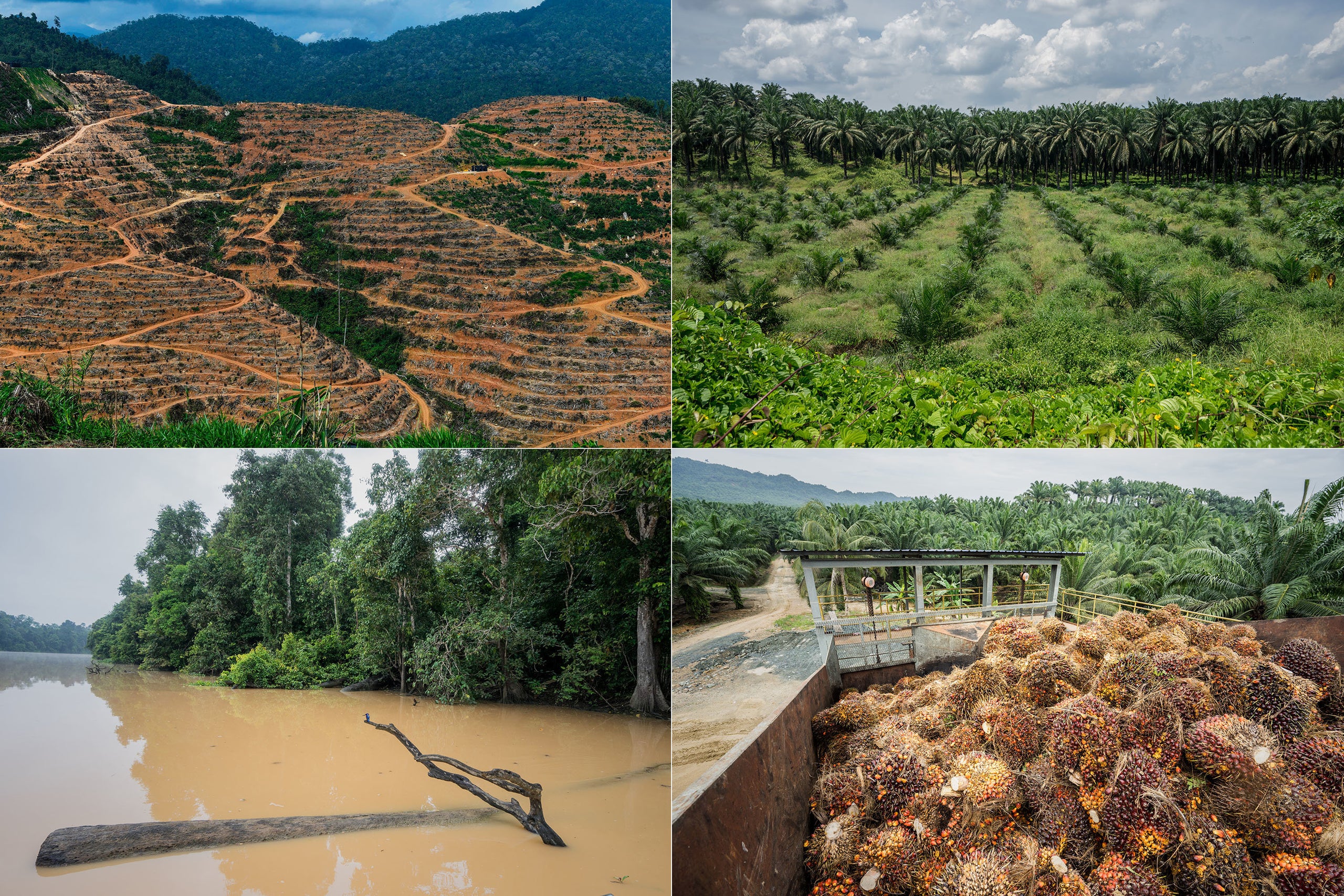
Left top: A durian plantation in Raub, on the outskirts of Kuala Lumpur. Soaring demand for durians in China is being blamed for a new wave of deforestation in Malaysia.
Right top: A palm oil plantation encroaches on a wildlife reserve in Sabah, Malaysia.
Left bottom: The Kinabatangan River flows through a wildlife reserve in Sabah, Malaysia. The overuse of pesticides during the heavy equatorial rains creates a deadly runoff into the fragile river and its tributaries.
Right bottom: A palm oil plantation and factory in Sabah, Malaysia.
Nature underpins all economies with the “free” services it provides in the form of clean water, air and the pollination of all major human food crops by bees and insects. In the Americas, this is said to total more than $24 trillion a year. The pollination of crops globally by bees and other animals alone is worth up to $577 billion.
The final report will be handed to world leaders not just to help politicians, businesses and the public become more aware of the trends shaping life on Earth, but also to show them how to better protect nature.
“High-level political attention on the environment has been focused largely on climate change because energy policy is central to economic growth. But biodiversity is just as important for the future of earth as climate change,” said Sir Robert Watson, overall chair of the study, in a telephone interview from Washington, D.C.
“We are at a crossroads. The historic and current degradation and destruction of nature undermine human well-being for current and countless future generations,” added the British-born atmospheric scientist who has led programs at NASA and was a science adviser in the Clinton administration. “Land degradation, biodiversity loss and climate change are three different faces of the same central challenge: the increasingly dangerous impact of our choices on the health of our natural environment.”
Around the world, land is being deforested, cleared and destroyed with catastrophic implications for wildlife and people. Forests are being felled across Malaysia, Indonesia and West Africa to give the world the palm oil we need for snacks and cosmetics. Huge swaths of Brazilian rainforest are being cleared to make way for soy plantations and cattle farms, and to feed the timber industry, a situation likely to accelerate under new leader Jair Bolsonaro, a right-wing populist.
Industrial farming is to blame for much of the loss of nature, said Mark Rounsevell, professor of land use change at the Karlsruhe Institute of Technology in Germany, who co-chaired the European section of the IPBES study. “The food system is the root of the problem. The cost of ecological degradation is not considered in the price we pay for food, yet we are still subsidizing fisheries and agriculture.”
This destruction wrought by farming threatens the foundations of our food system. A February report from the U.N. warned that the loss of soil, plants, trees and pollinators such as birds, bats and bees undermines the world’s ability to produce food.
An obsession with economic growth as well as spiraling human populations is also driving this destruction, particularly in the Americas where GDP is expected to nearly double by 2050 and the population is expected to increase 20 percent to 1.2 billion over the same period.
JADE MARUCUT FOR HUFFPOST
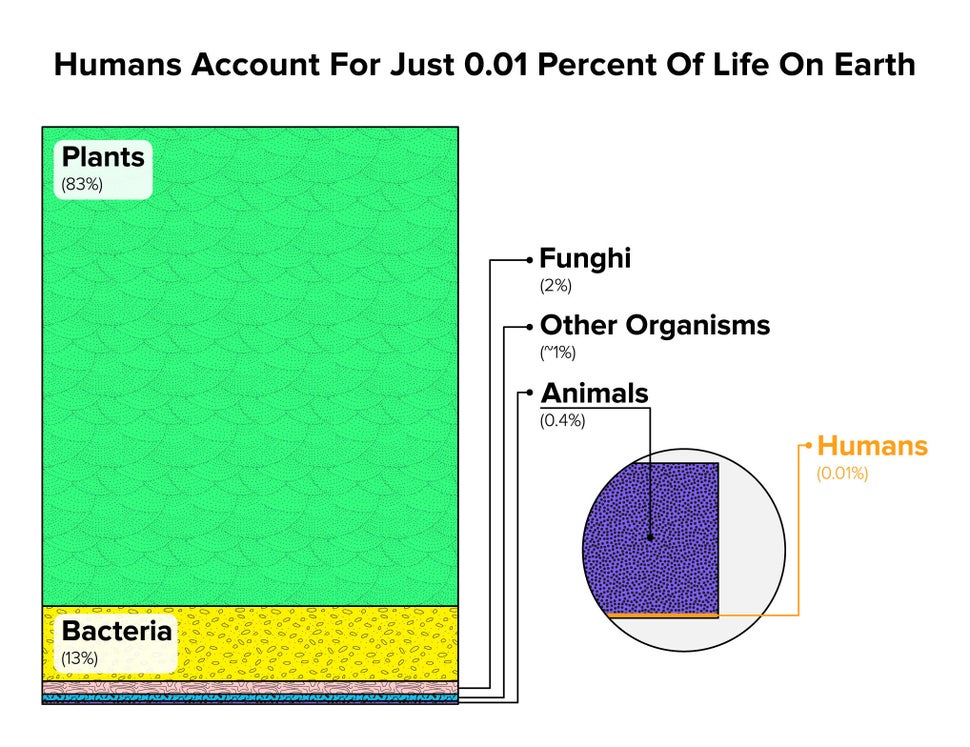
Human have had a huge impact on the world but we make up a tiny fraction of the living world. In the first ever calculation of the biomass of life on Earth, scientists found that humans make up just 0.01 percent of all living things. Source: Yinon M. Bar-On, Rob Phillips, and Ron Milo, PNAS, 2018
Nature is likely to be hit particularly hard over the next 30 years, said Jake Rice, chief scientist emeritus at the Canadian government’s department of oceans and fisheries, who co-chaired the Americas study. High consumption and destructive farming will further degrade land and marine ecosystems, he added, although the pace of destruction is diminishing because so much has already gone.
“The great transformation has already taken place in North America but the remote parts of South and Central America remain under threat. A new wave of destruction is transforming the Amazon and Pampas regions [of Latin America],” said Rice.
All of this comes at a huge cost and has implications for the systems that prop up life on this planet, throwing into doubt the ability of humans to survive.
“The loss of trees, grasslands and wetlands is costing the equivalent of about 10 percent of the world’s annual gross product, driving species extinctions, intensifying climate change and pushing the planet toward a sixth mass species extinction,” says the report.
Future generations will likely experience far less wildlife, said Luthando Dziba, head of conservation services at South African National Parks, who co-chaired the section of the IPBES report that focuses on Africa.
JADE MARUCUT FOR HUFFPOST
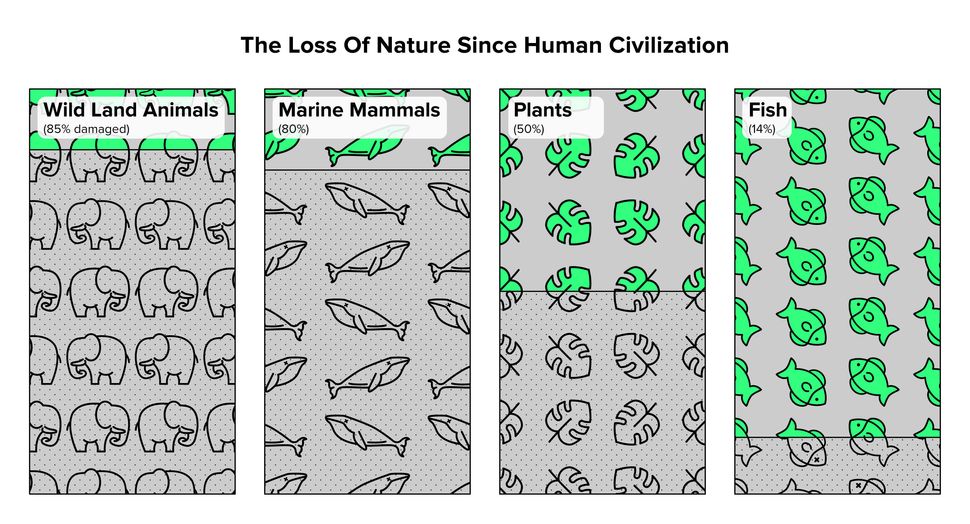
Humans have caused the loss of around 80 percent of wild land and marine mammals, and half of plants. Source: Yinon M. Bar-On, Rob Phillips, and Ron Milo, PNAS, 2018
“Africa is the world’s last home for a wide range of large mammals but the scientific consensus is that under current scenarios to 2100 more than half of African bird and mammal species could be lost,” said Dziba.
Around 20 percent of Africa’s land surface has already been degraded by soil erosion, loss of vegetation, pollution and salinization, he said, adding that the expected doubling of the continent’s population to 2.5 billion people by 2050 will put yet further pressure on its biodiversity.
While people are familiar with the threats to whales, elephants and other beloved animals, the problem goes far deeper than that. Animal populations have declined by 60 percent since 1970, driven by human actions, according to a recent World Wildlife Fund study.
And insects, vital to the diets of other animals, as well as the pollinators of our food, are facing a bleak future as populations appear to be collapsing. Land use changes and increased pesticide use are destroying habitats and vastly reducing numbers. In Europe, up to 37 percent of bees and 31 percent of butterflies are in decline, with major losses also recorded in southern Africa, according to the pollinators section of the report.
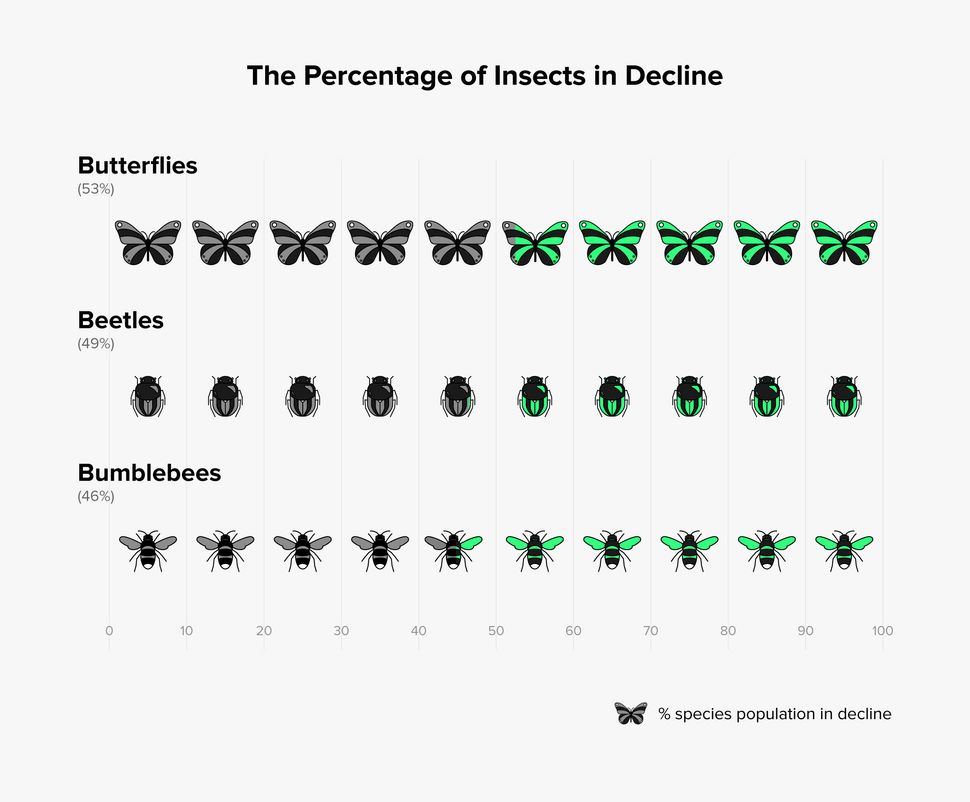
A major assessment of insect studies conducted over the last few decades found that 41 percent of insects are in decline. Source: Sánchez-Bayoa and Wyckhuy, Biological Conservation, 2019
“Species which are not charismatic have been politically overlooked,” said Rounsevell. “Over 70 percent of freshwater species and 61 percent of amphibians have declined [in Europe], along with 26 percent of marine fish populations and 42 percent of land-based animals … It is a dramatic change and a direct result of the intensification of farming,” he said.
This destruction is also driving mass human migration and increased conflict. Decreasing land productivity makes societies more vulnerable to social instability, says the report, which estimates that in around 30 years’ time land degradation, together with the closely related problems of climate change, will have forced 50 to 700 million people to migrate.
“It will just be no longer viable to live on those lands,” said Watson.
The study will also recognize that much of the remaining wealth of nature depends on indigenous people, who mostly live in the world’s remote areas and are on the frontline of the damage caused by destructive logging and industrial farming. According to IPBES, indigenous communities often know best how to conserve nature and are better placed than scientists to provide detailed information on environmental change.
Brazil – which nationwide hosts about 42,000 plant species, 9,000 species of vertebrates and almost 130,000 invertebrates – has an indigenous population of almost 900,000 people, says the report.
“What surprised me the most about this study was that it became clear that the older cultures, like the indigenous peoples of the Americas, have different values which protect nature better [than Western societies],” said Watson. “No one should romanticize indigenous peoples, and we cannot turn the clock back, but we can learn a lot from them on how to protect the planet.”
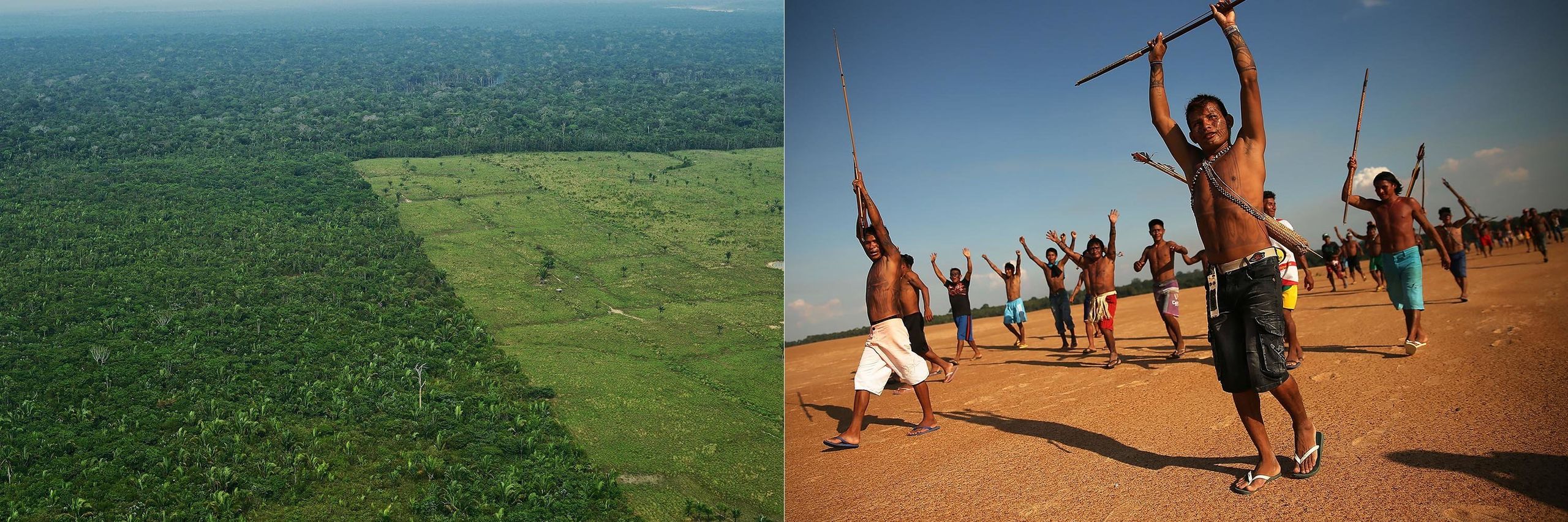
Left: Aerial view of deforestation in the Western Amazon region of Brazil.
Right: Members of the Munduruku indigenous tribe on the banks of the Tapajos River protest against plans to construct a hydroelectric dam on the river in the Amazon rainforest on November 26, 2014 near Sao Luiz do Tapajos, Para State, Brazil.
Although their conclusions are stark, the IPBES authors are not entirely gloomy about Earth’s prospects. In offering practical options for future action, they want to show that it is not too late to slow down or even reverse degradation.
The authors are expected to say in their conclusions that to avoid disaster, existing laws will have to be enforced, and further regulations put on, for example, deforestation and overfishing. Reports already published have also called for better protection of pollinators, tighter control of invasive species and greater public awareness of the decline in nature.
They will also recognize that individual and community actions to plant trees, regenerate abandoned lands and protect nature can have a major positive impact.
Many other solutions to save nature have been put forward by individuals and countries.
Several countries are taking bold initiatives to restore land, both to help meet climate targets and to protect and enhance biodiversity. Pakistan intends to plant 10 billion trees (although its previous billion tree campaign was not without controversy), Ethiopia has mobilized communities to regenerate 15 million hectares of degraded lands and the Green Wall project is pushing for a 4,970-mile long belt of vegetation across Africa. Meanwhile, the U.N. Environment program has reported a surge in the number and size of marine protected areas.
Public awareness of the crisis is also growing, with new social movements setting up to put pressure on governments to act urgently. The Extinction Rebellion movement, which began in London in October, argues that we face an unprecedented emergency. Backed by academics, scientists, church leaders and others, including Naomi Klein, Noam Chomsky and Vandana Shiva, it claims to have spread to 35 countries in its first two months. Children too are joining in. On March 15, thousands of young people across 30 countries plan to strike from school and protest against inaction on climate change.
But despite these moves to reverse the ongoing destruction of the natural world, the big picture remains worrying. Ambitious global agreements like the Aichi targets set in Japan in 2010 and the U.N.’s Sustainable Development Goals around protecting nature, may not be met at current rates of progress, say the report authors.
Ultimately, Watson concludes that saving nature will require a major rethink of how we live and how we think about nature, but that it is possible to turn this dire situation around if governments want it to happen.
“There are no magic bullets or one-size-fits-all answers. The best options are found in better governance, putting biodiversity concerns into the heart of farming and energy policies, the application of scientific knowledge and technology, and increased awareness and behavioral changes,” Watson said. “The evidence shows that we do know how to protect and at least partially restore our vital natural assets. We know what we have to do.”
For more content and to be part of the ‘This New World’ community, follow our Facebook page.
HuffPost’s ‘This New World’ series is funded by Partners for a New Economy and the Kendeda Fund. All content is editorially independent, with no influence or input from the foundations. If you have an idea or tip for the editorial series, send an email to thisnewworld@huffpost.com
A police deployment was held Thursday morning in Ottawa due to the presence of a bear in the ByWard Market area, according to the Ottawa Police Service (OPS).
According to the police, this is an adult black bear. The animal was likely to have taken refuge in a tree at a height of about 10 meters.
Ontario Ministry of Natural Resources and Forestry officers who were on site used a tranquilizer, but the bear would not have fallen from the tree.
The firefighters were called and were able to bring the animal back to the ground. The 70-kg animal was released in a forest in the Lanark area, according to the National Capital Commission.
The OPS reported receiving a call at 3:22 am on Thursday from people claiming to be followed by a bear.





 Exposing the Big Game
