Exposing the Big Game

Forget Hunters' Feeble Rationalizations and Trust Your Gut Feelings: Making Sport of Killing Is Not Healthy Human Behavior

Exposing the Big Game

Massive 12-foot alligator seized in Louisiana, two men cited for hunting violations

Exposing the Big Game's avatarCommittee to Abolish Sport Hunting Blog

https://www.knoe.com/content/news/Massive-12-foot-alligator-seized-in-Louisiana-two-men-cited-for-hunting-violations-560508901.html

CALCASIEU PARISH, La. (WAFB) – Two men were cited for alligator hunting violations Tuesday, Sept. 10, according to the Louisiana Department of Wildlife and Fisheries (LDWF).

Agents cited Jerryd Tassin, 37, of Marksville, and Hilton Rushing, 37, of Denham Springs, for taking alligators during a closed season. Tassin was further cited for taking alligators from an unapproved area. Rushing was also cited for taking alligators without a license.

A document from LDWF says the two engaged in an illegal alligator hunt Friday, Aug. 30 in Avoyelles Parish. Alligator hunting season for that part of the state didn’t open until Wednesday, Sept. 4. Investigators also learned that Tassin had one alligator tag for Calcasieu Parish and three tags for Avoyelles Parish, and that Rushing didn’t have a license, the document states.

Tassin and Rushing took three alligators in Calcasieu Parish and used two Avoyelles Parish tags on two of the…

View original post 115 more words

Scientists will face polar bears, isolation and darkness on Arctic mission to study climate change

Bremerhaven, Germany — Three hundred scientists have been training in sub-zero temperatures in preparation for the trip of a lifetime. They will spend months trapped in sea ice, as part of a year long Arctic expedition, called MOSAiC, studying the effects of climate change. The expedition sets off from Norway on September 20.

“We are looking at creating a whole picture of what the Arctic is going to do in the coming years,” said Alison Fong, who heads up MOSAiC’s ecosystems research team.

Polar bears are a major concern, and she might have to swap her microscope for a rifle scope.

“All of our scientists are trained in polar bear safety, which includes carrying a rifle for protection. When we work in remote sites on the ice, we will take small electrical fences with us and personnel carrying rifles and flare guns and other types of safety equipment,” Fong said.

Home base is a German icebreaker, the Polarstern. It will be fitted with scientific equipment, turning it into a floating laboratory.

patta-climate-arctic-ice-mission-frame-1765.jpg
The Polarstern will serve as home base for scientists studying climate change in the Arctic.  CBS NEWS

What happens in the Arctic doesn’t stay in the Arctic. It’s generally considered an early warning system for the impact of climate change, and scientists are hoping the expedition on this ship will raise their understanding of it to a whole new level.

Getting a taste of what lies ahead, the scientists practiced using a remotely controlled device which measures light through the ice, and drilling through the core to assess ice thickness.

The Arctic is warming faster than anywhere else on Earth but scientists have never been able to conduct research in the remote northern parts of it during winter. Now they will attempt an unprecedented scientific mission. The crew will sail close to the North Pole, cut the engine and wait for water to freeze around the vessel. They will then simply drift with the ice flow.

“You have seen that in the U.S. at the beginning of this year when the snowstorms and blizzards went down to Florida — that is all driven by climate change in the Arctic, and we need to understand that to understand how our extreme weather in the future will look like,” said Markus Rex, the expedition leader.

patta-climate-arctic-ice-mission-frame-2660.jpg
Scientists will brave the Arctic in order to study the effects of climate change.  CBS NEWS

Mental fortitude during this mission is a formidable challenge. The scientists are bracing themselves for long periods of total isolation and complete darkness. In the winter months they will never see daylight. But freezing yourself in ice is worth it, they believe, if it helps save humanity from the extreme consequences of a warming world.


CBS News, along with more than 250 news outlets worldwide, is participating in the Covering Climate Now project, a joint initiative founded by the Columbia Journalism Review and The Nation magazine. CBS News, the only broadcast network, is devoting this week to covering climate change, leading up to the United Nations Climate Action Summit  in New York on September 23.

The Ugly Side of Wildlife Tourism

https://thewire.in/the-arts/the-ugly-side-of-wildlife-tourism

Kirsten Luce’s photographs focus on the problems with ‘selfie tourism’.

With the growing popularity of Instagram and the “selfie” has come the search for the ultimate photo.

Now a growing industry offering access to animals in wildlife sanctuaries is emerging as the latest trend on social media.

“Without a doubt, the demand for this type of photo, to sit down next to a wild animal and have your photo taken, has grown exponentially because of social media,” says Kirsten Luce, an American photographer whose work previously concentrated on Latin American migrants in the state of Texas.

Thailand and Russia

While working on a project in Brazil, Peru and Colombia on the rise of selfie tourism, Luce realised just how big a problem it was.

She felt more research was needed and decided, along with her reporter, to focus on Thailand and Russia.

Chinese tourists at a crocodile centre in Thailand, taken by Kirsen Luce. Photo: RFI/Anne-Marie Bissada

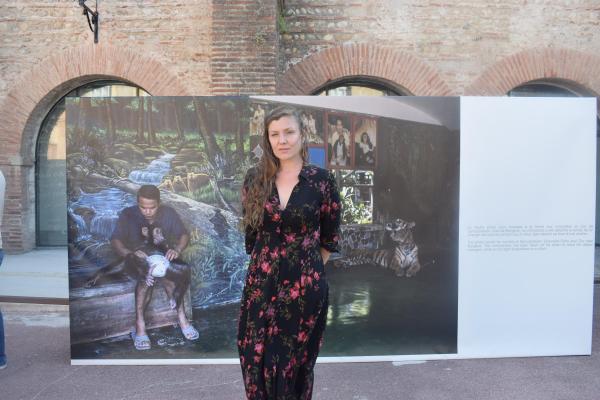
“We were looking at where native species were exploited for the entertainment of tourists,” Luce explains on the sidelines of her exhibition at the Visa pour l’image photojournalism festival in Perpignan, France.

“In Thailand, everybody goes looking for an experience with the Asian elephants. They also have a lot of tiger experiences, so that was an obvious choice.

“Since we had already looked at a lot of tropical places, we wanted something tonally and texturally different. In Russia we found that travelling marine mammals are exploited at a large number as are bears and even polar bears.”

Image of bears performing for the ice circus in Russia from Kirsten Luce’s exposition. Photo: RFI/Anne-Marie Bissada

It’s a topic that hits hard through its raw imagery.

Many people at the expo took the time to talk to Luce about what she saw and how they can help.

“With a project like wildlife tourism, I think because people have never really seen the topic tackled, they are universally responding by condemning it,” she says.

“I’ve never produced a body of work that has gotten such an emotional response from virtually everybody. Everybody wants to do something to stop it and I’ve even had people say to me, how are you able to sleep at night, it must be the hardest thing to witness?”

Images and access

Photo from Kirsten Luce’s photo exposition. Photo: RFI/Anne-Marie Bissada

But prior to visiting the sanctuaries, Luce and her reporter met former trainers, veterinarians and animal rights activists. They would explain how the animals were often mistreated or prepared before an audience to look healthy, especially if tourists were visiting an “ethical” venue such as those offering bathing with elephants.

“The animal rights activists and trainers that had turned away from the field would give us tips and clues as to what to look out for in behaviour, and also whether or not teeth or claws had been removed,” explains the photographer.

Image of a chained tiger seated on a platform in Kirsten Luce’s exposition. Photo: RFI/Anne-Marie Bissada

Impact

The beauty of photography is in capturing a moment in time – and how that moment can make an instantaneous connection with viewers.

In an elephant sanctuary in Thailand, one such photo brought about change.

“It was clear he needed vet care,” says Luce about the young elephant that was kept away from the public because he had a broken leg. “They claimed they were treating him.

Also read: The Story of How the Orphaned Tigress of Bandhavgarh Was Rehabilitated

“We had a fixer go back a couple of times to check on him – he would be in the exact same position. We knew that the elephant was not getting the care he needed.

“That photo got a lot of movement. There was a lot of pressure, and he was finally purchased and moved to a sanctuary,” Luce says, adding that it was a rare occurrence of a happy ending.

But the owner of the wildlife centre has many more elephants there, and the wider industry continues to thrive, catering for wildlife consumers.

Wildlife ‘likes’

In Russia, a burgeoning industry has kept photographer Olga Barantseva busy, fulfilling people’s desire to pose with a big bear.

Barantseva has nearly a hundred thousand followers on Instagram.

Stepan, the bear used in Barantseva’s photos, was a former circus bear, likely abused into submission, says Luce, which would explain his apparent docile nature that allows him to pose with humans.

Also read: What Happened to the Women in Photography?

Another phenomenon Luce experienced in Russia was the travelling dolphin shows.

“These marine mammals are living and performing in inflatable tents, almost like a circus would come to town for six weeks,” she says. “These belugas and dolphins would be living in tanks for six months.”

The travelling shows do not provide proper water filtering or medical attention, which almost certainly leads to premature death, and to keep up numbers, fresh stock is replaced illegally through poaching in the Black sea, according to Luce.

Editorial: Climate change is already here. 2020 could be your last chance to stop an apocalypse

Climate change opinion series part 1

(Shonagh Rae)

The world is drifting steadily toward a climate catastrophe. For many of us, that’s been clear for a few years or maybe a decade or even a few decades.

But others have known that a reckoning was coming for much longer. A Swedish scientist first calculated in 1896 that adding carbon dioxide to the atmosphere could lead to warmer global temperatures. By the 1930s, scientists were measuring the increase, and in the late 1960s, they had documented the impact of melting ice in Antarctica. By 1977, Exxon-Mobil had recognized its own role in the warming of the ocean, the polar ice melt and the rising sea level.

For obvious reasons, Exxon-Mobil launched a massive public disinformation campaign to muddy the science and downplay the danger. But in retrospect, it needn’t have bothered. Because even after the facts became incontestably clear, the world did shockingly little to protect itself. In the first 17 years after the Kyoto protocol committed its signatories to reducing greenhouse gas emissions, global emissions continued to rise. Decades of studied ignorance, political cowardice, cynical denialism and irresponsible dithering have allowed the problem to grow deeper and immeasurably harder to solve.

But today, we are at an important turning point. The changing climate is no longer an abstract threat lurking in our distant future — it is upon us. We feel it. We see it. In our longer and deeper droughts and our more brutal hurricanes and raging, hyper-destructive wildfires. And with that comes a new urgency, and a new opportunity, to act.

Climate change is now simply impossible to ignore. The temperature reached a record-breaking 90 degrees in Anchorage this summer and an unprecedented 108 degrees in Paris. We can watch glaciers melting and collapsing on the web; ice losses in Antarctica have tripled since 2012 so that sea levels are rising faster today than at any time in the last quarter-century. Human migration patterns are already changing in Africa and Latin America as extreme weather events disrupt crop patterns, harm harvests and force farmers off their land, sending climate refugees to Europe and the United States.

It’s often difficult to attribute specific events to climate change but, clearly, strange things are happening. In India, entire cities are running out of water, thanks, scientists say, to a dangerous combination of mismanagement and climate change. In Syria, the civil war that has killed hundreds of thousands of people and displaced more than 11 million is believed by many scientists to have been sparked at least in part by climate-related drought and warming. Closer to home, two invasive, non-native mosquito species that have the potential to transmit viruses, including dengue, Zika and yellow fever have recently been found in several California cities.

According to NASA, 18 of the 19 warmest years ever recorded have occurred since 2000. The last five years have been the hottest since record-keeping began in 1880. July set an all-time record.

Here’s another reason we’re at a turning point (at least in the United States): An election is coming.

For three years, Americans have been living under the willfully blind, anti-scientific, business-coddling rule of President Trump, who has stubbornly chosen climate denial over rationality. We now have an opportunity to resoundingly reject his policies by voting him out of office, along with congressional Republicans who enable him. There are plenty of reasons to fight for Trump’s defeat in November 2020, but his deeply irresponsible climate policies — including moving to pull the U.S. out of the Paris climate agreement, roll back Barack Obama’s emission limits on coal-fired plants, rescind rules governing methane emissions and relax national fuel emission standards — are among the strongest.

It is late — terribly late — for action, but with some luck, perhaps it is not too late to avoid some of the worst impacts of climate change. In nations across the world, people finally recognize climate change as a top or very serious threat, according to the Pew Research Center. In the U.S., even Republican voters — and especially younger ones — are waking up to the realities and dangers of a warming planet.

Fewer and fewer people today doubt the overwhelming scientific evidence: By burning fossil fuels for energy, humans have added so much carbon (and other greenhouse gases) to the atmosphere that we are changing nature itself, imperiling the delicate interdependence among species and putting our own survival at risk. Scientists say with certainty that we must radically transform how we make and use energy within a decade if we are to have any chance of mitigating the damage.

There are plenty of reasons to fight for Trump’s defeat in November 2020, but his deeply irresponsible climate policies … are among the strongest.

But figuring out what must be done at this late stage is complicated. There are a wide range of emissions sources and many ways to approach them, ranging from the microsteps that can be taken by individuals — Do you have to take that car trip? That airline flight? — to the much more important macro-policies that must be adopted by nations.

Globally, 25% of greenhouse gas emissions today comes from burning fossil fuels to create heat and electricity, mostly for residential and commercial buildings; another 23% is the result of burning fuel for industrial uses. And 14% comes from transportation.

All that burning of carbon fuels needs to end; yet unless policies and politics change dramatically, it won’t end. Even in this time of heightened clarity, two-thirds of new passenger vehicles bought in the U.S. last year were gas-guzzling pickup trucks and SUVs. Those SUVs will be on the road an average of eight years, and the pickups for more than 13 years, as the time to address the climate problem slips away. Blame for this falls not just on consumers, but also on the manufacturers and the government, which has done too little to disincentivize the driving of gas-powered cars.

In the years since Kyoto, the world has undertaken significant efforts to ratchet down energy consumption, curtail coal burning (the dirtiest of the fossil fuels) and turn to renewable energy sources, yet overall emissions have increased. Today there are 7.7 billion people on the planet — twice as many as 50 years ago — and more people means more demand for power, especially in fast-growing countries such as India and China. Last year saw a global acceleration of emissions, as total carbon levels in the atmosphere reached 414.8 parts per million in May, the highest recorded in 3 million years. The richer human society becomes, it seems, the more we poison the world.

At this point, the mission is no longer to avert or reverse climate change, but to mitigate its worst effects (by continuing to reduce emissions and slow warming) and to adapt to others. Adaptation might mean retreating from coastal developments as the seas rise or elevating roads and installing flooding pumps (as the city of Miami is already doing), or creating carbon sinks to remove carbon dioxide from the atmosphere, all while continuing to try to curtail further emissions.

None of this is cheap or easy, but neither is the alternative. 2017 ranks as the costliest year for severe weather events and climate disasters worldwide; in the U.S. there was more than $300 billion in cumulative damage, according to the National Oceanic and Atmospheric Administration. Obviously, the cost of dealing with inundated coastal areas — home to as many as 650 million people, or 8% of the world’s population — will be extraordinarily high. And that’s only one of the dangers on the horizon. We can expect people to be displaced by drought, river flooding, hurricanes and typhoons. Parts of the world can expect more food shortages, which some experts believe will lead in turn to political instability, civil unrest and mass migration. The U.S. military rightly refers to climate change as a “threat multiplier.”

Fighting the rise in temperature and sea levels will be tough. Our democracy doesn’t encourage politicians to take bold stances; our economic system doesn’t encourage companies to sacrifice profits for the common good. And we humans are understandably disinclined to live differently or to make sacrifices. But we must stop dawdling and forge ahead if we are to protect ourselves and our planet.

This is Part 1 of a three-part series on climate change.

Tsunamis, wildfires followed dinosaur-killing impact

Exposing the Big Game's avatarThe Extinction Chronicles

A new study that analyzed rock from deep within the Chicxulub impact crater helps reveal what happened within the first 24 hours after the asteroid impact that doomed the dinosaurs.

Flaming debris falling from roiling orange clouds with screaming dinosaurs in foreground.

Image via Curtin University.

Scientists have long believed that the end of the dinosaurs came as a result of a giant asteroid that crashed into Earth about 66 million years ago. Now, a new study by an international team of geologists, published in the peer-reviewed journal Proceedings of the National Academy of Sciences on September 9, 2019, has found hard evidence of the theory by analyzing the hundreds of feet of rocks that filled the impact crater within the first 24 hours after impact.

The geologists say the evidence shows that the asteroid impact caused wildfires, triggered tsunamis and blasted so much sulfur into the atmosphere…

View original post 723 more words

Jokowi Orders Crackdown on Arsonists: SE Asia Haze Update

Exposing the Big Game's avatarThe Extinction Chronicles

 Updated on 
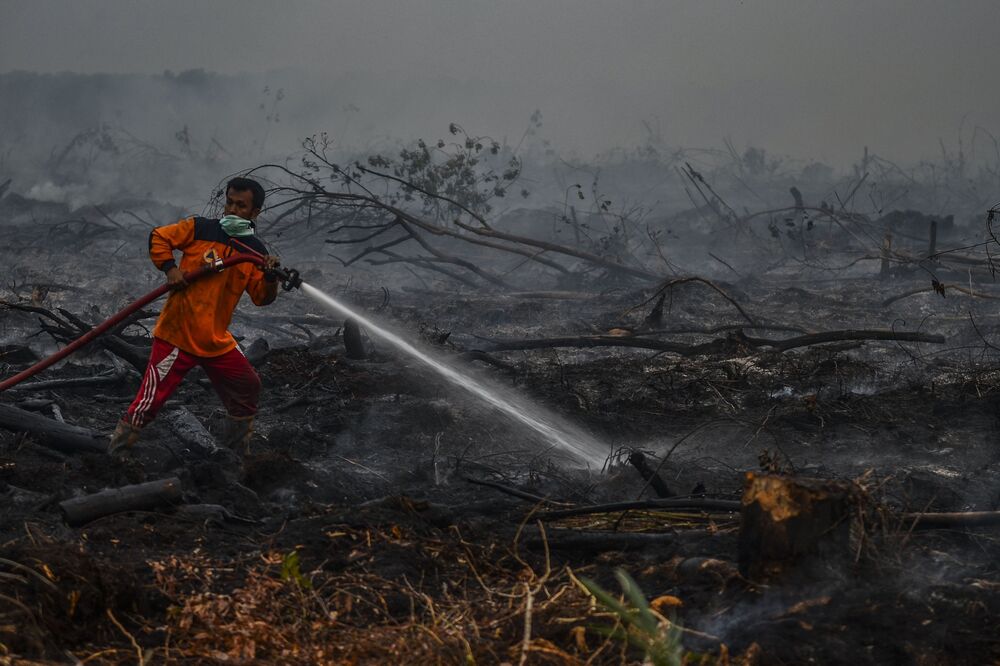
Firefighters battles a forest fire in Kampar, Riau Province on Sept. 9.
Firefighters battles a forest fire in Kampar, Riau Province on Sept. 9. Photographer: Wahyudi/AFP via Getty Images

Indonesian President Joko Widodo ordered a crackdown against individuals and companies responsible for forest fires that have caused a dangerous haze in parts of Southeast Asia, disrupting air travel and closure of schools.

Jokowi, as Widodo is commonly known, held a limited cabinet meeting in Pekanbaru in Riau, one of the worst affected areas, late on Monday to review steps to fight the fires, his office said in a statement. The president directed the disaster mitigation agency to expand the scope of artificial rain even as authorities deployed an additional 5,600 troops and firefighters.

Stinging smoke from illegal burning to clear land for palm oil and paper plantations has covered…

View original post 715 more words

More details: Man killed in Reeseville hunting incident

Exposing the Big Game's avatarCommittee to Abolish Sport Hunting Blog

Police siren lights light bar squad car

REESEVILLE — Authorities said a 65-year-old man is dead following a squirrel hunting incident Tuesday morning near Reeseville.

A call came into the Dodge County Sherriff’s office shortly before 8 a.m.

Play
Current Time0:00
/
Duration Time0:00
Stream TypeLIVE
Loaded: 0%
Progress: 0%
0:00
Fullscreen
00:00
Mute

Department of Natural Resources public information officer Joanne Haas said a party of three was hunting near Mud Lake on state property. The incident involved two brothers. A 61-year-old man told authorities he saw movement and shot his 65-year-old brother accidentally.

The Wisconsin DNR is investigating the accident with the assistance of the Wisconsin State Patrol and the Dodge County Sheriff’s Office.

View original post

One person dead in Dodge County hunting accident

Exposing the Big Game's avatarCommittee to Abolish Sport Hunting Blog

Posted: 11:23 AM, Sep 17, 2019

https://www.tmj4.com/news/local-news/one-person-dead-in-dodge-county-hunting-accident

Updated: 9:24 AM, Sep 17, 2019

DODGE COUNTY — The Dodge County Sheriff says one person has died in a hunting-related incident Tuesday morning.

image_from_ios (3).jpg

Law enforcement were called to County G and Mud Lake Road at around 7:00 a.m. Tuesday. Sheriff Dale Schmidt says it’s being treated as a death investigation.

image_from_ios (4).jpg

Schmidt says it’s still early in the investigation, but they are working closely with the Wisconsin Department of Natural Resources as they look into what happened.

This is a breaking news story. Stay with TODAY’S TMJ4 for additional updates.

View original post

Lion trophy approved for import into U.S., stirring controversy. Here’s why that matters.

Advocates question how this action benefits lions in the wild—a requirement under U.S. rules.

A FLORIDA TROPHY hunter has permission to import what is thought to be the first lion trophy from Tanzania since January 2016, according to the Center for Biological Diversity, an Arizona-based nonprofit that advocates for endangered species.

In that year, two subspecies of African lions were listed as threatened under the U.S. Endangered Species Act, meaning that those lions can be killed for trophies only if it can be shown that the hunts would enhance the survival of the species in the wild.

In May, the U.S. Fish and Wildlife Service, the agency that oversees trophy hunting imports to the United States, approved a hunter’s application to import the skin, skull, claws, and teeth of a lion killed in Lukwati North Game Reserve, a hunting concession leased from the government and run by Tanzanian safari operator McCallum Safaris. That’s according to records obtained from a Freedom of Information Act request submitted by Tanya Sanerib, international legal director for the Center for Biological Diversity. (See more from FOIA: We asked the government why animal welfare records disappeared.)

The hunter, whose identity could not be confirmed by National Geographic, originally applied to import a lion trophy from Tanzania in November 2016. It’s unclear exactly when he killed the lion. Nor is it clear whether the trophy has been imported. The permit to do so, issued by the Fish and Wildlife Service, expires in May 2020, a year after it was issued.

African lions have disappeared from 94 percent of their historic range, and populations have halved, to fewer than 25,000 since the early 1990s, according to the nonprofit Wildlife Conservation Network. The main causes of the decline are retaliatory killings of lions that attack villagers and depletion of their prey animals. Tanzania is home to 40 percent of Africa’s lions.

Sanerib, who calls the country a “stronghold” for lions, worries that the decision by the Fish and Wildlife Service could be a signal that the Trump administration will “open the floodgates” for future Tanzanian trophy imports for lions and other species, including elephants. The news of this approval of a lion import comes on the heels of a decision last week to allow a U.S. hunter to import a black rhino trophy killed last year in Namibia.

According to Laury Marshall Parramore, a spokeswoman with the Fish and Wildlife Service, “Legal, well-regulated hunting as part of a sound management program can benefit the conservation of certain species by providing incentives to local communities to conserve the species and by putting much-needed revenue back into conservation.”

Sanerib says she’s concerned about the lack of detail in the Fish and Wildlife Service’s determination that this hunt enhances lion conservation in Tanzania. She claims that the service didn’t do due diligence when approving the import permit. As part of her FOIA request, she says she obtained emails in which the service asked general questions of Tanzanian government officials, such as whether they were monitoring trophy hunting.

“Those are not the basic questions that I think that our government should be asking before we approve these types of practices. We should be way down in the weeds, getting all of the details to ensure that these programs are actually going to enhance the survival of species.”

“Organizationally, we’re opposed to trophy hunting—we don’t think we should be killing threatened and endangered species,” Sanerib says. “But if we are going to do it, if it is going to happen, Fish and Wildlife Service needs to follow the law, and they really need to ensure—and this is their own regulatory requirements—that this program has all the adequate safeguards to ensure that it’s going to be sustainable for the lion population.”

The Fish and Wildlife Service did not respond to a request for specific information about how this hunt benefits lions in Tanzania and for reaction to Sanerib’s concerns.

The lion decision is particularly troubling given Tanzania’s history of mismanaging trophy hunting, Sanerib says. In 2017, Hamisi Kigwangalla, Tanzania’s minister for natural resources and tourism, revoked hunting concession lease permits that previously had been issued to companies for a low set fee, citing a need for greater transparency about the process. The government then began auctioning off concession leases instead. But according to biologist Craig Packer, who had studied lions in Tanzania since the late 1970s, only undesirable concessions were put up for auction, a move he calls a “halfhearted” effort to reform.

Kigwangalla did not respond to a request for comment.

In 2015, Packer was barred from entering the country after he characterized the nation’s trophy hunting industry as corrupt. Trophy hunters are supposed to target only older male lions, thought to be less crucial to reproduction, but Packer says there was no accountability or oversight by Tanzania to ensure that this was happening. As trophy hunting declined in popularity, Packer says, concession operators charged hunters fees so low that they couldn’t possibly be providing enough revenue to maintain roads, hire rangers, and prevent illegal farming or grazing in the hunting reserves.

Whether this particular trophy import is good or bad depends on whether the hunt was shown to have a conservation benefit, Packer says. If the U.S. is rewarding responsible hunting operators, it will incentivize others to follow suit. “As long as the sport hunters are showing that they’re making a positive impact, good on them,” he says. “It would be great if the system is actually forcing some kind of reform.” But, he adds, the Fish and Wildlife Service “has no way of confirming whether Tanzania’s well-meaning policies are really being implemented.”

Representatives from the Tanzania Wildlife Authority, which implements the country’s Wildlife Conservation Act, the Tanzania Wildlife Research Institute, an organization under the Ministry of Natural Resources and Tourism that conducts wildlife research, and the Tanzania Tourist Board did not respond to requests for comment about how the country manages its trophy hunting.

John Jackson, a member of the International Wildlife Conservation Council, an advisory group to the Secretary of Interior, is the Florida hunter’s attorney. Jackson welcomes more frequent trophy imports from Tanzania and says the U.S. Fish and Wildlife Service has been “too slow” to issue these permits—a pace Jackson calls “inexcusable.” Since 2016, he says, many hunting operators have had to surrender their lands because of a lack of revenue, which leaves the animals in those lands unprotected. More frequent trophy hunts would allow concession operators to afford anti-poaching safety measures. “Hunting is the single most important mechanism to save lion,” he argues.

Jackson disagrees that Tanzania’s trophy hunting is mismanaged. As home to about 40 percent of Africa’s lions, he says, the country has “managed to save more lions than anybody else.”

“I wish there was another country equal to it,” he says. “It’s easy to criticize people, but it’s much more important to work with them and support them.”

Sanerib says Tanzania deserves credit for having a “phenomenal system” of protected areas but that its lion conservation success has been despite trophy hunting rather than because of it.

Elephants too?

The U.S. Fish and Wildlife Service’s findings for lions also could apply to elephants, Sanerib says. In 2014, the Obama administration effectively banned trophy imports of elephants from Tanzania because of a poaching crisis in the country and concerns about the management of its trophy hunting industry. Sanerib says this lion trophy import decision may indicate that the Trump administration plans to overturn that ban.

In 2017, the service reversed the ban on elephant trophy imports from Zimbabwe. “So we have some history—some very recent history—to point to as evidence of them, I would say, leaping before they take a look,” Sanerib says. (After President Trump tweeted his dissatisfaction with the Zimbabwe decision, the service reversed course and decided to evaluate applications on a case-by-case basis. Since then, no elephant trophies are known to have been imported from Zimbabwe.)

Anna Frostic, the managing wildlife attorney for the Humane Society, says the decisions to issue lion and black rhino trophy import permits indicate that there are more to come. She says the Fish and Wildlife Service “is making these decisions behind closed doors and without the input of independent scientists and the public.”

“The issuance of this one lion trophy import from Tanzania will likely be replicated and applied to the more than 40 other applications for Tanzania lion trophies that are pending,” she says.

Even though Tanzania is a stronghold for lions, she says the fact that overall lion numbers are dwindling means this potential new pattern is “extremely concerning.”

“The decision to legitimize that type of activity,” Frostic says, “is not only unethical and scientifically unjustifiable but is unlawful” based on the decision’s merits and because of the service’s lack of transparency in its decision making.

More than 80 tigers die after being removed from Thailand tourist trap

https://nypost.com/2019/09/16/more-than-80-tigers-die-after-being-removed-from-thailand-tourist-trap/

More then 80 tigers have died after they were rescued from a Thailand tourist attraction dubbed Tiger Temple, a report said.

A total of about 87 felines died from a virus they had contracted after being held at the The Wat Pha Luang Ta Bua Yanasampanno temple west of Bangkok, according to London’s Independent newspaper.

“When we took the tigers in, we noted that they had no immune system due to inbreeding,” said a senior official from Thailand’s department of national parks, wildlife and plant conservation.

The official said the animals were susceptible to the canine distemper virus.

While the tigers were living at the temple, monks charged admission for people to take photos with them and bottle feed their cubs.

But the tigers needed to be removed from amid allegations that they were being drugged and illegally bred.

Local media reports claim that as many as 87 of the 147 creatures taken from the temple have died.

During a raid of the temple, Thai officials found 40 dead tiger cubs in a freezer along with 20 glass jars containing baby tigers and tiger organs.

Also, a monk tried to flee with 700 vials of tiger skin and a suitcase full of tiger teeth.