The spread of a fast-moving virus outside of China is of “grave concern” and has prompted the World Health Organization to reconvene an emergency meeting this week to decide whether it’s a global health emergency.
“The evolution of the outbreak and further development of transmission, these are of grave concern,” says WHO official Dr. Mike Ryan.
World Health Organization Director-General Tedros Adhanom Ghebreyesus speaks during a press conference following an emergency talks over the new SARS-like virus spreading in China and other nations in Geneva on January 22, 2020.
Pierre Albouy | AFP | Getty Images
The spread of a fast-moving virus outside of China is of “grave concern” and has prompted the World Health Organization to reconvene an emergency meeting this week to decide whether it’s become a global health emergency, WHO officials said Wednesday.
SALT LAKE CITY (KUTV) – If you’re behind on your child support payments, this new Utah bill could prohibit you from hunting or fishing.
H.B. 197, sponsored by Rep. Karianne Lisonbee, would ban people who aren’t up to date on their child support payments from getting a license, permit or tag related to fishing or hunting in the state of Utah.
The bill would prohibit anyone who owes $2,500 or more child support from obtaining the legal permits from the Utah Division of Wildlife Resources.
An individual would only be allowed to buy a permit after they are no longer behind on payments and the Office of Recovery Services has made…
The Missouri Cattlemen’s Association is against the Missouri Department of Conservation’s ban on hunting feral hogs on public land which requires landowners to have a permit for thermal scopes and other equipment for hunting on their land.
Jeff Reed with Rolling Shoals Farm in Williamsville says his cow-calf operation is surrounded by Mark Twain National Forest which has become a harbor for feral hogs, which have caused a lot of damage, “We can document 40 to 50 Thousand dollars in loss, each year, to the feral hog.”
Reed says the Conservation Department has tried to trap the animals but with little success because of how smart the hogs are and the difficulty of moving the large metal traps in wooded areas. He tells Brownfield the department should not require landowners to have a…
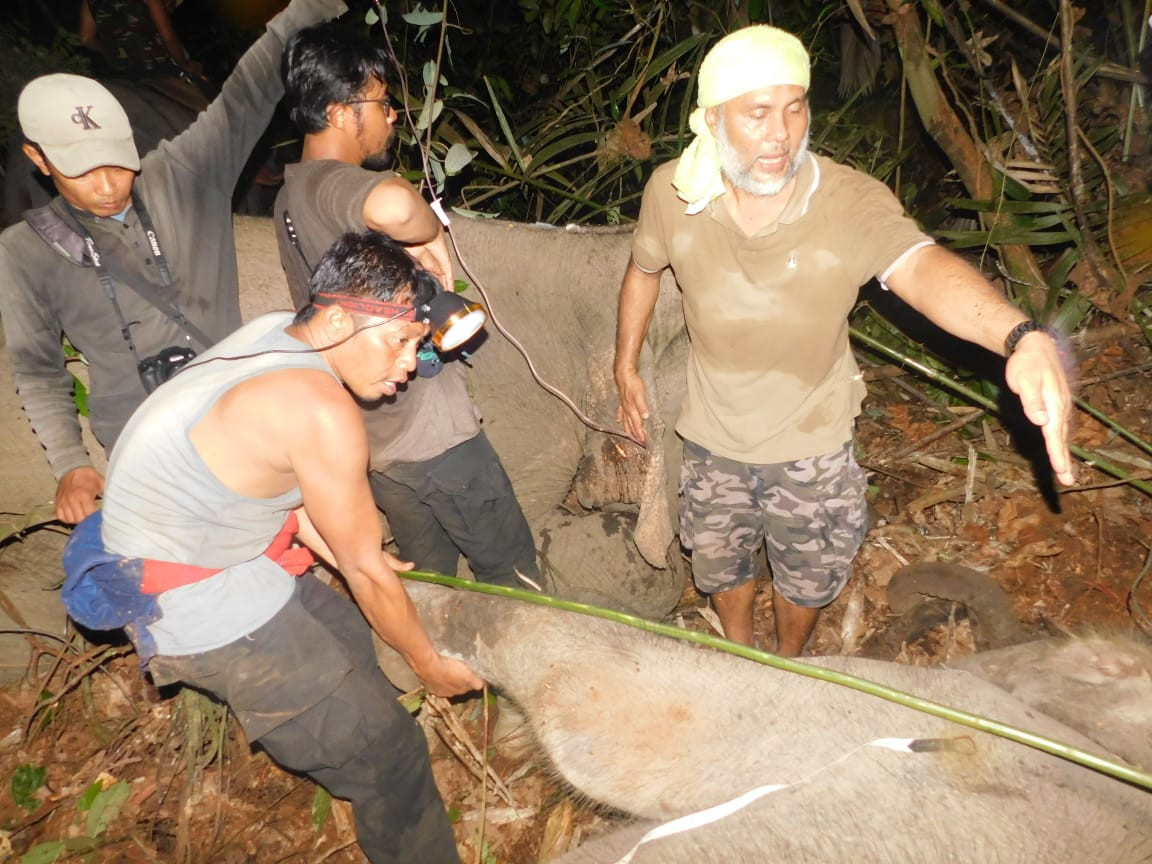
A team of staff and volunteers from the BBKSDA, the Tesso Nilo National Park Foundation, the Leuser Conservation Forum and other wildlife protection organizations help an injured elephant that fell into a trap in Bengkalis regency, Riau. (BBKSDA Riau/-)
A 5-year-old male elephant was wounded in Bengkalis regency of Riau after stepping into a trap.
Riau Natural Resources Conservation Agency Center (BKSDA) spokesperson Dian Indriati said the agency had yet to find where exactly the trap had been set up.
“We learned about the incident after an employee of PT Arara Abadi spotted the elephant, as well as 30 other elephants of the same herd, walking around the company’s concession area on Jan. 21,” Dian said.
A joint team comprising of staff and volunteers of the BBKSDA Riau, the Tesso Nilo National Park Foundation, the Leuser Conservation Forum as well as other wildlife protection organizations went to the location where the injured elephant was last seen following the employee’s report.
After tailing and observing the elephant herd for days, they finally found the injured elephant on Sunday.
“We shot him with a tranquilizer dart at 5:45 p.m. after he was separated from his herd,” Dian said.
After the elephant fell unconscious, the team extracted the nylon trap quickly to treat his injured right foot.
“We finished treating his injury at 8:45 p.m,” she said, adding that the team released the elephant at the same location where he had been found.
“His herd members were around when we treated his injury. He rejoined them after he awoke,” Dian added.
According to the conservation agency, hunters and local residents often set up traps to catch wild animals, which many locals consider pests.
In a bid to curb illegal hunting and protect wildlife, BKSDA Riau personnel dismantled 170 traps in November last year set up around conservation areas in the province.
Prior to the operation, at least 11 wild animals — including four elephants, three Sumatran tigers, two bears and two tapirs – were killed or injured by the traps set up at several wildlife reserves, including Giam Siak Kecil, Kerumutan and Zamrud National Park, according to the agency’s data. (dpk)
A domestic helper from the Philippines reads about a Filipino woman’s death in Hong Kong from SARS in March 2003.PETER PARKS/AFP VIA GETTY IMAGES
HONG KONG — Sometimes history seems to unspool in a continuous playback loop. That is the feeling I get from watching Hongkongers donning face masks, dousing hands with sanitizer, and once again bracing for the possibility that a deadly new coronavirus outbreak originating in mainland China will spread here.
Chinese authorities’ delayed response, the secrecy breeding mistrust, the lack of full transparency, and efforts to control the narrative by downplaying the seriousness — it all rings sadly familiar.
Public health emergencies should be handled quickly, transparently, and devoid of political considerations. But public health is inherently political and, with anything involving China, politics can never be fully excised. For Chinese Communist officials, particularly at the provincial level, there is an innate tendency to cover up and conceal, their long-imbued penchant for secrecy always taking precedence over trifling concerns like promoting public awareness and advocating proper precautions.
ADVERTISEMENT
SPONSOR CONTENT
The future of science and drug discovery
Genentech’s Mike Varney shares his perspective on three trends that will shape the biotech industry and healthcare in the next decade.
BY GENENTECH
That was certainly the case in late 1997, just after China’s assumed sovereignty over Hong Kong, when the territory was hit by an outbreak of the H5N1 virus known as “bird flu.” Well into the outbreak, with people sick and some dying, Hong Kong officials were reluctant to finger China as the source, even though 80% of the territory’s poultry came from the mainland. Hong Kong ordered the slaughter of more than 1.3 million chickens, ducks, pigeons, and other birds, but officials were still nonsensically hesitant to point to China as the culprit behind the contagion out of fear of contradicting Beijing, which insisted — wrongly — that all its chickens were healthy.
The same obfuscation and denial came from China’s Communist authorities in reaction to the severe acute respiratory syndrome (SARS) epidemic, also caused by a coronavirus, in late 2002 and 2003. Even as the virus spread, Chinese officials continued to undercount cases and delay reporting information to the World Health Organization.
The government did not warn the public for months, allowing people carrying the virus to migrate freely, and did not alert the WHO until February 2003. China finally began concerted action in the summer of 2003 and SARS was quickly brought under control. But the inadequate reporting and delayed response led to a public health trust deficit that persists today.
Like bird flu in 1997 and the SARS epidemic of 2002 to 2003, the newest coronavirus has originated in the mainland, this time in Wuhan, most likely in a market where exotic wild animals are sold. Like before, there are suspicions that in these early stages the number of confirmed cases were undercounted, underreported, or both. Like before, there were delays and denials, with Wuhan officials initially downplaying the virus as mild, treatable, and contained while dismissing the likelihood of human-to-human transmission. Those who disagreed online were questioned by police for spreading “false rumors.”
But 2020 is not 1997, nor even 2003. China’s public health infrastructure and reporting system have become more reliable. Most importantly, internet use and penetration in China today makes it virtually impossible for a cover-up to last for long. Despite censorship of some news about the coronavirus — including blocking foreign media websites — social media platforms have been filled with debate, discussion, and questions from citizens asking what precautions they should take.
State media has also made much of President Xi Jinping’s instruction to local officials to open up about the number of cases and the severity of the epidemic or risk consequences. And WHO investigators and Hong Kong specialists have been allowed to visit Wuhan.
Does this signal that Beijing is opting for a new policy of transparency this time?
“It’s still very mixed,” said my colleague, King-wa Fu, who studies Chinese censorship patterns at the University of Hong Kong. “We see censorship. But we also see a lot of discussion online. We’ll have to wait and see.”
The rapid spiral in the number of identified cases of infection with the coronavirus, and the new draconian measures taken, like effectively quarantining Wuhan at the start of the busy Lunar New Year travel period, breeds suspicion that the real picture may be far worse than officials even now admit.
Even the quarantine smacks of too little, too late. It seems ill-planned, and likely to be largely ineffective. First there is the near impracticality of sealing off a city of 11 million people, larger than the populations of Hong Kong or New York City. The move was taken the day before the New Year’s Eve travel period, when many people would have already started on their journeys. Planes, trains, and buses were halted, but it was unclear what provisions would be made for private cars. Perhaps most inexplicably, the ban was announced to take effect at 10 a.m. on a Thursday, creating an early-morning crush of travelers trying to get out ahead of the quarantine.
Then there’s the matter of whether such a closure of Wuhan could even be effective. Some public health experts I spoke with said there seems to have been no provision made for getting food, fuel, and critical supplies like medicine into the city, or how investigators, decision-makers, or even journalists would enter — and whether they would then be permitted to leave. And while the closure might temporarily tamp down the geographical spread of the coronavirus — apart from those residents who have already left — it could also have the unintended effect of turning Wuhan into an incubator of infection.
Both the Hong Kong and Chinese central governments are facing crises of confidence.
The Hong Kong government was already facing a loss of public confidence after months of protests sparked by Chief Executive Carrie Lam’s botched extradition bill. Some pro-democracy lawmakers and ordinary citizens are accusing the government of dragging its feet on the virus crisis for fear of offending Beijing — for example, not shutting down the West Kowloon rail terminus, and not immediately demanding arriving mainland train passengers fill out health declaration forms.
Bird flu redux.
For the Chinese Communist Party, which just celebrated 70 years in power, its legitimacy derives not from any election but from its performance. China’s leaders base their right to rule on how effectively they have managed what is soon to be the world’s largest economy.
One may have thought China’s leaders had learned from their errors handling SARS. Unfortunately, history teaches us otherwise, and seems to be repeating itself again.
Keith B. Richburg, a former Washington Post correspondent, is director of the University of Hong Kong’s Journalism and Media Studies Centre. This article was originally published in The South China Morning Post’s This Week in Asia.
Tokyo (CNN) — The phone lines at Kamome, a Tokyo-based travel agency that specializes in tours for Chinese travelers, haven’t stopped buzzing for the last three days.
On Sunday, China announced a ban on outbound group travel as part of its battle to stop the spread of the Wuhan coronavirus, which has killed 82 people and infected 2,700 in the country.
That has caused cancellation mayhem for Kamome’s staff as more than 20,000 of the company’s Chinese package tour customers pulled the plug on all trips to Japan up to February 10.
With Japan receiving approximately 9.6 million visitors from China in 2019, accounting for a third of foreign tourist expenditure in the country, speculation is growing around the ramifications the travel ban will have on Japan’s tourism industry and economy.
“We are concerned about the decrease in Chinese tourists…
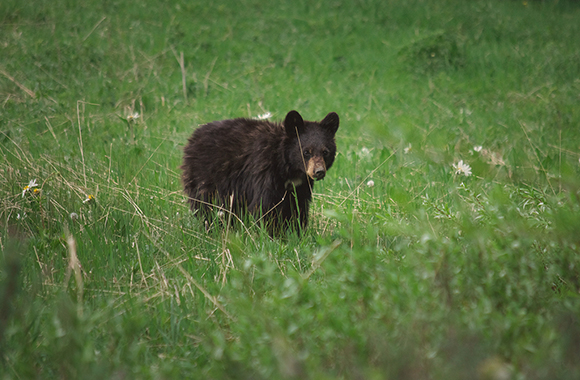
On January 15, 1999, after massive effort by my colleagues and me, the then Conservative government of Ontario announced an end to the hunting of black bears in the province, in the spring, although in some regions hunting could occur as early as late summer. There was no decrease in the number of bears (out of a population size not accurately known) that could be hunted, but the end to the spring hunt was welcomed because bear hunters often failed to detect the differences between mother bears (who where protected) with dependent cubs, and legally hunted male or non-maternal female bears, leaving dependent cubs to die in the bush. John Snobelen made the decision “…to move to end the spring bear hunt because [our government] will not tolerate cubs…
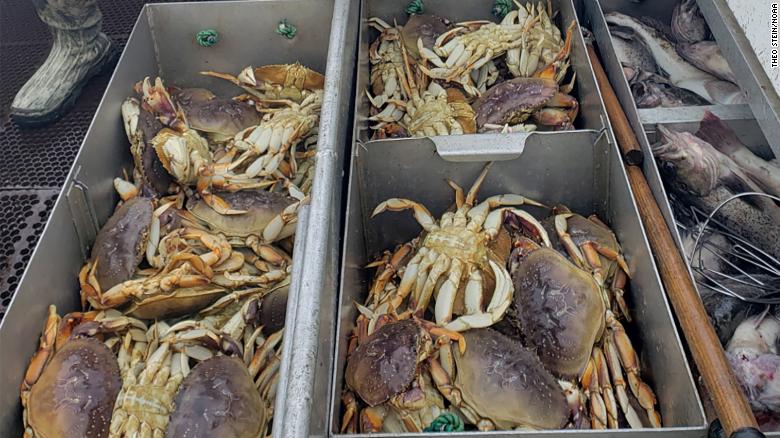
The Pacific Ocean is acidifying at such a rate that Dungeness crabs, some of the most valuable crustaceans in the Pacific Northwest, are suffering partially dissolved shells and damage to their sensory organs, a new study found.
(CNN)The Pacific Ocean is becoming more acidic, and the cash-crabs that live in its coastal waters are some of its first inhabitants to feel its effects.
The Dungeness crab is vital to commercial fisheries in the Pacific Northwest, but lower pH levels in its habitat are dissolving parts of its shell and damaging its sensory organs, a new study found.
Their injuries could impact coastal economies and forebode the obstacles in a changing sea. And while the results aren’t unexpected, the study’s authors said the damage to the crabs is
premature: The acidity wasn’t predicted to damage the crabs this quickly.
“If the crabs are affected already, we really need to make sure we pay much more attention to various components of the food chain before it is too late,” said study lead author Nina Bednarsek, a senior scientist with the Southern California Coastal Water Research Project.
The findings were published this month in the journal Science of the Total Environment and funded by the National Oceanic and Atmospheric Administration (NOAA). The agency studies ocean acidification and how changing pH levels are impacting coasts.
How the ocean acidifies
The ocean is acidifying because it’s absorbing more carbon dioxide from the atmosphere, which lowers pH levels in the water.
Ocean acidification changes the coasts, releasing excess nutrient that can create algae blooms and increasing sea temperatures and salinity, according to NOAA.
But for crustaceans and coral that rely on carbonate ions, which are less abundant in more acidic waters, to build their shells and coral skeletons, it becomes more difficult to build strong shells.
It’s not just crabs, either: Oysters, clams and plankton all rely on the same carbonate ions to strengthen themselves. And humans and sea creatures alike rely on them — some for food, others for economic security.
How it hurts the crabs
The acidification corroded the young shells of Dungeness crab larvae, which could impair their ability to deter predators and regulate their buoyancy in the water, the researchers said.
The crab larvae that showed signs that their shells were dissolving were smaller than the other larvae, too. This could cause developmental delays that could mess with their rate of maturation.
The tiny hair-like structures crabs use to navigate their environments were damaged by the low pH levels, too — something scientists had never seen before. Crabs without these mechanoreceptors could move more slowly and have difficulty swimming and searching for food.
“We found dissolution impacts to the crab larvae that were not expected to occur until much later in this century,” said Richard Feely, study co-author and NOAA senior scientist.
What’s next
It’s not clear if the same forces could negatively impact adult Dungeness crabs, a question that requires more research. But with the obstacles a crab larvae faces in its early development, it’s got less of a chance to survive to adulthood.
As for the acidifying ocean, NOAA proposes two methods of attack: Reducing our overall carbon footprint to reduce the carbon dioxide absorbed by the sea, or teach wildlife and the people who rely on it to adapt to how the sea will change.
NOAA works with local fishery manages and policy makers on conservation efforts — and researchers hope their findings might be enough to convince them to take immediate action.
ON JANUARY 25, 202012:09 PMIN FOREIGN Kindly Share This Story:FacebookTwitterEmailWhatsAppPinterestShare Liang Wudong A Wuhan hospital doctor has died nine days after contracting the deadly coronavirus as he battled to save infected patients in the city – as the death toll from China’s outbreak jumped to 41 today. Liang Wudong, 62, who had been treating patients in Wuhan, died from the virus this morning, state-run China Global Television Network reported in a tweet. ADVERTISING ADVERTISING Wudong, who was retired but drafted in to help with the outbreak, died this morning. It was also reported that another doctor, Jiang Jijun, had died from a heart attack while treating patients. It is unknown if the infectious disease specialist, who has treated bird flu and influenza A and tuberculosis over the years, died as a result of coronavirus or from exhaustion. Also today, distressing video has emerged showing the full scale of panic…
FILE – A man looks at caged civet cats in a wildlife market in Guangzhou, capital of south China’s Guangdong Province, China, Jan. 5, 2004.
WASHINGTON – The virus that has caused dozens of deaths and hundreds of illnesses worldwide emerged from a market in Wuhan, China, that sold live food animals, including some animals caught in the wild, according to Chinese authorities.
One study suggested a snake may have brought the virus to the market, but other experts were skeptical. The search for a definitive source continued.
A price list circulated on Chinese social media showed snakes, hedgehogs, peacocks, civet cats, scorpions, centipedes and more for sale at the market.
It’s not the first time these markets have bred a new disease, and experts said it probably won’t be the last. Severe acute respiratory syndrome, better known as SARS, originated at a similar market in China in 2002. It ultimately claimed nearly 800 lives.
FILE – A Chinese man looks over cages of dogs and rabbits at a live-animal market in Guangzhou, Southern China, Jan 6, 2004.
Bird flu spread in these markets in the late 1990s and early 2000s. The H5N1 strain of influenza has killed 455 people since 2003.
Without proper sanitation and animal handling, health officials said, these markets can be spawning grounds for diseases.
Live animal markets are found across the developing world, especially in Asia and Africa.
Most animals sold there are healthy. But in the crowded conditions at these markets, one sick animal can infect many more, experts said.
Wild cards
Wild animals introduce a dangerous wild card.
For example, civet cats carried the virus that caused SARS. But scientists think the virus originated in bats.
“In the normal world, these species would never meet,” said veterinarian Tony Goldberg, associate director for research at the University of Wisconsin Global Health Institute.
“But in these live animal markets, they brought those two species together,” he said. “And when you do that in these tight, crowded, stressful conditions, you create every opportunity for these viruses to jump host species.”
The virus could spread when a vendor butchers an animal. Or a sick animal could spread it through its saliva, urine, feces or other secretions.
Humans and domesticated animals have been exposed to each other’s diseases for millennia. We’ve developed some defenses. That’s not the case with a new virus coming from a wild animal, Goldberg said.
FILE – A Chinese man carries sacks containing geese at a live-animal market in Guangzhou, Southern China, Jan. 6, 2004.
The virus lottery
Given how common these markets are around the world, it’s almost surprising that new outbreaks don’t happen more often, veterinarian William Karesh, executive vice president for health and policy at EcoHealth Alliance, said.
“I’ve gone to a market in Southeast Asia and they’re selling maybe 5,000 or 6,000 bats every week,” he said. “And that’s just one market. As you drive around, there’s 20 or 30 of those markets within a few hours’ drive. So now we’re talking about tens of thousands of bats for sale, and tens of thousands of rats (and other species). And that’s going on throughout much of the world.
“So we’re talking, really, about millions of animals for sale on a daily basis and tens of millions of people shopping there,” Karesh said.
For a virus looking for a different species to infect, he said, it’s like playing the lottery.
“Your chances of winning are pretty high when you’ve got exposure to 10 or 15 or 20 million people every day,” Karesh said.
Traditions
People often don’t shop at these markets by choice, he said. When refrigeration is not available, the best way to get fresh meat is to buy it when it’s still alive. And customers can see if the animal is healthy before they buy it.
Also, many wild-caught foods are “deeply cherished in many cultures around the world,” not just in Africa and Asia, Goldberg said, even if they may carry diseases.
In the United States, rabbits carry tularemia, a bacterial disease that can be fatal. It’s on the list of potential bioterror weapons.
“You’ll see human cases pop up every now and then when rabbit hunters cut themselves when butchering a rabbit,” Goldberg said, adding he knows a rabbit hunter who got tularemia twice.
FILE – Packs of Canadian pork are displayed for sale at a supermarket in Beijing, June 18, 2019.
Market shift
The Chinese government closed live animal markets after SARS. But the markets have slowly reopened in the years since.
The government could close them again. But what may ultimately solve the problem is not a government mandate but a cultural shift.
Around the world, Karesh said, more young people are shopping at supermarkets.
“The grocery store is selling chilled refrigerated chicken, and it’s cheaper,” he said. “And people are busy. They’re going to work. They don’t really have time to go to that live animal market anymore.”
Plus, he added, attitudes are changing. Older people may see wild animals as a delicacy. The younger generation? Not so much.
“I don’t think they’re so interested in going to the live animal markets anymore to watch a bat be slaughtered or have a chicken have its throat cut,” he said.
“Twenty years ago, there weren’t many people in China who had pet dogs,” he said. Now, “there’s a new generation of people that when they see a dog, they’re not thinking about food. They’re thinking about, ‘Oh, wow, what a wonderful opportunity to have a pet.’”












 Exposing the Big Game