H e informed the Telegraph that virus in farmed pets were well kept an eye on – there have actually been numerous episodes of the extremely pathogenic H5N1 bird flu in fowl recently however none have actually infected the human populace since strenuous illness monitoring grabs the infection and also the pets are chosen.
“When you have this viral soup and you have a collection of pigs, poultry and bats as you had in that market in Wuhan it’s a perfect incubator of diseases,” he claimed.
Dr Michael Osterholm, supervisor of the Centre for Infectious Disease Research and also Policy at the University of Minnesota, claimed that live animal markets were a issue throughoutAsia
” I have actually remained in a market in Bangkok which was virtually a mile by a mile inside – you can locate virtually any kind of animal possible. I have a image where there are cages loaded with ferrets and also in addition to them are hens. From a flu viewpoint, birds and also pets with each other are bad,” he claimed.
A Chinese girl wears a protective mask as she is held by a relative in Beijing, China on January 21, 2020. Kevin Frayer/Getty Images
Only three and a half weeks ago, China announced the outbreak of a mysterious new coronavirus in the city of Wuhan involving a group of people who’d been exposed to animals at a local food market.
Flash-forward to Friday: The number of cases of 2019-nCoV, as the virus is known, has leaped to more than 800, and there are sick people in at least seven other countries.
Scientists have described the serious concept of “Hothouse Earth”.
An international team of researchers suggest that global warming will have severe consequences for the planet.
They paint a picture of boiling hot climates and towering seas in years to come if temperatures rise by just 2C.
That means it could turn some of the planet’s natural forces – that currently protect us – into our enemies.
Dr Sarah Cornell is an environmental scientist and one of the researchers behind the report for the Stockholm Resilience Centre.
She’s described some of the big changes which could happen with a 2C temperature rise – which is the globally accepted amount, according to the Paris climate agreement.
Chocolate is under threat
Image copyrightGETTY IMAGESImage captionCacao pods, from which we get cacao beans for making chocolate, grow in countries around the equator
This is something that is very close to Dr Cornell’s (and everyone else’s) heart.
“Chocolate is just one example of a globally important crop that grows in warm and humid climates,” she says.
But global warming doesn’t mean that there will be more places to grow cacao beans – in fact, it’s the opposite.
A rise in global temperatures causes weather systems to be unpredictable and inconsistent, which would put cacao growing at risk.
“It is about the really intricate pattern of temperature, water flow, light intensity, the nutrients already available in the soil,” says Dr Cornell.
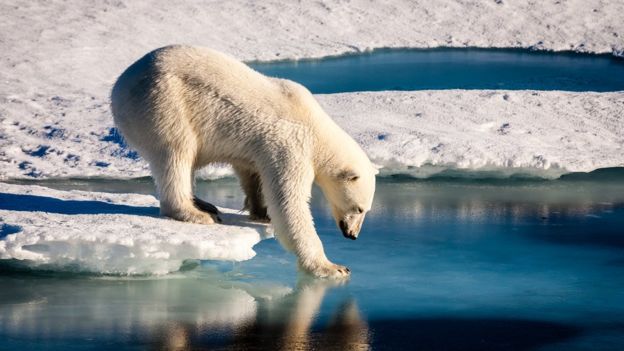
The Arctic could melt
Image copyrightGETTY IMAGES
Ice in the areas around the North Pole could melt completely, says Dr Cornell.
But it’s not just the animals living there which are under threat.
“When you melt the Arctic, you’re changing the way that the whole Earth works,” she says.
“You’re changing ice that reflects heat back into space into dark seawater that absorbs incoming solar radiation.”
So it’s a vicious circle – the less ice there is to reflect heat away from the Earth, the more global warming accelerates.
Image copyrightGETTY IMAGESImage captionThis village in Kiribati, in the Pacific Ocean, had to relocate because of rising sea levels
How can you be a country if you don’t have any land?
Melting ice means rising sea levels – which could put low-lying island nations, such as the Maldives, under the sea.
“It will have all kinds of social consequences because the people who live in these low-lying areas will have to go somewhere,” says Dr Cornell.
“There are already lots of discussions with people in low-lying Pacific islands talking with Australia and New Zealand about where they can live, and how they can have nationhood while renting land from another country.”
Unpredictable rain
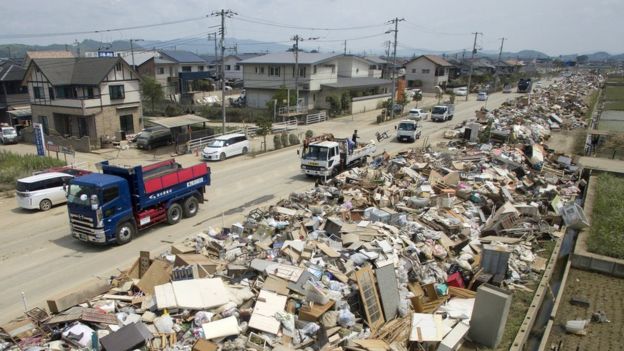
Image copyrightEPAImage captionRecent floods in Japan left hundreds of people dead and millions had to evacuate their homes
Combine rising temperatures with other human activity such as deforestation, and you have drastic effects on the water cycle.
“When you change landscapes, you change where water can flow,” says Dr Cornell.
“When you warm the planet and are simultaneously changing the landscape, you’re changing the water cycle… in a much less predictable way than it was before.”
Extreme changes to the water cycle can lead to severe floods – and severe droughts.
How a tree frog affects a whole ecosystem
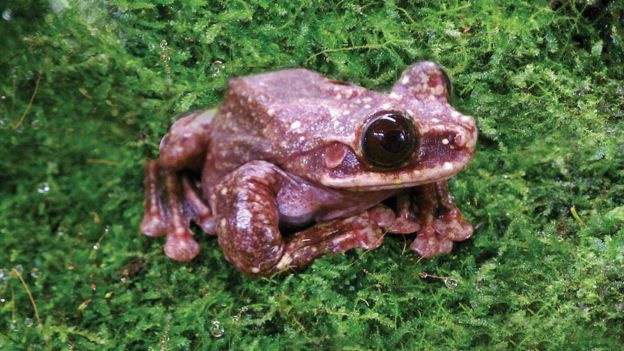
Image copyrightATLANTA BOTANICAL GARDENImage captionToughie the frog was originally from a forest in Panama
Two years ago, a little brown treefrog called Toughie died in Atlanta, USA, at the age of 12.
He was the last known living Rabbs’ fringe-limbed treefrog to exist.
Toughie’s story is a symbol of the rate of extinction that is being caused as a result of climate change.
The extinction of a species even as small as a frog has consequences which we don’t yet fully understand.
“We could lose treefrogs, and that doesn’t sound important but it’s vitally important because it’s what we lose with it,” says Dr Cornell.
“When we’re killing species, we probably won’t know in advance what the consequences are.
“But we already know that we’re making ecosystems much more vulnerable”.
Trump slams climate hysteria at World Economic Forum in Davos, Switzerland; reaction on ‘The Five.’
“The Five” hosts responded Thursday to President Trump’s recent speech at the World Economic Forum in Davos, Switzerland, in which he criticized climate change activists and alarmists as “perennial prophets of doom.”
“We missed the big news here,” Greg Gutfeld said. “Trump was entirely correct in everything he said, taking down the ‘prophets of doom,’ but he actually tied real climate action to ending the panic.”
Trump, who has previously referred to climate change as a “hoax,” seemed to change his tone during the climate-themed event, announcing that the U.S would join the World Economic Forum’s Trillion Tree Initiative, an effort that could cancel out the last 10 years of…
A massive smoke plume, powered by strong winds, rises above the the Woolsey fire on 9 November 2018 in Malibu, California. Photograph: David McNew/Getty Images
Political appointees at the interior department have sought to play up climate pollution from California wildfires while downplaying emissions from fossil fuels as a way of promoting more logging in the nation’s forests, internal emails obtained by the Guardian reveal.
The messaging plan was crafted in support of Donald Trump’s pro-industry arguments for harvesting more timber in California, which he says would thin forests and prevent fires – a point experts refute.
The emails show officials seeking to estimate the carbon emissions from devastating 2018 fires in California so they could compare them to the carbon footprint of the state’s electricity sector and then publish statements encouraging cutting down trees.
The records offer a look behind the scenes at how Trump and his appointees have tried to craft a narrative that forest protection efforts are responsible for wildfires, including in California, even as science shows fires are becoming more intense largely because of climate change.
James Reilly, a former petroleum geologist and astronaut who is the director of the US Geological Survey, in a series of emails in 2018 asked scientists to “gin up” emissions figures for him. He also said the numbers would make a “decent sound bite”, and acknowledged that wildfire emissions estimates could vary based on what kind of trees were burning but picked the ones that he said would make “a good story”.
Scientists who reviewed the exchanges said that at best Reilly used unfortunate language and the department cherry-picked data to help achieve their pro-industry policy goals; at worst he and others exploited a disaster and manipulated the data.
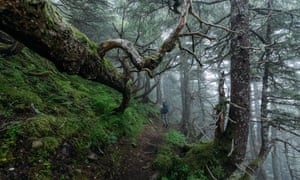
A trail through the Tongass national forest, where Trump proposed allowing logging. Photograph: Rafe Hanson
The emails add to concerns that the Trump administration is doing industry’s bidding rather than pursuing the public interest. Across agencies, top positions are filled by former lobbyists, and dozens of investigative reports have revealed agencies working closely with major industries to ease pollution, public health and safety regulations.
A USGS spokesperson said Reilly’s emails were “intended to instruct the subject matter expert to do the calculations as quickly as possible based on the best available data at the time and provide results in clear understandable language that the Secretary could use to effectively communicate to a variety of audiences.” The agency added that it “stands by the integrity of its sience”
When forests burn, they do emit greenhouse gases. But one expert said the numbers the interior department put forth are significant overestimates. They say logging wouldn’t necessarily help prevent or lessen wildfires. On the contrary, logging could negate the ability of forests to absorb carbon dioxide humans are emitting at record rates.
Chad Hanson, a California-based forest ecologist who co-founded the John Muir Project and a lawyer who has opposed logging after fires, called the strategizing revealed in the emails a “blatant political manipulation of science”.
Mark Harmon, a professor emeritus at Oregon State University’s College of Forestry, said while it’s normal for the department to want to quantify emissions from fires, it’s unclear whether they began the process with a particular figure in mind.
“Gin-up is an unfortunate phrase to be sure, but it might have been a very imprecise way to ask for an estimate. It certainly does not inspire confidence,” Harmon said.
He said the resulting quotes from top officials and press releases from the department are “about what you would expect from agencies trying to justify actions they already decided to take with minimal analysis”.
Harmon added that “the effect of logging on fires is highly variable,” depending on how it is done and the weather conditions.
Not long after the interior department came up with its carbon emission estimates from the 2018 California wildfires, Trump issued an executive order instructing federal land managers to significantly increase the amount of timber they harvest. This fall, he also proposed allowing logging in Alaska’s Tongass national forest, the largest intact temperate rainforest in North America.
Trump has also tweeted multiple times about wildfires, saying they are caused by bad land management or environmental laws that make water unavailable.
Monica Turner, a fire ecology scientist at the University of Wisconsin-Madison, said “it is climate that is responsible for the size and severity of these fires”.
An Interior department spokesperson said the department’s role is to follow the laws and use the best science and that it continues “to work to best understand and address the impacts of an ever-changing climate.”
Agency officials started emphasizing wildfire emissions data as a talking point as early as August 2018.
In an email chain that month, Reilly was asked by interior’s former deputy chief of staff Downey Magallanes to sign off on a statement that fires in 2018 had emitted 95.6m tons of CO2.
“Interesting statistics,” Reilly responded, noting that emissions would vary based on the types of trees on the land. “…We assumed woodlands mix since we don’t currently have details on the overall land cover types involved. Any variance to the fuel type will still leave it in the range to make the comparison, however. I’ll use this one if you don’t object. Makes a good story.”
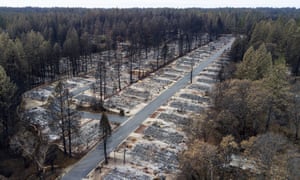
Homes leveled by the Camp fire at the Ridgewood Mobile Home Park retirement community in Paradise, California. Photograph: Noah Berger/AP
Reilly, who was confirmed to his position in April 2018, later asked career scientists at the agency for updated numbers, according to documents obtained under the Freedom of Information Act.
“I need to get a number for total CO2 releases for the recent CA fires and a comparison against emissions for all energy in US … Tasker from the boss; back to me ASAP,” he said on 10 October 2018. His boss at the time was the former interior secretary Ryan Zinke.
The job fell to Doug Beard, the director of the National Climate Adaptation Science Center, and Bradley Reed, an associate program coordinator in the Geographic Analysis and Monitoring Program, who responded with numbers from his team that afternoon.
In November 2018, Reilly once again asked for the same estimates of carbon dioxide generated by two devastating fires that fall in California – the Camp and Woolsey fires.
“The Secretary likes to have this kind of information when he speaks with the media,” Reilly said in a 16 November email to David Applegate, the associate director for natural hazards.
Applegate directed Beard to get the numbers, and Reilly chimed in, asking Beard: “Can you have [the scientists] gin up an estimate on the total CO2 equivalent releases are so far for the current 2 fires in CA?” He said he wanted to compare the figures to the carbon pollution caused by transportation in California.
“That would make a decent sound bite the Sec could use to put some perspective on it,” said Reilly.
Just a week earlier, the ferocious Camp fire had destroyed Paradise, California, killing dozens and becoming the deadliest wildfire in the state’s history. The scenes detailed were horrific.
Conservatives have insisted that the wildfires are happening because environmentalists have overzealously encouraged the conservation of forests. Trump has battled with California – the face of the American progressive movement he opposes – over a multitude of other issues, including the state’s longstanding climate policy of requiring new cars to go farther on less fuel.
The new emails show communications staffers and political appointees using government scientists as foot soldiers in those battles.
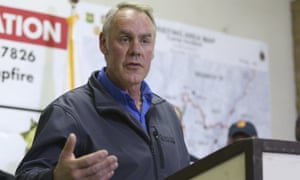
‘There’s too much dead and dying timber in the forest, which fuels these catastrophic fires,’ Zinke said. Photograph: Rich Pedroncelli/AP
Advertisement
Now, under the leadership of the former lobbyist David Bernhardt, the agency has sought to remove consideration of climate change from many of its decisions, while expanding oil and gas drilling on federal land. Multiple whistleblowers have accused the department of stifling climate science.
Bernhardt in a May 2019 hearing told lawmakers there are no laws obligating him to combat climate change.
After Reilly asked his staff to calculate the wildfire emissions numbers in November, an interior spokeswoman emailed him asking for the same information so she could put out a statement from Zinke. A few days later, the agency published a press release on Zinke’s behalf, with the title “New Analysis Shows 2018 California Wildfires Emitted as Much Carbon Dioxide as an Entire Year’s Worth of Electricity.”
“There’s too much dead and dying timber in the forest, which fuels these catastrophic fires,” Zinke said. “Proper management of our forests, to include small prescribed burns, mechanical thinning, and other techniques, will improve forest health and reduce the risk of wildfires, while also helping curb the carbon emissions.”
Hanson, the forest and fire ecologist, said that in addition to using the government data for political purposes, the department numbers overstated the carbon emissions from forest fires while downplaying emissions from fossil fuels.
He said that the carbon emissions numbers generated by USGS and released to the public were an “overestimate” that “can’t be squared with empirical data” from field studies of post-wildfire burn sites in California. Other scientists the Guardian spoke with did not dispute the government’s data, but did find fault with the way it was presented to the public.
“The comparison of fire to electrical emissions [in California] was not explained or justified”, said Harmon, the Oregon State University scientist. “Picking other sectors would have left an entirely different image in the reader’s mind…If the comparison had been made nationally it would have been found that fire related emissions of carbon dioxide were equivalent to 1.7% of fossil fuel related emissions. So it is hard to escape the conclusion that some cherry picking was going on.”
Jayson O’Neill, the deputy director of the Western Values Project, said the emails are another example of the administration “trying to find ways to tell a story to achieve industry goals”.
“As wildfire experts have repeatedly explained, you can’t log or even ‘rake’ our way out of this mess,” O’Neill said. “The Trump administration and the interior department are pushing mystical theories that are false in order to justify gutting public land protections to advance their pro-industry and lobbyist dominated agenda.”
BOISE, Idaho (AP) — The director of the Idaho Department of Fish and Game on Thursday said there are an estimated 1,000 wolves in Idaho.
Ed Schriever told the House Resources and Conservation Committee that the estimate made public for the first time is the first wolf population estimate in Idaho since 2015.
“We will be making that estimate every year, and we will know from this point forward if the population is going up, as some people speculate, if it’s been level, or if it’s decreasing,” Shriever told lawmakers.
Shriever said the wolf population peaked early in the summer of 2019 at about 1,500 following the birth of pups. He said subtracting hunting and trapping kills along with other deaths puts the population now closer to 1,000.
After the meeting, Schriever said the estimate is based on about 13 million photos from…
ANCHORAGE, Alaska (KTUU) – Changing sea ice conditions are forcing polar bears to adapt. New research shows that a growing percentage of polar bears are coming to land and becoming dependent on human provisions for food, while those that stay on the dwindling sea ice to continue natural polar bear behavior may be floating on an ecological trap.
The USGS researchers used GPS collars with a camera, accelerometor and other scientific tools to track and analyze the bears’ behaviors.
Researchers with the USGS Alaska Science Center have noticed the behavioral changes in polar bears on the Southern Beaufort Sea over the last 15 years and more recently a team began studies to determine which behavior was better for the bears. The researchers used GPS collars with video cameras and an accelerometer to track the bears, calculate how much energy they used, and compare the energy requirements of coming to land during summer months versus staying on the sea ice.
“Going into it we thought it’s surely going to be more energetically expensive to come to shore, because often times bears are staying on the sea ice until the last possible minute before they come to shore,” Todd Atwood, a research wildlife biologists with USGS said. “In some cases bears are swimming 400, 500 kilometers to get to land. Swimming is a lot more energetically expensive than walking. So we expected them burn through a lot more energy to get to land, and that’s what we found.”
By pairing the GPS camera collar with a tri-axial accelerometer, the researchers were able to estimate how much energy bears used for different behaviors by calculating overall dynamic body acceleration.
CARACAS, Venezuela — Eleven young people, mostly teenagers, who were hunting small animals died in a fire that swept through a sugarcane field in Venezuela, authorities said Friday.
Investigators said those who died were trying to catch rabbits and iguanas fleeing a controlled burn Thursday afternoon before strong winds drove the flames in their direction, trapping them.
Attorney General Tarek William Saab said in a national TV broadcast that residents of the community have hunted animals that way for decades.
The fire got out of control in Cagua in Aragua state, 110 kilometers (68 miles) southwest of the capital of Caracas.
President Trump on Friday became the first sitting president to speak at the annual March for Life rally — a visible show of support for those who want to restrict abortion access. The event comes six weeks before Supreme Court arguments in one of the most important abortion cases since Roe v. Wade, which legalized abortion nationwide.
Mr. Trump has in the past called himself “very pro-choice,” but since becoming president has identified as “pro-life” and pushed policies that support efforts to limit abortion.
“From the appointment of pro-life judges and federal workers, to cutting taxpayer funding for abortions here and abroad, to calling for an end to late-term abortions, President Trump and his administration have been consistent champions for life and their support for the March for Life has been unwavering,” said Jeanne Mancini, president of March for Life, in a statement…
43 people being monitored for possible exposure to coronavirus
v
EVERETT — The first person diagnosed with the Wuhan coronavirus in the United States is being treated by a few medical workers and a robot.
The robot, equipped with a stethoscope, is helping doctors take the man’s vitals and communicate with him through a large screen, said Dr. George Diaz, chief of the infectious disease division at the Providence Regional Medical Center in Everett.
Image of the robot caring for a Snohomish County man with coronavirus (CNN photo)
The man, who is in his 30s, was diagnosed with the virus on Monday. He initially went to an urgent care clinic on January 19 and told the staff that he was concerned about possibly having symptoms of the novel coronavirus because he recently traveled to Wuhan, China, Diaz said.


/cdn.vox-cdn.com/uploads/chorus_image/image/66137516/GettyImages_1195126107.7.jpg)






 Exposing the Big Game