A Comprehensive Chart of Vegan Protein Sources

https://www.healthline.com/nutrition/vegan-protein-sources-chart#bottom-line

When I first adopted a plant-based diet, I wasn’t sure how to best replace animal products with vegan ones.

Fortunately, it turned out to be easy to get enough protein without meat, fish, dairy, or eggs. Even better, I quickly discovered that vegan protein sources are delicious and incredibly easy to prepare.

The average person needs approximately 0.45–0.73 grams of protein per pound of body weight (1.0–1.6 grams per kg) daily, depending on your physical activity level. That’s about 70–113 grams for a 155-pound (70-kg) individual (1Trusted Source).

Because there are so many protein-rich plant foods, you can easily get enough protein on a vegan diet. Plus, experts agree that a well-planned plant-based diet provides all of the nutrients you need, including protein (2Trusted Source3Trusted Source4Trusted Source).

Here are some of the best vegan sources of dietary protein, plus a helpful chart.

vegan protein sources chart

Nuts and seeds

Nuts and seeds are naturally rich in protein.

You can enjoy them on their own, blended into nut butters, mixed into yogurt, oatmeal, or trail mix, or added to smoothies, salads, grain dishes, and homemade veggie burger patties.

Here’s the amount of protein found in a 1-ounce (28–30-gram) serving of various nuts and seeds (5Trusted Source6Trusted Source7Trusted Source8Trusted Source9Trusted Source10Trusted Source11Trusted Source12Trusted Source):

  • Walnuts: 4.5 grams
  • Almonds: 6 grams
  • Cashews: 4.5 grams
  • Chia seeds: 6 grams
  • Flax seeds: 6 grams
  • Hemp seeds: 9.5 grams
  • Sunflower seeds: 5.5 grams
  • Pumpkin seeds: 8.5 grams

SUMMARY

A small, 1-ounce (28–30-gram) serving of various nuts and seeds offers roughly 4–9 grams of protein. You can eat them raw or add them to various foods, such as a smoothie, oatmeal, or salad.

Nondairy milks

A growing number of nondairy milks are available today, but not all of them are great sources of protein.

If you’re hoping to use nondairy milk as a source of protein, be sure to buy one of the varieties below. These can be used just like dairy milk in coffee, soup, and batter for baked goods, as well as smoothies, cereal, and cream sauces.

Here’s the protein found in 1 cup (240 mL) of the nondairy milks highest in protein (13Trusted Source14Trusted Source):

  • Soy milk: 6 grams
  • Pea milk: 8 grams

SUMMARY

Soy and pea milk are among the most naturally protein-rich nondairy milks, packing 6–8 grams per cup (240 mL).

HEALTHLINE NEWSLETTERSign up for daily nutrition tips and tricks

Healthier eating shouldn’t be a hassle. We’ll send you our evidence-based tips on meal planning and nutritionEnter your emailGET STARTED

Your privacy is important to us

Legumes

Legumes, which include beans, peas, and lentils, are great sources of protein for people on plant-based diets.

Plus, you can eat cooked legumes on their own, as part of a marinated grain salad (or other salads), and in burritos, quesadillas, soups, and nachos.

The list below outlines the protein content of 1/2 cup (80–93 grams) of a variety of canned legumes (15Trusted Source16Trusted Source17Trusted Source18Trusted Source19Trusted Source20Trusted Source):

  • Black beans: 8 grams
  • Pinto beans: 7 grams
  • Chickpeas: 7.5 grams
  • Kidney beans: 8 grams
  • Lentils: 8 grams
  • Peas: 8 grams

SUMMARY

Legumes like beans, peas, and lentils are packed with protein. Eat these as a side dish or in burritos, soups, and salads.

powered by Rubicon Project

Soy products and vegan meat alternatives

a grain bowl with tofu, nuts, avocado, and lettuce
Nataša Mandić/Stocksy United

Vegan meats go beyond packaged plant-based burgers and hotdogs.

Soy foods like tofu and tempeh work well in breakfast scrambles, roasted in the oven, and in stir-fries, burritos, and sandwiches. Seitan, a savory protein made from vital wheat gluten, is great in soups, salads, grain dishes, tacos, and sandwiches.

Similar serving sizes of various vegan meats provide the following amounts of protein (21Trusted Source22Trusted Source23Trusted Source24Trusted Source25Trusted Source):

  • Tofu (3 ounces or 85 grams): 4 grams
  • Tempeh (3/4 cup or 100 grams): 13 grams
  • Seitan (3 ounces or 100 grams): 19 grams
  • Beyond Meat meatballs (5 total, 100 grams): 20 grams
  • Impossible Burger (1 patty, 113 grams): 19 grams

SUMMARY

Soy foods, seitan, and various prepackaged vegan meats offer 4–20 grams of protein per serving.

High protein grains

Grains are a lesser-known source of plant protein but offer a great way to supplement your protein intake.

You can use cooked grains as the base of a meal, incorporate them into homemade veggie burgers and granola bars, top salads and soups with them, stuff bell peppers with them, and eat them in breakfast bowls and burritos.

Here’s the protein content of a 1/2 cup (100–126 grams) of several popular grains when cooked (26Trusted Source27Trusted Source28Trusted Source29Trusted Source30Trusted Source31Trusted Source32Trusted Source):

  • Quinoa: 4.5 grams
  • Brown rice: 3 grams
  • Amaranth: 4.7 grams
  • Millet: 3.5 grams
  • Oats: 3 grams
  • Spelt: 6 grams
  • Teff: 4.9 grams

SUMMARY

Whole grains are an excellent choice to supplement your protein intake. Spelt, teff, amaranth, and quinoa are all particularly high in protein.

High protein fruits and vegetables

All fruits and veggies contain small amounts of protein, but some more than others.

Fruits and vegetables are most often enjoyed raw, cooked, or blended into smoothies and sauces. You can enjoy them at any meal or snack.

Similar serving sizes of high protein fruits and veggies pack the following amounts of protein (33Trusted Source34Trusted Source35Trusted Source36Trusted Source37Trusted Source38Trusted Source39Trusted Source):

  • Broccoli (1 raw cup or 90 grams): 2.5 grams
  • Sweet potato (1 medium-sized, cooked, 150-gram potato): 2 grams
  • Artichoke (1 small veggie, 90 grams): 3 grams
  • Spinach (3 raw cups or 85 grams): 2 grams
  • Banana (1 fruit, 125 grams): 1.5 grams
  • Blackberries (1 cup or 145 grams): 2 grams
  • Guava (1 cup or 165 grams): 4.5 grams

SUMMARY

Incorporating more fruits and veggies into your diet is a great way to meet your protein needs. Guava is particularly rich in protein.

The bottom line

Many people on vegan diets wonder how to get enough protein.

You’ll be glad to know that plenty of protein-rich plant foods provide more than enough of this nutrient to meet the recommended daily needs.

For example, legumes and vegan meat alternatives — and even certain nondairy milks, whole grains, and fruits and veggies — are great sources of protein on plant-based diets.

Just one thing

Try this today: One of my favorite high protein vegan dishes is a tofu breakfast scramble.

To make it, sauté your favorite chopped veggies (I like broccoli, bell pepper, onion, and garlic) with a little olive oil, then season them with turmeric, black salt, and nutritional yeast, and add a block of crumbled extra-firm tofu until it’s warm.

Optional additions include baby spinach, diced tomatoes, and vegan shredded cheese.
Climate and nature crises: solve both or solve neither, say experts

https://www.theguardian.com/environment/2021/jun/10/climate-and-nature-crises-solve-both-or-solve-neither-say-experts

Restoring nature boosts biodiversity and ecosystems that can rapidly and cheaply absorb carbon emissions

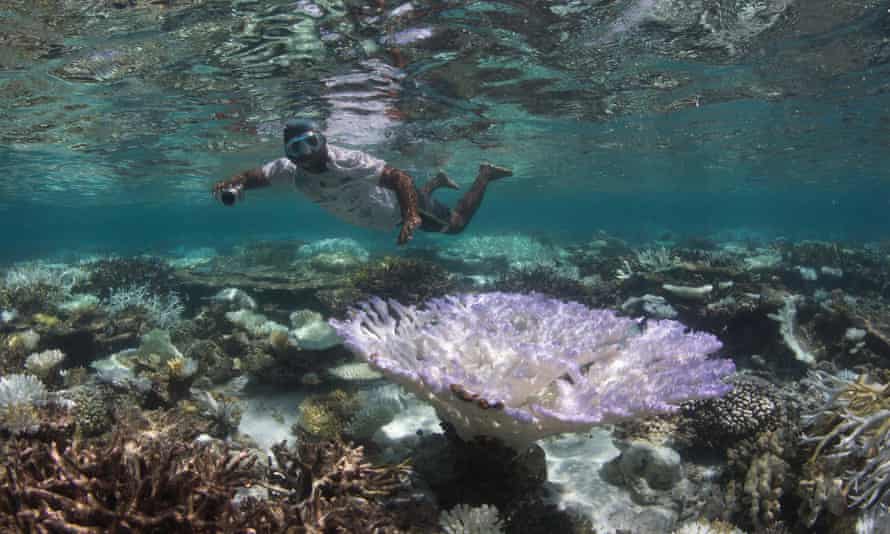
A snorkeler observes coral bleaching in the Maldives.
A snorkeler swims through bleached coral in the Maldives. Half of the world’s coral cover has been lost since Victorian times, say scientists. Photograph: AP

Damian Carrington Environment editor@dpcarringtonThu 10 Jun 2021 09.00 EDT

Humanity must solve the climate and nature crises together or solve neither, according to a report from 50 of the world’s leading scientists.

Global heating and the destruction of wildlife is wreaking increasing damage on the natural world, which humanity depends on for food, water and clean air. Many of the human activities causing the crises are the same and the scientists said increased use of nature as a solution was vital.

The devastation of forests, peatlands, mangroves and other ecosystems has decimated wildlife populations and released huge amounts of carbon dioxide. Rising temperatures and extreme weather are, in turn increasingly damaging biodiversity.

But restoring and protecting nature boosts biodiversity and the ecosystems that can rapidly and cheaply absorb carbon again, the researchers said. While this is crucial, the scientists emphasise that rapid cuts in fossil fuel burning is also essential to ending the climate emergency.AdvertisementRevealed: rightwing firm posed as leftist group on Facebook to divide DemocratsJustice department calls for internal inquiry into seizure of Democrats’ data – liveAntónio Guterres on the climate crisis: ‘We are coming to a point of no return’All the Queen’s presidents: Biden joins long line of US leaders to meet royalScientists link intense exercise with MND risk in some peopleAstronomers find blinking giant star near heart of Milky WayAll the Queen’s presidents: Biden joins long line of USleaders to meet royalhttps://imasdk.googleapis.com/js/core/bridge3.464.0_en.html#goog_654935847https://imasdk.googleapis.com/js/core/bridge3.464.0_en.html#goog_1087530625https://imasdk.googleapis.com/js/core/bridge3.464.0_en.html#goog_1014483751All the Queen’s presidents: Biden joins long line of US leaders to meet royal

They also warned against action on one crisis inadvertently aggravating the other, such as creating monoculture tree plantations that store carbon but are wildlife deserts and more vulnerable to extreme weather.

“It is clear that we cannot solve [the global biodiversity and climate crises] in isolation – we either solve both or we solve neither,” said Sveinung Rotevatn, Norway’s climate and environment minister.

The peer-reviewed report was produced by the world’s leading biodiversity and climate experts, who were convened by the Intergovernmental Panel on Climate Change and the Intergovernmental Science-Policy Platform on Biodiversity and Ecosystem Services, both which report to the world’s political leaders.

The report identified actions to simultaneously fight the climate and nature crises, including expanding nature reserves and restoring – or halting the loss of – ecosystems rich in species and carbon, such as forests, natural grasslands and kelp forests.

“It’s very disturbing to see the impacts over recent years,” said Prof Alex David Rogers, of conservation group REV Ocean and the University of Oxford, and a report author. “Between 1970 and 2000, mangrove forests have lost about 40% of their cover and salt marshes an estimated 60%. We’ve also lost half of coral cover since Victorian times.”

Food systems cause a third of all greenhouse gas emissions, and more sustainable farming is another important action, helped by the ending of destructive subsidies and rich nations eating less meat and cutting food waste.

“Animal agriculture not only emits 10 to 100 times more greenhouse gases per unit product than plant-based foods, they also use 10 to 100 times more land,” said Prof Pete Smith, of the University of Aberdeen. “So more plant-based diets would mean more environmentally friendly farming and then there would be more land on which to apply nature-based solutions.”

The scientists also warned against actions that tackled one crisis but worsened the other. “When I went for a walk in a plantation forest in England, it was sterile. It was a single, non-native species of tree,” said Prof Camille Parmesan, of the University of Plymouth. “There was nothing else there, no insects, no birds, no undergrowth. You might as well have built a concrete building.”

Past tree planting on carbon-rich peatlands that had never been forested was another example, said Smith. “That was an epic fail for the climate and for biodiversity.”

Planting very large areas with single crops to burn for energy was also problematic, even if the CO2 was captured and buried, Smith said: “To get the billions of tonnes of carbon removal that has been proposed in some scenarios for global stabilisation of climate, you would need thousands of millions of hectares – an area twice the size of India.”

Protecting and restoring natural ecosystems was the fastest and cheapest way to remove CO2 from the atmosphere, the scientists said. Cutting fossil fuel emissions was essential, but not enough at this point in the climate crisis, said Parmesan. “We cannot avoid dangerous climate change without soaking up some of the carbon that we’ve already put into the atmosphere and the best way to suck up carbon is using the power of plants,” she said.

“The science of restoration of ecosystems has really blossomed over the last 40 years. We are now able to efficiently and effectively restore complex systems, tropical rainforest, coastal wetlands, kelp forests and seagrass meadows, natural American prairie, and UK meadows back to their near historical diversity.”

Prof Mark Maslin, of University College London, said the report was seminal: “The science is very clear that climate change and biodiversity are inseparable. To stabilise climate change we need massive rewilding and reforestation.”

The UK environment minister, Zac Goldsmith, said: “This is an absolutely critical year for nature and climate. With the UN biodiversity [and climate summits], we have an opportunity and responsibility to put the world on a path to recovery. This hugely valuable report makes it clear that addressing biodiversity loss and climate change together offers our best chance of doing so.”

Carbon Dioxide Levels in Atmosphere Hit Record High: ‘We’re Running Out of Time’

Exposing the Big Game's avatarThe Extinction Chronicles

https://people.com/human-interest/carbon-dioxide-levels-in-atmosphere-hit-record-high-were-running-out-of-time/

“If we want to avoid catastrophic climate change, the highest priority must be to reduce CO2 pollution to zero at the earliest possible date,” Pieter Tans, a senior scientist with NOAA, saidBy Morgan SmithJune 08, 2021 03:27 PMhttps://3cd329176f5fdaeebc6c012a2cf17e7c.safeframe.googlesyndication.com/safeframe/1-0-38/html/container.htmlhttps://3cd329176f5fdaeebc6c012a2cf17e7c.safeframe.googlesyndication.com/safeframe/1-0-38/html/container.htmlADVERTISEMENT

A placard reading 'Stop CO2' is seen during 'Fridays for future' demonstration, a worldwide climate strike

CREDIT: NICOLÒ CAMPO/LIGHTROCKET VIA GETTY

Despite many people staying indoors and off the roads for the past year amid the ongoing COVID-19 pandemic,new datafrom the National Oceanic and Atmospheric Administration (NOAA) shows carbon dioxide levels have soared to a record high, alarming many scientists that the climate-change crisis is quickly getting worse.

Theresearch, published Monday by a group of scientists from NOAA and the Scripps Institution of Oceanography at the University of California San Diego, measured carbon dioxide levels, the chief human-caused greenhouse gas, at Mauna Loa, Hawaii in May, when carbon levels in the air peak.

Atmospheric carbon dioxide saw a monthly average of 419…

View original post 375 more words

New Study: Bats and Pangolins Weren’t Sold In Wuhan’s Wet Markets, But Other Mammals Were

New Study: Bats and Pangolins Weren’t Sold In Wuhan’s Wet Markets, But Other Mammals Were

By JIM GERAGHTY

June 10, 2021 12:58 PM

Customers select seafood at a wet market in Dandong, Liaoning Province, China, in 2017. (Philip Wen/Reuters)

Speaking of wet markets, a new research paper offers the results of an exhaustive review of the animals sold in the wet markets in Wuhan before the outbreak of COVID-19. Perhaps most surprisingly, the review of more than 36,000 animals of 38 species in 17 wet market shops concludes that pangolins and bats were not sold in the wet markets of the city. But the study cannot rule out that some other species of animal sold in the city’s wet markets was the source of the virus.

From May 2017 to November 2019 — long before anyone had heard of COVID-19 — Xaio Xaio, of the Lab Animal Research Center at the Hubei University of Chinese Medicine in Wuhan, conducted monthly surveys of all 17 wet market shops in the city selling live wild animals for food and pets. Xaio was attempting to trace a tick-borne virus, SFTS — severe fever with thrombocytopenia syndrome. (The paper calls Xaio’s detailed census of the animals sold in the markets “serendipitous.”)https://imasdk.googleapis.com/js/core/bridge3.464.0_en.html#goog_1076108420https://imasdk.googleapis.com/js/core/bridge3.464.0_en.html#goog_1765360566https://imasdk.googleapis.com/js/core/bridge3.464.0_en.html#goog_1554775109

The investigation of the animals sold sounds pretty thorough:

X.X. was granted unique and complete access to trading practices. On each visit, vendors were asked what species they had sold over the preceding month and in what numbers, along with the prices and origin of these goods (wild caught or captive bred/ farmed). Additionally, to substantiate interview data, the number of individuals available for sale at the time of each visit was noted, and animals were checked for gunshot wounds (from homemade firearms—gun ownership is strictly regulated in China) or leg-hold (snap) trap injuries, indicative of wild capture.

Across all 17 shops, vendors reported total sales of 36,295 individuals, belonging to 38 terrestrial wild animal species, averaging 1170.81 individuals per month Including species sold by weight inflated this total to 47,381 individuals. Notably, no pangolin or bat species were among these animals for sale.

But this information doesn’t completely slam the door on the wet market theory, because bats and pangolins are not the only species that could have carried the virus.

Almost all animals were sold alive, caged, stacked and in poor condition. Most stores offered butchering services, done on site, with considerable implications for food hygiene and animal welfare. Approximately 30 percent of individuals from 6 mammal species inspected had suffered wounds from gunshots or traps, implying illegal wild harvesting. Thirteen of these 17 stores clearly posted the necessary permits from Wuhan Forestry Bureau allowing them to sell legitimate wild animal species (e.g., Siamese Crocodile (Crocodylus siamensis), Indian Peafowl (Pavo cristatus), Common Pheasant (Phasianus colchicus) and Amur hedgehog (Erinaceus amurensis)) for food; four shops had no such permit. Species names were given in Chinese only, with no clear taxonomic binomial designation. None of the 17 shops posted an origin certificate or quarantine certificate, so all wildlife trade was fundamentally illegal. Notably, vendors freely disclosed a variety of protected species on sale illegally in their shops, therefore they would not benefit from specifically concealing pangolin trade or the trade in any particular species, and so we are confident this list is complete.

So which other animals have been found with SARS-CoV-2? This March, Nature listed  “cats and dogs, to pumas, gorillas and snow leopards in zoos, and farmed mink” as animals that have been infected with SARS-CoV-2 after encountering an infected human being.  Another study noted, “sporadic SARS-CoV-2 virus cases have been recorded in kept ferrets in Slovenia and in Spain.”

The new study reports that on average, each month the city’s wet markets collectively sold 38 racoon dogs, and ten minks. The original SARS virus was found in civet cat cages, and the markets sold about eleven masked palm civets per month. And if SARS-CoV-2 is contagious in a lot of varieties of small mammals… the markets sold on average of 332 amur hedgehogs, 168 Chinese hares, 43 Chinese bamboo rats, 30 red foxes, and a wide variety of others each month. That’s a long list of suspects.

And yet, so far, testing has not yet found any wild animals or livestock in China with SARS-CoV-2.

NOW WATCH: ‘Researcher Tied to Wuhan Lab Thanked Fauci for Dismissing Lab-Leak Theory’

Wandering elephants are touching hearts in China. Humans may be reason they left home.

https://www.nbcnews.com/news/china/wandering-elephants-are-touching-hearts-china-humans-may-be-reason-n1270450

“It almost felt as if they had a holy aura around them,” said Adam Chang, who was hired to deliver corn and pineapples to the elephants.00:49 /02:43TAP TO UNMUTE

June 11, 2021, 7:20 AM PDTBy Robbie Hu and Zeerak Khurram

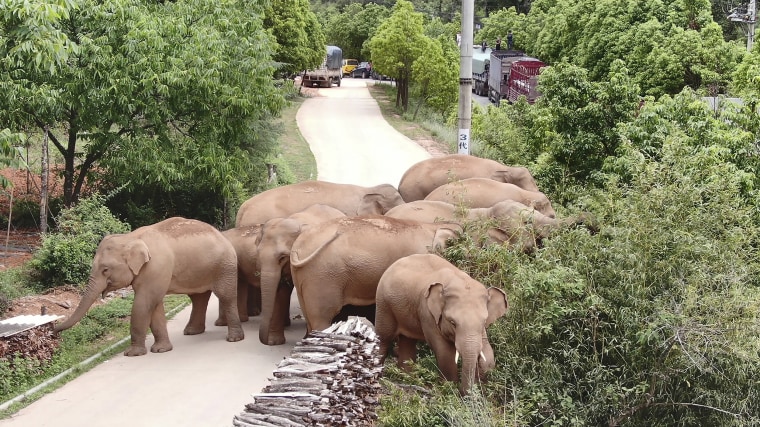
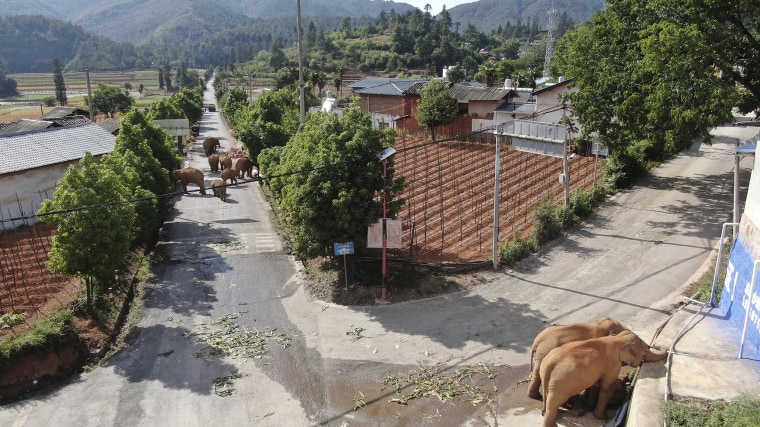
herd of elephants traipsing through southwest China has captured the imagination of millions.

Monitored by hundreds of police officers assisted by drones, the massive animals reached Kunming in southern Yunnan province earlier this week after traveling some 300 miles from their native nature reserve, state-owned media reported.

Adam Chang was hired to deliver corn and pineapples to the elephants, which on average stand 11 feet tall and weigh 11,000 lbs.

He said what he saw was amazing.

“I saw them picking apart the corn with their trunks,” he told NBC News over the messaging and social media app WeChat.

“They are just so much more lively than those I saw in the zoo. It almost felt as if they had a holy aura around them,” he said.

Image: A migrating herd of elephants roam through a neighborhood near the Shuanghe Township, Jinning District of Kunming city in southwestern China's Yunnan Province
A migrating herd of elephants roam through a neighborhood near the Shuanghe Township, in southwestern China’s Yunnan Province, last week. Yunnan Forest Fire Brigade / AP

While news of their migration has spread across China and gone viral online, with many expressing wonder and fascination, experts warned that this rare journey could indicate the inevitable and damaging consequences of human encroachment on the elephants’ natural habitat.

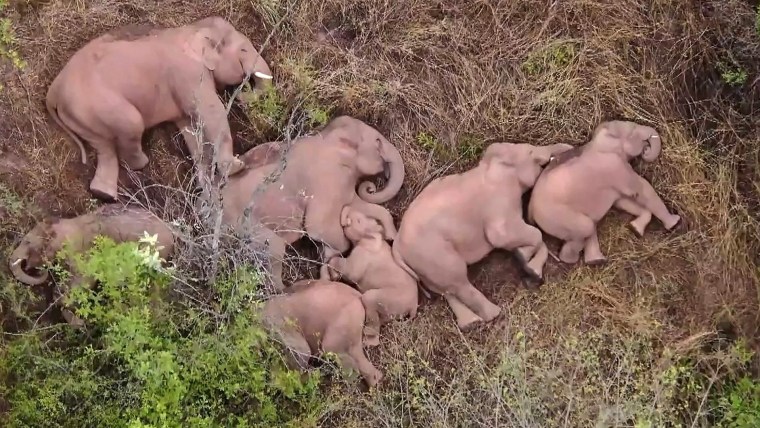
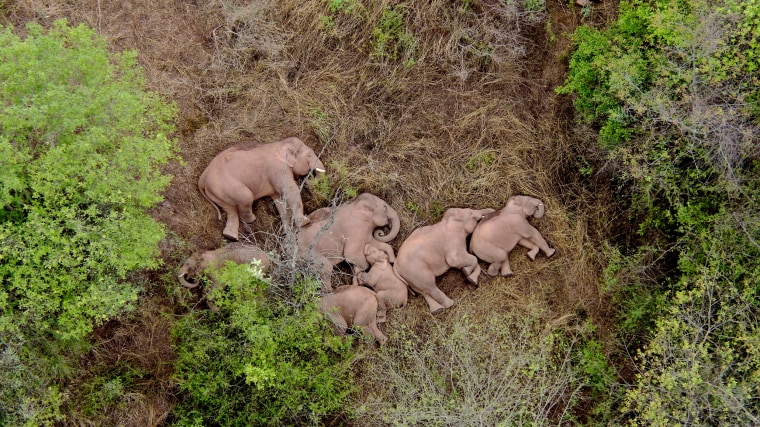
The herd reached Kunming on June 2, despite efforts from police to lure them back home. The animals took their time crossing what would have been busy thoroughfares, eating and stumbling into irrigation ditches before going to sleep in woods nearby.

After trending on social media in late May, many netizens were awestruck, while some complained about the destruction left in their wake.

Jason Cao, owner of a Yunnan mining company contracted by the government to deliver their feed, said he didn’t think the damage they caused was serious.

“Elephants are holy animals that can bring fortune and peace in Chinese culture, so we are very happy the elephants came,” he said.

Elephant herd pauses to nap during mysterious trek

JUNE 10, 202101:52

Both Chang and Cao declined to offer their given first names because they had not been given permission to speak to the media by local officials and feared retribution. Instead they asked to be identified with their “American” names.

The herd first came to the attention of outsiders in March 2020 when they left their home in the Xishuangbanna National Nature Reserve in southwest Yunnan at the border with Myanmar and Laos. A calf was born in November and two elephants split off from the rest in April 2021, according to the state news agency Xinhua.

Officials and experts say they don’t know why the herd is migrating.

Recommended

LATINOPuerto Rico probes fire that left 900K clients without power

POP CULTURE NEWSIconic ‘Doge’ meme NFT sells for record $4M

According to Tammie Matson, zoologist and research fellow at the University of Rwanda and director of Matson and Ridley Safaris, elephants can travel long distances if there isn’t enough habitat to meet their needs.

“Some may be driven to move away to get access to these resources to avoid competition,” she said.

Image: A migrating herd of elephants roam through a neighborhood near the Shuanghe Township, Jinning District of Kunming city in southwestern China's Yunnan Province,
Experts have warned that this rare journey could indicate the inevitable and damaging consequences of human encroachment on the elephants’ natural habitat.Yunnan Forest Fire Brigade / AP

Xinhua has reported that the Asian elephant population in Yunnan has ballooned from 180 in the 1980s to 300 in 2021. So it is possible that as numbers grew, a subgroup began searching for new habitat, got lost and just kept traveling, according to Nilanga Jayasinghe, manager of the wildlife conservation team at WWF, an international nongovernmental organization that specializes in wildlife preservation.

Download the NBC News app for breaking news and politics

Netizens have plenty of theories as to why the elephants are migrating, blaming global warming and deforestation.

Asian elephants inhabit forests and grassland, so deforestation rates in Xishuangbanna, which reached an annual average of 4.1 square miles in 2010, may have contributed to the herd’s migration.

Still, long-distance treks are not unknown for the animals, according to Raman Sukumar, professor of ecology at the Indian Institute of Science in Bengaluru, India, with similar migrations having happened in India and Sri Lanka.

These trips can have a negative impact on a herd’s health, he warned.

Image: Wild Asian elephants lie on the ground and rest in Jinning district of Kunming
Wild Asian elephants lie on the ground and rest in Jinning district of Kunming, Yunnan province, China on June 7, 2021. A herd of 15 wild elephants has trekked hundreds of kilometers after leaving their forest habitat in Xishuangbanna National Nature Reserve, according to local media.China Daily / via Reuters

“I would expect that the stress levels in the elephants would start going up because the elephants are in a totally different kind of terrain,” he said. “It is very densely populated … It’s not so easy for them to navigate through a city.”

For Hannah Mumby, assistant professor at the University of Hong Kong’s School of Biological Sciences, it is important to address the root cause of their departure, otherwise this behavior could be repeated.

The China Central Television News Agency has captured signs of a second herd of elephants attempting to migrate across a river in Xishuangbanna.

In the meantime, those who have seen the elephants say the experience is more than memorable.

“Before this encounter I just felt curious about animals, now I think I would volunteer in animal rights groups to preserve those giant creatures,” Chang said.

National Geographic recognizes new Southern Ocean, bringing global total to five

https://www.theguardian.com/environment/2021/jun/10/new-ocean-global-total-five-national-geographic

Organization says the Southern Ocean consists of the waters surrounding Antarctica, out to 60-degrees south latitude

Scientists have long known that the waters surrounding Antarctica form a ‘distinct ecological region defined, by ocean currents and temperatures’.
Scientists have long known that the waters surrounding Antarctica form a ‘distinct ecological region defined, by ocean currents and temperatures’. Photograph: British Antarctic Survey/Reuters

Adam Gabbatt@adamgabbattThu 10 Jun 2021 09.12 EDT

Anyone who thought the world had four oceans will now have to think again, after the National Geographic Society announced it would recognize a new Southern Ocean in Antarctica, bringing the global total to five.

The National Geographic, a non-profit scientific and educational organization whose mapping standards are referenced by many atlases and cartographers, said the Southern Ocean consists of the waters surrounding Antarctica, out to 60-degrees south latitude.

National Geographic Society geographer Alex Tait said scientists have long known that the waters surrounding Antarctica form a “distinct ecological region defined, by ocean currents and temperatures”.

Tait told the Washington Post that the span of water is yet to be officially recognized as an ocean by the relevant international body: “But we thought it was important at this point to officially recognize it.”Advertisement

Astronomers find blinking giant star near heart of Milky Way

https://imasdk.googleapis.com/js/core/bridge3.464.0_en.html#goog_68953121https://imasdk.googleapis.com/js/core/bridge3.464.0_en.html#goog_820988871https://imasdk.googleapis.com/js/core/bridge3.464.0_en.html#goog_1377544760https://imasdk.googleapis.com/js/core/bridge3.464.0_en.html#goog_820988873

“People look to us for geographic fact: How many continents, how many countries, how many oceans? Up until now, we’ve said four oceans,” Tait said, referring to the Arctic, Atlantic, Indian and Pacific.

The US Board of Geographic Names, a federal body created in 1890 to establish and maintain “uniform geographic name usage” through the federal government, already recognizes the Southern ocean as occupying the same territory, but this is the first time the National Geographic has done so.

Attempts to ratify the boundaries and name of the Southern Ocean internationally have been thwarted.

The concept was proposed to the International Hydrographic Organization, which works to ensure the world’s seas, oceans and navigable waters are surveyed and charted, in 2000, but some of the IHO’s 94 members dissented. Despite that, Tait said it was important that the National Geographic christen the water area.

“We think it’s really important from an educational standpoint, as well as from a map-labeling standpoint, to bring attention to the Southern Ocean as a fifth ocean,” Tait told the Post.

“So when students learn about parts of the ocean world, they learn it’s an interconnected ocean, and they learn there’s these regions called oceans that are really important, and there’s a distinct one in the icy waters around Antarctica.”

Youth hunt returns: What to know for this year’s junior hunter event in Milan

Exposing the Big Game's avatarCommittee to Abolish Sport Hunting Blog

https://www.recordonline.com/story/sports/recreational/2021/06/09/junior-hunter-dutchess-event-returns-after-covid-postponement/7610228002/

Bill ConnersOutdoorsView Comments0:360:36https://imasdk.googleapis.com/js/core/bridge3.464.0_en.html#goog_1130724161

Since the first Junior Hunter Pheasant Huntwas held by the Federation of Dutchess County Fish and Game Clubs in 1995, the hunt has been held every year since, except two.About 10 years ago extremely poor weather conditions left the fields flooded and forced the cancellation, and then last year — a year I’m sure none of us will ever forget — COVID restrictions left organizers no choice but to cancel the hunt.

Now called the David Wohlbach Memorial Hunt, it was the passion of Wohlbach until his untimely passing just weeks ahead of the event in 2014. The hunt is now organized by Anthony Pittore, also of the Dutchess Federation.

I recall conversations with Wohlbach when he was organizing the first hunt.He told me that he hopedthat it would be the first of many that would be held well into the future, and it…

View original post 605 more words

In the face of new laws trapping and killing wolves, groups vie for greater protections

Exposing the Big Game's avatarCommittee to Abolish Sport Hunting Blog

https://missoulacurrent.com/outdoors/2021/06/laws-targeting-wolves/

BY CARSON MCCULLOUGH (COURTHOUSE NEWS)JUNE 9, 2021

    image_print

    (CN) — Wildlife advocates asked the U.S. Forest Service to double-up on protections for wolves in Idaho and Montana following recent pushes to dramatically cut wolf populations.

    The petition, submitted to Agriculture Secretary Tom Vilsack on Wednesday, comes shortly after two of the most wolf-rich states in the nation passed a slew of laws making it easier for hunters and trappers to kill the four-legged predators.

    Montana passed measures that greatly expanded the trapping and killing capabilities for wolf hunters, while Idaho passed a law that calls for the killing of up to 90% of the state’s wolf population. Idaho also recently allowed their hunters to peruse the animals after hours with the help of night vision googles and ATVs.

    While wolves were once classified as endangered, reintroduction efforts in the Northwest have proven extremely successful and have sent population numbers skyrocketing…

    View original post 434 more words

    Hunter charged in shooting death goes to trial

    Exposing the Big Game's avatarCommittee to Abolish Sport Hunting Blog

    Hunter charged in shooting death goes to trial

    NewsNEWS|2d ago

    McKenna Harford

    mharford@skyhinews.com

    A man charged with criminally negligent homicide in connection to a deadly hunting incident last fall pleaded not guilty in Grand County District Court on May 27, setting his case for trial in October.

    Harry Watkins, 52, is accused of shooting and killing 26-year-old Simon Howell of West Virginia on Nov. 9 while they were hunting outside Kremmling.

    Few details about the incident have been publicly provided, but 14th Judicial District Attorney Matt Karzen indicated in November that the charges were brought because prosecutors believe Watkins’ behavior was reckless.


    “The rules of hunting safety exist to keep this exact kind of tragedy from happening,” Karzen said in a news release announcing Watkins’ charges. “Complacency and lack of discipline is all it takes for someone to be killed.”

    However, Watkins’ attorney, David Jones, described the case…

    View original post 274 more words