Using and consuming honey taken from bees is not vegan. All the latest research suggests that bees are sentient individuals whose lives matter to them. In keeping with the many other species whose lives and bodies are ‘farmed’ by humans, honey bees are artificially-bred agricultural animals.
I know you’ll sometimes read that it’s a ‘controversial’ subject. It’s not. The denial of nonhuman sentience and the disregarding of their interests are familiar tactics in a nonvegan world that values others only in terms of what humans can take from them by force and use to make money. Those with vested interests will always jump on this bandwagon so as to safeguard their profits and attempt to silence criticism.
While the 6th mass extinction proceeds unchecked, the related insect apocalypse is ringing yet another alarm bell in a biodiversity crisis accelerating as the planet’s human population grows. This crisis is increasingly…
Only in the past decade have scientists been able to estimate the amount and sources of these emissions, allowing a greater understanding of the difference reducing methane pollution can make for climate change.
How do methane emissions contribute to climate change?
A gray wolf in the Teanaway pack in central Washington.WDFW
The number of wolves in Washington state rose strongly last year, according to an annual report from the state Department of Fish and Wildlife released Friday. The rate of increase was more than double what Oregon reported earlier in the week for its wolf population in 2020.
The gray wolf population in Washington state increased by 22% in the past year, raising the minimum number of wolves documented by state and tribal biologists to 178 in 29 packs — up from 145 wolves and 26 packs at the end of 2019. A combination of in-migration from neighboring states and Canada plus births within existing packs probably accounted for the increase, biologists told the state Fish and Wildlife Commission during a briefing Friday.
“Washington wolf recovery continues to make solid progress,” said WDFW Director Kelly Susewind. “For the first time the North Cascades wolf recovery area has met the local recovery objective — four successful breeding pairs — during 2020.”
The majority of the state’s wolves are still concentrated in northeastern Washington. Under state rules set a decade ago, the gray wolf is not considered recovered until the species also recolonizes the South Cascades and Olympic Peninsula region.
Biologists can’t predict when packs might fully disperse throughout their historic range statewide, said WDFW wolf specialist Ben Maletzke.
“As more packs establish in the North Cascades, it’ll be far easier for wolves to make that jump south and get into the South Cascades,” Maletzke said Friday. “I just don’t know the timeframe and how long it will take.”CREDIT WASHINGTON DEPARTMENT OF FISH AND WILDLIFE
Given the uncertain timeline to full recovery, it is also unclear when policymakers in Olympia might accede to persistent requests from ranchers and sportsmen to be able to hunt wolves, as is the case in Idaho.
Forty-six of the wolves counted in the latest wolf census were reported by the Colville Confederated Tribes on their north-central Washington reservation. A few years ago, the tribe authorized wolf hunting by its members. Tribal hunters killed eight wolves in 2020, according to the WDFW annual report.
States took over full responsibility for gray wolf management at the beginning of this year when the outgoing Trump administration declared the species recovered from endangered status in the lower 48 states. Several lawsuits have challenged the federal delisting, but in the meantime states and tribes are calling the shots literally and figuratively.
During 2020, seven Washington packs were blamed for attacks on sheep or cattle. WDFW killed three wolves in the Wedge pack last year, the entire known pack, because of repeated livestock depredations by those animals.
Fur trapping, hunting and predator control bounties extirpated wolves from Washington state around the 1930s. Wolves returned on their own from Idaho and British Columbia beginning in 2008.
The Washington population update was released a day after Oregon unveiled its new tally of the wolf population in the state. The Oregon Department of Fish and Wildlife said it directly counted 173 wolves this past winter, an increase of almost 10% from the year before.
While the population of Oregon wolves increased, they occupied similar ranges to prior years. The number of Oregon counties with wolves stayed the same at 12 and the number of wolf packs also held steady at 22 in 2020.
The wolf population in neighboring Idaho is much higher — around 1,500 according to Idaho Department of Fish and Game estimates. The Republican-controlled Idaho Legislature this week laid the groundwork for an aggressive cull of Idaho’s wolves.
Legislation passed by the Idaho Senate on Wednesday and now moving speedily through the state House would increase funding for private contractors to cut the wolf population from about 1,500 to as few as 150. It also allows the use of night vision equipment to help kill wolves as well as hunting from snowmobiles and all-terrain vehicles, among other changes.
Backers said there are too many wolves and they are attacking cattle and sheep, costing ranchers hundreds of thousands of dollars. They also said they are reducing elk and deer populations and taking away opportunities for hunters.
The proposed reduction in wolf numbers is so dramatic — as much as 90% — that it may invite federal intervention. It is already provoking an outcry from environmental groups such as the Center for Biological Diversity and Idaho Conservation League.
On Friday, Washington Fish and Wildlife Commission member Fred Koontz called Idaho’s actions especially “troubling” given how much wolves wander back and forth across state lines.
“While we can celebrate what is going on in Washington, long term population persistence of wolves in Washington is totally linked to what is happening in British Columbia, Idaho, Montana and Oregon,” Koontz said.
(CNN)Hundreds of mysterious fast radio bursts have been detected in space thanks to a Canadian telescope and an international group of researchers.The origins of these bright, millisecond-long flashes of light are unknown because the bursts, or FRBs, are unpredictable and vanish quickly. Scientists first observed them in 2007. In the decade following, they only observed about 140 bursts across the universe.”The thing about FRBs is that they are really hard to catch,” said Kiyoshi Masui, assistant professor of physics at MIT and member of the university’s Kavli Institute for Astrophysics and Space Research. “You have to have your radio telescope pointed at just the right place at just the right time and you can’t predict where or when that will be.”
Most radio telescopes only see a patch of sky the size of the moon at…
Updated 11:09 PM ET, Mon June 7, 2021A 2019 photo by National Oceanic and Atmospheric Administration of the Mauna Loa Atmospheric Baseline Observatory in Hawaii.
Despite a massive reduction in commuting and in many commercial activities during the early months of the pandemic, the amount of carbon in Earth’s atmosphere in May reached its highest level in modern history, a global indicator released on Monday showed.Scientists from the National Oceanic and Atmospheric Administration (NOAA) and the Scripps Institution of Oceanography at the University of California San Diego, said the findings, based on the amount of carbon dioxide in the air at NOAA’s weather station on Mauna Loa in Hawaii, was the highest since measurements began 63 years ago.The measurement, called the Keeling Curve after Charles David Keeling, the scientist who began tracking carbon dioxide there in 1958, is a global benchmark for atmospheric carbon levels.
The amount of carbon in the air now is as much as it was about 4 million years ago, a time when sea level was 78 feet (24 meters) higher than it is today and the average temperature was 7 degrees Fahrenheit higher than it was before the Industrial Revolution, said a report on the emissions.
Want to stay updated on the latest space and science news?We’ve got you.Sign Me UpBy subscribing you agree to ourprivacy policy.“We are adding roughly 40 billion metric tons of CO2 pollution to the atmosphere per year,” Tans wrote in the report. “That is a mountain of carbon that we dig up out of the Earth, burn, and release into the atmosphere as CO2 — year after year.”
Despite the pandemic lockdown, scientists were not able to see a drop in the overall amount of carbon in the atmosphere partly because of wildfires, which also release carbon, as well as the natural behavior of carbon in the atmosphere, the report said.The carbon dioxide levels measured were not affected by the eruption of Hawaiian volcanoes, Tans said, adding the station is situated far enough from active volcanoes that measurements are not distorted, and occasional plumes of carbon dioxide are removed from the data.
The scientists urged the global community to transition to solar and wind energy instead of fossil fuels, warning that the world has been unable to slow, let alone reverse, annual carbon dioxide levels thus far.”The solution is right before our eyes,” said Tans. “If we take real action soon, we might still be able to avoid catastrophic climate change.”
The rodents, which live at elevations of more than 15,000 feet, have fluffy tails that act as rudders while they sail between rocky cliffs.BYCARRIE ARNOLDPUBLISHED JUNE 7, 2021• 5 MIN READ
It’s not easy making a living among the wind-scoured rock faces of the Himalaya, home to the world’s tallest mountains. Beyond large boulders and caves, only a few scraggly trees provide protection from predators and shrieking gusts.
Among the hardy inhabitants is the woolly flying squirrel (Eupetaurus cinereus), which, at five pounds and three feet long, is one of the world’s largest squirrels. It’s also one of the least known mammals on Earth: First named 130 years ago, the house cat-size rodent was believed extinct until its “rediscovery” in the 1990s.
Kristofer Helgen, chief scientist and director of the Australian Museum Research Institute, has been drawn to animals that exist mostly as scientific question marks.
Intrigued by some recent squirrel sightings in the Himalaya, Helgen—a National Geographic Explorer—and his colleagues decided to dig deeper into this mysterious species by examining museum specimens and collecting data from sightings of the species, such as from camera traps. (Read about India’s giant purple squirrels.)
Their results revealed an unexpected twist. The woolly flying squirrel is actually two distinct species that live thousands of miles apart on the roof of the world: the Tibetan woolly flying squirrel (Eupetaurus tibetensis) and the Yunnan woolly flying squirrel (Eupetaurus nivamons).https://www.youtube.com/embed/mSv-geBpmAc
WATCH A VIDEO OF A YUNNAN WOOLLY FLYING SQUIRRELThis animal was captured on a camera trap in the Gaoligongshan National Nature Reserve near the border of China and Myanmar (Burma).
“This discovery is so exciting,” says John Koprowski, a squirrel expert at the University of Wyoming who was not involved with the research. “That there were two relatively large animals that had gone unreported shows how little we know about the natural world.”
‘No zoologist dared to describe it’
The woolly squirrel’s rocky habitat, at elevations of nearly 16,000 feet, is remote and uninhabited, part of the reason why few Western scientists have even seen the animal in the wild. The creature’s nocturnal nature and grayish brown fur, which blends into the rocks, makes it even harder to spot. When zoologist Oldfield Thomas identified it in 1888, he noted that “no zoologist has dared to describe it.”
Then zoologist Peter Zahler “rediscovered” the animal in a remote corner of Pakistan in 1994, allowing scientists to learn more about the secretive species—that it exists solely on pine needles and juniper leaves, and that its tall teeth are ridged to grind down waxy leaves and extract their paltry nutrition.(Read about some flying squirrels that secretly glow pink.)
“Flying squirrels” is also a bit of a misnomer: The animals glide between rocks and cliffs using skin stretched between their front and hind legs.about:blank
3:28
QUIRKY SQUIRREL BEHAVIORS EXPLAINED
Their long, fluffy tails, often as long as the body itself, act as a rudder and can function as an umbrella in a sudden downpour. The rodents’ large body size also conserves heat in the frigid mountains, as does their dense, plush fur.
When the pair visited eight museums worldwide to examine 24 woolly squirrel specimens—the newest of which was nearly 50 years old—Helgen and Jackson discovered the shapes of the squirrels’ skulls showed major differences, and that the animal soon to be named E. tibetensis had a black tip on its tail, which was lacking in the other pelts. DNA analysis confirmed the species is actually two.
“These species have been waiting in a museum drawer for a hundred years to reveal their secrets,” says Melissa Roberts Hawkins, curator of mammals and a squirrel expert with the Smithsonian Institution.
Hawkins says that looking at body structure and genetics are essential in studying flying squirrels because “two squirrels can look very different and be the same species, and two other squirrels can look identical but be separated by several million years of evolution.”
Since the information was gleaned from a limited number of museum specimens, Helgen says both woolly squirrel species’ population size and threats are unknown.
“This is only the beginning,” Helgen says. “Now that they’ve been named, scientists can learn more about how they live.”SHARETWEETEMAIL
Two new species of cat-size flying squirrel discovered in the Himalaya
The rodents, which live at elevations of more than 15,000 feet, have fluffy tails that act as rudders while they sail between rocky cliffs.BYCARRIE ARNOLDPUBLISHED JUNE 7, 2021• 5 MIN READ
It’s not easy making a living among the wind-scoured rock faces of the Himalaya, home to the world’s tallest mountains. Beyond large boulders and caves, only a few scraggly trees provide protection from predators and shrieking gusts.
Among the hardy inhabitants is the woolly flying squirrel (Eupetaurus cinereus), which, at five pounds and three feet long, is one of the world’s largest squirrels. It’s also one of the least known mammals on Earth: First named 130 years ago, the house cat-size rodent was believed extinct until its “rediscovery” in the 1990s.
Kristofer Helgen, chief scientist and director of the Australian Museum Research Institute, has been drawn to animals that exist mostly as scientific question marks.
Intrigued by some recent squirrel sightings in the Himalaya, Helgen—a National Geographic Explorer—and his colleagues decided to dig deeper into this mysterious species by examining museum specimens and collecting data from sightings of the species, such as from camera traps. (Read about India’s giant purple squirrels.)
Their results revealed an unexpected twist. The woolly flying squirrel is actually two distinct species that live thousands of miles apart on the roof of the world: the Tibetan woolly flying squirrel (Eupetaurus tibetensis) and the Yunnan woolly flying squirrel (Eupetaurus nivamons).https://www.youtube.com/embed/mSv-geBpmAc
WATCH A VIDEO OF A YUNNAN WOOLLY FLYING SQUIRRELThis animal was captured on a camera trap in the Gaoligongshan National Nature Reserve near the border of China and Myanmar (Burma).
“This discovery is so exciting,” says John Koprowski, a squirrel expert at the University of Wyoming who was not involved with the research. “That there were two relatively large animals that had gone unreported shows how little we know about the natural world.”
‘No zoologist dared to describe it’
The woolly squirrel’s rocky habitat, at elevations of nearly 16,000 feet, is remote and uninhabited, part of the reason why few Western scientists have even seen the animal in the wild. The creature’s nocturnal nature and grayish brown fur, which blends into the rocks, makes it even harder to spot. When zoologist Oldfield Thomas identified it in 1888, he noted that “no zoologist has dared to describe it.”
Then zoologist Peter Zahler “rediscovered” the animal in a remote corner of Pakistan in 1994, allowing scientists to learn more about the secretive species—that it exists solely on pine needles and juniper leaves, and that its tall teeth are ridged to grind down waxy leaves and extract their paltry nutrition.(Read about some flying squirrels that secretly glow pink.)
“Flying squirrels” is also a bit of a misnomer: The animals glide between rocks and cliffs using skin stretched between their front and hind legs.about:blank
3:28
QUIRKY SQUIRREL BEHAVIORS EXPLAINED
Their long, fluffy tails, often as long as the body itself, act as a rudder and can function as an umbrella in a sudden downpour. The rodents’ large body size also conserves heat in the frigid mountains, as does their dense, plush fur.
When the pair visited eight museums worldwide to examine 24 woolly squirrel specimens—the newest of which was nearly 50 years old—Helgen and Jackson discovered the shapes of the squirrels’ skulls showed major differences, and that the animal soon to be named E. tibetensis had a black tip on its tail, which was lacking in the other pelts. DNA analysis confirmed the species is actually two.
“These species have been waiting in a museum drawer for a hundred years to reveal their secrets,” says Melissa Roberts Hawkins, curator of mammals and a squirrel expert with the Smithsonian Institution.
Hawkins says that looking at body structure and genetics are essential in studying flying squirrels because “two squirrels can look very different and be the same species, and two other squirrels can look identical but be separated by several million years of evolution.”
Since the information was gleaned from a limited number of museum specimens, Helgen says both woolly squirrel species’ population size and threats are unknown.
“This is only the beginning,” Helgen says. “Now that they’ve been named, scientists can learn more about how they live.”SHARETWEETEMAIL
The government on Tuesday proposed the use of meat alternatives as part of efforts to achieve a decarbonized society.
In its 2021 white paper on the environment, “sound material-cycle society” — where waste and use of natural resources is reduced as much as possible — and biodiversity, the government stressed the need to reform lifestyles to reduce carbon dioxide emissions.
The white paper took up the issue of substitute meat products, such as those using soybeans and other plant-based ingredients, for the first time, noting that they cause less carbon dioxide emissions than meat during the manufacturing process.
The move comes after Prime Minister Yoshihide Suga declared last October that Japan will seek to achieve net-zero greenhouse gas emissions by 2050.
Food “may cause environmental impacts, such as through CO2 emissions during the production, processing and disposal stages, and development of forest areas for use as farmland,” the white paper said. The production of meat especially causes high levels of carbon dioxide emissions through the production and transport of feed, and the release of methane by livestock.
The report cited an increase in the number of restaurants and convenience stores offering meat alternatives.
“It is expected that alternative foods that look and feel like meat will be developed and become more familiar items,” it noted.
The white paper also emphasized the need to reduce carbon emissions related to the production, consumption and disposal of clothes.
It called on people to insulate their homes and use electricity generated from renewable energy sources.
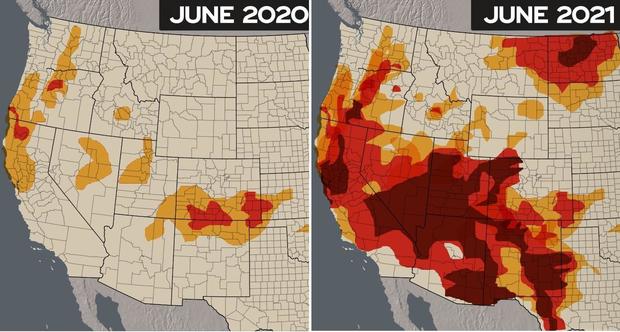
By almost any measure the drought in the Western states this year is about as bad as we’ve ever seen — perhaps the worst in modern history. A severe lack of rainfall over the past two years, combined with a steadily heating climate, has turned California into a tinderbox, setting the stage for what will likely be a catastrophic fire season ahead.
This comes on the heels of the worst fire season in recorded history in the West, setting a new bar for what seemed possible. In 2020, more than 8 million acres burned, with California and Colorado experiencing their largest fires ever.
That’s why it’s startling to see the comparison between last year’s relatively modest drought and this year’s record-setting drought. Drought conditions this time last year are a blip on the radar compared to where we are right now.
Over the past 20 years, the coverage of exceptional drought has never surpassed 11%. Right now it is a staggering 27%.
CBS NEWS AND US DROUGHT MONITOR
The escalating drought has severely dried out vegetation weeks before fire season really kicks in. The energy, or fuel, available to feed fires, technically called the Energy Release Component, is at a record level for this time of year.
In the chart below for the Central Sierra mountains of California, the blue line represents the current energy available for fires, and the red line shows the previous highs.
Lisa Charles’s family on a fishing trip.Photograph: Lisa Charles
All of Newtok’s 400 residents will have to move to higher ground but funding shortages and Covid means some are being left behindJuliaIlhardtTue 8 Jun 2021 11.12 EDT
Two years ago, Lisa Charles and her family moved from their lifelong home in the town of Newtok,Alaska, to Mertarvik, a 30-minute trip by boat or snow machine depending on the season.
Lisa is a member of one of the US’s first communities of climate transplants, though she is also Yup’ik, a mother of seven, a nonprofit employee, and a political volunteer. Melting permafrost has rapidly accelerated the erosion of the land under Newtok, bringing houses precariously close to the water’s edge.
All of the town’s nearly 400 residents will eventually have to make the move to Mertarvik, but a lack of funding and the global pandemic have left the village…
An artist’s impression shows an exoplanet orbiting the Sun-like star. Credit: ESO/M. Kornmesser
An international group of collaborators, including scientists from NASA’s Jet Propulsion Laboratory and The University of New Mexico, have discovered a new, temperate sub-Neptune sized exoplanet with a 24-day orbital period orbiting a nearby M dwarf star. The recent discovery offers exciting research opportunities thanks to the planet’s substantial atmosphere, small star, and how fast the system is moving away from the Earth.
The research, titled TOI-1231 b: A Temperate, Neptune-Sized Planet Transiting the Nearby M3 Dwarf NLTT 24399, will be published in a future issue ofThe Astronomical Journal.The exoplanet, TOI-1231 b, was detected using photometric data from the Transiting Exoplanet Survey Satellite (TESS) and followed up with observations using the Planet Finder Spectrograph (PFS) on the Magellan Clay telescope at Las Campanas Observatory in Chile…



 A 2019 photo by National Oceanic and Atmospheric Administration of the Mauna Loa Atmospheric Baseline Observatory in Hawaii.




 Exposing the Big Game


