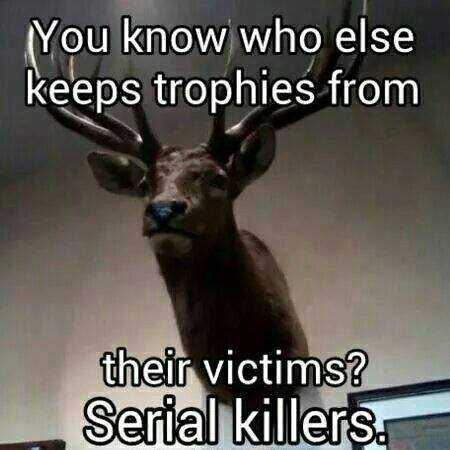
Who Else Keeps Trophies?
Image
8

…Doesn’t make it right.
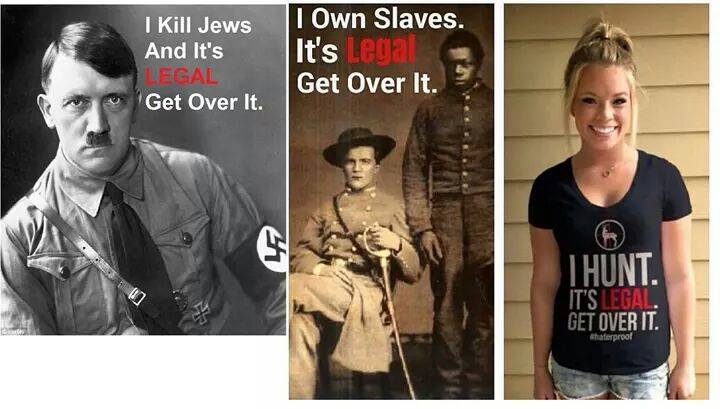
Tolerance has it limits. Laws change and evolve with the times. Things have gotten a little better for human rights and a whole lot worse for animals and their rights. It depends on who’s making the laws. Today’s Nazi party is run by sport hunters and their game department lackeys. The victims have no say in the matter. We must be their voice.
Abolish Atrocities Against Animals Today!
http://theirturn.net/rare-animal-hunt-auction/
The 6,000 member Dallas Safari Club will auction off rare animals hunts this weekend during the banquet at its annual convention, which is a “showcase of hunting, sporting and outdoor adventure,” according to the Club’s website. During the auction, “bidders of any age or gender” will have the chance to bid on “amazing items,” including “youth hunts in New Zealand and Texas, a challenging Mid-Asian ibex hunt in Russia, and a bongo hunt in Cameroon.”
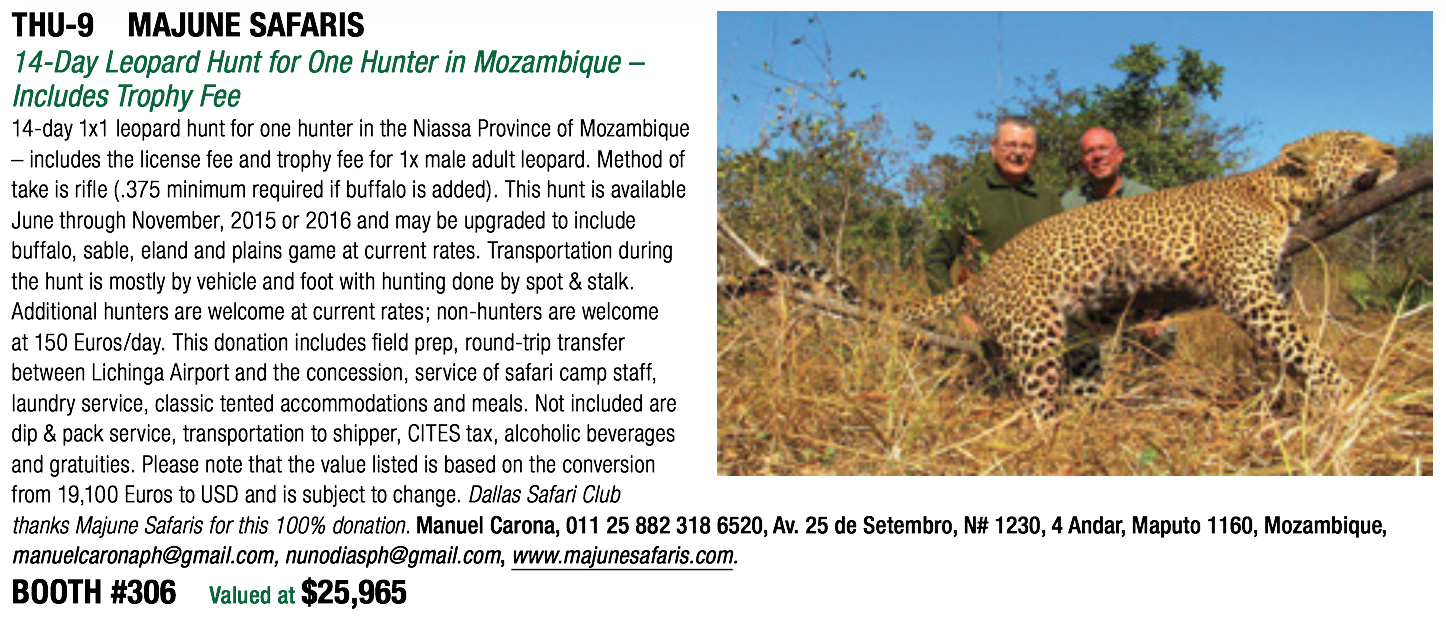
The 2014 convention made international headlines when one attendee, Corey Knowlton, paid $350,000 to shoot an endangered black rhino in Namibia. Mr. Knowlton, who has purportedly received death threats, tells critics that he is motivated by “conservation.” Specifically, he claims that his substantial contribution will be allocated to rhino conservation efforts and that killing the rhino in question would actually benefit other rhinos in the area who he has been attacking.
But, if conservation is really Mr. Knowlton’s motivation, then why doesn’t he allocate a small part of his winning bid to relocate him? And, if he’s concerned that the menacing rhino is harming the others, then why hasn’t he shot him down hasn’t he done it in the 12 months since he won the bid? Could it be because the U.S. Fish & Wildlife Service has not yet issued a permit to import the rhino’s body and that Mr. Knowlton has no intention of returning from Africa without his “trophy.”
In an interview with Jane Velez-Mitchell on JaneUnchained.com, Christopher Gervais, the director of the Wildlife Conservation Film Festival & Biodiversity Conference, says that killing animals is not the way to preserve them: “You do not hunt a vulnerable species in the name of conservation. Other organizations are conserving without hunting and killing.” Conservation funds. he says, can be raised through photography safaris during which animals are shot with cameras instead of guns.
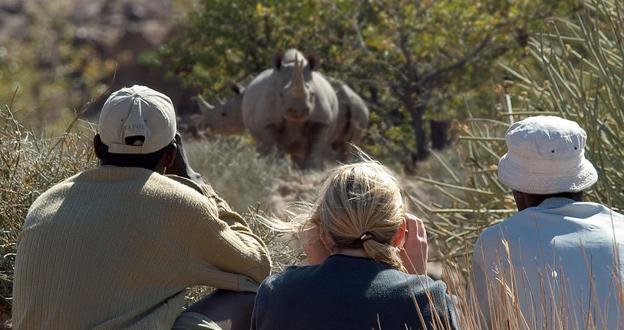
Please sign the petition to the U.S. Fish & Wildlife Service to deny a permit that would allow 2014 Dallas Safari Club auction winner Corey Knowlton to import a black rhinoceros trophy from Namibia.

A crowd of hunters participating in the Teton park hunt herded elk from a no-hunting area into a barrage of bullets on Wednesday, upsetting nonhunting passersby.
Thursday, November 20, 2014 4:30 am
Witnesses say hunters in Grand Teton National Park drove a herd of elk from a no-hunt zone and toward an awaiting firing line Wednesday.
The scene at the sage flats north of Kelly was a surprise to Michigan resident and Jackson Hole visitor Joanna Childers, who was on a wildlife safari during her first visit to Teton park.
“It looked like a bunch of hunters surrounded a pack of elk,” Childers said. “Hunters were staked out in the road and around the field.
“You see these animals and they’re in a pack and there a bunch of rifles pointed at them from every direction,” she said. “Overall, it was kind of sad and pretty unfair.”
Wildlife photographer Tom Mangelsen — long an opponent of the park hunt — said hunter behavior Wednesday was as egregious as he’s seen.
By Mangelsen’s account, around 11 a.m. a person pushed a herd of about 100 elk out of an area off limits to hunters near Kelly. Once the herd was on the move, chaos ensued, he said.
“All the sudden somebody shot and they just opened fire on them,” Mangelsen said. “It’s really poor sportsmanship — it was illegal and it was just a display of totally barbaric hunting.”
The photographer estimated that 30 people were involved in the drive, that 25 shots were fired and that eight to 10 elk were killed.
Teton park officials did not corroborate many of the details described by Mangelsen and others, but said some hunters were ticketed Wednesday.
“There was quite a bit of action as far as hunters go and the movement of elk near Kelly,” park spokeswoman Jackie Skaggs said. “At least two citations have been issued.”
Two hunters shot and killed bull elk Tuesday in the park, where harvest is restricted to cows and calves. The elk were confiscated by the Wyoming Game and Fish Department, Skaggs said.
One of those hunters was also cited for shooting at a running herd, she said.
Rules unique to the park hunt prohibit firing more than one shot at a group of running animals.
Seven park rangers were still in the field at the time Skaggs spoke with the Jackson Hole Daily, and she said it’s possible there were other violations.
It’s legal for hunters to drive elk out of areas where hunting is prohibited in the park, Skaggs said.
Mangelsen said some people were firing from the road, which is illegal. Photos he provided show hunters with rifles and shooting sticks setting up on the roadside.
Jeff Soulliere, another local photographer, said the display left him speechless.
“It absolutely was a mess,” Soulliere said. “This is a national park, and you’ve got tourists on the road right next to hunters with high-powered rifles.
“It really struck me as, ‘you got to be kidding me,’ ” he said. “No one was taking safety into consideration because they were herding and surrounding them and they could have shot each other.”
[Too bad they didn’t.]
One of the would-be hunter-commenters here recently demanded I explain why I compare hunters to pedophiles and serial killers. Since, as a rule, I don’t approve comments from hunters or their apologists (and because I felt it was so bloody obvious), that question hasn’t been answered here since June 10, in a post entitled, Poachers and Pedophiles are Like Apples and Oranges.
But now that Corey Knowlton has added his voice to the choir of  self-confessed twisted-psycho-hunter-perverts with the telling statement to the WFAA, “I’m a hunter; I want to experience a black rhino. I want to be intimately involved with a black rhino,” it’s time to re-examine the connection in a little more detail. What kind of mind uses the word “experience” for the act of taking a life? Ted Bundy called his murders “possessing.” Like a trophy hunter, he felt entitled to claim another’s life for his own pleasure. In his case, the lives were young co-eds and 12 year old girls—in Knowlton’s case, endangered rhinos. Ted Bundy’s third person narrative of his predations could easily be mistaken (aside, perhaps, from the level of literacy) with Ted Nugent describing one of his trophy kills: “The fantasy that accompanies and generates the anticipation that precedes the crime is always more stimulating than the immediate aftermath of the crime itself. He should have recognized that what really fascinated him was the hunt, the adventure of searching out his victims. And, to a degree, possessing them physically as one would possess a potted plant, a painting, or a Porsche. Owning, as it were, this individual.”
Pertaining to the likes of Alaskan trophy hunter turned-serial killer, Robert Hansen, who preyed on exotic dancers and child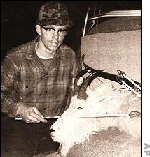 prostitutes, in addition to Dall sheep, mountain goats and countless other species, conservationist Gareth Patterson wrote: “Certainly one could state that, like the serial killer, the trophy hunter plans his killing with considerable care and deliberation. Like the serial killer, he decides well in advance the type of victim–that is, which species he intends to target. Also like the serial killer, the trophy hunter plans with great care where and how the killing will take place–in what area, with what weapon. What the serial killer and trophy hunter also share is a compulsion to collect trophies or souvenirs of their killings. The serial killer retains certain body parts and/or other trophies for much the same reason as the big game hunter mounts the head and antlers taken from his prey…as trophies of the chase.”
And, as I put it the last time I addressed the pedophilic serial killer/trophy hunter connection: …the analogy between a trophy hunter and a serial killer has been well established—both are single-minded in their quest for the kill, placing their own perverse desires above the self-interests—indeed, the very lives—of their victims. Both perpetrators like to take souvenirs from their kills, and neither one cares what the rest of the world thinks of their actions.
“I’m a hunter,” Knowlton told WFAA. “I want to experience a black rhino. I want to be intimately involved with a black rhino.”
http://www.cbsnews.com/news/texas-hunting-club-may-cancel-endangered-rhino-hunt/

DALLAS – A Texas hunting club that auctioned off a permit to shoot an endangered black rhinoceros in Africa said it will cancel the hunt if a federal agency denies the winning bidder’s request to bring the dead animal back to the U.S. as a trophy.

CBS Evening News
An anonymous bidder will pay a record $350,000 permit to hunt a black rhino, one of the most endangered animals on the planet. The club that host…
Corey Knowlton bid $350,000 at a January auction that the Dallas Safari Club billed as a fundraising effort to save the endangered species. Last spring, he applied for a permit from the U.S. Fish and Wildlife Service that would enable him to import the rhino’s body following the hunt in Namibia. But he’s still waiting to hear back.
The agency is applying extra scrutiny to Knowlton’s request because of the rise in poaching, said spokesman Gavin Shire.
If the permit is denied, the safari club plans to refund Knowlton’s money that was pledged to a rhino conservation fund in the southwestern African country.
“Most people that have an animal mounted, it’s their memory of their experience,” said Ben Carter, the safari club’s executive director. “It’s not always, ‘Look at what I’ve shot.’ When they look at it, they remember everything. That’s what he bid the money on, that opportunity.”

CBS This Morning
A hunting group in Texas that auctioned off a permit to kill a black rhino in Namibia, says it’s receiving death threats. The animal is considere…
The wildlife agency began taking public comment on the permit application this month and has already heard from many of the groups that fervently opposed the auction.
The safari club has defended the planned hunt, noting that auction proceeds would go to a trust fund administered by the Namibian government to help boost the black rhino population.
The wildlife service expects to make a decision after the public comment period ends Dec. 8, taking into account the state of the herd in Namibia, where 1,800 of the world’s 4,880 black rhinos live. The agency also is examining exactly how the auction funds would be administered.
Last year, the service granted a permit to import a sport-hunted black rhino taken in Namibia in 2009, but increased poaching since then may impact whether any more are approved, said Shire.
Each year, the Namibian government issues five black rhino hunting permits that fund efforts to protect the species. The program includes habitat improvement, hiring game scouts to monitor the rhinos, and removing the animals’ horns to reduce their appeal to poachers.
“The aim is to re-invest these financial resources back to conservation, protected area management and rural community development,” said Kenneth Uiseb, Namibia’s director of wildlife monitoring and research.
But opponents of the auction say the programs are not worthwhile if they entail the killing of any endangered animal.
“Kill it to save it is not only cruel, it’s not conservation,” said Jeff Flocken, the North American regional director for the International Fund for Animal Welfare. “If black rhinos and other dwindling species are to have a future, people must be encouraged to value animals for their inherent worth alive, not their price tag when they are dead.”
The safari club has said the hunt will involve one of five black rhinos selected by a committee and approved by the Namibian government. The five are to be older males that can’t reproduce.
Namibia sold another hunting permit for $200,000 directly to Michael Luzich, a Las Vegas investment manager who is also seeking a permit to bring the trophy into the U.S., according to Shire.
But Luzich has received far less scrutiny than Knowlton, who said in January he hired full-time security because he received death threats after his name was leaked on the Internet.
Knowlton lives in Royse City, about 30 miles from Dallas, and leads international hunting trips for a Virginia-based company, The Hunting Consortium. He has killed more than 120 species, including the so-called big five in Africa – a lion, a leopard, an elephant, a Cape buffalo and a rhinoceros, according to the company’s website.
He did not return messages left by The Associated Press for this story, but told Dallas television station WFAA in January that he believed the hunt would be managed well.
“I’m a hunter,” Knowlton told WFAA. “I want to experience a black rhino. I want to be intimately involved with a black rhino.”
Imports From Namibia & SA.
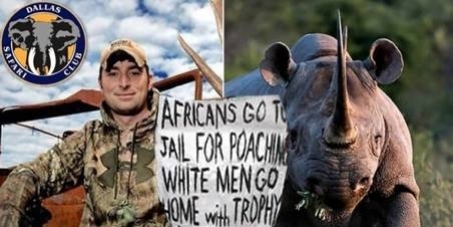
20,130 signers. Let’s reach 100,000
http://www.reuters.com/article/2014/10/23/us-usa-alabama-rhino-idUSKCN0IC2NH20141023
(Reuters) – A South African company has been indicted in Alabama for selling illegal rhinoceros hunts to Americans and secretly trafficking in the endangered animals’ horns, which sell on the black market at prices higher than gold, prosecutors said on Thursday.
The 18-count indictment charged Valinor Trading CC, which operated in the United States as Out of Africa Adventurous Safaris, and company owners Dawie Groenewald, 46, and his brother, Janneman Groenewald, 44, with conspiracy, Lacey Act violations, mail fraud, money laundering and structuring bank deposits to avoid reporting requirements.
All species of rhinoceros are protected under U.S. and international laws, including the Lacey Act, which addresses illegal poaching and wildlife trafficking, according to a statement from the U.S. Department of Justice.
“This case should send a warning shot to outfitters and hunters that the sale of illegal hunts in the U.S. will be vigorously prosecuted regardless of where the hunt takes place,” Acting Assistant Attorney General for the Environment and Natural Resources Division Sam Hirsch said in the statement.
The whereabouts of the Groenewalds, and whether they have hired a lawyer, could not immediately be determined.
National Geographic magazine reported that Dawie Groenewald was arrested in 2010 in South Africa, along with 10 others and that a multi-count case has been under way for four years.
Both Groenewald brothers are South African nationals. Janneman Groenewald lived and operated out of Alabama’s Autauga County, where he maintained company bank accounts.
Nine American hunters paid up to $15,000 per animal for a total of 11 hunts sold at hunting conventions and gun shows in the United States between 2005 and 2010.
None of the hunters was charged because prosecutors said the hunters were tricked by the Groenewalds into believing they were shooting legally at “problem” rhinos. The Groenewalds obtained no hunting permits from the Republic of South Africa or local government, the indictment said.
The hunts took place at a ranch in Mussina, Limpopo Province, South Africa co-owned by the Groenewalds and American investors, according to the indictment.
After killing or capturing a rhino, the hunters posed for photos with the carcasses that appeared on company marketing brochures, the indictment said. Dawie Groenewald, who supervised the hunts, then cut off the horns with chainsaws and knives.
The population of rhinos, indigenous to southern Africa, is being decimated by poachers who supply a demand for horns for decorative and supposed medicinal purposes, prosecutors said.
The investigation was part of ongoing Operation Crash, named for a term used to describe a rhino herd, led by the U.S. Fish and Wildlife Service. It has resulted in 26 arrests and 18 convictions, with prison terms as high as 70 months for illegal rhino hunting or trafficking in horns.
The YouTube series, titled “Game On,” features Jones and a friend setting out on hunting trips together. The first episode, a poorly-made jaunt to Lake Charles, La. for a crocodile hunt, begins with the line, from Jones’ friend Taylor Altom: “I want to shoot a gator in the face.” The pair travel through the swamp in search of alligators for a weekend with the help of a local hunter.
WARNING: Disturbing Images
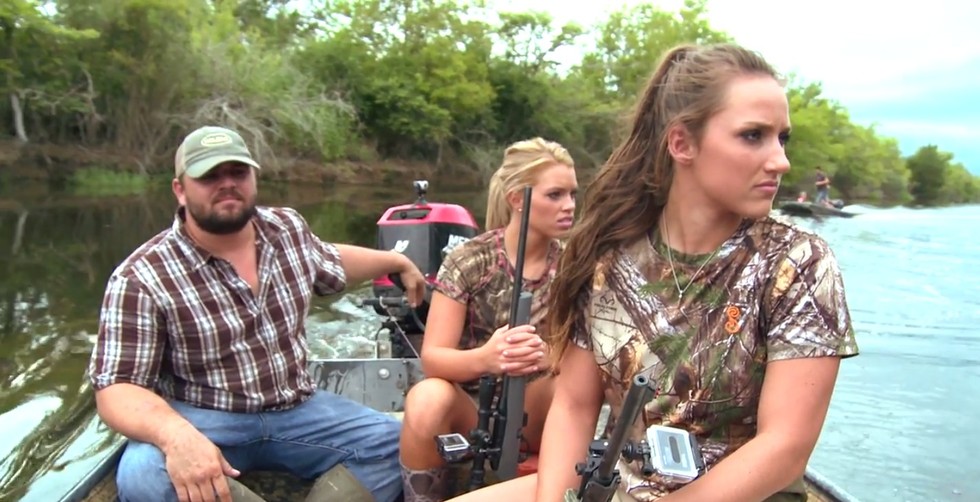
(Kendall Jones/YouTube)The episode, which can be seen at this link, ends with Jones shooting an alligator who was caught on a baited hook in the head as her guide holds it up about six inches away from her. She’s careful to thank her Remington, a nod to the show’s sponsor.

(Kendall Jones/YouTube)The American alligator was taken off the U.S. Fish and Wildlife’s Endangered Species List in 1987, and is actually faring pretty well. But hunting methods like baited hooks have been criticized before as inhumane ways of killing the animals. During alligator hunts, a short wooden peg is usually attached to a line, baited with beef or roadkill and then thrown into the water or tied to a branch to lure the alligator. Because take isn’t allowed after sunset, it’s possible that alligators will have to spend the entire night on a line before they’re shot with a gun or bow and arrow.
When Jones was attacked for hunting big game in Africa, a petition started by a Cape Town native calling on her to be banned from hunting in African states gained over 150,000 signatures. Another petition asked Facebook to remove her grisly hunting photos — which they eventually ended up doing. No word yet on whether YouTube will do the same thing.
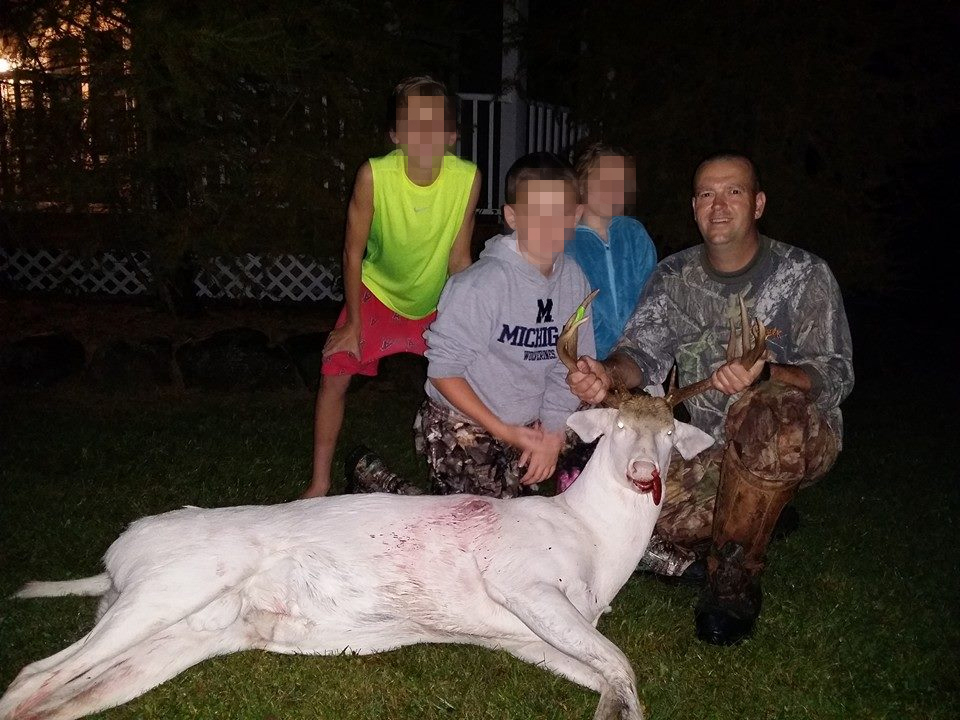
An 11-year-old boy in Michigan had an encounter last week with one of nature’s most awe-inspiring sights — an albino deer, alive and free in the wild. Only about one in 20,000 deer are born with albinism, and far fewer survive to maturity like this one had.
But the boy was on no nature walk; he was on a hunting trip with his father, and the rare deer wouldn’t survive the day.
Warning: Graphic image below
With the encouragement of his father, Mick Dingman, the sixth-grader steadied his crossbow and fired a fatal shot through the deer’s lungs, besmirching that snow-white coat with the spill and splatter of blood. The rare animal had been seen by folks around town leading up to that moment, but now this deer was the Dingmans’ alone.
Dingman tells the Livingston Daily that he plans to commemorate the killing by getting the 12-pointed buck mounted by a taxidermist: “It’s too rare and too pretty not to spend the extra money and have the whole thing done.”
“[My son] kind of feels like a rock star right now,” says Dingman, adding that the youth’s supposed accomplishment has caught the attention of hunting magazines, who are interested in sharing the story. But not everyone is so excited.
Amy Sprecher, in neighboring Wisconsin, runs a white deer protection group composed of hunters and non-hunters who are opposed to killing albinos — and she says stories like this are “maddening.”
“It’s just wrong. I don’t understand why’d you’d want to take that animal away from everybody,” Sprecher told The Dodo. “There are people who want to hunt white deer for bragging rights, but that’s not what hunting is about. Hunters that would never shoot a white deer don’t understand these people either.”
And Sprecher is not alone in her outrage. Not long after the Livingston Daily posted this photo and story online, readers began expressing anger.
“Wouldn’t you much rather observe something so rare again year after year than just stare at this giant full mounted carcass for the rest of your life?” writes Christina Brown.
“This deer was in our backyard in the spring and my wife took a picture. All of the people near us wanted to only shoot pictures, not the deer. We aren’t anti hunting but instead wanted this rare deer to be able to spread his genes so his legacy lives on after he died of a natural cause,” writes Tim Reinert.
Given the rarity of albino deer, four states, Illinois, Iowa, Tennessee and Wisconsin, have made it illegal to kill them. Critics have argued that laws protecting white deer are based more on emotion than science — arguing that albinism is a genetic disorder, not something to be cherished — but emotions surrounding white deer is certainly nothing new.
According to Native American tradition, white deer, like the one killed by Mick Dingman’s son, are one of the most sacred creatures on the planet.
“Albino animals are looked at as a spirit animal, which you are suppose to learn from rather than shoot and kill,” Jonnie J. Sam, from Michigan’s Ottawa Indian tribe, told The Dodo.
“I’d be more inclined to see if the animal has something to teach me, but sadly not everybody looks at it that way.”
 Exposing the Big Game