DefaultMono SansMono SerifSansSerifComicFancySmall CapsDefaultX-SmallSmallMediumLargeX-LargeXX-LargeDefaultOutline DarkOutline LightOutline Dark BoldOutline Light BoldShadow DarkShadow LightShadow Dark BoldShadow Light BoldDefaultBlackSilverGrayWhiteMaroonRedPurpleFuchsiaGreenLimeOliveYellowNavyBlueTealAquaOrangeDefault100%75%50%25%0%DefaultBlackSilverGrayWhiteMaroonRedPurpleFuchsiaGreenLimeOliveYellowNavyBlueTealAquaOrangeDefault100%75%50%25%0%
Two bills in the Vermont Legislature that were originally set up to ban two hunting practices in the state have been watered down as they exit the Senate.
MONTPELIER, Vt. (WCAX) – Two bills in the Vermont Legislature that were originally set up to ban two hunting practices in the state have been watered down as they exit the Senate.
Both have created dialogue about trapping in the state and hunting coyotes with hounds. It’s leaving advocacy groups on both sides of the hunting spectrum watching closely.
“It seems like we have reached that middle ground that makes sense,” Vt. Fish and Wildlife Commissioner Chris Herrick said.
Herrick says two Senate bills advancing are reflective of compromise happening in Vermont’s everchanging landscape around…
It’s not hard to hunt feral hogs in Texas. That’s partly because there are so many of them here– the most of any state, experts think – and partly because it’s state policy to make hog hunting as easy as possible.
Feral hogs are amongthe most destructive invasive speciesin the United States. Every year, they cause over $1 billion in damage nationwide to crops and property. So landowners and government agencies like the U.S. Department of Agriculture are invested in decreasing their population.
Texas is a hog hunting paradise. Before 2019, hunters were required to have a license to hunt them. But the Legislaturegot rid of that requirement. Now, only a hunter’s education…
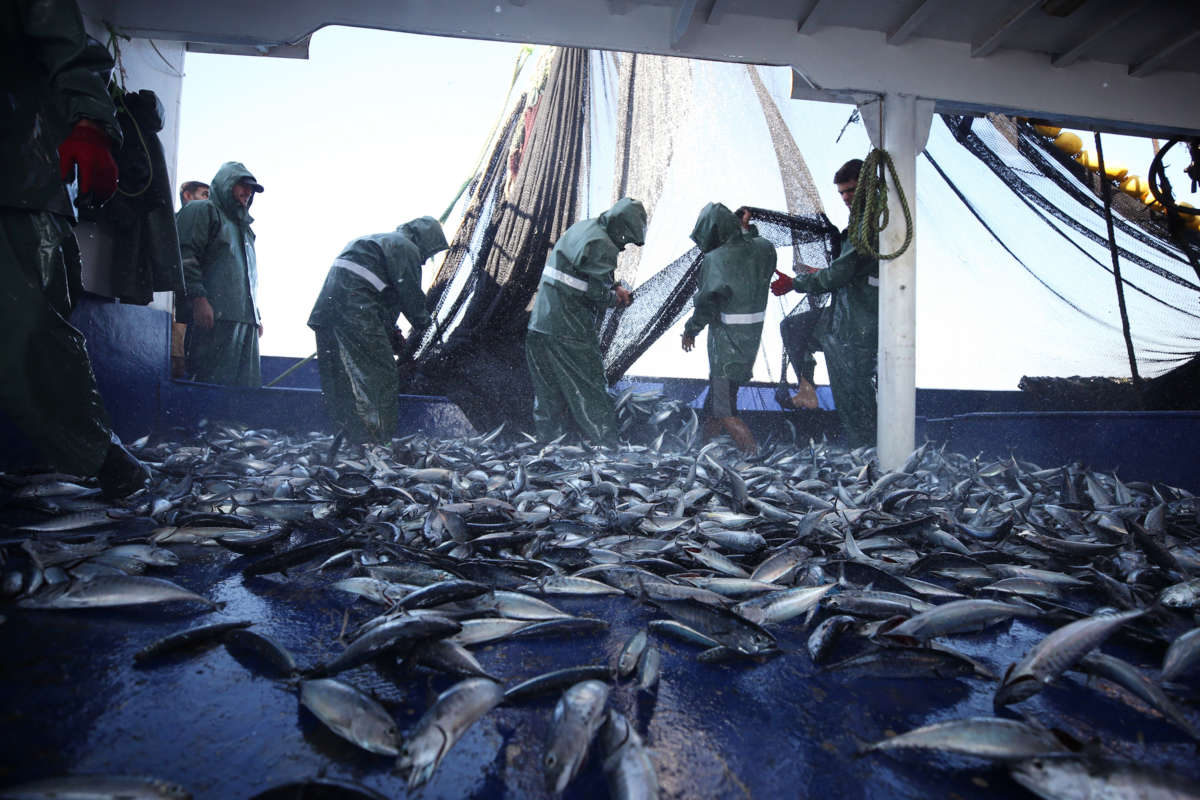
As fishing vessels scour the oceans for fewer and fewer fish, the trail of each one can be tracked via satellite. Each ship crosses and recrosses the paths left by others until the seas of the world start to resemble the fishing nets they play host to. Within this tangled web, the paths of two vessels caught the attention of the investigative team at my organization, the Environmental Justice Foundation — their strange, parallel movements didn’t look right.
This chance observation, unremarkable to most, was the start of a year-long investigation to expose the Israr fleet — three vessels illegally fishing for tuna, damaging our already over-exploited ocean ecosystems, threatening the food security and livelihoods of coastal communities, and using every means possible to evade detection. These vessels, and others like them, fish illegally and often indiscriminately, outcompeting local fishers and putting at risk the food security and livelihoods of over 100 million people who rely on small-scale fishing.
The operator controlling this fleet knew how to work the system. They knew the chronic lack of transparency, communication and accountability across the global fishing sector could be used to their advantage to keep the fleet’s illegal and destructive activities off the radar.
Don’t miss a beat
Get the latest news and thought-provoking analysis from Truthout.
Email
They are by no means the first to notice and exploit this weakness — the systemic lack of transparency across global fisheries is one of the most significant enablers of illegal fishing around the world. Crucial information on vessel ownership, records of illegal activity and fishing authorization are not publicly available, forcing authorities to make uninformed decisions on which vessels are allowed to fish their waters. The lack of data flow hinders collaboration between NGOs, governments and regional fishing authorities working to apprehend illicit operators and makes it far too easy for illegal fishing to thrive. It also creates a lawless environment ripe for human rights abuses to flourish, with no oversight and no escape.
There is a proverbial playbook of tried-and-tested tactics that exploit the flaws in the system. The owner of the Israr fleet knew them all.
Practiced Deception
Israr 1 and 2, taken by a crew member onboard Israr 3
All fishing vessels are required to sail under the flag of a nation, and, in theory, abide by the laws of that state. The Israr fleet not only went “stateless” for a time, illegally sailing under no flag, the sailors repeatedly changed their flags. Swapping flags may not be illegal, but it is used by illegal operators to create confusion around who is responsible for monitoring and sanctioning the vessel, or to adopt a flag of a state they know simply can’t or won’t monitor their operations and enforce laws and regulations. Under cover of this uncertainty, they can continue their criminal activity uninterrupted, damaging our oceans and decimating fish populations.
To add to this confusion, the owners changed the names of the vessels, with crew switching digital ID codes mid-voyage and physically painting over the name on the side of each vessel with bright white paint. This tactic is only effective because of our disjointed system. Universal vessel identification systems do not apply to all fishing vessels, not all nations have national vessels identification schemes for non-eligible vessels, and many of these registries are not publicly available to check vessels committing illegal acts against. There is currently no truly universal, openly available system of vessel identification — a unique number or code, a so-called unique vessel identifier (UVI) — that stays with each vessel from shipyard to scrapyard, regardless of name or flag changes. Without such records, it is almost impossible to uncover the illegal history of a vessel, and to hold the owners and operators accountable.
The Israr fleet also engaged in trans-shipment, meeting other vessels at sea to transfer catch, supplies or crew. While this can occur legally, it has become a characteristic tactic of illegal operators trying to cover their tracks. It allows them to “launder” fish caught illegally and perpetuate the abuse and enslavement of crew by enabling vessels to stay away from port for months or even years.
For example, migrant workers in Korea’s distant water fishing fleet reported being forced to work 18-hour days; a quarter of the crew we spoke to had experienced physical abuse and over 60 percent had witnessed verbal abuse. Almost all had their passports confiscated by their captain and several months’ wages deducted at the start of contracts to discourage them from escaping these abusive environments. These vessels regularly remained at sea for over a year, and in some cases over 18 months, without calling at port.
A Lucky Observation
It took over a year of investigation to build a case against the Israr fleet, but it paid off. In December 2021, the fleet was blacklisted by the International Commission for the Conservation of Atlantic Tunas, a significant blow to this illicit network. If properly implemented, this will prevent the fleet from selling any of the fish they catch.
We cheered this small victory the Environmental Justice Foundation — one less fleet abusing the system and damaging our oceans. But what about the next vessel, and the one after that?
The Israr fleet was caught by chance by an observant, determined NGO. Up against global illegal fishing operations catching 26 million tonnes of fish each year, this approach will barely scratch the surface. We cannot afford to continue in this hit-or-miss manner.
Systemic Change
We need a system that works for us, not for them — a system built on transparency. By opening data flow between nations and bringing vessel license lists, history of offenses and full ownership details into the public realm, we can start to protect our ocean from these damaging fleets and hold the owners of these vessels accountable.
This systemic change is needed on an international level. In the Israr investigation alone, we worked with fishing authorities in Belize, Saint Vincent and the Grenadines, Brazil, Senegal, Trinidad and Tobago, the U.S., France and Oman, all tuna regional fisheries management organizations, the European Commission, INTERPOL and crew members in Mauritius. This is the level of international data-sharing and collaboration we need to achieve.
This may sound daunting, but bringing fisheries out of the shadows does not require new, sophisticated technology, or unrealistic expense. It can be achieved by any country through a combination of public data-sharing, enforcement of sustainable fisheries laws, and the use of existing technology to understand, map and disclose supply chains.
If we fail to enact this change, millions of people will suffer, especially coastal communities that rely on thriving fisheries to survive. We are already seeing the consequences of apathy in Ghana, where the fundamental human rights of Ghanaian fishing communities are being threatened by the government’s failure to tackle overfishing and illegal fishing by industrial trawlers. Over half the 215 small-scale fishers, processors and traders we spoke to reported going without sufficient food over the past year, and over 70 percent reported a deterioration in their living conditions over the past five years. The vast majority of industrial trawlers in Ghana, although operating under the Ghanaian flag, are controlled and financed by distant water fishing companies based in China.
Illegal fishing is pushing ocean ecosystems toward total collapse and stripping millions of people of their food security and livelihoods. It is cause for international shame that the chronic lack of transparency can still be used get away with these crimes. Only through international collaboration can we bring fishing out of the shadows and return our oceans to their rightful glory.
German citizen Carsten Aust visited Canada to raise awareness and funds for a Philippine children’s charity, but his noble mission took a tragic turn after an ill-fated decision to join his new friends hunting for a bear ended in the death of a 59-year-old Rosengart man.
“In his wildest dreams, he never imagined he would be in a courtroom facing any charge of any kind,” his lawyer Jeff Gindin told court Wednesday. “It’s a terrible tragedy.”
A Facebook page for Vision Help International Care Foundation (Philippines) identifies Carsten and Mercy Aust as the charity’s founders.
Oleg Unruh died Oct. 5 after he was shot returning to his vehicle following a day hunting for deer in…
Louisiana Department of Wildlife and Fisheries (LDWF) Enforcement agents cited nine people for alleged turkey hunting violations during the opening weekend of the 2022 turkey hunting season. Turkey season opened on April 2 in all three turkey hunting areas.
On April 1 agents cited:
Jonathan Dees, 43, of Albany for hunting turkeys during a closed season and failing to comply with turkey tagging requirements in Tangipahoa Parish.
On April 2 agents cited:
Darrell L. Arnold, 75, of Alexandria, for possessing illegal turkey during an open season and failing to maintain sex identification of tag meat in Vernon Parish.
Christopher W. Carmack, 26, of Deridder, for hunting during a turkey lottery hunt without lottery permit in Vernon Parish.
Mark R. Wallace, 63, of Deridder, for hunting turkeys over a baited area in Vernon Parish.
We kill 9.5 billion animals in the United States every year, and behind the death of each one of those animals is someone forced to become numb.Felix Ordonez Ausin/Reuters 2005
Growing up in Mexico City, my first job as a teenager was slitting the throats of chickens at a slaughterhouse. I started off as a “peeler.” I would pluck the feathers from their bodies as they came to me on the line. About 2% of the time, they would still be alive, still moving. Later, I moved on to a new role: cutting throats, which I did 700 to 800 times during my shift from 3 a.m. to 7:30 a.m. before heading to school at 8:30 a.m.
I was mostly numb to the killing. I didn’t recognize that each of those animals was an individual with a rich emotional life of their own. Occasionally, however, I would recognize their desperate eyes as they would look at me. But in order to do my job, to get through the day, I couldn’t care. It wasn’t until decades later, when I saw a video online of a chicken being killed that I came to grips with the disturbing reality of mass killing.
Many of us are concerned with the needless suffering of animals in industrialized animal agriculture, but the human cost of mass slaughter is just as troubling. I have two children and two grandchildren now, and I wouldn’t want any of them working in a slaughterhouse. But if not my children, then whose children will be asked to do this work?
SALE! Get an Entire 12 Weeks of Unlimited Digital Access for 99¢
I experienced this firsthand: My boss and co-workers resorted to drugs and alcohol consumption after their shifts. My boss’s wife hid her black eyes behind dark sunglasses. We all directed our attention away from her plight: The abuse she was facing at the hands of someone who was supposed to care for her — the same way we had to ignore the animals we were charged with killing.
If compassion were a muscle, this work we did left it weak and atrophied.
We kill 9.5 billion animals in the United States every year, and behind the death of each one of those animals is someone forced to become numb to perform this inherently violent task. The rest of us avert our eyes. We say we care so much about where our food comes from while being shielded from the dark reality of its production.
Will we continue to increase our consumption of animals and rely on a system that requires people to kill for hours on end to feed our planet?
I certainly hope not. And we don’t have to accept the status quo.
A new bill, AB2764, introduced by Assembly Members Adrin Nazarian, D-Los Angeles, and Alex Lee, D-San Jose, would halt the construction and expansion of factory farms and slaughterhouses in California.
No doubt, future generations will look back in horror at our treatment of humans and animals. We need to create a kinder food system, one where we protect the vulnerable and foster compassion. This is the world we should all want for my grandchildren.
Susana Chavez was born in Mexico City and moved to California as a teenager. She is an elected member of the Core leadership team of Direct Action Everywhere (DxE), a global grassroots network with the goal of achieving revolutionary social and political change for animals in one generation.
ARussian lawmaker has warned that Moscow would retaliate if Finland joins NATO as Russian aggression in Ukraine spurs the Nordic country towards membership of the alliance.
He said that Finland had developed close ties with Russia but NATO membership would mean “it would become a target.”
“I think it [would be] a terrible tragedy for the entire Finnish people,” said Dzhabarov.
However, he said that it was unlikely that “the Finns themselves will sign a card for the destruction of their country,” in comments reported on Wednesday by Russian state-owned domestic news agency RIA Novosti.
End the Killing of Black Bears in California Voice your support for bears to the California Fish & Game Commission before Thursday, April 21
The California grizzly was hunted to extinction nearly a century ago. Now, the state is failing to protect California black bears from hunting, despite bear killing being unethical and relying on dubious claims about the health of the population.
The California Department of Fish & Wildlife has reported population declines of up to 67%, but continues to approve the hunting of black bears. They are considering increasing hunting opportunities even though black bears are already facing extreme hardship from wildfires, drought, and vehicle accidents.
Our partners at the Humane Society of the United States petitioned the California Fish and Game Commission (CFGC) (petition 2021/2022-027) to enact a moratorium on bear hunting, citing concerns over the health and viability of the state’s…
Renowned linguist, philosopher and Salon contributorNoam Chomskyissued a dire warning on Wednesday that humanity is at a crucial point in its history — largely due to the twin threats ofclimate changeandnuclear war.
“Because of Trump’s fanaticism, the worshipful base of the Republican Party barely regards climate change as a serious problem. That’s a death warrant to the species,” Chomsky said in an interview withThe New Statesman. The American scholar, who is currently a professor at the Massachusetts Institute of Technology and the University of Arizona, also warned of Russian President Vladimir Putin’s “monstrous” war in Ukraine. Chomsky explained that Putin has set off a…
The military horses that carry America’s heroes to their final resting place in Arlington National Cemetery are living in unsanitary and potentially life-threatening conditions, according to a US Army report reviewed exclusively by CNN, consuming poor-quality feed, suffering from parasites and standing in their own excrement in tiny mud lots scattered with gravel and construction waste.