Jeff Bezos’s 10-minute trip to space has inspired a myriad of reactions, from boredom to anger to a surge of “space penis” memes making fun of the shape of his rocket. I am mortally certain this was not the reception Bezos — the richest person on Earth — was hoping for. And I hope that the world’s unimpressed reaction is followed by greater scrutiny of Bezos’s wealth, why he has it, and why we live under a system that makes it possible for anyone to hold over $200 billion while paying virtually no taxes.
By all reports, Bezos has been obsessed with space for 30 years, and spent a small fortune — a pittance to him, it is to be noted — almost but not quite getting there. After his billionaire rival, Richard Branson, pulled a similar stunt 10 days ago, you’d have thought from the media coverage that Branson had landed on the moon and discovered cold fusion in a crater. The coverage of the Bezos fling was about as exciting as this cat meme, and all he got for his troubles in the end were enough penis jokes to last 10 lifetimes.
You’d think the owner of The Washington Post would rate more ink from his colleagues in the biz, but alas for Bezos, he has learned a hard but unavoidable lesson: Almost nobody remembers someone who does something for the second time.
Stay in the loop
Never miss the news and analysis you care about.
Email
Case in point, and a pop quiz (no Googling the answer, you): It is universally known that Neil Armstrong was the first astronaut to step on the surface of the moon during the Apollo 11 mission. Who was the first astronaut out the door of Apollo 12, the second mission to land on the moon? Answer: Charles “Pete” Conrad. Extra points: What did he say after stepping out of the spacecraft? Answer: “Whoopie!”
Don’t worry, I had to look it up, too. No disrespect meant to astronaut Conrad, who did it right.
Yet as ridiculous as Bezos’s space coffee break was, I still get occasional pushback when I refer to people like him and Branson, who pay almost nothing in taxes annually, as “tax cheats.” They aren’t cheating, I am told, but are playing by the laws as they find them. Change the laws if you don’t like them!
Well, that right there is the thing. Most of us aren’t billionaires who can afford to financially adopt the kind of powerful politicians who can rewrite the tax codes in our favor. What do you call a system where rich people pay Congress members to do just that? I call it cheating, and sleep like a baby at night. If I slip a few Benjamins to the home plate umpire so he will expand the strike zone for my pitcher during the game, I am cheating, and that is this.
Such behavior has launched Bezos into an economic atmosphere no spacecraft can reach, whatever shape it may hold. In one second, Bezos makes as much or more money than the average worker pulls down in a week. In a minute, he makes more than the average worker earns in a year. “Based on the median net worth of an average US household, $97,300, an average American spending $1 is roughly equivalent to Bezos spending $1.95 million,” reportsBusiness Insider. “The Amazon CEO’s net worth took a hit of more than $10 billion in 2019 — and he still didn’t lose his spot as the world’s richest person.”
Yes, Bezos has donated some of his money. After many years of not giving much of his fortune away, he and his then-wife have donated $2 billion to combat homelessness and improve education, gave $200 million to the Smithsonian Institution’s National Air and Space Museum, and pledged $10 billion to combat the climate crisis since 2018. This is great, but it represents an infinitesimal portion of his fortune. Thanks to the magic of compound interest, his own money will make that money back for him in the time it takes to drive to Nana’s house.
Instead of lauding Bezos’s late-blooming philanthropy, we should be asking ourselves: Why is it OK for anyone to have the amount of money that Bezos has, when so much of the world has so little?This was a step toward the commercialization of space, and I want no part of that.
Moreover, we should consider the manner in which that fortune was amassed. Amazon, Bezos’s massive company, came to be a $1.5 trillion economic juggernaut by using brazenly monopolistic tactics to either buy up rivals or run them off the road. The company pays almost nothing in taxes, and to pad the bottom line, Amazon has become one of the most notorious union-busting corporations on Earth.
“Recently, Amazon won a closely watched National Labor Relations Board election against the Retail Wholesale and Department Store Union at a warehouse in Bessemer, Alabama,” John Logan reported for Truthout in May. “But it did so only after spending millions of dollars on harassing and intimidating its workers for two months before the vote. Now, the company is using the same strategy to bust a new independent union drive at its Staten Island facility in New York.”
Before embarking on his little trip, Bezos made word noises that seemed to indicate he sort of, kind of gets it. When asked if these “joyrides for the wealthy” waste money that could be used to help people on Earth, he replied, “Well, I say they’re largely right. We have to do both. You know, we have lots of problems here and now on Earth and we need to work on those, and we always need to look to the future. We’ve always done that as a species, as a civilization. We have to do both.”
We have to do both … so long as I get to play with my toys first. It was a politician’s answer, the kind of pabulum senators spout to reporters before the elevator doors close. I’ll believe Bezos and his ilk mean it if I never, ever hear talk about low-orbit billboards advertising Amazon products, or about corporate logos (come to think of it, the Amazon logo also has some strange penis action going on) visible on the moon. I fear that is where we are headed, because Bezos and Branson did not do this for the sake of discovery or exploration. They were clear: This was a step toward the commercialization of space, and I want no part of that.
Again, I am not alone. “What Branson’s and Bezos’s baby jaunts into the sky represent is not progress,” writes Barry Petchesky for Defector. “They are not about exploration or knowledge. They are moneymaking ventures. They are, as initially envisioned, about the promise of spaceflight tourism. They are symbolic, but of a future (and a present!) where only the extremely wealthy can get a taste of the peak awe that humanity is capable of feeling.”
There was no peak awe in beholding the Bezos space penis, and word has it Tesla billionaire Elon Musk is lining himself up to be the next obscenely wealthy turd to bounce some expensive metal off the inside of the outer atmosphere.
Meanwhile, billionaires like Bezos made your yearly salary three times over in the minutes it took you to read this article. Launch that into space.
Updated: 4:08 PM EDT Jul 20, 2021Infinite Scroll EnabledPlay Video SHOW TRANSCRIPT
GET LOCAL BREAKING NEWS ALERTS
The latest breaking updates, delivered straight to your email inbox.SUBMITPrivacy NoticeNORFOLK, Mass. —
A Boston man is facing multiple charges in connection with a reported sexual assault of a horse that happened in Norfolk last week, according to police.
Norfolk police say 19-year-old Jackson Z. Kelley, who lives in Boston’s Allston neighborhood, turned himself in late Tuesday morning with his attorney.Advertisement
Kelley was arrested, booked at the police station and transported to Wrentham District Court to be arraigned on the following charges: sexual contact with an animal, cruelty to animals and nighttime breaking and entering with intent to commit a felony.
“The Norfolk Police Department would like to thank the public for taking the time to come forward and become involved,” reads a statement from the department. “We received many calls providing information which eventually led to the identification of Kelley as the suspect.”
The MetroWest Daily News, a WCVB media partner, reports that during his arraignment on Tuesday, Kelley was ordered to be held without bail pending a dangerousness hearing that is scheduled for Friday.
The owner of Turner Hill Equestrian Stables, Hillary Swarr, confirmed to NewsCenter 5 on July 17 that one of the horses at her Miller Street facility was sexually assaulted in the early morning hours of July 15.
“I don’t think anybody is prepared for something like this,” Swarr said.Play Video
Swarr says she got an alert from her security system at around 4:30 a.m. on July 15 and she saw a man inside the stables abusing one of the horses when she checked her security cameras.
According to Swarr, the man unplugged all of her security cameras except one, and was able to flee the scene before anyone could get to the stables to stop or apprehend him.
“I felt violated. I felt lost. I felt scared,” Swarr said. “To see that someone would come into my own home and degrade a positive environment left me feeling violated.
According to Swarr, the suspect — later identified as Kelley — knew how to handle horses and is familiar with the animals.
“Someone, perhaps, in the business was savvy enough to get into the barn; be able to halter a horse, which to people who are novice, was not the easiest task; was able to put it on a cross-tie system, which secures the horse in a certain, particular area; and had the knowh0w to get grain or feed to keep it occupied,” Swarr said.
Norfolk Police Dept.Jackson Z. Kelley, 19, of Boston’s Allston neighborhood
In a statement, the horse’s owner — who wishes to remain anonymous — said that while she questions why the man committed the “grotesque act” on her horse, she feels “empowered” to support her fellow members in the Massachusetts equestrian community, both people and horses alike.
“If it weren’t for good surveillance, we’d never know about this,” the statement reads. “No one should experience sexual assault, and we will find this individual and bring him to justice.”
Swarr says DNA samples were collected from the mare that was assaulted and were being processed by investigators. She says the horse that was assaulted was not injured.
Norfolk Police Detective Samuel Webb, who led the investigation, told The MetroWest Daily News that he sent an alert out to surrounding communities to see if they had any information or similar incidents.
“I was able to get some leads from that,” Webb said. “I have some things I’m going to check out.”
Swarr told The Daily News that she has installed a new security system that will hopefully prevent an incident like this from happening again to any of the 22 privately-owned horses that reside at her stable.
Emergency Management B.C. warns that available accommodation for thousands of wildfire evacuees strained to the limit in Thompson and Cariboo regions, with some evacuees being sheltered as far south as ChilliwackAuthor of the article:
Amy Smart, The Canadian PressPublishing date:Jul 19, 2021 • 1 day ago • 4 minute read • Join the conversation
This handout photo courtesy of B.C. Wildfire Service shows a wildfire southwest of Deka Lake (C41102), which is estimated to be 200 hectares, British Columbia, on July 2, 2021.PHOTO BY -/AFP
Article content
MERRITT — A regional politician in British Columbia’s Interior is calling for more support amid a “dire” wildfire situation that he said has filled every available hotel with fleeing evacuees and stretched local security resources beyond their capacity.
Advertisement
STORY CONTINUES BELOW
Article content
Ken Gillis, who chairs the Thompson-Nicola Regional District, signed an evacuation order Monday for 28 properties near the community of Westwold, the latest in…
Erick LundgrenPhD Student, Centre for Compassionate Conservation, University of Technology Sydney
Arian WallachLecturer, Centre for Compassionate Conservation, University of Technology Sydney
Daniel RampAssociate Professor and Director, Centre for Compassionate Conservation, University of Technology Sydney
Disclosure statement
Arian Wallach receives funding from the Australian Research Council.
Daniel Ramp receives funding from the Australian Research Council.
Erick Lundgren does not work for, consult, own shares in or receive funding from any company or organization that would benefit from this article, and has disclosed no relevant affiliations beyond their academic appointment.
In the heart of the world’s deserts – some of the most expansive wild places left on Earth – roam herds of feral donkeys and horses. These are the descendants of a once-essential but now-obsolete labour force.
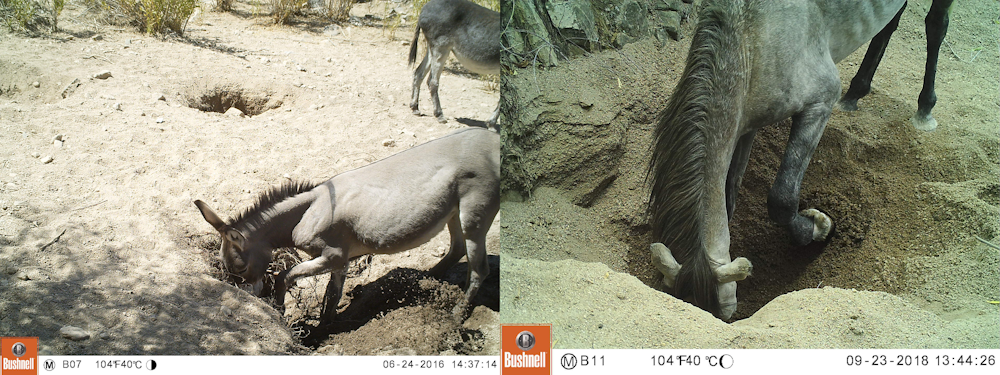
These wild animals are generally considered a threat to the natural environment, and have been the target of mass eradication and lethal control programs in Australia. However, as we show in a new research paper in Science, these animals do something amazing that has long been overlooked: they dig wells — or “ass holes”.
In fact, we found that ass holes in North America — where feral donkeys and horses are widespread — dramatically increased water availability in desert streams, particularly during the height of summer when temperatures reached near 50℃. At some sites, the wells were the only sources of water.
Feral donkeys and horses dig wells to desert groundwater. Erick Lundgren
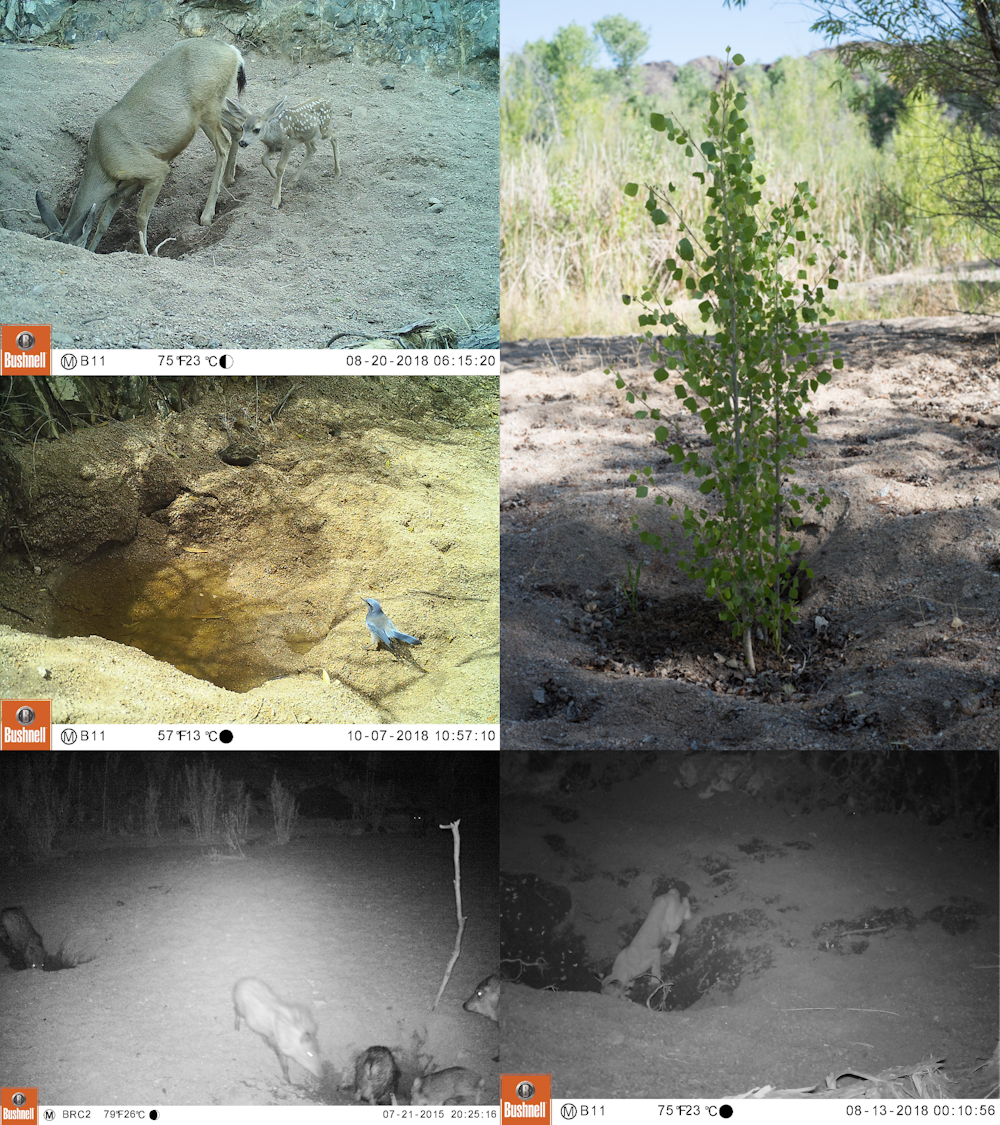
The wells didn’t just provide water for the donkeys and horses, but were also used by more than 57 other species, including numerous birds, other herbivores such as mule deer, and even mountain lions. (The lions are also predators of feral donkeys and horses.)
How The Conversation is different: All our authors are experts.
Learn more
Incredibly, once the wells dried up some became nurseries for the germination and establishment of wetland trees.
Numerous species use equid wells. This includes mule deer (top left), scrub jays (middle left), javelina (bottom left), cottonwood trees (top right), and bobcats (bottom right). Erick Lundgren
Ass holes in Australia
Our research didn’t evaluate the impact of donkey-dug wells in arid Australia. But Australia is home to most of the world’s feral donkeys, and it’s likely their wells support wildlife in similar ways.
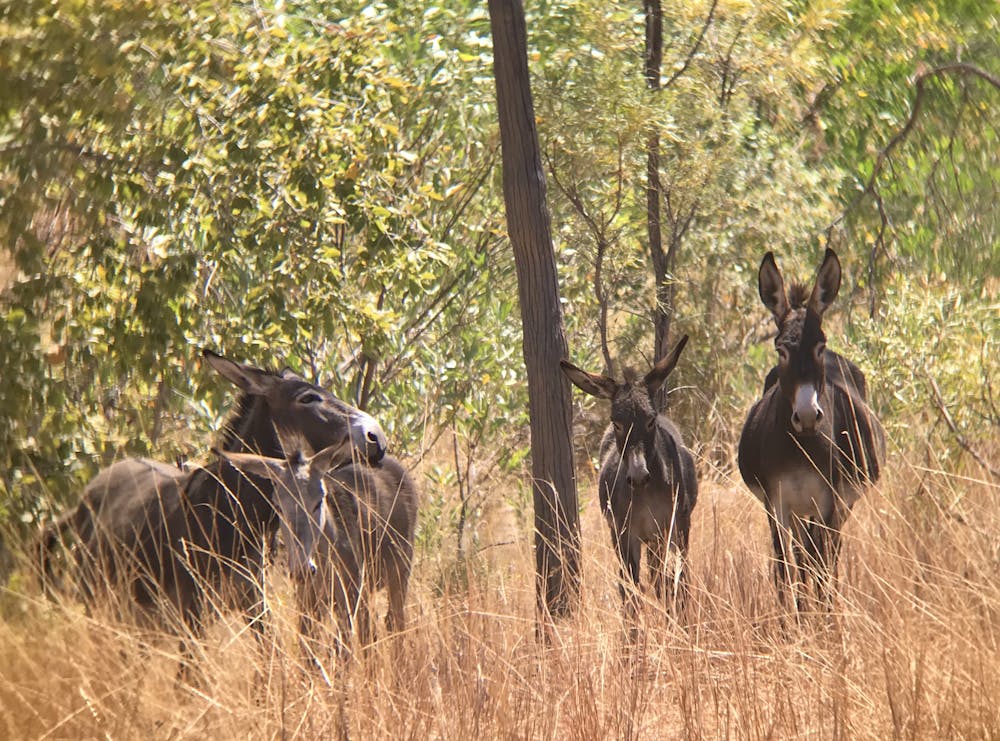
Across the Kimberley in Western Australia, helicopter pilots regularly saw strings of wells in dry streambeds. However, these all but disappeared as mass shootings since the late 1970s have driven donkeys near local extinction. Only on Kachana Station, where the last of the Kimberley’s feral donkeys are protected, are these wells still to be found.
In Queensland, brumbies (feral horses) have been observed digging wells deeper than their own height to reach groundwater.
Some of the last feral donkeys of the Kimberley. Arian Wallach
Feral horses and donkeys are not alone in this ability to maintain water availability through well digging.
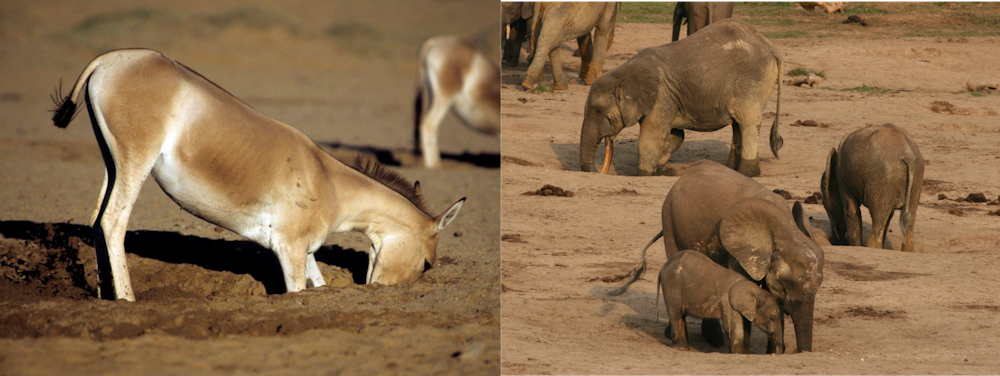
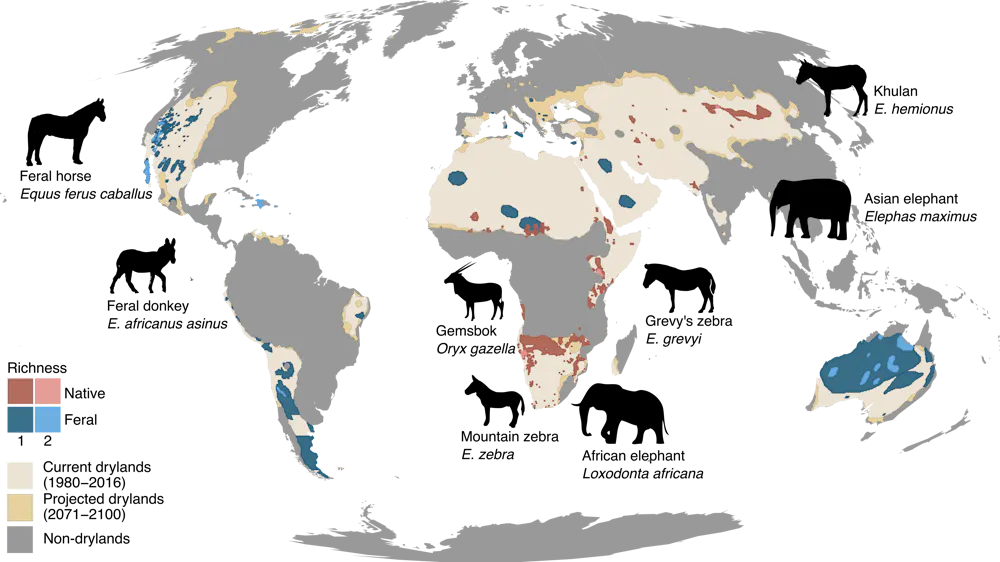
Other equids — including mountain zebras, Grevy’s zebras and the kulan — dig wells. African and Asian elephants dig wells, too. These wells provide resources for other animal species, including the near-threatened argali and the mysterious Gobi desert grizzly bear in Mongolia.
These animals, like most of the world’s remaining megafauna, are threatened by human hunting and habitat loss.
Other megafauna dig wells, too, including kulans in central Asia, and African elephants. Petra Kaczensky, Richard Ruggiero
Digging wells has ancient origins
These declines are the modern continuation of an ancient pattern visible since humans left Africa during the late Pleistocene, beginning around 100,000 years ago. As our ancestors stepped foot on new lands, the largest animals disappeared, most likely from human hunting, with contributions from climate change.
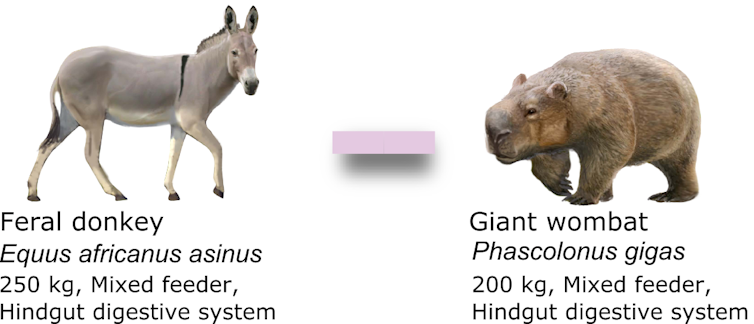
If their modern relatives dig wells, we presume many of these extinct megafauna may have also dug wells. In Australia, for example, a pair of common wombats were recently documented digging a 4m-deep well, which was used by numerous species, such as wallabies, emus, goannas and various birds, during a severe drought. This means ancient giant wombats (Phascolonus gigas) may have dug wells across the arid interior, too.
Likewise, a diversity of equids and elephant-like proboscideans that once roamed other parts of world, may have dug wells like their surviving relatives.
Indeed, these animals have left riddles in the soils of the Earth, such as the preserved remnants of a 13,500-year-old, 2m-deep well in western North America, perhaps dug by a mammoth during an ancient drought, as a 2012 research paper proposes.
Feral equids are resurrecting this ancient way of life. While donkeys and horses were introduced to places like Australia, it’s clear they hold some curious resemblances to some of its great lost beasts.
Our previous research published in PNAS showed introduced megafauna actually make Australia overall more functionally similar to the ancient past, prior to widespread human-caused extinctions.
Donkeys share many similar traits with extinct giant wombats, who once may have dug wells in Australian drylands. Illustration by Oscar Sanisidro
For example, donkeys and feral horses have trait combinations (including diet, body mass, and digestive systems) that mirror those of the giant wombat. This suggests — in addition to potentially restoring well-digging capacities to arid Australia — they may also influence vegetation in similar ways.
Water is a limited resource, made even scarcer by farming, mining, climate change, and other human activities. With deserts predicted to spread, feral animals may provide unexpected gifts of life in drying lands.
Feral donkeys, horses (mapped in blue), and other existing megafauna (mapped in red) may restore digging capacities to many drylands. Non-dryland areas are mapped in grey, and the projected expansion of drylands from climate change in yellow. Erick Lundgren/Science, Author provided
Despite these ecological benefits in desert environments, feral animals have long been denied the care, curiosity and respect native species deservedly receive. Instead, these animals are targeted by culling programs for conservation and the meat industry.
Several groups signaled intent to file a lawsuit over the expanded wolf-killing law they say will result in the deaths of other federally protected animals.
BOISE, Idaho — Note: The video above is from a May story about the impacts of the expanded wolf-killing law.
Environmental groups have notified Idaho Gov. Brad Little and other state officials of their intent to file a lawsuit over an expanded wolf-killing law they believe will result in the illegal killing of federally protected grizzly bear and lynx.
The Center for Biological Diversity, Western Watersheds Project and others on Monday gave a required 60-day notice of their intent to sue if Idaho officials don’t prohibit all hunting, trapping and snaring in grizzly bear and lynx habitat.
For lynx, the conditions could cover most of Idaho except for the southwestern portion of the state. For grizzly bears, the areas would include portions of northern, central and eastern Idaho. Wolves are found in roughly the northern two-thirds of the state.
In May, the Republican governor signed into law a measure lawmakers said could lead to killing 90% of the state’s 1,500 wolves through expanded trapping and hunting. It took effect July 1.
Lawmakers who sponsored the measure, backed by hunters and the state’s powerful ranching sector but heavily criticized by environmental advocates, said numerous times that the state is allowed to cut the number of wolves down to 150 before federal authorities would take over management of the species. They said reducing the wolf population would reduce attacks on livestock and boost deer and elk herds.
“Lynx, grizzly bears, and gray wolves all inhabit similar habitat types and geographic ranges in Idaho, and wolf hunting and trapping therefore frequently occur in areas in which lynx and grizzlies are also present,” the groups said in their letter. “Moreover, because snare and other authorized means of hunting and trapping are imprecise tools, they pose a substantial risk to non-target species, including lynx and grizzly bears.”
Besides Little, the letter was also sent to the members of the Idaho Fish and Game Commission and the directors of the Idaho Department of Fish and Game and Idaho State Department of Agriculture.
Roger Phillips, spokesman for the state Department of Fish and Game, said the agency doesn’t comment on pending litigation.ADVERTISEMENT
Little’s office didn’t immediately respond to a request for comment from The Associated Press.
Environmental groups filed a similar notice of intent to sue in Montana last month that also involves the potential killing of grizzly bears and lynx by wolf hunters and trappers.
A primary change in the new law allows the state to hire private contractors to kill wolves and provides more money for state officials to hire the contractors.
The law also expands the way wolves can be hunted and killed. Those methods include trapping and snaring an unlimited number of wolves on a single hunting tag, using night-vision equipment, chasing down wolves on snowmobiles and ATVs and shooting them from helicopters. It also authorizes year-round wolf trapping on private property.
It’s not clear if the expanded methods and seasons to kill wolves would reduce the wolf population to 150. Republican state Rep. Fred Wood, a former member of the Idaho Fish and Game Commission, said the only way to do that would be to use poison, which is not in the new law.
However, hunters have said night-vision scopes, now allowed, could significantly increase the number of wolves killed. But the threatened lawsuit cites possible deaths of grizzly bears and lynx from expanded trapping and snaring of wolves.
“Idaho’s outdated plans for wolf killing will inevitably harm other native wildlife species,” said Patrick Kelly, Idaho director of Western Watersheds Project. “It’s unacceptable to allow imperiled species to be ‘collateral damage’ in Idaho’s war on wolves.”
The state Department of Fish and Game reported in February that the wolf population has held at about 1,500 the past two years. The numbers were derived by using remote cameras and other methods.
About 500 wolves have been killed in the state in each of the last two years by hunters, trappers and wolf control measures carried out by state and federal authorities.
The entire staff at AIIMS, Delhi, has been placed in isolation as a preventative measure after a 12-year-old boy undergoing treatment for H5N1 Avian influenza died
All India Institute of Medical Sciences (AIIMS), New Delhi today recorded the first bird flu death in the country for this year after a 12-year-old boy undergoing treatment for H5N1 Avian influenza died at its pediatric department.
The entire staff at AIIMS, New Delhi, has been placed in isolation as a preventative measure.
Lawsuit Launched Over Idaho’s Harmful Wolf-Hunting Laws
New Laws Pose Substantial Risks to Federally Protected Lynxes, Grizzly Bears
BOISE,Idaho— Ten groups filed anotice of intenttoday to sue the state of Idaho to challenge the state’s new wolf-hunting laws, which also pose a serious risk to federally protected species like lynxes and grizzly bears.
The laws, which call for the killing of up to 90% of the current gray wolf population, allow for year-round hunting, trapping and snaring, with hunters and trappers allowed to kill an unlimited number of wolves on a single tag. The state’s authorization of an unlimited season and expanded methods of killing wolves is likely to result in incidental trapping and snaring of federally protected lynxes and grizzly bears, violating the Endangered Species Act.
Earthjustice sent the notice on behalf of the Center for Biological Diversity, Footloose Montana, Friends of the Clearwater, International…





 Updated: 4:08 PM EDT Jul 20, 2021Infinite Scroll EnabledPlay Video SHOW TRANSCRIPT



 We believe in the free flow of information