The video was taken during a 2013 hunting trip to Botswana but was shared Tuesday.
Wayne LaPierre stands on stage at the NRA annual meeting in Dallas on May 5, 2018.Daniel Acker / Bloomberg via Getty Images fileApril 28, 2021, 9:35 AM PDTByMinyvonne Burke
The National Rifle Association confirmed that a video going around shows its CEO, Wayne LaPierre, killing an elephant during a botched hunt.
The video was taken during a 2013 hunting trip to Botswana but was shared Tuesday by The New Yorker and the nonprofit journalism outletThe Trace.
In the nearly 10-minute video, LaPierre fires at the elephant, causing it to drop to the ground. Because the elephant is still alive, LaPierre and the group move closer to it.
A guide points to the spot where LaPierre needs to fire to kill the elephant, but LaPierre misses. He tries two more times from point-blank…
A letter of concern signed by a broad coalition of more than 40 agricultural groups, ports and other river stakeholders along the Columbia/Snake river system is opposing a plan to breach four Snake River dams to protect spawning salmon. The plan was proposed by Rep. Mike Simpson of Idaho and includes compensation for farmers and others that would be hurt by the plan. The letter, addressed to key members of Congress and available as a template, was released March 26. The letter says that while the plan wouldn’t do much to protect salmon, it would likely devastate wheat growers and other agricultural interests in the region that depend on cheap barge transportation.
According to Simpson’s plan, the first dam breaching of the Lower Granite Dam would happen in 2030. Little Goose, Lower Monumental and Ice Harbor dams would follow by 2031. The $33 billion plan would essentially reorder the entire transportation structure of the region. Simpson announced his plan in early February in a video on his website. Much of the money would go to compensate interests, including farmers, injured by the closures.
The Pacific Northwest states of Oregon, Washington, Idaho and parts of Montana grow wheat for export to 20 Asian Pacific Rim nations and elsewhere. According to U.S. Wheat Associates, a wheat-export marketing organization, U.S. farmers produce about 1.9 billion bushels of wheat a year, with about 500 Panamax-sized ships-worth a year exported.
In the PNW, that wheat is barged down the Columbia/Snake system. Without the cost savings of barge transportation, it’s unlikely PNW wheat would remain competitive. About 60 percent of the cargo that moves on the Snake River is high-quality U.S. wheat grown in the region. Nearly 10 percent of all U.S. wheat exports travel by barge on the Snake River each year. The remaining 40 percent of the cargoes on the Snake are fuel products, fertilizers, wood products and large industrial components like wind turbine parts and other project cargo.Sign up for Waterway Journal’s weekly newsletter.Our weekly newsletter delivers the latest inland marine news straight to your inbox including breaking news, our exclusive columns and much more.Your EmailEmail AddressSubscribe
The letter was signed by the Washington Association of Wheat Growers, Pacific Northwest Grain & Feed Association, Oregon Wheat Growers League, the Idaho Wheat Commission, the Idaho Farm Bureau, the Montana Grain Growers Association and other ag groups, including the National Association of Wheat Growers. It was also signed by every river port, including the ports of Benton, Chinook, Clarkston, Ilwaco, Kalama, Lewiston, Longview, Morrow, Pasco and Royal Slope, as well as the American Waterways Operators and the Pacific Northwest Waterways Association.
Wouldn’t Fix Spawning Concerns
The letter addresses the concerns about spawning salmon that led to the proposal. The letter points out that studies have shown a broad decline in spawning salmon populations along the whole West Coast, including in free-flowing rivers without any dams. The causes for this decline are debated; some scientists attribute it to ocean acidification and other changes in the ocean environment brought about by climate change.
“While we share Representative Simpson’s concerns about poor smolt-to-adult returns (SARs) for the Snake River, there is no scientific evidence that breaching the lower Snake River dams will address that problem in a meaningful way,” the letter says. It claims the Lower Snake River already has 95 percent free passage for salmon.
Environmental Impact
The dams are crucial for providing clean power to the Bonneville Power Administration, which has estimated that replacing the emissions-free hydropower with other sustainable and emissions-free sources would cost the region $16 billion over a 20-year span, raising its wholesale rates by 50 percent and the average public power customer’s electricity bills by 25 percent, and would double the risk of power outages.
Another “brown” effect of this closure would be to increase emissions by trucks and rail. “Over 38,000 rail cars or over 149,000 semi-trucks would be needed to move the cargo that went by barge in 2018, assuming that many trucks, drivers, locomotives and rail cars could be sourced, and highways and rail lines through the sensitive airshed of the Columbia River Gorge could accommodate the additional traffic. The impact to the environment cannot be overstated. … Shifting cargo from Snake River barging to truck and rail will result in significant annual increases in emissions, as follows: over 860,000 tons of CO2, 306.5 tons of NOx, 7.5 tons of PM, 69.7 tons of CO, and 7 tons of VOC,” according to the letter.
The letter concludes, “We strongly support science-based salmon recovery solutions that address the myriad threats to Northwest fish runs over every part of their life cycle. Though we do not question Rep. Simpson’s commitment to salmon, this proposal continues the narrow focus on four run-of-river dams with some of the highest fish passage numbers in our region. It is a speculative and costly plan that assumes we must choose between productive, fish-friendly federal projects and our Northwest salmon and steelhead runs.”
Fortunately for PNW ag interests, the plan has attracted little support in Congress; there is not yet a bill including the plan, and its chances of passage are slim, according to observers.
Tesla Inc.TSLA,-1.44%disclosed Wednesday that it received notice in April from the Environmental Protection Agency (EPA) alleging the electric vehicle company “failed to provide records demonstrating compliance” with National Emission Standards for Hazardous Air Pollutants under the Clean Air Act of 1963. In a10-Q filing with the Securities and Exchange Commission, Tesla said the allegations are related to the Act’s Surface Coating of Automobiles and Light-Duty Trucks regulations. The stock rose 0.3% in morning trading, after dropping 4.5% on Tuesday in the wake of what was seen asmixed first-quarter results. “Tesla has responded to all information requests from the EPA and refutes the allegations,” the company said in a statement. “While the outcome of this matter…
This September 2017 photo provided by researcher Brian Menounos shows the Klinaklini glacier in British Columbia, Canada. The glacier and the adjacent icefield lost about 15 gigatons of water from 2000-2019, Menounos says. And the rate of loss accelerated over the last five years of the study. (Brian Menounos via AP)MoreBY SETH BORENSTEINWed, April 28, 2021, 8:01 AM·3 min read
Glaciers are melting faster, losing 31% more snow and ice per year than they did 15 years earlier, according to three-dimensional satellite measurements of all the world’s mountain glaciers.
Scientists blame human-caused climate change.
Using 20 years of recently declassified satellite data, scientists calculated that the world’s 220,000 mountain glaciers are losing more than 328 billion tons (298 billion metric tons) of ice and snow per year since 2015, according to a study in Wednesday’sjournal Nature. That’s enough melt flowing into the…
Jonathan Balcombe, Ph.D., is the author of What a Fish Knows and Super Fly and co-star of the new Netflix documentary, Seaspiracy. He recently shared his thoughts on the film with Sentient Media. Here’s what he had to say:Play00:00-01:25MuteSettingsEnter fullscreenhttps://www.youtube-nocookie.com/embed/bTEQqODe5gM?autoplay=0&controls=0&disablekb=1&playsinline=0&cc_load_policy=0&cc_lang_pref=auto&widget_referrer=https%3A%2F%2Fsentientmedia.org%2Fseaspiracy-co-star-jonathan-balcombe-gives-his-take-on-the-film%2F%3Ffbclid%3DIwAR3SkGmGZuLTRswhwMjq2mDsRZrhKQvy2l-rfd9eqVU0c5_yUqVi4nsBwvo&noCookie=true&rel=0&showinfo=0&iv_load_policy=3&modestbranding=1&enablejsapi=1&origin=https%3A%2F%2Fsentientmedia.org&widgetid=1Play
Jonathan Balcombe: The new film Seaspiracy does a terrific job of lifting the veil off of humanity’s terrible, unremitting exploitation of ocean habitats and its denizens. I like many things about this film. More so than many documentaries, it tells a story, that of filmmaker Ali Tabrizi and his partner Lucy Tabrizi’s global quest to document the various ways we are ruining ocean habitats. The couple set out to examine the problem of ocean plastics, and in doing so they discover that this is just the tip of the iceberg in our current path of destruction. I was pleased that the film emphasized the cruel and unconscionable ways that billions, perhaps trillions of fishes suffer and die at our hands every year.
Interviews with representatives of organizations purporting to protect oceans reveal a willful neglect of the paramount issue—our insatiable appetite for fish—reminiscent of producer Kip Anderson’s 2014 film Cowspiracy. I especially like that the film manages to end on a hopeful note, reminding viewers that we each can play a role in mitigating and ultimately reversing our voracious impact on sea creatures by refraining from eating them. If you haven’t already, watch this film. If you still eat fish, stop.Read More
At OBI Seafoods, a sprawling operation with outposts throughout Alaska, there’s all sorts of extra machinery for workers to master. At Whole Foods Market, there are new guidelines for purchasing salmon from wholesalers. And at Ivar’s, a fixture on Seattle’s waterfront for eight decades, the chef is sending back more and more salmon delivered to his kitchen.
Behind all these changes is an alarming trend that’s been building for years: The giant schools of wild Pacific salmon that can turn southeast Alaska’s ice-cold waters into a brilliant orange blur are thinning out, and those that do survive are shrinking in size.
It’s the shrinking part that’s causing the biggest logistical snarl right now. Many salmon are so small they’ve thrown off OBI’s fish-sorting process and no longer meet the purchasing specifications at Whole Foods and culinary demands at Ivar’s. There, head chef Craig Breeden snaps photos of the fish next to his knife to illustrate their diminutive size before shipping them back.
“It’s very irritating when the supplier sends it to me and I see the size of these fillets,” he said. “In the last eight to 10 years, the salmon sizes have started to get smaller and smaller.”
These disruptions are, for now, more a nuisance than serious problem. But they almost certainly presage more costly changes to come and, much more importantly, raise alarm bells about the growing crisis in some key salmon populations that is being driven, according to many scientists, by climate change and more competition for food. Decades after the Atlantic cod fisheries collapsed, concern is now mounting among experts that wild Pacific salmon could face a similar fate.
“The whole thing is out of whack,” said Laurie Weitkamp, a U.S. fisheries biologist at the National Oceanic and Atmospheric Administration. “Salmon managers are realizing that climate change is impacting their stocks and it is generally not favorable and it’s only going to get worse.”
Salmon are so vital that scientists call them a “keystone” species, since animals such as bears and eagles depend on them, and the fish indirectly spread nutrients into ecosystems including forests. A salmon’s life journey from freshwater streams to the ocean and back again to reproduce and die makes them especially vulnerable to warming temperatures and a shifting environment.
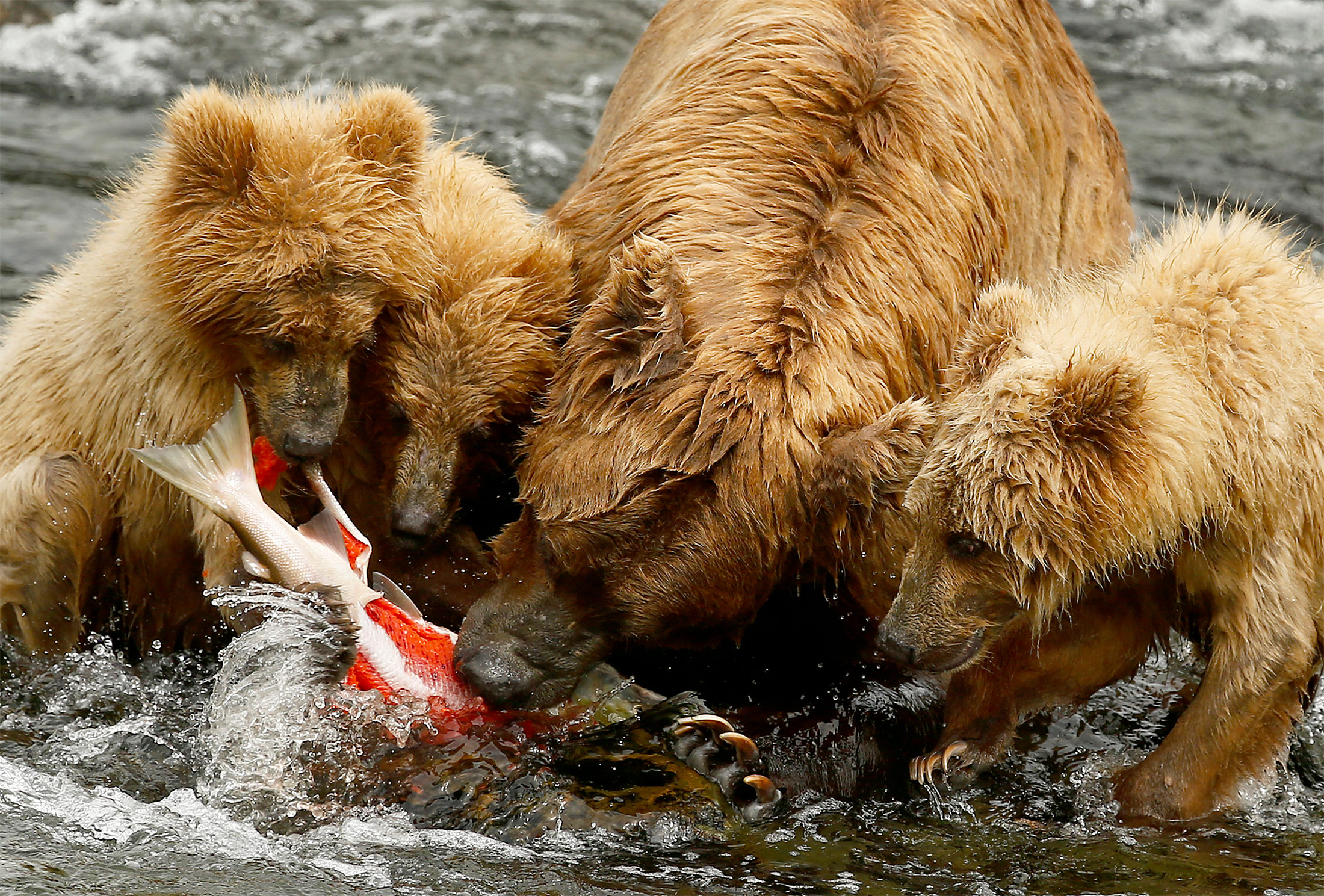
A bear and her cubs eat a sockeye salmon in Alaska’s Katmai National Park.Photographer: Luis Sinco/Los Angeles Times/Getty Images
Alaskan salmon are getting smaller partly because they’re returning from the ocean at a younger age, though scientists don’t really know why. The trend is also playing out across the Pacific Rim, from the U.S. mainland and Canada to Russia and Japan.
“When the size and the numbers go down that’s a harbinger of change that is taken as a red flag among many scientists,” said Peter Westley of the University of Alaska Fairbanks, co-author of a study on salmon size published last year with the University of California Santa Cruz.
The scientists examined four of the five Pacific salmon species in Alaska. Chinook — pursued by anglers and valued by restaurants — had the biggest average decline, at 8%, compared with pre-1990 fish. All other species shrunk, with sockeye showing the smallest decline at 2.1%. The most rapid changes were in the past decade.
Dwindling sizes in other species signaled a fishery’s collapse, including Canada’s Atlantic cod three decades ago.
In Europe and New England, the memory of rivers teeming with wild Atlantic salmon is all but forgotten due to overfishing, habitat loss and dam construction that blocked spawning grounds, said David Montgomery, whose 2003 book “King of Fish: The Thousand Year Run of Salmon” warns that the Pacific species could face the same fate. “Sadly, the book is still current.”
Agriculture, mining and other man-made interactions have sent Pacific salmon numbers plummeting in places including the Pacific Northwest’s Columbia-Snake River Basin. In some parts of Canada and the U.S., they’re endangered. Key runs in Alaska and Canada’s British Columbia province are seeing some of the worst years.
B.C.’s Fraser River had record low sockeye run sizes in three of the last five years, with last season setting a new low, said the Pacific Salmon Commission, which oversees management of the fish in the U.S. and Canada.
Collapsing Fisheries
“We are seeing a march north on the declines and collapses of salmon fisheries,” said Guido Rahr, head of Portland, Oregon-based Wild Salmon Center. “Japan has almost no wild fish left. In parts of Russia, once massive salmon runs are collapsing due to overfishing.”
Russia and the U.S. make up 85% of the world’s remaining Pacific salmon.
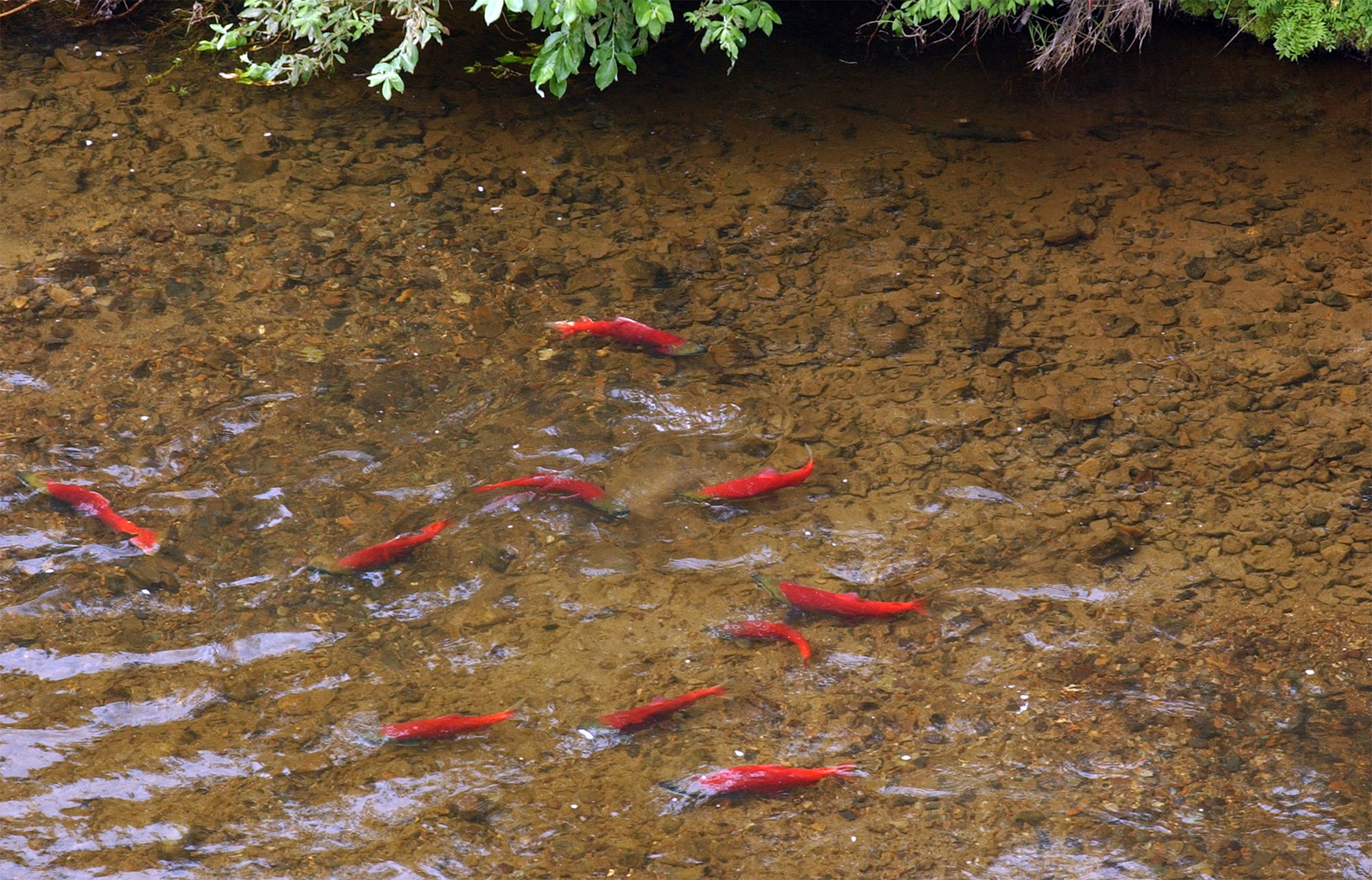
Sockeye salmon school up in the Upper Talarik River in the Alaska Peninsula.Photographer: Bob Hallinen/Anchorage Daily News/Tribune News Service/Getty Images
Less weighty catches mean fewer dollars for the $2 billion industry. Last year’s haul garnered $295.2 million, down 56% from 2019, Alaska estimates show.
“Salmon is such a nuanced and interconnected species — one little tweak when they are young can make a big change,” said Arron Kallenberg, founder and chief executive officer of seafood retailer Wild Alaskan Co. “From an industry standpoint it certainty makes an impact.”
While salmon runs in some areas saw steep population declines, Bristol Bay — supplier of about half the world’s sockeye — has had booming harvests. Even so, signs of smaller fish abound, OBI Seafoods CEO Mark Palmer said.What on Earth?The Bloomberg Green newsletter is your guide to the latest in climate news, zero-emission tech and green finance.EmailSign UpBy submitting my information, I agree to the Privacy Policy and Terms of Service and to receive offers and promotions from Bloomberg.
Historically, 4-pound sockeye and larger — key for commercial fisheries — comprise as much as 70% of each season’s Bristol Bay catch, Palmer said. Today, those larger salmon are no more than half the catch.
“Your yields go down a little bit with smaller fish,” he said.
At southeast Alaska’s Klukwan village, 115 miles north of Juneau, fishing nets have told the tale of shrinking salmon for years.
“Something is out of whack in the ocean and we wish we knew a way to fix it,” said Jones Hotch Jr., a tribal council member of this community of 40 families along a river whose indigenous name means “winter container for salmon.”
They depend on annual salmon return, which is why Hotch Jr. is pushing for stronger environmental protections against mining and other threats to the Chilkat River.
“My drive for saving our river for salmon runs to the very marrow of my being,” the 70-year-old said. “I believe that when we save our salmon, we save and preserve our culture.”
Play VideoDuration1:07Watch mama grizzly bear and cubs captured on trail cameraAn Idaho Fish and Game trail camera captured a grizzly bear sow and her two cubs as they sniffed a sapling baited with a scent lure. The bears were seen in the Upper Snake Region near Island Park on April 20, 2019.BYIDAHO DEPARTMENT OF FISH AND GAME
Fish and Game officials found the bear’s carcass lying partially submerged in Little Warm River near Island Park after they received a signal from the bear’s radio tracking collar indicating that it had died. It’s the third grizzly…
West Virginia Natural Police say they found blinds and multiple baited areas leading up to the opening of turkey season. (West Virginia Natural Resources Police)
CHARLESTON, W.Va. (WCHS) —West Virginia Natural Resources Police said multiple people in several counties face charges for illegal hunting.
Police said the illegal hunting was taking place during the youth season and the first week of regular season.
The news release did not give a total of number of hunters who face charges.
Charges range from hunting turkey closed season, hunting turkey with the use of bait and illegal killing/possession of wildlife. All charges are pending in magistrate court.
Robert Ahmasuk (right) and Joni Spiess hold up a phone with a photo of Lola, Ahmasuk’s 4-year-old Husky-Lab-Beagle mix (Lex Treinen/Alaska Public Media)
In mid-February, 13-year-old Robert Ahmasuk was returning from a hunting trip on skis with his dog Lola near Gunsight Mountain, off the Glenn Highway. Just 50 yards from the parking lot, Lola, a 4-year-old husky mix, started acting anxious and darted off the trail.
That’s when Ahmasuk and his mom heard a yelp.
“I went over there first and I was like, ‘Oh, crap. Lola’s in a trap. Mom, get over here. Help me!’” said Ahmasuk, who lives in Anchorage most of the year.
They attempted to free Lola but knew their time was limited. Despite years of experience with trapping and hunting themselves, they weren’t able…