Help keep One Green Planet free and independent! Together we can ensure our platform remains a hub for empowering ideas committed to fighting for a sustainable, healthy, and compassionate world. Please support us in keeping our mission strong.Pay
Cocaine trafficking is endangering rare tropical birds as traffickers push into remote forests to avoid detection, a study in Nature Sustainability reveals. Two-thirds of key bird habitats in Central America are at risk from “narco-driven” deforestation. For four decades, U.S. drug policy has failed to curb illegal networks, pushing traffickers deeper into forests. Here, they build infrastructure for drug shipments and establish cattle pastures to launder money and control territories. Lead author Amanda Rodewald from Cornell Lab of Ornithology highlights the severe impact on both vulnerable human and non-human populations, particularly Indigenous communities.
Millions of hectares of tropical forests have been destroyed by narco-trafficking, forcing Indigenous people to either cooperate or flee. Co-author Nicholas Magliocca from the University of Alabama stresses that resistance often leads to violence and land dispossession.
For the first time, researchers have quantified the impact on bird populations. They found 67 migratory bird species, including endangered golden-cheeked warblers, at increased risk. Remote sensing shows that 15-30% of annual deforestation in Nicaragua, Honduras, and Guatemala is due to cocaine trafficking.
The largest remaining forests in Central America, the “five great forests,” are experiencing rising cocaine trafficking. Traffickers use these forests for cattle ranching to launder money. Magliocca argues that U.S. drug policy has failed, as cocaine trafficking has expanded globally. The study suggests that creating jobs, clarifying land tenure, and improving forest protection can help tackle the problem. Empowering Indigenous groups to control their territories can protect against narco-trafficking and other environmental crimes.
Eat Less Meat: Download Food Monster, the largest plant-based Recipe app on the App Store, to help reduce your environmental footprint, save animals and get healthy. You can also buy a hard or soft copy of our favorite vegan cookbooks.
Adopt-a-Pet: Visit WildWatchers, a watchdog platform specifically designed for animal, earth, and wildlife warriors to actively give back, rescue, and protect animals and the planet.
Reduce Your Fast Fashion Footprint: Take initiative by standing up against fast fashion Pollution and supporting sustainable and circular brands like Tiny Rescue that raise awareness around important issues through recycled zero-waste clothing designed to be returned and remade over and over again.
Support Independent Media: Being publicly funded gives us a greater chance to continue providing you with high-quality content. Please consider supporting us by donating!
Sign a Petition: Your voice matters! Help turn petitions into victories by signing the latest list of must-sign petitions to help people, animals, and the planet.
Stay Informed: Keep up with the latest news and important stories involving animals, the environment, sustainable living, food, health, and human interest topics by subscribing to our newsletter!
Do What You Can: Reduce waste, plant trees, eat local, travel responsibly, reuse stuff, say no to single-use plastics, recycle, vote smart, switch to cold water laundry, divest from fossil fuels, save water, shop wisely, Donate if you can, grow your food, volunteer, conserve energy, compost, and don’t forget about the microplastics and microbeads lurking in common household and personal care products!
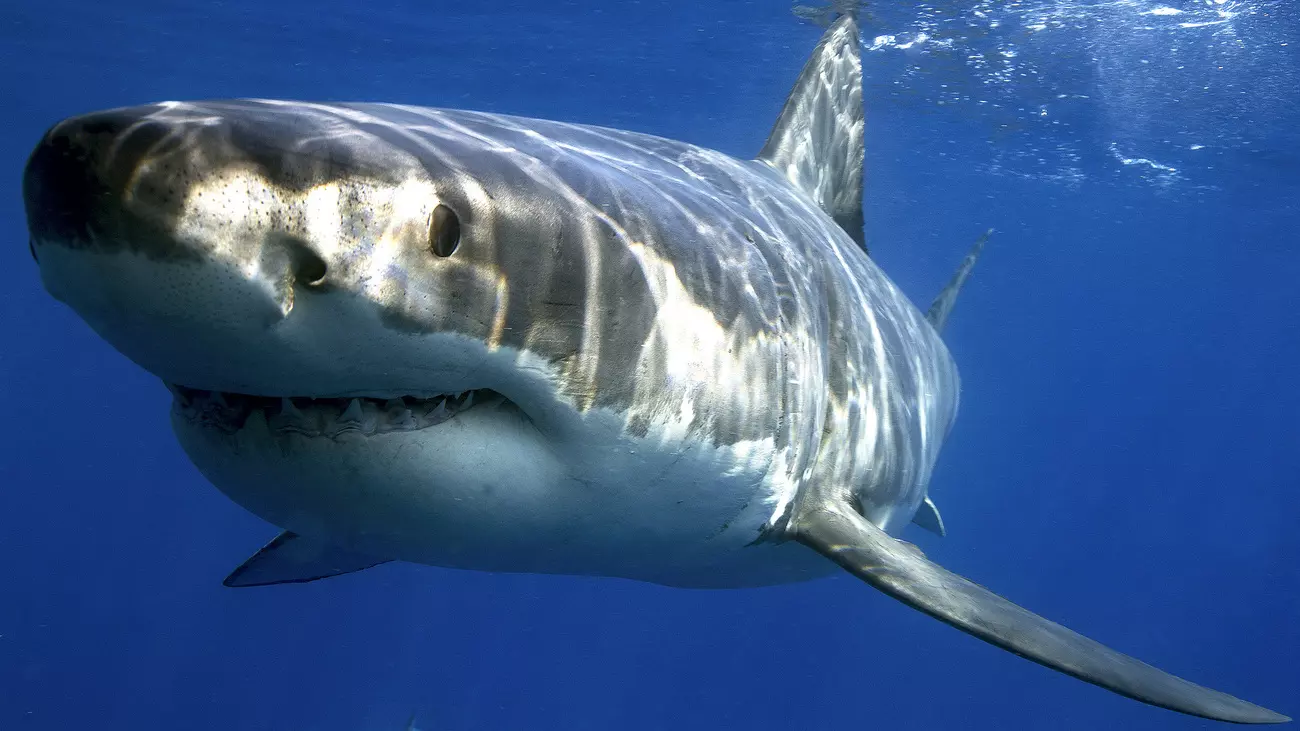
“Sharks play a critical role in keeping oceans healthy, balancing the food chain and ensuring species diversity. Only on your movie screen will they swim through the Seine or the River Thames in London and eat people as if they’re gobbling down potato chips with ketchup squirted all over.
Back in the 70s, the movie Jaws did sharks no favour. We’re still doing damage control giving their reputation a complete makeover by recognising their amazing contribution to a healthy planet. Now we’re up against another movie piggybacking on this less than favourable image of the species, having sharks behave like a menacing predator, while in reality we are the ones hunting them to extinction.
It seems ‘Under Paris’ could be intended to show the shark as a victim of humankind and raise awareness about ocean pollution, loss of habitat and shark conservation. Yet it still emphasizes the eternal stereotype of radical activists and sharks as the villain in the story. Nature and wildlife conservation organisations like IFAW, however, base their campaigns on scientific reports and approaches aiming for both people and animals to thrive.
It’s time to set the record straight: Sharks keep our marine ecosystems healthy, and this makes our planet more climate change resilient. They capture carbon, not dead humans – with climate change being the real horror here. The movie also portrays the mutated shark who has adapted to climate change, and people being too busy with their lives to pay attention to looming disaster. If we don’t take urgent action, we may find Paris and other places like London, Amsterdam or Berlin actually under water in the future.
If you’re still not convinced after watching ‘Under Paris’ and you’re looking for more evidence – click here for more info on how sharks benefit our planet and help combat climate change.”
– Barbara Slee, senior program manager International Policy at IFAW
Mark Lyons, a senior USDA animal health official, said federal officials are “still working closely to understand the breadth” of the bird flu outbreak in the nation’s dairy herds.
Former government health officials with experience with the Covid-19 pandemic say they want a better understanding of how rapidly the virus is spreading in dairy cows. | Angela Weiss/AFP via Getty Images
Reliance on individual dairy farmers to help track the spread of avian flu is leaving the federal government without the data necessary to understand — and slow — the virus’ spread in the U.S.
The biggest challenge for the federal response, agriculture and public health officials told POLITICO, is that the more the virus spreads among dairy cows, the more opportunity it has to mutate and become easier to jump to additional humans. The number of documented infected dairy herds in recent weeks has risen rapidly — and several other states have confirmed initial infections in cows.
But many dairy farmers are declining to test their cows, leaving the nation vulnerable to a situation in which federal officials won’t have adequate warning if the virus evolves and poses a greater risk of infection to people.
“The longer this is prevalent in animal farms and livestock operations across the state, the greater the opportunity is for future mutations in animals or human risks in different ways going forward,” said Tim Boring, who heads the Department of Agriculture and Rural Development in Michigan, a state with two confirmed human cases to date as it deals with a major bird flu outbreak among poultry and now dairy herds.
The federal response is largely focusing on voluntary efforts by farmers to help track and contain the outbreak. But many farms still have not signed up for USDA efforts to boost surveillance and testing for the virus. To date, 94 herds across 12 states have tested positive for bird flu, but the testing has covered a mere fraction of the nation’s nine million dairy cattle. Only about 45 exposed and symptomatic humans have been tested for avian flu, CDC Principal Deputy Director Nirav Shah said in a Thursday briefing with reporters.
Mark Lyons, a senior USDA animal health official, said federal officials are “still working closely to understand the breadth” of the bird flu outbreak in the nation’s dairy herds.
While the risk to the public remains low, the CDC is focusing on preventing cases in populations at higher risk of infection. Given the extent of spread among dairy cows, additional human cases in farmers and dairy workers “would not be surprising,” according to CDC spokesperson Rosa Norman.
“Continued comprehensive surveillance in wild birds, poultry, mammals and people worldwide are critical to determine the public health risk, along with ongoing preparedness efforts,” the spokesperson said. “We are taking a number of measures to keep up testing and sequencing of influenza viruses over the summer to help increase surveillance.”
Jerome Adams, former surgeon general under President Donald Trump, said more testing is needed to understand how widespread avian influenza is — a threat he described as rapidly growing and potentially catastrophic despite the limited human infections detected to date. But farmers and workers must be reassured that they will not face legal penalties by allowing government officials onto farms and there should be financial incentives to participate in testing, he added.
“We failed — through two administrations — to develop and implement an effective surveillance strategy with Covid, and we are repeating the same mistakes with [this virus],” Adams said. “Farmers are reticent to test for many reasons. Fear of financial harm is a major factor.”
Since April, more than 15,000 animal samples have been tested, with more than 4,300 under a federal order requiring dairy cow testing before animals are moved across state lines, according to USDA data.
Deborah Birx, former Trump administration coronavirus response coordinator, said it is essential to know whether the baseline incidence of infections among dairy cows and humans is changing so the government can prepare a response.
“It’s not about pointing fingers, it’s not about whether their workers are documented, it’s about knowing where we are and how much this is spreading in humans, and how much is spreading in cows,” Birx said. Allowing voluntary anonymous testing and taking steps to allay fears that farms could be shut down is critical to get that buy-in, she added.
Deborah Birx in recent weeks has called for an increase in testing of dairy cows to better understand the spread of avian influenza. | Drew Angerer/Getty Images
A new effort by the CDC aims to ensure that clinical laboratories send samples from people with suspected novel influenza infections like avian flu to state health laboratories for further testing. The guidelines call for the CDC to be alerted of specimens that test positive for such viruses or if unsubtyped results are obtained.
“We have indicated to states that the threshold for testing somebody is exceedingly low if they do happen to detect somebody who has been exposed and who would like to be tested,” Shah told reporters. “We’re open to doing that, very much so.”
HHS Secretary Xavier Becerra urged state leaders at the Western Governors’ Association Annual Meeting to help increase monitoring for avian influenza.
“That includes reaching out to dairy farmers in your states to confirm they are taking steps to protect workers — and encouraging those farms to test their cows or their milk so we know quickly if a herd is positive,” Becerra said earlier this week according to prepared remarks.
Although federal funds have been allocated, no farms have enrolled in voluntary on-site milk testing, according to the USDA. Fewer than a dozen farms have applied for separate financial aid in exchange for boosting biosecurity measures to help contain the virus. Meanwhile, federal rulemaking is delaying the rollout of compensation for farmers who have lost or had to kill cows because of the disease.
That’s a problem because the scope of financial support for dairy farmers to date has been “peanuts,” according to Michael Mina, chief science officer at telehealth company eMed and a mass-testing advocate during the Covid-19 pandemic. With the virus spread across many herds across the country, strengthening sequencing efforts to understand if a mutation that warrants aggressive action toward a particular farm is critical.
“We actually did have a period of time where there was a possibility to contain this had we taken very aggressive fast action,” Mina said. “Those days are done. It’s big and you can’t just squash it.”
Michael Osterholm, an epidemiologist and director of the Center for Infectious Disease Research and Policy at the University of Minnesota, said that even if every cow in the U.S. is tested daily, it does not guarantee that a mutation won’t occur that starts a new pandemic.
“What I would like to know is in terms of transmission issues, is how many of these current farms that are turning up positive can trace back cattle movement to the original outbreak farms,” Osterholm said. “If that can’t happen, it greatly complicates how you try to stop ongoing transmission in dairy cattle.”
Michigan, which is dealing with a major bird flu outbreak among poultry and now dairy herds, is undertaking an “aggressive” response effort, Boring said. There have been no confirmed avian flu fatalities in the U.S.
In recent days, Wyoming, Minnesota and Iowa have announced their first confirmed avian influenza cases in dairy herds, underscoring many agriculture officials’ fears that the virus is present in wide swaths of the country but just hasn’t yet been detected.
Shah deferred to USDA when asked how much dairy cow surveillance testing the CDC believes is necessary on a call with reporters on Thursday. State agriculture officials and some farmers pushed back on an early CDC effort to deploy federal public health officials on farms across the country to better track and contain the virus.
So far, 11 farms have enrolled in financial support programs the USDA announced May 10 to help bolster biosecurity measures to contain the virus, according to USDA spokesperson Allan Rodriguez. No farms have enrolled in a separate voluntary testing pilot program to monitor virus levels in milk in dairy herds, though there’s been interest in the effort and the USDA “expects the number of participating producers to increase in the weeks ahead.” The department is talking with at least 20 states about participation in the pilot program.
“USDA continues to ramp up outreach and leverage every tool available to raise awareness of these new resources,” Rodriguez added.
Dr. Jamie Jonker, the chief science officer at the National Milk Producers Federation, said that “any widespread disruption to an industry is going to encounter a wide variety of responses and questions.”
“Only three months into H5N1 in dairy cows, testing is identifying affected farms, and dairy farmers are taking action in response,” Jonker said. “With USDA programs in effect for just over one month, farmers are working with USDA to make them effective, even as details of those programs are still being worked out,” he added, noting dairy farmers are doing what they can both to understand the H5N1 situation and work effectively to address it.
Boring said Michigan state officials are working to head off a potentially devastating blow to the dairy industry and to try to keep the virus from spreading to more humans. While the U.S. has responded to bird flu outbreaks in the poultry industry for decades, the outbreak among dairy cows is a new and vastly different challenge. Boring acknowledged state officials are still flying somewhat blind in their response after the virus was first detected in dairy cows in Texas in late March.
“It’s a tough situation. There’s a lot that we still don’t know. We’re learning more every day,” Boring said.
“So oftentimes, we’re working with a bit of incomplete information,” he added.
Boring said he believes several Michigan farms have reached out to the USDA for more information about the financial aid the department announced last month as a way to contain the virus, but he didn’t know whether any farmers have applied for the USDA money.
Producers in his state are chiefly watching the USDA’s expected rollout of specific emergency assistance funding for livestock losses in the coming weeks. Agriculture officials in blue and red states are pressing the USDA to make that move as generous as possible to offset the growing economic toll of the virus, while working to contain the spread.
But that effort is “continuing to go through the [federal rulemaking process],” according to USDA, signaling that a full rollout could take months. It’s also unclear how many infected cows in the U.S. are dying from bird flu or being killed due to a drop in milk production.
Boring confirmed “there have been instances of cow fatalities associated with this” in Michigan, but he didn’t know how many infected cows have been killed, or culled, in his state.
He suggested culling is still used in “rare instances” for infected cows that contract other diseases and wasn’t aware of any mass culling.
“We’re concerned about the spread of this into other populations, whether it’s swine, or whether it’s directly to humans,” Boring said.
Still, public health experts like Osterholm who have been monitoring avian influenza for decades caution that no one knows what the future holds.
“I’ve been dealing with this virus since 2003 and on multiple occasions, thought, well, this is it, it’s going to go, and then it didn’t,” Osterholm said. “That doesn’t mean it won’t go now, but it also means be careful, because, in fact, what we’re seeing happen may not be indicative that we’re going to see a major antigenic change in the virus.”
By Marco Silva, @BBCMarcoSilva, Climate disinformation reporterShare
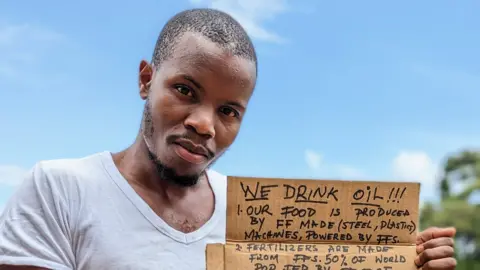
Climate change deniers have found a new champion in Kenyan farmer Jusper Machogu. On social media, he has become known as a flagbearer for fossil fuels in Africa, but there is more to his campaign than meets the eye.
At first glance, the 29-year-old Mr Machogu is just a young farmer with a knack for social media.
On X, formerly Twitter, he regularly posts videos of himself weeding his land, planting garlic, or picking avocados – offering viewers a window into life in rural Kisii, south-west Kenya.
While farming content may get him clicks, likes, and retweets, it is Mr Machogu’s denial of man-made climate change that has helped supercharge his online profile.
Since he began posting debunked theories about climate change, he has received thousands of dollars in donations – some of which came from individuals in Western countries linked to fossil-fuel interests.
Mr Machogu insists this has not influenced his views, saying they are genuinely held.
Scientists have proven that the Earth is heating up because of greenhouse gases that are emitted into the atmosphere when we burn fossil fuels – like oil, gas, or coal.
But Mr Machogu disagrees.
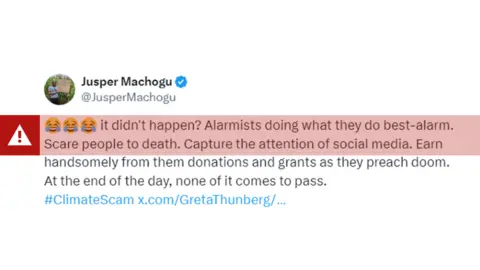
“Climate change is mostly natural. A warmer climate is good for life,” Mr Machogu wrongly claimed in a tweet posted in February, along with the hashtag #ClimateScam (which he has used hundreds of times).
However, it is also “one of the most vulnerable continents” to climate change and its effects – including more intense and frequent heatwaves, prolonged droughts, and devastating floods.
Despite all this, Mr Machogu continues to insist “there is no climate crisis”.
On social media, he has repeatedly posted unfounded claims that man-made climate change is not only a “scam” or a “hoax”, but also a ploy by Western nations to “keep Africa poor”.
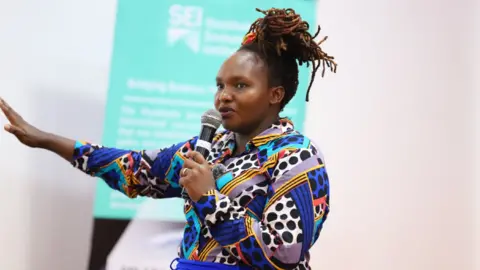
“[His views] are definitely coming up from a place of lack of understanding,” says Joyce Kimutai, a climate scientist from Kenya who has contributed to IPCC reports.
Joyce Kimutai says Mr Machogu’s views are not shared by many Kenyans
ADVERTISEMENT
“This is not religion, this is not just belief. It’s about analysing the data and seeing changes in the data.
“Saying that climate [change] is a hoax is just really not true,” Dr Kimutai added.
Mr Machogu began tweeting false and misleading claims about climate change in late 2021, after carrying out his “own research” into the topic.
Since then, he has launched his own campaign – which he dubbed “Fossil Fuels for Africa” – arguing that the continent should be tapping into its vast reserves of oil, gas, and coal.
“We need fossil fuels to develop our Africa,” Mr Machogu tweeted last year.
This view appears to be shared by some African governments, who have given their go-ahead to new oil and gas projects despite pledging to “transition away” from fossil fuels.
Leaders like Ugandan President Yoweri Museveni have argued that it is hypocritical for Western nations to impose restrictions on African states, when they have become rich from fossil fuels.
But climate activists like 24-year-old Nicholas Omonuk, from Uganda, point out that fossil fuel exploration has not always been a synonym for growth and development in Africa.
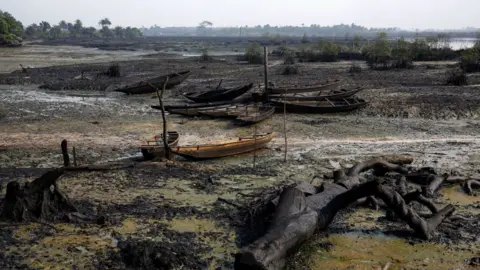
“In [Nigeria’s] Niger Delta, there’s been oil extraction since the 1900s, but people there are still poor and are still suffering from health risks and from pollution,” he said.
Crude oil pollution has affected fishing and farming communities in Nigeria’s Niger Delta
And yet, Mr Machogu believes he has found a willing audience for his message – he has more than 25,000 followers on X.
“I think Africans are really embracing the fact that I’m saying: ‘Fossil fuels for Africa’,” he told the BBC.
But by tracking conversations involving Mr Machogu’s X handle, BBC Verify found that most users engaging with his account are actually based in the US, the UK, and Canada.
Many of those users also promote conspiracy theories online – not just about climate change, but also about vaccines, Covid-19, or the war in Ukraine.
However niche its views may be, this online community has thrown its support behind Mr Machogu and helped him fund his campaign.
“Through saying whatever I say, I have seen my follower count going up and I’ve got people reaching out to me saying: how can we help you?,” he said.
ADVERTISEMENT
On X, Mr Machogu has accused climate activists of alarmism
BBC Verify looked at fundraising pages set up by Mr Machogu and found that, in the last two years, he has raised more than $9,000 (£7,000) from donations.
Mr Machogu has posted online about using some of these funds to furnish his new home.
But he also claims to have used donations to help dozens of local families by building a borehole for water, distributing gas bottles for cooking, or connecting their homes to the electricity grid.
Among his donors were individuals with links to the fossil fuel industry and to groups known for promoting climate change denial.
But Mr Machogu rejects suggestions that those donations have had any impact on his opinions on climate change.
“Nobody has told me to change my views,” Mr Machogu insists.
“I don’t have a problem with making money while saying what I believe I should say or doing what’s good for my community.”
By sharing his views online, he has undoubtedly caught the eye of many in the West who share his stance on fossil-fuel exploration and climate change.
Canadian author Jordan Peterson retweeted one of his posts about fossil fuels, describing him as an “actual African”, in contrast with what Mr Peterson called the “poor, oppressed, useless African” supposedly imagined by “globalist utopians”.
A US fossil fuel advocate paid for Mr Machogu to travel to South Africa for a conference promoting African oil and gas late last year.
And, just months before, a film crew from the UK travelled to Kisii to interview him for a new documentary that described climate change as an “eccentric environmental scare”.
To some, Mr Machogu’s new-found popularity has not come as a surprise.
“There’s been a real explosion in fossil fuel development projects in Africa,” says Amy Westervelt, a US investigative climate reporter who covers attempts to obstruct climate policy.
“And because a lot of countries are passing policies that are limiting fossil fuels, Africa is also seen as a big market.
“So, it’s very helpful to have people in Africa saying: ‘We want these projects’.”
That is certainly a point Mr Machogu has made – again and again – on social media.
But Dr Kimutai says his promotion of fossil fuels, along with his denial of man-made climate change, could have consequences.
“Because we still have low climate literacy levels in Africa and in Kenya, and if that conspiracy theory spreads to communities or to people, it could just really undermine climate action.
By Pallab Ghosh, @BBCPallab, Science CorrespondentShare
Charles Darwin enjoys a near god-like status among scientists for his theory of evolution. But his ideas that animals are conscious in the same way humans are have long been shunned. Until now.
“There is no fundamental difference between man and animals in their ability to feel pleasure and pain, happiness, and misery,” Darwin wrote.
But his suggestion that animals think and feel was seen as scientific heresy among many, if not most animal behaviour experts.
Attributing consciousness to animals based on their responses was seen as a cardinal sin. The argument went that projecting human traits, feelings, and behaviours onto animals had no scientific basis and there was no way of testing what goes on in animals’ minds.
But if new evidence emerges of animals’ abilities to feel and process what is going on around them, could that mean they are, in fact, conscious?
We now know that bees can count, recognise human faces and learn how to use tools.
Prof Lars Chittka of Queen Mary University of London has worked on many of the major studies of bee intelligence.
“If bees are that intelligent, maybe they can think and feel something, which are the building blocks of consciousness,” he says.
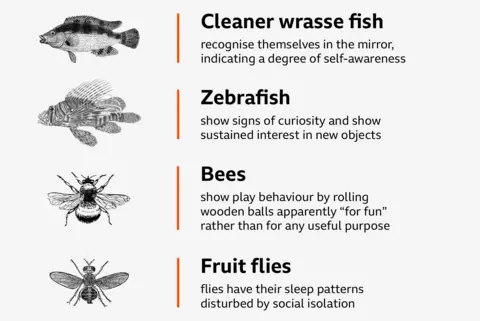
Prof Chittka’s experiments showed that bees would modify their behaviour following a traumatic incident and seemed to be able to play, rolling small wooden balls, which he says they appeared to enjoy as an activity.
These results have persuaded one of the most influential and respected scientists in animal research to make this strong, stark and contentious statement:
“Given all the evidence that is on the table, it is quite likely that bees are conscious,” he said.
It isn’t just bees. Many say that it is now time to think again, with the emergence of new evidence they say marks a “sea change” in thinking on the science of animal consciousness.
They include Prof Jonathan Birch of the London School of Economics.
“We have researchers from different fields starting to dare to ask questions about animal consciousness and explicitly think about how their research might be relevant to those questions,” says Prof Birch.
Anyone looking for a eureka moment will be disappointed.
Instead, a steady growth of evidence for a rethink has led to murmurings among the researchers involved. Now, many want a change in scientific thinking in the field.
What has been discovered may not amount to conclusive proof of animal consciousness, but taken together, it is enough to suggest that there is “a realistic possibility” that animals are capable of consciousness, according to Prof Birch.
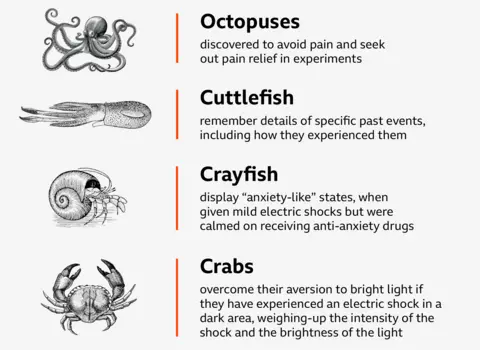
This applies not only to what are known as higher animals such as apes and dolphins who have reached a more advanced stage of development than other animals. It also applies to simpler creatures, such as snakes, octopuses, crabs, bees and possibly even fruit flies, according to the group, who want funding for more research to determine whether animals are conscious, and if so, to what extent.
But if you’re wondering what we even mean by consciousness, you’re not alone. It’s something scientists can’t even agree on.
An early effort came in the 17th century, by the French philosopher René Descartes who said: “I think therefore I am.”
He added that “language is the only certain sign of thought hidden in a body”.
But those statements have muddied the waters for far too long, according to Prof Anil Seth of Sussex University, who has been wrestling with the definition of consciousness for much of his professional career.
“This unholy trinity, of language, intelligence and consciousness goes back all the way to Descartes,” he told BBC News, with a degree of annoyance at the lack of questioning of this approach until recently.
The “unholy trinity” is at the core of a movement called behaviourism, which emerged in the early 20th Century. It says that thoughts and feelings cannot be measured by scientific methods and so should be ignored when analysing behaviour.
Many animal behaviour experts were schooled in this view, but it is beginning to make way for a less human-centred approach, according to Prof Seth.
“Because we see things through a human lens, we tend to associate consciousness with language and intelligence. Just because they go together in us, it doesn’t mean they go together in general.”
ADVERTISEMENT
Some are very critical of some uses of the word consciousness.
“The field is replete with weasel words and unfortunately one of those is consciousness,” says Prof Stevan Harnad of Quebec University.
“It is a word that is confidently used by a lot of people, but they all mean something different, and so it is not clear at all what it means.”
He says that a better, less weasley, word is “sentience”, which is more tightly defined as the capacity to feel. “To feel everything, a pinch, to see the colour red, to feel tired and hungry, those are all things you feel,” says Prof Harnad.
Others who have been instinctively sceptical of the idea of animals being conscious say that the new broader interpretation of what it means to be conscious makes a difference.
Dr Monique Udell, from Oregon State University, says she comes from a behaviourist background.
“If we look at distinct behaviours, for example what species can recognise themselves in a mirror, how many can plan ahead or are able to remember things that happened in the past, we are able to test these questions with experimentation and observation and draw more accurate conclusions based on data,” she says.
“And if we are going to define consciousness as a sum of measurable behaviours, then animals that have succeeded in these particular tasks can be said to have something that we choose to call consciousness.”
This is a much narrower definition of consciousness than the new group is promoting, but a respectful clash of ideas is what science is all about, according to Dr Udell.
“Having people who take ideas with a grain of salt and cast a critical eye is important because if we don’t come at these questions in different ways, then it is going to be harder to progress.”
But what next? Some say far more animals need to be studied for the possibility of consciousness than is currently the case.
“Right now, most of the science is done on humans and monkeys and we are making the job much harder than it needs to be because we are not learning about consciousness in its most basic form,” says Kristin Andrews, a professor of philosophy specialising in animal minds at York university in Toronto.
Prof Andrews and many others believe that research on humans and monkeys is the study of higher level consciousness – exhibited in the ability to communicate and feel complex emotions – whereas an octopus or snake may also have a more basic level of consciousness that we are ignoring by not investigating it.
The short four paragraph declaration states that it is “irresponsible” to ignore the possibility of animal consciousness.
“We should consider welfare risks and use the evidence to inform our responses to these risks,” it says.
Chris Magee is from Understanding Animal Research, a UK body backed by research organisations and companies that undertake animal experiments.
He says animals already are assumed to be conscious when it comes to whether to conduct experiments on them and says UK regulations require that experiments should be conducted only if the benefits to medical research outweigh the suffering caused.
“There is enough evidence for us to have a precautionary approach,” he says.
But there is also a lot we don’t know, including about decapod crustaceans such as crabs, lobsters, crayfish, and shrimp.
“We don’t know very much about their lived experience, or even basic things like the point at which they die.
“And this is important because we need to set rules to protect them either in the lab or in the wild.”
Prof Birch’s team found that there was strong evidence that these creatures were sentient in that they could experience feelings of pain, pleasure, thirst, hunger, warmth, joy, comfort and excitement. The conclusions led to the government including these creatures into its Animal Welfare (Sentience) Act in 2022.
“Issues related to octopus and crab welfare have been neglected,” says Prof Birch.
“The emerging science should encourage society to take these issues a bit more seriously.”
There are millions of different types of animals and precious little research has been carried out on how they experience the world. We know a bit about bees and other researchers have shown indications of conscious behaviour in cockroaches and even fruit flies but there are so many other experiments to be done involving so many other animals.
It is a field of study that the modern-day heretics who have signed the New York Declaration claim has been neglected, even ridiculed. Their approach, to say the unsayable and risk sanction is nothing new.
Around the same time that Rene Descartes was saying “I think therefore I am”, the Catholic church found the Italian astronomer Galileo Galilei “vehemently suspect of heresy” for suggesting that the Earth was not the centre of the Universe.
It was a shift in thinking that opened our eyes to a truer, richer picture of the Universe and our place in it.
Shifting ourselves from the centre of the Universe a second time may well do the same for our understanding of ourselves as well as the other living things with whom we share the planet.