Penis bones are found in certain species of mammal, but not all.
Fiona Rogers/Stone/Getty Images
MATILDA BRINDLE
3.12.2022 6:00 PM
ONE OF THE WEIRDEST and most wonderful products of evolution is the penis bone or baculum. The baculum is an extra-skeletal bone, which means it is not attached to the rest of the skeleton but instead floats daintily at the end of the penis. Depending on the animal, bacula range in size from under a millimeter to nearly a meter long, and in shape, varying from needle-like spines to fork-like prongs.
The walrus baculum, which could easily be mistaken for a 2ft-long club, is around 1/6th of its body length, whereas the diminutive centimeter-long baculum of the ring-tailed lemur is only around 1/40th of its body length.
Bacula is found in certain species of mammal, but not all. Most primate males have a baculum, so humans are rather an oddity in that they don’t have one. In a handful of extraordinary circumstances human males have formed bones in the soft tissue at the end of their penises, but this is a rare abnormality, rather than a baculum.
In a study published in 2016 in Proceedings of the Royal Society B, my colleague Kit Opie and I examined how the baculum developed in mammals by studying how it is distributed across different species in light of their pattern of descent (known as phylogenetics).
We showed that the baculum first evolved after placental and non-placental mammals split, around 145 million years ago, but before the most recent common ancestor of primates and carnivores evolved, around 95 million years ago. Our research also shows that the common ancestor of primates and carnivores had a baculum. This means that any species in these groups without a baculum, such as humans, must have lost it over the course of evolution.
So, why on Earth would an animal need a bone in its penis in the first place? Scientists have come up with a few theories as to why a baculum might be handy. In certain species, such as cats, a female’s body doesn’t release its eggs until she mates, and some argue that the baculum may help to stimulate females and trigger ovulation. Another, somewhat colorfully named, theory is the vaginal friction hypothesis. This essentially argues that the baculum acts as a shoehorn, enabling a male to overcome any friction and squeeze himself into a female.
Is that it?Shutterstock
Finally, it has been proposed that the baculum helps prolong intromission, otherwise known as vaginal penetration. Far from simply being a nice way to spend an afternoon, prolonging intromission like this is a way for a male to prevent a female from sneaking off and mating with anyone else before his sperm have had a chance to work their magic. This theory brings a whole new meaning to the term “cock-blocking”.
We found that, over the entire course of primate evolution, having a baculum was linked to longer intromission durations (anything over three minutes). On top of this, males of primate species with longer intromission durations tend to have far longer bacula than males of species where intromission is short.
Another interesting discovery was that males of species facing high levels of sexual competition for females have longer bacula than those facing lower levels of sexual competition.
But what about humans? If the penis bone is so important in competing for a mate and prolonging copulation, then why don’t we have one? Well, the short answer to that is that humans don’t quite make it into the “prolonged intromission” category. The average duration from penetration to ejaculation for human males is less than two minutes.
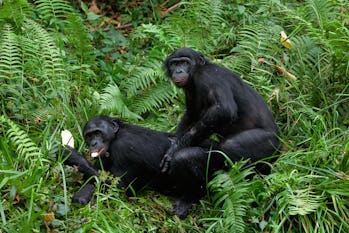
But bonobos only copulate for about 15 seconds at a time and they still have a baculum, even if it is very small (about 8mm). So what makes us different? It’s possible that this comes down to our mating strategies. Human males (generally) have minimal sexual competition as females typically only mate with one male at a time. Perhaps the adoption of this mating pattern, in addition to our short intromission duration, was the last straw for the baculum.
Scientists are only just beginning to piece together the function of this most unusual bone. What seems to be clear is that changes in the primate baculum are driven, at least partly, by a species’ mating strategy.
In this photo taken Wednesday, Oct. 14, 2015, an inspector reaches for a packaged animal part during an inspection of the shipment of hunting trophies from South Africa, in SeaTac, Wash.(Associated Press photo/Elaine Thompson)
Story at a glance
The Center for Biological Diversity obtained data from the U.S. Fish and Wildlife Service on trophy hunting imports from 2016 through 2020.
U.S. hunters imported more than 700,000 hunting trophies — including skulls, mounts and teeth, among others — during this timeframe.
According to the Humane Society International, the U.S. is the largest importer of hunting trophies.
U.S. hunters imported more than 700,000 hunting trophies — including skulls, mounts, and teeth, among others — over the course of 5 years.
The meat industry largely defines what’s animal cruelty and what isn’t; a recent court ruling in Pennsylvania could offer a new legal route for activists.
In 2018, Erin Wing worked for two months at a 1,000-cow dairy farm in Chambersburg, a small Pennsylvania town about three hours west of Philadelphia, where she was one of 10 employees who milked and fed the cows. But something set her apart from the other workers: Wing wore a hidden camera, living a double life as an undercover investigator for Animal Outlook, an animal advocacy nonprofit.
During her stint, Wing captured a variety of horrors on film. Some were inhumane but legal and not uncommon in the dairy industry, like removing calves’ horns —which is done to prevent the horns from injuring workers — without pain mitigation like anesthesia or anti-inflammatory drugs.
But she also documented acts of cruelty that seemed wholly gratuitous, like employees beating, stomping on, and kicking cows, and many others I’ll omit for the sake of readers’ peace of mind.
Want to eat less meat but don’t know where to start? Sign up for Vox’s five-day newsletter full of practical tips — and food for thought — to incorporate more plant-based food into your diet.
“All told, we documented over 300 incidents that we believed violated Pennsylvania’s laws,” Will Lowrey, an attorney with Animal Outlook, told me.
The Pennsylvania State Police opened an investigation, and over a year later it announced that the district attorney of Franklin County in Pennsylvania, where Chambersburg is located, would not press charges against the farm as a corporation, the owner, and 14 current and former employees. The police also assured the public that the farm had taken steps to improve training and animal handling procedures. (The Pennsylvania State Police declined an interview, Martin Farms could not be reached for comment, and the Franklin County district attorney did not respond to requests for comment.)Top ArticlesREAD MOREIs booking Airbnbs really the best way tohelp Ukrainians?
The DA’s decision wasn’t surprising. Many undercover investigations that document cruelty to farmed animals don’t result in prosecution, and when they do, it’s usually over the more egregious, often one-off acts of cruelty conducted by stressed-out, low-paid workers. The routine yet inhumane practices instituted by the owner — and often pervasive throughout the industry — go unexamined, even though they account for much more animal suffering.
And with 9 billion animals churning through the meat, dairy, and egg industries each year and just a handful of undercover investigators documenting how they’re treated, consumers and policymakers are left in the dark. This system persists because farmed animals are largely invisible in the law.
But due to a quirk in Pennsylvania’s legal code — the ability of private citizens to challenge government officials’ decision not to prosecute — Animal Outlook was able to circumvent that invisibility and set a new precedent for animal law. But before I get to that, it helps to understand the legal system under which animals are farmed.
How the animal agriculture lobby erased farmed animals from the law
At the federal level, there are no laws that protect animals while they’re on the farm.
The Animal Welfare Act, which sets minimum standards for animals used in zoos or research or sold as pets, specifically exempts animals raised for food. The Humane Methods of Slaughter Act and the 28-Hour Law (the latter which covers farmed animals in transport) are weakly enforced, and both exempt poultry, which make up 98 percent of US land animals raised for food.
Every state has an anti-cruelty statute on the books, and a few exempt farmed animals altogether, while most exempt what are considered “customary farming practices” — or as Pennsylvania law puts it, “normal farming operations.” It doesn’t matter how inhumane those practices may appear as long as they are commonly used, year after year.
“In most of the United States, prosecutors, judges, and juries no longer have the power to determine whether or not farmed animals are treated in an acceptable manner,” wrote animal law professors Mariann Sullivan and David Wolfson in their seminal text on state and federal anti-cruelty exemptions. “The industry alone defines the criminality of its own conduct.”
As a result, only more extreme acts of cruelty — like some of the acts documented at Martin Farms — are potentially prosecutable under the law. But they’re typically only uncovered if a group like Animal Outlook sends an investigator onto one of America’s tens of thousands of factory farms, which leaves most abuse undocumented and unaddressed.
And even if an investigator can gain employment on a farm, political and cultural factors pose major barriers to seeking justice for the abuse they document. Factory farms tend to be located in rural areas, where they are woven deeply into the fabric of the region’s politics, economy, and culture, so sheriffs and district attorneys are often reluctant to take action. When they do, it’s usually against low-level employees who are disproportionately immigrants and are labeled as “bad apple” workers while (typically white) owners and management often get off scot-free.
“You see this syndrome where the owner says, ‘Oh, my god, I’m so shocked — this is terrible. We’re firing them right away and they should be prosecuted’,” Sullivan, who teaches animal law at Cornell Law School and hosts the Animal Law podcast, told me. “So the very low-level people get prosecuted for this gratuitous cruelty. … And they’re eligible for being thrown under the bus by the owners.”
This kind of outcome for undercover investigations happens frequently enough that it’s causing some in the animal protection movement to critically examine the carceral approach to investigative work.
By getting laws passed, animal advocates have been able to ban or restrict the use of some customary farming practices, mostly cages and crates for hens and pigs, in 14 states. But the legislative route is slow and difficult; to even get to a full vote, farmed animal welfare bills first have to make it through the statehouse’s agriculture committee, where they usually go to die, as they’re often chaired by industry-friendly lawmakers.
Advocates have found some success through putting the vote directly to the people via ballot measures, but those are costly, and fewer than half of US states allow such direct measures.
This challenging legal landscape, and the political and cultural factors that block the gaps that could overcome it, have long stymied animal lawyers and advocates who’ve amassed thousands of hours of footage of animal abuse through their undercover investigations. But due to the above-mentioned quirk in Pennsylvania law — the ability to petition a court to overturn the district attorney’s denial of prosecution — Animal Outlook shifted what practices can be deemed “normal” in the first place.
The organization’s initial petition was denied, so it appealed to Pennsylvania’s Superior Court. Last month, in a precedent-setting decision, the court’s three-judge panel ruled that the lower court was required to order the Franklin County district attorney to prosecute Martin Farms for animal cruelty, including over common practices like dehorning without pain mitigation.
“The most obvious evidence overlooked by the trial court was that concerning the dehorning of calves…” the decision reads. Citing Dr. Holly Cheever, a veterinarian who reviewed the investigative footage, the decision went on to state that “the technique used by Martin Farms as shown in the video caused the calves to be ‘in agonizing pain, shown by their violent thrashing and bellowing.’”
The judge characterized the district attorney’s position on exempting dehorning without pain mitigation as “absurd,” creating a crack in the meat industry’s ironclad legal armor.
Animal Outlook’s investigation could influence the future of animal law
“I can’t even describe the feeling I had,” Wing, the investigator, said about hearing of the ruling for the first time. “I have thought of Martin Farms and that investigation for years. … I definitely have had nightmares about what I witnessed there.”
Erin Wing, an investigator with the animal advocacy group Animal Outlook, shares fruit with a cow at Wildwood Farm Sanctuary & Preserve in Newberg, Oregon. In 2018, Wing spent two months undercover at a dairy farm in Pennsylvania.
“I do think it’s an amazing and important case,” Sullivan told me. “Obviously it’s limited to Pennsylvania, but the fact that an appellate court looked at this situation and was clearly horrified … feels like a very big deal.”
The case would still be influential if it had merely centered on the more malicious acts of animal cruelty, but what makes it more important is that the court also questioned whether dehorning calves without pain mitigation should be considered “normal” in the first place (and if not, it could then be prosecutable). The court also deemed Martin Farms’ dehorning not normal because employees roughly handled the calves and performed dehorning at an age when the practice is more painful.
Since Pennsylvania’s anti-cruelty statute exempts “normal agricultural operations,” this decision could lead to advocates challenging other common farming practices in the courts.
Dehorning without pain mitigation exists in a “normality gray zone” because while some dairy industry organizations don’t like it, a lot of farmers still do it because they don’t think pain mitigation is necessary, they’re unfamiliar with the available drugs, or the drugs take too much time to administer. A 2021 survey of 217 dairy farmers in Wisconsin, which ranks second in dairy production, found that only half used pain relief for the procedure.
Does that make it a normal agricultural practice? When does a practice go from normal to abnormal, from legal to illegal? As battery cages for egg-laying hens get replaced by cage-free systems, what will the threshold be that tilts cages from normality to cruelty in the eyes of the law? Someday, a Pennsylvania judge may decide.
“How could this be a standard practice — to take a hot iron and press it into the skull of a young calf and burn their skin away, burn their horn tissue away, and especially to do that without some form of anesthetic?” Wing says. “To have that be recognized [by the court] is really incredible.”
The decision “sends a clear message that animals used in agriculture are protected by the law,” Lowrey said.
And even though the precedent is limited to Pennsylvania, it’s important in two other ways. First, Pennsylvania is a major agricultural state, ranking fourth in egg production, seventh in dairy, 10th in turkey, and 14th in chicken. All told, over 235 million animals are raised for food in the state each year. Those who advocate for them now have another tool in their legal toolbox.
Sullivan says it also sets a cultural precedent, which can’t be discounted — and it gives animal lawyers across the country a decision to reference when challenging other states’ exemptions.
It could be months or even years until the case is resolved, and anything could happen. The Franklin County district attorney could appeal and the case could be dismissed, washing away this new precedent in animal law. The case could move forward and the district attorney could fail in their case, or it could successfully prosecute Martin Farms, emphasizing that the practice of dehorning without pain mitigation was no longer “normal” in Pennsylvania farming, setting a cultural precedent in a major agricultural state.
But whatever the outcome, the Pennsylvania Superior Court decision illustrates what can happen when standard yet horrific farming practices are put under a microscope: The institutions that govern how America farms and eats might be forced to evolve.
An octopus sheltering in a broken glass bottle. John Paul Meillon
Whether it’s mimicking venomous creatures, or shooting jets of water at aquarium light switches to turn them off, octopuses are nothing if not resourceful. Now, an analysis of underwater images suggests octopuses are increasingly using discarded bottles, cans, and other human rubbish as shelter or as a sanctuary for their eggs.
The study — the first to systematically evaluate and characterize litter use by octopuses using crowdsourced images — analyzed hundreds of underwater photos posted on social media platforms and image databases or collected by marine biologists and diving interest groups.
The research, published in Marine Pollution Bulletin, documented 24 species of octopus sheltering inside glass bottles, cans, and even an old battery; burying themselves under a mixture of bottle tops and seashells; even carrying plastic items around while “stilt-walking” on two tentacles to conceal themselves from predators.
“The deep-sea records were extremely interesting, because even at great depths these animals are interacting with the litter,” said Maira Proietti of the Federal University of Rio Grande in Brazil, who supervised the research. “They clearly see that there’s a lot of litter around, and it can therefore act as a kind of artificial camouflage.
“It shows their extreme ability to adapt. They are very intelligent animals, and they will use what they have at their disposal to continue sheltering or walking around with protection.”
The octopuses seemed to show a preference for unbroken items, as well as darker or opaque containers, and the most common interaction recorded was using rubbish as shelter.
Proietti said, “While these interactions could seem positive for the animals because they are lacking natural shelters such as seashells, it is not a good thing to think that the animals may be using litter as shelter because the seashells are gone.”
Sheltering or laying eggs inside discarded tires, batteries, or plastic objects could also expose octopuses to heavy metals and other harmful chemicals, she said.
The instinct to return home, and the planning, saving and grappling with underinsurance that requires, is unfolding amid the backdrop of the western United States’ worst drought in 1,200 years and what’s morphed into a year-long fire season. Winter wildfires by the names of Emerald and Airport have scorched thousands of acres in California; led to the destruction of over 100 structures in Kansas; and amid this writing, prompted the evacuation of 1,100 houses in the Florida Panhandle — at a time of year when those with intimate knowledge of the cycles of burning and regeneration once relied on wetter and cooler conditions to keep blazes at bay.
According to a February 23 report by the United Nations, extreme wildfires such as the Marshall fire are on track to increase by up to 50 percent by 2100 due to the climate crisis. “We have reached a point where there is no future scenario in our lifetimes that does not see an increase in wildfire,” Molly Mowery, executive director of the Community Wildfire Planning Center, told Truthout. “So we must accept fire and learn to live with it.”
Never miss another story
Get the news you want, delivered to your inbox every day.
Email
But in Colorado, many looking to build back on their land have no plans — or no ample budget — to upgrade the houses they’ll erect again to be any less flammable than the structures that just burned down.
Colorado is one of just eight states without a minimum building code, and some critics are urging officials to act on this problem. The lack of comprehensive state policy means that fireproofing is not required in Superior and Louisville, the towns that were leveled by fire on December 30, so residents may build back with the same combustible materials.
In contrast with Colorado, Oregon passed a wildfire mitigation bill requiring a set of uniform standards in high-risk areas in 2020, following a slew of destructive fires. Early research shows that enforcing a building code that includes fire-resilient materials may reduce the chance that a building is lost during a wildfire by 40 percent, according to a December 2021 working paper by the National Bureau of Economic Research.
Beyond the Forest
Numerous factors are at play in the rise of extreme fires, wildfire ecologists say. A heightened concentration of oxygen in the atmosphere as a result of changing climatic conditions, for instance, acts on smaller fires much like blowing on embers to stoke flames in a wood stove. A paper published in February 2022 in Nature found that an increase in nighttime temperatures across burnable areas of the earth has had the overall effect of weakening the “brakes” on wildfires — the overnight window during which a landscape is less flammable, dew sets in and flames die down — thus allowing for even longer, stronger fires.“We have reached a point where there is no future scenario in our lifetimes that does not see an increase in wildfire.”
Another major factor driving the rise in destructive and traumatic fire events is the expansion of human designs — namely, suburbs — into what’s known as the wildland-urban interface (WUI), where the built environment intermingles with ecosystems lush with flammable vegetation. Nearly a third of all wildfires in the U.S. occur in the WUI — just about all of them caused by human activity such as downed power lines, fireworks, cigarettes, and potentially in the case of the Marshall fire, which is still under investigation, smoldering underground coal mines.
And yet we continue to build in the WUI. According to a study of public records on 200 million parcels accessed through Zillow, between 1992 and 2015, the number of residential homes built in the WUI rose by 32 million. That’s on track to double by 2030.
“The general public tends to think that they aren’t in a fire-prone environment if they don’t see the forest right up against the neighborhood,” John Abatzoglou, head of the University of California Merced’s Climatology Lab, told 5280, of the grassland areas throughout Boulder County. “By thinking that way, we may be increasing the vulnerability of communities that are not in forested environments but are still quite fire-prone,” Abatzoglou said.
As some social scientists point out, the expansion into these hyper-flammable zones is also driven by our system of unencumbered economic growth and the absence of a strong social safety net. Unaffordable housing has pushed some residents to purchase homes or build in the WUI, where it’s cheaper, further expanding burnable structures in the most flammable places.
Often, discussions around resilience to fire center on hardening homes through measures such as surrounding a foundation with gravel and blocking vents with mesh to prevent materials like pine needles and embers from getting inside.
But Sasha Plotnikova, an independent scholar and architect based in Los Angeles, told Truthout that we also need to look at the often-horrendous conditions that working-class tenants and unhoused people are forced into. “As long as the places where we live are understood as commodities, we’ll only further entrench ourselves in a system premised on the exploitation of poor people and natural resources,” Plotnikova said.
The Housing Crisis Is a Fire Factor Too
In Louisville, Colorado, the coal-town-turned-suburb that the Marshall fire leveled, Mirek Maez, general contractor and owner of Cooper Building Group, says supply chain issues and the doubling in cost of building materials means the lumber and metal plates he’s ordering to help residents build back won’t show up for a year and a half.The expansion into these hyper-flammable zones is also driven by our system of unencumbered economic growth and the absence of a strong social safety net.
“People are just ordering and ordering and ordering and well now, we have another 1,000 people ordering,” he told Denver-area NBC-affiliate 9News. “It’s a snowball effect that doesn’t seem to be ending.”
That delay is exacerbating what was already a housing crisis, with former homeowners now displaced by fire stressing the rental market. The spike in demand is continuing to drive up rental prices even further.
“Landlords’ incentive right now is to push out long-time residents, do a superficial renovation, and jack up the rent,” Plotnikova said.
The principle of “degrowth,” which holds that scaling back what we consume could actually improve overall quality of life, could also, perhaps, slow expansion into the most flammable locales. If housing was more accessible and not driven by a growth-oriented economic model, the argument goes, there may not be reason to continue carving out the WUI, “to pull ever-larger swaths of nature into circuits of extraction and production,” as leading degrowth scholar Jason Hickel said of the concept in his book, Less Is More.
Short of system change, however — or while we work towards it — the reality is that houses and buildings must be adapted, or “hardened,” as soon as possible, to prevent loss of life and repeat infernos. Proactive mitigation includes measures such as replacing wood fences with metal ones and retrofitting homes with fire-resistant shingles.
Unlike flood risk, fire risk must be viewed at the micro and the macro scales, Mowery said, “because property owners can make choices that can change their [and their neighbors’] risk.”
Luckily, more data on fire risk is available than ever before. A new map — the first-ever comprehensive tool to chart fire risk — was created by the USDA Forest Service under the direction of Congress in 2021. Signing up for local emergency alerts is also critical, Mowery said, along with tuning in to programs like Ready, Set, Go! and Firewise.
Additionally, Rebecca Samulski, executive director of Fire Adapted Colorado, told Truthout that as long as construction is still occurring in the WUI, which is expected, wildfire professionals can also forge relationships with groups that encourage urban infill over sprawl in the WUI for benefits like transportation and sustainable infrastructure. “We cannot and should not exclude fire from our environments, but we can have wildfires without having wildfire disasters,” Samulski said.
We’ve Done It Before
We tend to think of flame-laden landscapes as uniquely of the Anthropocene — haunting and heartbreaking, which indeed they are. But human communities have actually lived in WUI-like conditions for millennia, according to a 2021 paper coauthored by Christopher Roos, assistant professor of anthropology at Southern Methodist University.
“One dimension of the issues that human communities seem to be facing … is a lack of historical perspective,” Roos said at a March 2021 Southwest Fire Science Consortium webinar.
Roos and his coauthors partnered with Jemez Pueblo fire experts as well as members of Hopi, White Mountain Apache and Zuni tribes, to study former “fire wise” villages and towns in the Jemez Plateau, in what is now northern New Mexico. “Fire and smoke would have been as commonplace as birdsong,” Roos said of how local Indigenous groups lived with frequent patches of controlled surface fires, prior to being displaced by settler-colonial dynamics. “In a matter of decades, modern human-natural systems at the WUI have developed a pathological relationship with fire,” the paper reads.
Place-based, Indigenous-influenced fire management practices have been catching on in some state legislatures. In 2021, California and New Mexico both passed prescribed burn bills. Notably, Colorado’s forest service is one of the only state agencies that is not allowed to conduct prescribed burns under state law, as Colorado Public Radio reported.
Chris Toya, archaeologist and tribal historic preservation officer for the Jemez Pueblo, who spoke alongside Roos, noted that the kind of controlled fires that keep grasses and other combustible growth in check have not occurred on the Jemez Plateau since before the Jemez population was removed to the Village of Walatowa around the turn of the 17th century and his ancestral lands later placed under management by federal agencies, including the U.S. Forest Service and the National Park Service. “As far as purposefully putting fire on the ground [now], we’re very limited to pretty much just the areas that we manage down here in the valley,” Toya explained.
More co-management relationships between state and federal agencies and tribes could help with the learning curve. “It all comes down to education,” Toya said. “We can manage our forest more efficiently, that way not only Jemez people can enjoy the forest but also anybody else that wants to be out there to get the benefits of being outdoors.”
A hunter looks across a valley northwest of Vernal, just outside of the Ashley National Forest, on Oct. 19, 2020. Here are 10 bills that lawmakers passed this session that have implications for the state’s wildlife.
Each year, the Utah Legislature tackles a number of hunting, fishing and sportsman-related bills.
Whether it’s a small change to hunter education courses, stiffer penalties for trespassing or a brand new hunt that Utahns can look forward to, here are nine bills that lawmakers passed this session that have implications for the state’s wildlife.
The next step is a signature from Utah Gov. Spencer Cox.
HB142 | Donation of Food
Did you shoot an elk, then realize that’s just too much meat? Thanks to a bill sponsored by Rep. Joel Ferry, R-Brigham City, you may be able to donate some…
Members of the Utah Wildlife Board discuss their original vote for a season ban of trail cameras for hunting purposes during a meeting at the Eccles Wildlife Education Center in Farmington Thursday. The board voted to uphold its original decision made in January. (Utah Department of Natural Resources )
It was a three-hour meeting Thursday, where dozens of hunters provided feedback, yet, the board voted in favor of keeping the rule as is — it passed with a narrow, 4-3 decision on Jan. 4. Only…
President Biden’s national security adviser Jake Sullivan said Sunday that China will “absolutely” face consequences if it economically supports Russia’s invasion of Ukraine.
During an appearance on CNN’s “State of the Union,” Sullivan sidestepped a question by anchor Dana Bash about whether he considered Chinese President Xi Jinping a “co-conspirator” in Russian President Vladimir Putin‘s war on Ukraine, but ultimately said the relationship between the two authoritarian countries was a “concern.”
“We believe that China, in fact, was aware before the invasion took place that Vladimir Putin was planning something,” Sullivan responded. “They may not have known the full extent of it, because it’s very possible that Putin lied to them in the same way he lied to Europeans and others. We also are watching closely to see the extent to which China actually does provide any form of support, material support or economic support to Russia.”
White House national security adviser Jake Sullivan gives an update about Ukraine during a press briefing at the White House, Friday, Feb. 11, 2022, in Washington.
“It is a concern of ours,” he continued, “and we have communicated to Beijing that we will not stand by and allow any country to compensate Russia for its losses from the economic sanctions.”
Sullivan would not say whether the U.S. would sanction China if it were found to have aided the Russian invasion.
“I’m not going to sit here publicly and brandish threats,” he said, “but what I will tell you is that we are communicating directly, privately to Beijing that there will absolutely be consequences for large scale sanctions evasion efforts or support to Russia to backfill them. We will not allow that to go forward and allow there to be a lifeline to Russia from these economic sanctions from any country anywhere in the world.”
Chinese President Xi Jinping stands in front of national flags of China and Republic of Congo during a meeting with visting Congolese dignitaries at the Great Hall of the People in Beijing, China, Tuesday, July 5, 2016. (AP Photo/Ng Han Guan, Pool, File)
A Western intelligence report earlier this month showed that Chinese officials had at least some knowledge of Russia’s plan to invade Ukraine. The report detailed that Chinese officials called on Russia to put off the invasion of Ukraine until after the Olympics in Beijing. China has denied the report as “speculation.”
The Olympics concluded on Feb. 20 and Russian troops invaded Ukraine on Feb. 24. One day after the invasion, China lifted its restrictions on Russian wheat imports to help ease the impact of the sanctions.
Russian President Vladimir Putin shakes hands with his Chinese counterpart Xi Jinping at the Kremlin in Moscow, Russia, June 5, 2019. (REUTERS/Evgenia Novozhenina/Pool)
Republican Rep. Young Kim of California and Democratic Rep. Elissa Slotkin of Michigan last week introduced a bipartisan bill, called the DICTATOR Act, that would require a State Department investigation into the extent to which the Chinese government has supported Russia’s invasion of Ukraine.
“While the United States, NATO allies and other nations have taken steps to hold Vladimir Putin accountable for his unprovoked invasion of Ukraine and to provide support to the Ukrainian people as they defend their freedoms, silence and deference from the People’s Republic of China toward the Russian Federation cannot be ignored,” Rep. Kim said in a statement announcing the bill.
Meanwhile, China’s government on Saturday reportedly warned that any country supporting Taiwan’s militarily would face the “worst consequences,” and that “no one and no force” would be able to stop the Communist Party if it took action against the island country.
Jessica Chasmar is a reporter for Fox News Digital. Story tips can be sent to Jessica.Chasmar@fox.com and on Twitter: @JessicaChasmar.
Any country supporting Taiwan militarily would face the “worst consequences,” China’s government warned Saturday, adding that “no one and no force” would be able to stop the Communist Party if it took action against the island country, according to a report.
China’s relationship with Taiwan has come into focus against the backdrop of Russia’s invasion of Ukraine, with the island bolstering its own defenses since the war started in case of aggression from the mainland.
Taiwan said it planned to double its yearly missile-production capacity this year. The announcement from the defense ministry came after Taiwan approved an extra $8.6 billion for military spending over the next five years.
Beijing doesn’t see Taiwan as a sovereign country but rather as a breakaway province that can be absorbed back into China by force if deemed necessary.
Chinese military personnel pass by a board displaying a photo of Chinese President Xi Jinping on March 4, 2022, in Beijing. (Associated Press)
The Communist Party’s warning came a day after Chinese President Xi Jinping held diplomatic talks with Australia, according to Sky News Australia.
Taiwan President Tsai Ing-wen (R) listens while inspecting reservists training at a military base in Taoyuan on March 12, 2022. (Photo by SAM YEH/AFP via Getty Images)
China’s Ministry of National Defense accused Australian Defense Minister Peter Dutton of “ideological bias” after he said the country would do “whatever we can” to keep China from attacking Taiwan, Sky News reported.
More aggressive stance
China has taken a more aggressive stance against the Democratic island nation lately, sending a record number of fighter jets into Taiwan’s air defense zone late last year.
And last month, as Russian tanks rolled into Ukraine, nine Chinese aircraft entered Taiwan’s air defense zone, prompting a broadcast warning from the island nation.
Taiwan has been increasingly on edge since Russia’s invasion of Ukraine, seeing parallels between their own situation with Beijing. After the invasion, the slogan “Today, Ukraine, tomorrow, Taiwan!” spread online, according to The New York Times.
According to some estimates, China spends more than $250 billion on its annual military budget, while Taiwan spends around $13 billion.
The Communist Party characteristically balked at Taiwan’s recent concerns in the wake of Moscow’s war in Ukraine, suggesting it’s exaggerated rhetoric meant to make Beijing look aggressive.
‘Continue to watch’
“We continue to watch to try to identify, has [China] learned the correct lessons as it applies to the changing world order and the concern that we see in the Ukraine?” U.S. Navy Adm. John Aquilino, commander of the U.S. Indo-Pacific Command, told the Senate Armed Services Committee on Thursday, according to the Military Times, of the unified global condemnation of Russia over the invasion and its military struggles in Ukraine.
The setback for Russia has been encouraging to many in Taiwan.
“Putin’s war sends a signal to China that it won’t be as easy to take Taiwan as it imagines,” Taiwanese lawmaker Lin Chu-Yin told Bloomberg this week. “And it also breaks the myth that one can easily defeat another smaller or militarily weaker country with missiles.”





 Top Articles