What are the largest impact craters on Earth?

Exposing the Big Game's avatarThe Extinction Chronicles

ByDonavyn Coffeypublishedabout 4 hours ago

What are the largest three?

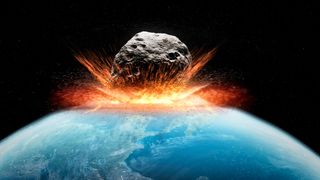
An illustration of an asteroid slamming into Earth.

An illustration of an asteroid slamming into Earth. A space rock this size would leave an enormous crater.(Image credit: SCIEPRO Via Getty Images)

In its 4.5 billion-year existence, Earth has been punched and gouged by hundreds of large asteroids that have slammed into its surface. At least190 of these collisionshave left colossal scars that are still visible today. But not every space rock that zips into our planet’s atmosphere makes it to the ground. So what does it take for anasteroidto make a dent on Earth, and which known impact events have left the biggest craters?

Most space rocks that barrel into Earth’s atmosphere aren’t giant at all. They’re very small — around 3 feet (1 meter) across,according to NASA. That’s good for Earthlings, as any space rock less than 82 feet…

View original post 914 more words

PLANE CRASH: ENC businessman & girlfriend on board flight

Exposing the Big Game's avatarCommittee to Abolish Sport Hunting Blog

Default Mono Sans Mono Serif Sans Serif Comic Fancy Small CapsDefault X-Small Small Medium Large X-Large XX-LargeDefault Outline Dark Outline Light Outline Dark Bold Outline Light Bold Shadow Dark Shadow Light Shadow Dark Bold Shadow Light BoldDefault Black Silver Gray White Maroon Red Purple Fuchsia Green Lime Olive Yellow Navy Blue Teal Aqua OrangeDefault 100% 75% 50% 25% 0%Default Black Silver Gray White Maroon Red Purple Fuchsia Green Lime Olive Yellow Navy Blue Teal Aqua OrangeDefault 100% 75% 50% 25% 0%

https://www.witn.com/2022/02/14/plane-crash-carteret-county-students-reported-be-board/

PLANE CRASH: Carteret County students reported to be on board

ByWITN Web Team

Published:Feb. 14, 2022 at 8:40 AM PST|Updated:12 minutes ago

CARTERET COUNTY, N.C. (WITN) – An Eastern Carolina businessman and his girlfriend are among those who are feared lost after a plane crash Sunday off our coast.

Tom Harrison, who co-owns Mattamuskeet Ventures, tells WITN that his friend and business partner Hunter Parks and Parks’ girlfriend, Stephanie Fulcher, were returning from a duck hunting trip in Hyde County when the plane they were on crashed Sunday.

“He was one of the most generous people I know and he had a duck hunting property and he had invited a large number of youth and veterans. There’s a special duck season, a 1-day duck season for youth and veterans and he…

View original post 156 more words

The West’s megadrought is worst in 1,200 years. Los Angeles is taking wastewater recycling to the extreme

Exposing the Big Game's avatarThe Extinction Chronicles

By Stephanie Elam, CNN

https://www.cnn.com/2022/02/14/us/west-megadrought-climate-wastewater-recycling/index.html

Updated 1:29 PM ET, Mon February 14, 2022

Grant Lake, controlled by the Los Angeles Department of Water & Power, appeared to be nearly empty in August.

Grant Lake, controlled by the Los Angeles Department of Water & Power, appeared to be nearly empty in August.

Los Angeles (CNN)The West is in its worst drought in centuries, scientists reported Monday.

A study published inNature Climate Changefound the period from 2000 to 2021 was the driest in 1,200 years. Last year’s drought severity was “exceptional,” researchers said, and all indications are the extreme conditions will continue through 2022.

Thehuman-caused climate crisishas made the megadrought 72% worse, the study noted.

      Burning fossil fuels is having a direct impact on water availability in the West, which for the past two decades has been characterized by dry weather, withhopeful but fleeting burstsof precipitation.

      https://65e6445883c934f483acff6f5b583223.safeframe.googlesyndication.com/safeframe/1-0-38/html/container.html

        You don’t have to look further than Los Angeles in December for an example. With nearly 10…

        View original post 1,183 more words

        National security adviser Sullivan describes what Russian invasion of Ukraine would ‘likely’ look like

        Exposing the Big Game's avatarThe Extinction Chronicles

        Jake Sullivan said US will ‘impose costs on Russia’ and will emerge ‘stronger’

        By Cameron Cawthorne | Fox New

        https://www.foxnews.com/politics/jake-sullivan-russia-invasion-ukraine

        Print

        Email

        Fox News Flash top headlines for February 13

        Fox News Flash top headlines are here. Check out what’s clicking on Foxnews.com.

        NEWYou can now listen to Fox News articles!

        Listen to this article

        0:00 / 2:391X

        BeyondWords

        National security adviser Jake Sullivan on Sunday said that he cannot know for sure what will happen inUkraine, but described how a potentialRussianinvasion would play out if it were to happen.

        “If there is a military invasion of Ukraine by Russia, it’s likely to begin with a significant barrage of missiles and bomb attacks,” Sullivan said. “Those are never as precise as any army would like them to be, and we don’t even know how precise the Russian army would like them to be, so…

        View original post 411 more words

        Federal judge restores wolf protections, derails Michigan’s hunting talks

        Exposing the Big Game's avatarCommittee to Abolish Sport Hunting Blog

        Updated: Feb. 11, 2022, 1:36 p.m. | Published: Feb. 11, 2022, 12:49 p.m.

        https://www.mlive.com/public-interest/2022/02/federal-judge-restores-wolf-protections-derails-michigans-hunting-talks.html?fbclid=IwAR0OVlNfmfvcvJa_heGbNEue-SJmH6F8_Hd5YT07mRJwsR2peCA9LbVLEt8

        Gray wolf in snow
        A federal judge ordered gray wolves be protected under the U.S. Endangered Species act after the species was de-listed in the Midwest and parts of the West.

        Facebook Logo

        Twitter Logo

        4,492

        shares

        BySheri McWhirter | smcwhirter@mlive.com

        Great Lakes gray wolves are back under federal protection amid Michigan’s ongoing talks on how to manage them – talks that promised to revisit debate on hunting the top predator species.

        A federal judge in California this week ordered safeguards under the U.S. Endangered Species Act be returned to wolves across much of the nation, reversing their removal from the list in the waning days of the Trump administration. The changed federal status of wolves comes while state wildlife regulators are in the midst of updating Michigan’s playbook for overseeing the species once responsibility shifted to states.

        Related:Michigan updating gray wolf plan…

        View original post 898 more words

        Maine’s major hunting seasons ending

        Exposing the Big Game's avatarCommittee to Abolish Sport Hunting Blog

        The next big season begins in May when it becomes legal to hunt wild turkeys.

        Credit: Adobe

        Author: Associated Press

        https://www.newscentermaine.com/article/news/community/maines-small-game-hunting-seasons-ending-for-the-spring-augusta/97-21effce9-5196-488f-a33a-7d5acd8c8c54?fbclid=IwAR3iMMCvIQtXRDlgEDs07wUPM5f6GshZ93HicFunyGtMBA9No_7x_Tz2-OU

        Published:3:05 PM EST February 12, 2022

        Updated:3:25 PM EST February 12, 2022

        Facebook

        Twitter

        AUGUSTA, Maine — A handful of Maine’s winter hunting seasons for small game animals are ending for the spring. The bobcat season ends on Feb. 21, while the fox season lasts until Feb. 28.

        There’s also a season for snowshoe hare that ends on Feb. 28 on Vinalhaven Island and March 31 everywhere else. Hunters who pursue gray squirrels via falconry can continue to do so until Feb. 28.

        The main season for squirrels ended Dec. 31. Maine’s major hunting seasons mostly take place in the fall.

        The next big season begins in May when it becomes legal to hunt wild turkeys.

        Related Articles

        View original post 9 more words

        The Most Extreme ‘Rogue Wave’ on Record Was Just Confirmed in The North Pacific

        Buoy riding the rogue wave. (MarineLabs)

        NATURE

        CARLY CASSELLA

        https://www.sciencealert.com/a-rogue-wave-four-stories-high-is-the-largest-on-record

        14 FEBRUARY 2022

        In November of 2020, a freak wave came out of the blue, lifting a lonesome buoy off the coast of British Columbia 17.6 meters high (58 feet).

        The four-story wall of water has now been confirmed as the most extreme rogue wave ever recorded.

        https://be400ecd2b2ddbede632d2c176f1f016.safeframe.googlesyndication.com/safeframe/1-0-38/html/container.html

        Such an exceptional event is thought to occur only once every 1,300 years. And unless the buoy had been taken for a ride, we might never have known it even happened.

        For centuries, rogue waves were considered nothing but nautical folklore. It wasn’t until 1995 that myth became fact. On the first day of the new year, a nearly 26-meter-high wave (85 feet) suddenly struck an oil-drilling platform roughly 160 kilometers (100 miles) off the coast of Norway.

        At the time, the so-called Draupner wave defied all previous models scientists had put together.

        Since then, dozens more rogue waves have been recorded (some even in lakes), and while the one that surfaced near Ucluelet, Vancouver Island was not the tallest, its relative size compared to the waves around it was unprecedented.

        Scientists define a rogue wave as any wave more than twice the height of the waves surrounding it. The Draupner wave, for instance, was 25.6 meters tall, while its neighbors were only 12 meters tall.

        In comparison, the Ucluelet wave was nearly three times the size of its peers.

        “Proportionally, the Ucluelet wave is likely the most extreme rogue wave ever recorded,” says physicist Johannes Gemmrich from the University of Victoria. 

        “Only a few rogue waves in high sea states have been observed directly, and nothing of this magnitude.”

        https://be400ecd2b2ddbede632d2c176f1f016.safeframe.googlesyndication.com/safeframe/1-0-38/html/container.html

        Today, researchers are still trying to figure out how rogue waves are formed so we can better predict when they will arise. This includes measuring rogue waves in real time and also running models on the way they get whipped up by the wind.

        The buoy that picked up the Ucluelet wave was placed offshore along with dozens of others by a research institute called MarineLabs in an attempt to learn more about hazards out in the deep.

        Even when freak waves occur far offshore, they can still destroy marine operations, wind farms, or oil rigs. If they are big enough, they can even put the lives of beachgoers at risk.

        Luckily, neither Ucluelet nor Draupner caused any severe damage or took any lives, but other rogue waves have.

        Some ships that went missing in the 1970s, for instance, are now thought to have been sunk by sudden, looming waves. The leftover floating wreckage looks like the work of an immense white cap.

        Unfortunately, a recent study predicts wave heights in the North Pacific are going to increase with climate change, which suggests the Ucluelet wave may not hold its record for as long as our current predictions suggest. 

        “We are aiming to improve safety and decision-making for marine operations and coastal communities through widespread measurement of the world’s coastlines,” says MarineLabs CEO Scott Beatty. 

        “Capturing this once-in-a-millennium wave, right in our backyard, is a thrilling indicator of the power of coastal intelligence to transform marine safety.”

        The study was published in Scientific Reports. 

        Alabama troopers locate lost hunter in Baldwin County


        by WEAR staffWednesday, February 9th 2022

        https://weartv.com/news/local/alabama-troopers-locate-lost-hunter-in-baldwin-county?fbclid=IwAR2LusTBUy-vMJs0xAKeRd3X7OOmutF3f7pnDkz6w00cUKIPTAzLl878oUE

        UserWay icon for accessibility widget
        ALEA

        ALEA

        Facebook Share Icon
        Twitter Share Icon
        Email Share Icon

        BALDWIN COUNTY, Ala. — Authorities located a hunter in Baldwin County Wednesday afternoon who had been lost since Tuesday.

        Around 9:45 a.m. Wednesday, troopers with the Alabama Law Enforcement Agency’s Marine Patrol Division were notified by Baldwin County 911 of a hunter lost in the Mobile-Delta area.

        The troopers responded and were able to locate the 39-year-old man around 1 p.m. in Bayou Jasmine near the Tensaw River. He was uninjured.

        ALEA says the man left his home Tuesday morning

        “At some point during his hunt, [he] had become separated from his motorboat,” a release states. “The hunter stayed out overnight before contacting 911 to advise he was unable to find his way back to the motorboat.”

        If Russia invades Ukraine, what’s next?

        BY JOSHUA C. HUMINSKI, OPINION CONTRIBUTOR — 02/13/22 02:01 PM EST  1,190

        THE VIEWS EXPRESSED BY CONTRIBUTORS ARE THEIR OWN AND NOT THE VIEW OF THE HILL

        21

        Share to Facebook  Share to Twitter 

        If Russia invades Ukraine, what’s next?


        Just In…

        VIEW ALL

        https://imasdk.googleapis.com/js/core/bridge3.498.1_en.html#goog_640210055

        1 second of 15 secondsVolume 0%

        With all of the focus on whether or not Russia will invade Ukraine, and how the West might respond, little public attention is being given to the day after in this crisis. Few are asking the question, “What will Moscow do in response to the West’s answer to Russia’s aggression, and where will that leave the West, in turn?”  

        From the outset, if the West and NATO are to maintain credibility, there must be a response. Uncontested aggression only breeds more uncontested aggression and not responding could well set a dangerous precedent further afield. 

        Every crisis develops, however, its own dynamic and it is critical that this dynamic be considered when planning a slate of responses. Every geopolitical contest of wills requires thinking through the move after the immediate move, and right now it would appear that Washington, London, Brussels and indeed Moscow are not considering what comes next or what comes thereafter.   

        https://bdd09a8da0b779fc42ce98887ae5e9e7.safeframe.googlesyndication.com/safeframe/1-0-38/html/container.html

        On Saturday, in a call with President Vladimir Putin, President Joseph Biden warned that the U.S. and its allies would “respond decisively and impose swift and severe costs on Russia” if Moscow expands its invasion of Ukraine. What that entails remains to be seen. Previously the United States indicated

        The United States indicated that multiple options are on the table for responding to expanded Russian aggression against Ukraine. Thus far, sanctions up to and including measures against President Vladimir Putin and his inner circle, disconnecting Russia from the SWIFT banking network and supporting an insurgency against Russian forces, have all been floated as possible options. It now appears that U.S. and European officials are preparing to target Russian banks such as state-backed VTB and Sberbank, and sanction the country’s tech and defense sectors, as well as its oligarchs.

        This is, however, where the dialogue has ended. There has been no follow-on discussion for if or how Russia will respond in kind.   

        This is part of sensible strategic planning and cause for a measure of caution when increasingly hyperbolic claims of imminence or inevitability are making the rounds. One can be sure that Russia will respond to any Western response to its expanded invasion of Ukraine. What that response looks like, likely will be contingent upon what the West does. It is here that there is an alarming possibility of unintended consequences and escalation.

        Russia has options should to respond to the West’s actions, which Western planners would do well to consider. Economically, there is, of course, the potential for the suspension of the oil and gas transshipment, a not insignificant weapon Moscow has wielded in the past to influence countries’ behavior. But Russia is also a key exporter of other critical resources and has threatened to withhold those, as well; at the end of January 2021, the vice speaker of Russia’s Federation Council suggested that Moscow would slow or halt natural resource transfers to Europe. The disruption of the sale of critical raw materials will have considerable knock-on effects in other markets, perhaps just as much as oil and gas prices.     

        https://bdd09a8da0b779fc42ce98887ae5e9e7.safeframe.googlesyndication.com/safeframe/1-0-38/html/container.html

        Russia has hinted at possible responses to proposed Western actions. In 2014, when Russia annexed Crimea, there were discussions of potentially disconnecting Russia from SWIFT, then, to which Dmitri Medvedev, Russia’s prime minister, hyperbolically warned would be a “declaration of war.” At the end of January, the vice speaker of Russia’s Federation Council suggested that Moscow would slow or halt natural resource transfers to Europe if Russia was disconnected. This is to say nothing of the potential knock-on market impacts of disconnecting Russia from the network.   

        Would Russia respond with cyberattacks? The reality is that they already are engaged in an aggressive cyber campaign against both Ukraine and the United States. Moscow will continue this line of effort regardless of the outcome of the present crisis. Indeed, just last week the FBI asked businesses to report any suspected Russian hacking activity. Russia will target, in the event of kinetic activity, Ukrainian command and control, communications and other critical infrastructure. If and when the West responds to Russia’s aggression, Moscow will escalate in turn, but using capabilities of which American intelligence is likely aware.  

        Thus far, the West has been fortunate enough to avoid an outright war in cyberspace. There have, of course, been cyberattacks, intelligence operations and criminality online, but an open war in cyberspace has not yet happened. Imagine a NotPetya-style attack on the United States in which computers of the financial sector and power grid, along with regular businesses, are wiped.  

        Would Russia increase its political warfare campaign? This too is a likely possibility. Moscow could expand its efforts to exacerbate existing schisms within European countries and in the United States through online manipulation and more. Moscow has demonstrated an ability and interest in interfering in elections, and while it has thus far refrained from outright intervention, it could change that course of action to something more direct. Indeed, there is already evidence that Russia has penetrated electoral rolls and stolen election data in the past. With an alarming portion of the American population already questioning the veracity of elections, little additional effort would be needed to cause further chaos and division.   

        Would Russia risk something bolder and more aggressive, seeking to increase pressure elsewhere? That is where the dynamics of escalation become of greater concern. Would Moscow consider seizing Gotland from Sweden? Would the Kremlin seek to foment a crisis in a country with an ethnic Russian population, like Estonia? Crises and responses tend to create their own inertia and their own momentum. While Putin, President Biden, and President Volodymyr Zelensky are all rational actors operating within rational systems crisis dynamics, an urge to respond and the pressure of the moment can and indeed do overwhelm rationality.   

        https://bdd09a8da0b779fc42ce98887ae5e9e7.safeframe.googlesyndication.com/safeframe/1-0-38/html/container.html

        This dynamic should be kept in mind as the West engages with Russia and potentially responds to Moscow’s aggression. There are some things that should be said publicly to reassure allies and others that should be said privately to deter adversaries. Things said and left unsaid, actions taken and actions avoided, all have consequences, and in the field of geopolitics, those consequences can be dire.   

        Right now, we do not know what Putin’s intentions are and to suggest otherwise is pure fantasy. We do not know what Moscow will do and, as such, we do not know how the West will respond. It is, however, important to think through what could happen and what could happen next. Planning and preparation are not assumptions that any specific outcome will occur, but are prudent measures in advance of any crisis. We do not want to find ourselves unprepared for Russia’s response and fall into an escalatory trap.