There was at least one fatality out of four firearms-related hunting incidents during deer season. All were self-inflicted, according to Missouri Department of Conservation.
Aconservation official is sharing gun safety protocols because deaths like these can be prevented, he said.
There’s not much known about the juvenile who died this past deer season. The News-Leader requested the incident report from MDC, but there were few details.
The unnamed individual was deer hunting and reportedly died from a self-inflicted gunshot wound to the chest in Clark County, in the northeastern corner of the state, on Dec. 4, 2021. They were younger than 18 years old.
Hunter Education and Shooting Range Coordinator Justin McGuire works with MDC staff and volunteers alike to plan hunter safety classes while also providing direction and guidance. He also coordinates programs for the department’s staffed and unstaffed shooting…
Freddie Armstead, Sr. – Photo from Marengo County Commission
A longtime Marengo County Commissioner has died after accidentally shooting himself.
Demopolis Police Chief Rex Flowers says Commissioner Freddie Armstead, Sr. had returned home from deer hunting last night and was getting his rifles out of the backseat of his truck. That’s when Flowers says one of the rifles accidentally fired, and shot Armstead.
He was taken by ambulance to Whitfield Regional Hospital in Demopolis where he died.
Armstead represented District 1 on the commission for many years.
Stay with Alabama News Network for funeral information.
Former seal hunt defender Brian Peckford, 79, makes political last stand at expense of cattle, pigs, & public health
OTTAWA, Canada––Canadian cattle and pigs fed grain from the United States are going hungry. Some cattle and pigs en route from Canada to finishing and slaughter in the U.S. may be stuck aboard trucks.
Entering a third weekend, a blockade of major Canadian transportation corridors by truckers opposed to COVID-19 vaccination and testing mandates may be lifted by a court injunction reportedly issued late on February 11, 2022 and by a provincial state of emergency declared by Ontario prime minister Doug Ford.
Meanwhile the truckers––representing just a tiny fraction of the total Canadian trucking industry––have for two weeks obstructed access to the Canadian national capital district in downtown Ottawa, blocked traffic at the Ambassador Bridge between Windsor, Ontario, and Detroit, Michigan, and sporadically shut down other border crossings into the U.S., as well as disrupting traffic in the provincial capitals of Alberta, Saskatchewan, Manitoba, and British Columbia.
(Beth Clifton collage)
Anti-vaccination, anti-testing
Behind the chaos lurks the ghosts of past political impasses over cod fishing quotas and the Atlantic Canadian seal hunt.
What the long depleted Atlantic Canadian cod stocks and the nearly moribund seal hunt have to do with horn-honking truckers, cattle and pigs mooing and oinking with hunger pangs, and widespread public and political exasperation with the anti-vaccination and anti-COVID testing truckers becomes clear only after looking behind the protests themselves to the people amplifying and orchestrating the truckers’ blockades and convoys––almost entirely from far behind the scenes.
Summarized Robin Levinson-King of BBC News, from the Windsor border crossing, “A ‘Freedom Convoy’ was organized last month in response to the introduction of a new rule that all truckers must be vaccinated to cross the U.S.-Canada border, or quarantine upon their return. The protest has since grown into a broader challenge to all COVID health restrictions.
“The vast majority of Canadian truckers are vaccinated and trucking associations have distanced themselves from the protests,” Levinson-King stipulated.
(Beth Clifton collage)
Peckford chairs influential leadership group
Nonetheless, thousands of demonstrators have gathered with trucks and farm equipment at potential pinch-points, where local obstructions of traffic can have national repercussions.
“The trade disruption has been estimated to cost some $380 million dollars each day,” Levinson-King said.
CTV News reporter Maggie Parkhill on February 10, 2022 identified Brian Peckford, 79, former prime minister of Newfoundland & Labrador, as “chairman of the group ‘Taking Back our Freedoms,’ which claims that COVID-19 restrictions and mandates are ‘unlawful.’
“The group also says it encourages Canadians to reject ‘forced’ COVID-19 vaccinations for children, a practice which is not currently happening in Canada,” Parkhill wrote.
Peckford in addition is “pursuing a lawsuit against the federal government,” Parkhill added, “claiming the COVID-19 vaccine mandate for international travel is unconstitutional.”
(Beth Clifton collage)
Seal hunt defense failed within Peckford’s own party
Peckford, heading the government of Newfoundland & Labrador from March 26, 1979 until March 22, 1989, helped to lead the Canadian defense of the Atlantic Canada seal hunt throughout his political tenure.
But Peckford, elected as a Progressive Conservative, found his position undercut when Brian Mulroney of Bai Comeau, Quebec, a fellow Progressive Conservative, rode a rare tide of Quebec support for the Progressive Conservative Party to become prime minister of Canada.
Mulroney, the first and only prime minister of Canada elected without substantial support from Newfoundland, responded to international pressure––and growing losses from lack of demand for seal pelts––by suspending the Atlantic Canada seal hunt in 1984.
The suspension held until 1995, more than a year after Mulroney left office in 1993.
Atlantic Canadian sealing survived the 1914 loss of 78 sealers from The Newfoundland, above, and 173 from the Southern Cross, lost with all hands.
“Grandfather spent 49 springs at the seal hunt”
Peckford entered politics in opposition to the Liberal Party domination of the Newfoundland & Labrador government begun by Joey Smallwood (1900-1991).
Smallwood, who led the former British Dominion of Newfoundland into Canadian confederation in 1949, served as Newfoundland prime minister until 1972.
Smallwood throughout his political career advocated for the Atlantic Canada seal hunt, against growing opposition not only from abroad, but from the rest of Canada, as many Canadians wearied of the annual bloodbath and of the mounting cost of subsidizing it.
Peckford, trying to establish his bona fides in dethroning the Newfoundland Liberals, “brags that his grandfather spent 49 springs at the seal hunt,” reported Douglas Martin of The New York Times in 1984.
Whatever the economic future of Newfoundland, it likely will have little to do with either cod or seals. (Beth Clifton collage)
Contributed to the Atlantic Canada cod stock crash
Earlier, during the negotiations that produced the 1982 Canadian constitution, Peckford unsuccessfully sought greater provincial authority over fisheries regulation.
This brought him into bitter confrontation with federal Liberal Party fisheries policy. Soon after the Liberal Party succeeded the Mulroney government, the federal Department of Fisheries & Oceans licensed three foreign factory trawlers to fish in Atlantic Canadian waters.
Peckford called this “a disaster of monumental proportions,” as it proved to be, albeit partly because of his own politically motivated fisheries management decisions, not just because of federal excesses.
The Atlantic Canada cod stocks collapsed three years after Peckford left office, and have yet to recover.
(Beth Clifton collage)
Moved to British Columbia
Loss of cod fishing, meanwhile, increased political pressure on a succession of Canadian federal governments to continue subsidizing sealing in a futile effort to quell Newfoundland resentment by creating makework jobs.
(Beth & Merritt Clifton)
With no political future left for him in Newfoundland & Labrador, Peckford relocated to British Columbia, where in 1998 he conducted an inquiry into Fraser River salmon fishery management and became increasingly associated with right-leaning political extremism.
“The chickens try to hide their head from you by sticking it under the wing of the chicken next to them on the slaughter line. You can tell by them looking at you, they’re scared to death.” – Virgil Butler, former Tyson chicken slaughterhouse worker
Beth Clifton’s collage depicts the contrition of Virgil Butler & Laura Alexander, who wrote: “We could no longer look at a piece of meat anymore without seeing the sad face of the suffering animal who had lived in it when the animal was still alive.”
A “Super Bowl” of Suffering for Nothing
Chicken “wings” aren’t wings, since real wings contain full-grown bones.
An industry article about “more wings from every chicken” explained that “A new patented cut uses the chicken’s scapula bone and surrounding meat and skin to yield six – not four – wing pieces per bird.”
The scapula is the chicken’s shoulder blade – skin, bone, flesh, and cartilage mishmashed into “wings” to disguise what they actually are.
CHICKEN DREAMING
(Ancestral memories in a metal “broiler” chicken shed.)
He sits in this house of feces and pain With thousands of others All the same, call it a triumph or Call it insane. His eyes are burning. His liver is leaking. His legs are aching and lame. But he will be Eaten with pleasure All the same.
His nerves, bones and tendons will be nuggets in a bucket Chewed by a fan At a game. His “wings” (don’t ask) will prove What it means To be a Man Like every other Man and his brother, Inane.
His breast will water The mouth of a lady trying To lose weight with this Lump on her plate. For this he was made For supper.
Meanwhile he dreams his Impossible dream: Ancestral memories Of family and friends Of tropical forest all rainy and green From which he came To suffer like this For a foul mouth of chicken bliss. – Karen Davis
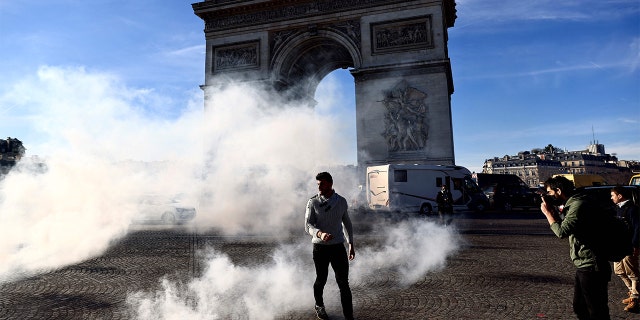
Police in Parisused tear gas Saturday against protesters inspired by theCanadian “Freedom Convoy”who were demonstrating against COVID-19 vaccine mandates on the Champs-Élysées avenue
French police set up checkpoints on roads into Paris, stopping more than 500 vehicles from heading to the protest, but dozens were able to get through. Tear gas was fired, and several protesters were detained as some demonstrators climbed on their vehicles in the middle of the road.
A man walks through tear gas on the Place Charles De Gaulle in Paris Feb. 12, 2022, as convoys of protesters, “Convoi de la Liberte,” arrived in the French capital.(Sameer Al-Doumy/AFP via Getty Images)
US poultry producers are tightening safety measures for their flocks as disease experts warn that wild birds are likely spreading a highly lethal form of avian flu across the country.
Indiana on Wednesday reported highly pathogenic bird flu on a commercial turkey farm, leading China, South Korea and Mexico to ban poultry imports from the state. The outbreak put the US industry on edge at a time that labor shortages are fueling food inflation.
MADISON, Wis. — The Wisconsin Department of Natural Resources says the state is no longer allowed to have a wolf-hunting season following a U.S. district court ruling Thursday that returned wolves to the Federal Endangered Species List.
The DNR says it is reviewing the ruling to determine how it affects those who bought licenses for the fall wolf hunt. The department also says the state’s wolf population “remains healthy and secure.”
As a result of the Feb. 10 ruling, the DNR says permits that previously allowed the lethal removal of wolves by landowners experiencing wolf conflicts are no longer valid. The DNR is also not allowed to use lethal control as part of its conflict management program. Training dogs to track and trail wolves also is not allowed.
The DNR says it will continue to help people who have conflicts with wolves through an interagency agreement with the USDA-Wildlife Services.
If you think wolves are attacking your livestock, pets or hunting dogs, or if wolves in your area are showing threatening or dangerous behavior, you should contact USDA-Wildlife Services immediately. You can call 1-800-433-0663 or 920-324-4514 for support in southern Wisconsin.
The answer lies in the psychology behind the way we perceive contradictory information: a manifestation of cognitive dissonance called the ‘meat paradox’
Feb 10, 2022 • 2 days ago • 6 minute read • 74 Comments
Many people experience the “meat paradox,” U.K. researchers say: caring for animals yet also consuming them as meat. PHOTO BY LINO MIRGELER /DPA/AFP via Getty Images
Reviews and recommendations are unbiased and products are independently selected. Postmedia may earn an affiliate commission from purchases made through links on this page.
Article content
Canadians prefer pepperoni on their pizza. And though one in four considered cutting it during COVID-19, beef is still a staple.
Toyota Super Bowl ad features Canadian Paralympians, no cars
about:blank
If you eat meat — as more than 90 per cent of Canadians do — chances are good, it comes from factory farms. Each year, 80 billion animals are slaughtered for meat globally, more than 90 per cent of which are estimated to live in intensive farming systems.
The alternative — meat bearing labels such as “free-range,” “grass-fed” and “certified humane” — is very much the minority. But those $7.99 rotisserie birds come at a cost to animal welfare and the environment.
According to Our World in Data, livestock production takes a significant environmental toll. Beef (meat and dairy), lamb and mutton emit the most greenhouse gas per kilogram than any other food. And when it comes to producing the beef that leads the pack in emissions, a study published in the journal Animal Welfare suggests that 13.6 per cent of bulls are inadequately stunned.
Many of the same people who regularly put meat on their plates are also likely to identify as animal lovers — sharing their homes with pets they adore, devouring cute animal videos on social media and supporting stricter food labelling around animal welfare.
A 2017 study published in the journal Society & Animals even suggests that people empathize more with dogs than they do other adults.
So, how do people reconcile their affection for animals with their desire to eat them in the form of meat?
The answer lies in the psychology behind the way we perceive contradictory information: a manifestation of cognitive dissonance (the discomfort of our beliefs clashing with new information) called the “meat paradox.”
In a first-of-its-kind literature review published in the Social Psychological Bulletin, U.K. researchers from the Societies Research Hub at Anglia Ruskin University (ARU) and Nottingham Trent University investigated the meat paradox and identified its two main psychological processes: triggers, such as reminding people of meat’s animal origin; and restorative strategies including disengagement from the issue.
Advertisement
STORY CONTINUES BELOW
Your next adventure is a flight away.
American Airlines mobile app, touchless kiosks, and travel planning tools make traveling easier than ever. Book now.
Ad By American Airlines
See More
Article content
“One of the big triggers of this meat paradox and of this cognitive dissonance, as we call it — this feeling of discomfort — is just hearing information about animals,” says ARU doctoral researcher Sarah Gradidge, lead author of the literature review.
“So simply just, for example, saying to somebody that their meat comes from an animal could be a trigger of this discomfort and can make them feel very uncomfortable and potentially very threatened.”
The researchers found that people use different strategies to deal with the meat paradox and alleviate their discomfort. Different people — intersecting with age, culture, dietary preferences, gender, occupation or religion — use different strategies, adds Gradidge, though figuring out why requires future research.
Simply just saying to somebody that their meat comes from an animal could be a trigger of this discomfort and can make them feel very uncomfortable and potentially very threatened.
Some tend to use indirect strategies, the most common of which is avoidance: mental (e.g., avoiding thinking about meat as animal flesh) or physical (e.g., steering clear of slaughterhouse footage).
“Obviously, if you’re eating meat, you might not want to think about where that meat has come from. So very simply, you might just be avoiding any thoughts that this meat has come from an animal,” says Gradidge.
Others tend to use more direct strategies to reduce dissonance by justifying their meat consumption. Most commonly: “denying positive traits to animals,” the 4Ns — defending meat eating as “natural,” “necessary,” “nice” and “normal” — and “denial of adverse consequences.”
“Instead of not thinking about it, they might actually be actively denying certain information. They may be denying that meat consumption causes harm to animals. They may be denying that animals even feel pain,” Gradidge explains.
“And that alleviates guilt because obviously, if animals can’t feel pain, then meat consumption isn’t going to hurt them. It essentially renders meat consumption completely harmless because it doesn’t cause any pain.”
Vegaphobia — stigma against vegans and vegetarians — can also be a strategy for dealing with the meat paradox, she adds. Sociologists Matthew Cole and Karen Morgan first identified the phenomenon in 2011 in their examination of the British media’s “derogatory” portrayal of vegans.
Most people want to act in a moral way, says Gradidge. If someone were to tell them that their meat eating is causing harm, for example, it could make them feel threatened and uncomfortable.
Instead of dealing with those emotions of discomfort, reflecting on and perhaps changing their own behaviour — such as reducing meat consumption — they may deflect the threat towards vegans and vegetarians. “I suppose, almost like shooting the messenger.”
Advertisement
STORY CONTINUES BELOW
Article content
In “It ain’t easy eating greens,” a 2015 study published in the journal Group Processes & Intergroup Relations, researchers Cara C. MacInnis and Gordon Hodson observed that only people with an addiction are viewed more negatively than vegans and vegetarians.
“Unlike other forms of bias (e.g., racism, sexism), negativity toward vegetarians and vegans is not widely considered a societal problem; rather, (it) is commonplace and largely accepted,” the Guardian reports of their conclusions.
Demonstrating this stigma — a phenomenon called do-gooder derogation — doesn’t just apply to vegans and vegetarians, Gradidge highlights, but people dealing with other moral issues as well (e.g., resentment of others’ generosity).
The way people communicate information about the consequences of meat eating matters, highlights Gradidge.
An August 2021 study published in the journal PLOS One suggests that blaming people — intentionally or not — for their role in unethical behaviour “leads to increased defensiveness and may be counterproductive.”
Alleviating them of any wrongdoing, however, may make them more receptive to information and potential change.
“It’s really, really important that when we’re talking about these issues, we’re doing it in a way that is absolving. So, we’re doing it in a way that’s not blaming meat eaters and saying, ‘It’s all your fault, you’re a bad person,’ etc.,” says Gradidge.
Advertisement
STORY CONTINUES BELOW
Article content
“We want to try to do it in a way that’s compassionate, and in a way that’s relatable to them. We really want to avoid these ‘us versus them’ politics. We don’t want to be presenting it as us, the animal welfare advocates, against them, the meat eaters. We really want to be thinking about how we can relate and try to bridge the gap.”
Effective communication requires finding the “sweet spot of cognitive dissonance,” she adds. Behavioural change requires some discomfort — if people don’t feel any, they’ll continue doing what they’ve always done.
If people feel too threatened, however, they tend to switch off and avoid the issue. A minority of people will even do the opposite in an urge to rebel (a psychological effect called reactance). If the message is to decrease meat consumption, they will increase it due to a perceived loss of freedom.
Raising awareness about animal welfare and environmental issues related to meat consumption is necessary, says Gradidge, but needs to be done in a way that will encourage people to reflect — not disengage.
“It raises some major issues when we’re talking about these issues, because we need to talk about them. But then we have to really navigate this cognitive dissonance and this potential discomfort as well,” she adds.
“It’s not about trying to force people to change their behaviour. It’s about trying to get people to reflect on their meat consumption themselves and to then make the decision themselves…. But obviously if we are presenting it in a way that’s threatening, then people aren’t going to reflect at all. They’re just going to ignore the information sadly.”
Close up image of a gray wolf in winter. Following a U.S. District courts ruling on Feb. 10 returning wolves in the lower 48 states to the Federal Endangered Species List, Wisconsin is not authorized to implement a wolf harvest season. Photo Credit: iStock.com – Lynn_Bystrom
MADISON, Wis.–The Wisconsin Department of Natural Resources (DNR) today announced that following a U.S. District court’s ruling on Feb. 10 returning wolves in the lower 48 states (except the northern Rocky Mountains region) to the Federal Endangered Species List, Wisconsin is not authorized to implement a wolf harvest season. The DNR is reviewing the ruling to determine how it impacts hunters and trappers who purchased licenses for the Fall 2021 wolf hunt.
Wisconsin’s wolf population remains healthy and secure in the state. The department will continue its robust wolf population monitoring program to ensure the population…