Hunters who thought they killed an 8-point buck got a big surprise when they got the deer home: report

Exposing the Big Game's avatarCommittee to Abolish Sport Hunting Blog

Updated: Feb. 08, 2022, 5:41 p.m. | Published: Feb. 08, 2022, 7:45 a.m.

https://www.pennlive.com/sports/2022/02/hunters-who-thought-they-killed-an-8-point-buck-got-a-big-surprise-when-they-got-the-deer-home-report.html?fbclid=IwAR3KMLN_rCPJsu7M_w69R-8mkk39fx_NFePjUi75VjamiCJZByDnZz-b8-g

982

shares

ByBrian Linder | blinder@pennlive.com

It is not often that a hunter gets a chance to take an 8-point buck, so when a group of Alabama hunters got the rare opportunity, they were pretty excited.

But,according to a report,when they got the deer with the big rack back home and started cleaning it, they were startled.

Turns out, what they bagged was something far more rare than an 8-point buck. It was an 8-point doe. Kind of.

That’s right. The big deer had a full rack of antlers, but no visible male reproductive parts, according to reports. And, officials with Alabama’s Wildlife and Freshwater Fisheries Division’s Deer Program said they’ve never seen anything quite like what the group brought in.

“I’ve seen a few over the years that looked like does externally that…

View original post 261 more words

A motorcycle tire stuck around a crocodile’s neck for 6 years is finally removed

February 9, 202210:09 AM ET

THE ASSOCIATED PRESS

A crocodile with a motorcycle tire stuck around its neck basks on a riverbank in Palu, Central Sulawesi in 2020. The wild crocodile that has the used tire stuck around its neck for six years has finally been freed by an Indonesian bird catcher in a tireless effort that wildlife conservation officials hailed as a milestone.

Mohammad Taufan/AP

PALU, Indonesia — A wild crocodile with a used motorcycle tire stuck around its neck for six years has finally been freed by an Indonesian bird catcher in a tireless effort that wildlife conservation officials hailed as a milestone Wednesday.

The 4.5-meter (14.8-foot) saltwater female crocodile has become an icon to the people in Palu, the capital city of Central Sulawesi. The beast was seen on the city’s river with the tire around its neck becoming increasingly tighter, running the risk of choking her.

Conservation officials were racing to rescue the crocodile since residents spotted the reptile in 2016, generating sympathy among residents and worldwide. In 2020, Australian crocodile wrangler Matthew Wright and American wildlife biologist Forrest Galante tried and failed to free the reptile.

In early January, 35-year-old bird catcher and trader Tili, who recently moved to the city, heard about the famous crocodile from his neighbors and determined to rescue the reptile after he saw her frequently sunbathing at a nearby estuary.

“I have experiences and skills in catching animals, not only birds, but farm animals that are released from the cage,” Tili, who goes by a single name, told The Associated Press. “I believe I can rescue the crocodile with my skills.”

Article continues after sponsor message

https://163d43d86a3bb658abf2bce1a594aa8e.safeframe.googlesyndication.com/safeframe/1-0-38/html/container.html

He stringed ropes of various sizes into a trap tied to a tree near the river, and laid chickens, ducks and birds as bait. After three weeks of waiting and several failed attempts, the crocodile finally fell into the trap Monday night. With the help of two of his friends, Tili pulled the trapped crocodile ashore and sawed through the tire, which was 50 centimeters (1.6 feet) in diameter.

A video that circulated widely on the internet showed a crowd cheering nearby as Tili and his friends broke the crocodile free. Other residents then contacted firefighters and a wildlife conservation agency to help them release the animal back into the wild.

“For all of the efforts Tili has done for protected wildlife and being the kind of animal lover he is, that’s a great milestone,” said Haruna Hamma who heads Central Sulawesi province’s conservation agency.

He said it was unclear how a used motorcycle tire got stuck around the crocodile neck. Conservationists have said that it was likely deliberately placed by people in a failed attempt to trap it as a pet or skin it for sale, but crocodiles and other swimming reptiles often travel into garbage-studded waters with nothing to stop a tire from encircling them, Hamma said.

Government data recorded 279 crocodile attacks in Indonesia, the world’s largest archipelago nation with more than 17,000 islands, between 2007 and 2014. Of these, as many as 268 cases of attacks were carried out by saltwater crocodiles, of which 135 were fatal.

Despite the attacks, the saltwater crocodile is protected under Indonesian law.

Arkansas woman warning others after her dog gets stuck in trap along nature trail

Exposing the Big Game's avatarCommittee to Abolish Sport Hunting Blog

Ann Marks is reeling after an evening walk with her dog turned into a nightmare after Gypsy walked into a wildlife trap along a nature trail.

https://www.thv11.com/article/news/local/woman-warns-others-dog-caught-trap-on-nature-trail/91-b2a1cb5a-27a3-4e21-b9ba-3cbbf8d803ae

Arkansas woman warns others after her dog was caught in trap on nature trail

00:0000:00

Author:Frederick Price (KTHV)

Published:5:30 PM CST February 7, 2022

Updated:9:01 AM CST February 8, 2022

Facebook

Twitter

MAYFLOWER, Ark — One Arkansas woman is reeling after an evening walk with her dog turned into a nightmare after Gypsy walked into a wildlife trap along a nature trail in Mayflower.

With warmer temperatures starting to roll in following the harsh winter storms, more people like Ann Marks are at the hiking and nature trails.

https://imasdk.googleapis.com/js/core/bridge3.496.0_en.html#goog_112142814

https://imasdk.googleapis.com/js/core/bridge3.496.0_en.html#goog_1014285305

about:blank

00:09 / 01:03

‘Smart’ Contact Lens Prototype Has Built-In Display Screen

FEATURED BY

She visits them often to walk Gypsy, her high energy German Shorthaired Pointer who loves the exercise.

“She’s my everything, we…

View original post 257 more words

Woman warns walkers to beware of traps

Exposing the Big Game's avatarCommittee to Abolish Sport Hunting Blog

1of 3

Dog trap

Submitted photos

Gypsy, a 4-year-old German Shorthaired Pointer, got her right front paw caught in a trap near the back entrance to Bells Slough trail in Mayflower.

    Dog trap

    This is the unmarked trap that Gypsy got her right front paw caught in Jan. 27.

      Gypsy, a 4-year-old German Shorthaired Pointer, is recovering after getting her right front paw caught in a trap near a popular walking trail in Mayflower.

        A Faulkner County woman wanted to make people aware to watch out for traps after her dog – Gypsy, a 4-year-old German Shorthaired Pointer – got her right front paw caught in one last week near the back entrance to Bells Slough trail in Mayflower.

        Ann Marks took Gypsy to the popular walking trail around 4:30 p.m. Jan. 27. As they…

        View original post 313 more words

        Hunters slaughter hundreds of fenced-in animals, sparking outrage

        Exposing the Big Game's avatarCommittee to Abolish Sport Hunting Blog

        By

        Ben Cost

        February 7, 2022 4:58pm 

        Updated

        Spanish hunters are under fire for reportedly slaughtering nearly 450 fenced-in game animals in what environmentalists have dubbed an "orgy of blood and death."
        Spanish hunters are under fire for reportedly slaughtering nearly 450 fenced-in game animals in what environmentalists have dubbed an “orgy of blood and death.”Courtesy of El Mundo

        MORE ON:HUNTING

        It was a slaughterfest of a-pork-alyptic proportions.

        Spanish hunters are under fire for reportedly slaughtering nearly 450 fenced-in game animals in what environmentalists have dubbed an “orgy of blood and death.”

        “It’s an absolute bloodbath, slaughter on a totally senseless scale,” Eduardo Goncalves, founder of the Campaign to Ban Trophy Hunting, toldthe Independentof the “shocking” massacre, which occurred in one day on a private estate in Villaviciosa de Córdoba, Andalucia.

        Participating sportsmen paid more than…

        View original post 346 more words

        Comet 2014 UN271 the largest ever observed

        Exposing the Big Game's avatarThe Extinction Chronicles

        by Bob Yirka , Phys.org

        https://phys.org/news/2022-02-comet-un271-largest.html

        Comet 2014 UN271 the largest ever observed
        Fig. 1. Recentered 233 GHz total image of 2014 UN271 merging data from the two SB and the four spectral windows. The synthesized beam, shown in white, is 0.067”× 0.062”. The scale of the color bar is in mJy. Credit: https://arxiv.org/pdf/2201.13188.pdf

        A team of researchers with the Paris observatory and Instituto de Astrofísica de Andalucía-CSIC, has confirmed that comet 2014 UN271 is the largest comet ever observed. They published a paper describing their findings on the arXiv preprint server, and it has been accepted for publication inAstronomy and Astrophysics Letters.

        Comet 2014 UN271, also known as Bernardinelli-Bernstein, was first sighted in 2014; hence, the initial part of its name. Researchers determined at the time that it had originated in the Oort Cloud. It was observed during the search for solar system objects during the Dark Energy Survey. Back then, thecometwas…

        View original post 252 more words

        Winter ‘heat wave’ hits San Francisco Bay Area: How hot will it get?

        Exposing the Big Game's avatarThe Extinction Chronicles

        Photo of Amy Graff

        Amy Graff,SFGATE

        Feb. 8, 2022

        https://www.sfgate.com/weather/article/Winter-heat-wave-hits-San-Francisco-Bay-Area-16841049.php

        People enjoy their leisure time on a beach in Half Moon Bay in California, the United States, Feb. 28, 2021. 
        People enjoy their leisure time on a beach in Half Moon Bay in California, the United States, Feb. 28, 2021.Xinhua News Agency/Xinhua News Agency/Getty Images

        Call it California living — beachweatherin February.

        Record-breaking temperatures are heating up Northern California this week with afternoon highs expected to be 10 to 20 degrees above normal, the National Weather Service said. Temperatures in the mid- to upper 70s will be widespread by mid-week and some locations including the beach in Santa Cruz are likely to break into the 80s.

        “We have an extreme forecast index and this event is on the higher end of being a rare occurrence for us,” said Brooke Bingaman, a meteorologist with the weather service’s Monterey office.

        https://imasdk.googleapis.com/js/core/bridge3.496.0_en.html#goog_415005744

        The warmest day of the week will be Thursday when San Francisco is forecast to top out at 75 degrees and the…

        View original post 298 more words

        Scientists raise alarm over ‘dangerously fast’ growth in atmospheric methane

        As global methane concentrations soar over 1,900 parts per billion, some researchers fear that global warming itself is behind the rapid rise.

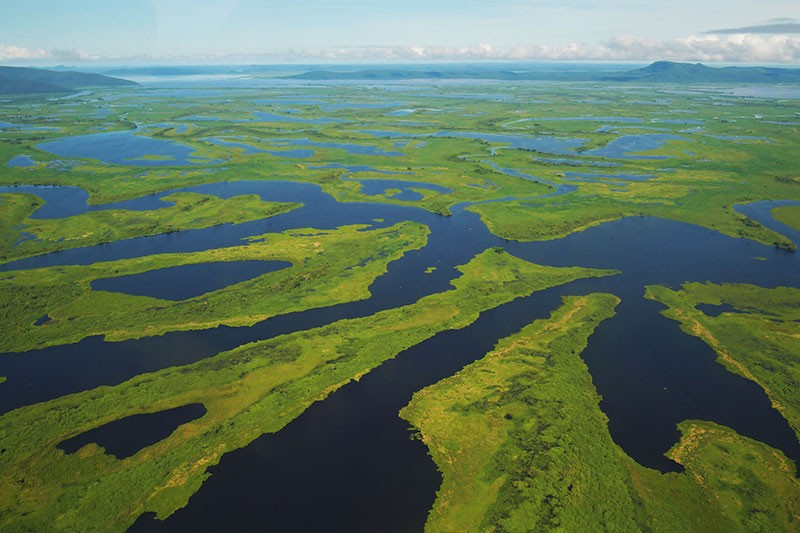
        Aerial view of the Pantanal wetlands, in Mato Grosso state, Brazil.
        Tropical wetlands, such as the Pantanal in Brazil, are a major source of methane emissions.Credit: Carl De Souza/AFP via Getty

        Methane concentrations in the atmosphere raced past 1,900 parts per billion last year, nearly triple preindustrial levels, according to data released in January by the US National Oceanic and Atmospheric Administration (NOAA). Scientists says the grim milestone underscores the importance of a pledge made at last year’s COP26 climate summit to curb emissions of methane, a greenhouse gas at least 28 times as potent as CO2.

        The growth of methane emissions slowed around the turn of the millennium, but began a rapid and mysterious uptick around 2007. The spike has caused many researchers to worry that global warming is creating a feedback mechanism that will cause ever more methane to be released, making it even harder to rein in rising temperatures.

        “Methane levels are growing dangerously fast,” says Euan Nisbet, an Earth scientist at Royal Holloway, University of London, in Egham, UK. The emissions, which seem to have accelerated in the past few years, are a major threat to the world’s goal of limiting global warming to 1.5–2 °C over pre-industrial temperatures, he says.

        A worrying trend: Line chart showing the rise in atmospheric methane levels since 1985.
        Source: NOAA

        Enigmatic patterns

        For more than a decade, researchers have deployed aircraft, taken satellite measurements and run models in an effort to understand the drivers of the increase (see ‘A worrying trend’)1,2. Potential explanations range from the expanding exploitation of oil and natural gas and rising emissions from landfill to growing livestock herds and increasing activity by microbes in wetlands3.

        “The causes of the methane trends have indeed proved rather enigmatic,” says Alex Turner, an atmospheric chemist at the University of Washington in Seattle. And despite a flurry of research, Turner says he is yet to see any conclusive answers emerge.

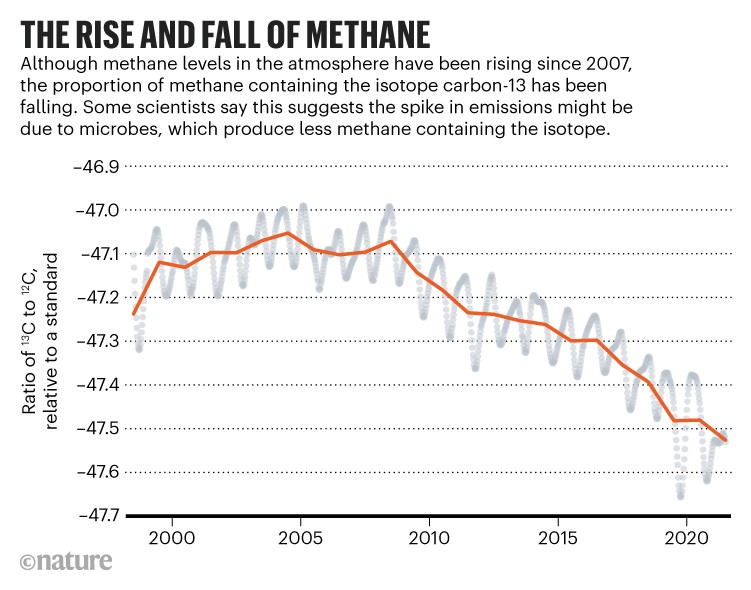
        One clue is in the isotopic signature of methane molecules. The majority of carbon is carbon-12, but methane molecules sometimes also contain the heavier isotope carbon-13. Methane generated by microbes — after they consume carbon in the mud of a wetland or in the gut of a cow, for instance — contains less 13C than does methane generated by heat and pressure inside Earth, which is released during fossil-fuel extraction.

        Scientists have sought to understand the source of the mystery methane by comparing this knowledge about the production of the gas with what is observed in the atmosphere.

        By studying methane trapped decades or centuries ago in ice cores and accumulated snow, as well as gas in the atmosphere, they have been able to show that for two centuries after the start of the Industrial Revolution the proportion of methane containing 13C increased4. But since 2007, when methane levels began to rise more rapidly again, the proportion of methane containing 13C began to fall (see ‘The rise and fall of methane’). Some researchers believe that this suggests that much of the increase in the past 15 years might be due to microbial sources, rather than the extraction of fossil fuels.

        The rise and fall of methane: Line chart showing the proportion of methane containing the isotope carbon-13.
        Source: Sylvia Michel, University of Colorado Institute of Arctic and Alpine Research

        Back to the source

        “It’s a powerful signal,” says Xin Lan, an atmospheric scientist at NOAA’s Global Monitoring Laboratory in Boulder, Colorado, and it suggests that human activities alone are not responsible for the increase. Lan’s team has used the atmospheric 13C data to estimate that microbes are responsible for around 85% of the growth in emissions since 2007, with fossil-fuel extraction accounting for the remainder5.

        The next — and most challenging — step is to try to pin down the relative contributions of microbes from various systems, such as natural wetlands or human-raised livestock and landfills. This may help determine whether warming itself is contributing to the increase, potentially via mechanisms such as increasing the productivity of tropical wetlands. To provide answers, Lan and her team are running atmospheric models to trace methane back to its source.

        “Is warming feeding the warming? It’s an incredibly important question,” says Nisbet. “As yet, no answer, but it very much looks that way.”

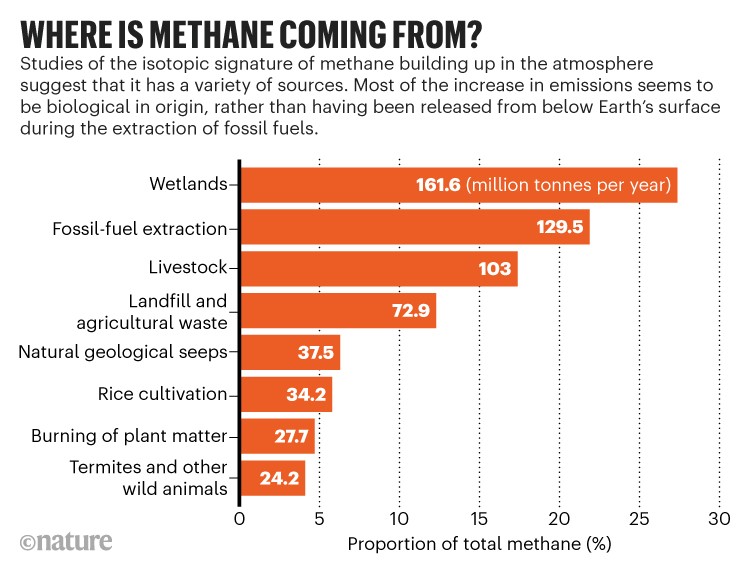
        Regardless of how this mystery plays out, humans are not off the hook. Based on their latest analysis of the isotopic trends, Lan’s team estimates that anthropogenic sources such as livestock, agricultural waste, landfill and fossil-fuel extraction accounted for about 62% of total methane emissions since from 2007 to 2016 (see ‘Where is methane coming from?’).

        Where is methane coming from?: Bar chart showing proportions of total methane produced by various sources.
        SOURCE: Ref. 5.

        Global Methane Pledge

        This means there is plenty that can be done to reduce emissions. Despite NOAA’s worrying numbers for 2021, scientists already have the knowledge to help governments take action, says Riley Duren, who leads Carbon Mapper, a non-profit consortium in Pasadena, California, that uses satellites to pinpoint the source of methane emissions.

        Last month, for instance, Carbon Mapper and the Environmental Defense Fund, an advocacy group in New York City, released data revealing that 30 oil and gas facilities in the southwestern United States have collectively emitted about 100,000 tonnes of methane for at least the past three years, equivalent to the annual warming impact of half a million cars. These facilities could easily halt those emissions by preventing methane from leaking out, the groups argue.

        At COP26 in Glasgow, UK, more than 100 countries signed the Global Methane Pledge to cut emissions by 30% from 2020 levels by 2030, and Duren says the emphasis must now be on action, including in low- and middle-income countries across the global south. “Tackling methane is probably the best opportunity we have to buy some time”, he says, to solve the much bigger challenge of reducing the world’s CO2 emissions.

        doi: https://doi.org/10.1038/d41586-022-00312-2

        UPDATES & CORRECTIONS

        • Correction 08 February 2022: An earlier version of this story said that bacteria generate methane in wetlands and the guts of cows. Methane is emitted by microbes in these places.

        References

        1. 1.Nisbet, E. et al. Phil. Trans. R. Soc. A. https://doi.org/10.1098/rsta.2021.0112

        Phasing Out Animal Agriculture Could Stabilize Climate Change

        Published: February 7, 2022

        https://www.technologynetworks.com/applied-sciences/news/phasing-out-animal-agriculture-could-stabilize-climate-change-358277

        | Original story from the University of California, Berkeley

        Credit: Pixabay.

        Read time:

         5 minutesGet PDF Version

        A new study of the climate impacts of raising animals for food concludes that phasing out all animal agriculture has the potential to substantially alter the trajectory of global warming.

        The work is a collaboration between Michael Eisen, professor of molecular and cell biology at the University of California, Berkeley, and Patrick Brown, professor emeritus of biochemistry at Stanford University and the CEO of Impossible Foods Inc., a company that sells plant-based meat substitutes.

        Eisen, who consults for Impossible Foods, and Brown used a simple climate model to look at the combined impact of eliminating emissions linked to animal agriculture and of restoring native vegetation on the 30% of Earth’s land surface currently used to house and feed livestock.

        They found that the resulting drop in methane and nitrous oxide levels, and the conversion of 800 gigatons (800 billion tons) of carbon dioxide to forest, grassland and soil biomass, would have the same beneficial impact on global warming as cutting annual global CO2 emissions by 68%.

        “Our work shows that ending animal agriculture has the unique potential to significantly reduce atmospheric levels of all three major greenhouse gases, which, because we have dithered in responding to the climate crisis, is now necessary to avert climate catastrophe,” said Eisen, who is also a Howard Hughes Medical Institute (HHMI) investigator at UC Berkeley.

        A major reason for the large long-term effect Eisen and Brown observe is that its benefits accrue rapidly. Brown argues that this demonstrates that eliminating animal agriculture should be as high a priority as eliminating fossil fuel use.

        “Eliminating animal agriculture would have a quicker and greater impact over the next 20 to 50 years, the critical window for avoiding climate catastrophe, and thus should be at the top of the list of potential climate solutions,” Brown said.

        “There is,” he added, “an enormous, previously unrecognized opportunity to sharply bend the trajectory of climate change within a couple of decades, with multiple additional environmental and public health benefits, and minimal economic disruption.”

        The study was published Feb. 1 in the journal PLOS Climate.

        Not an impossible task

        Eisen and Brown have discussed the impacts of raising animals for food for years. Both men are vegans. Eisen stopped eating meat after convincing himself of the dire impact animal agriculture has on the world’s climate. Brown founded Impossible Foods in 2011 for similar reasons, began marketing the Impossible Burger in 2016, and recently launched plant-based chicken nuggets and ground pork products. 

        “My awareness of the potential impact was a major motivation for launching Impossible Foods,” Brown said. “In fact, I’ve been saying for years that replacing livestock in the global food system would turn back the clock on climate change. But although I knew that this conclusion was directionally correct, the environment and policy community would accept it only if we did this rigorous modeling that Mike and I did.”

        Most research on the impact of animal agriculture has focused on the impact today of methane emissions from animals and their manure, nitrous oxide from fertilizer used to grow animal feed, and from the carbon dioxide produced raising and transporting animals and meat. Two reports within the past year, however, addressed a different aspect of animal agriculture: the potential that grazing land has for regrowing vegetation and sequestering carbon from the atmosphere.

        “Everybody knows that methane is a problem. Everybody knows that livestock contribute to global warming in some way,” Eisen said. “But animal ag contributes to global warming in two ways: It contributes via emissions and contributes because that land would otherwise be holding carbon. Most analyses only look at one of those things.”

        Even though the animal industry today is responsible for about 16% of annual greenhouse gas emissions, by some estimates about one-third of all the carbon dioxide humans have added to the atmosphere since the dawn of animal husbandry is a result of land cleared for animal grazing and to grow feed or provide forage for animals used as food.

        “What hadn’t been recognized is the much more impactful potential to unlock negative emissions by eliminating that industry,” Brown said.

        The two scientists spent the pandemic years researching climate models and climate change literature to quantify the direct and indirect impact of eliminating animal agriculture worldwide. While cows and other bovids, like buffalo, represent about 80% of animal agriculture’s impact, they also considered the impact of pigs, chickens and other domesticated animals used for food, though not the world’s fisheries. 

        While both researchers would just as soon eliminate animal agriculture today, they chose a more realistic scenario: a phaseout over 15 years.

        “A 15-year phaseout is not unrealistic — a lot of things happen on that timeframe,” Eisen said. “We went from having no cellphones to cellphones being ubiquitous in less time than that. It’s not that we’re saying we’re going to get rid of animal ag in the next 15 years, though that’s sort of the mission for Impossible Foods, but that is something we could do.”

        Their conclusions are that a 15-year phaseout would immediately eliminate about one-third of all methane emissions globally and two-thirds of all nitrous oxide emissions, allowing the atmosphere to achieve a new equilibrium at lower levels of both.

        Better nutrition without animal products

        While Eisen and Brown acknowledge that animal products are key to nutrition in most countries — they supply about 18% of the calories, 40% of the protein and 45% of the fat in the human food supply — they point out that worldwide, about 400 million people already live on entirely plant-based diets. Existing crops could replace the calories, protein and fat from animals with a vastly reduced land, water, greenhouse gas and biodiversity impact, requiring only minor adjustments to optimize nutrition.

        Based on his experience with Impossible Foods, Brown said, “there’s compelling evidence that animal agriculture can be replaced without requiring meat lovers to compromise on nutrition or any of the sensory pleasures they love.”

        Both scientists hope that their study will prod policymakers to consider the reduction or elimination of animal agriculture — barely mentioned in the most recent IPCC (Intergovernmental Panel on Climate Change) report — as an important option for reducing greenhouse gases. They look forward to a robust debate now that their data and analysis are online through the open access journal PLOS Climate.

        “What we really did in the paper was try to formalize what it would mean to get rid of animal agriculture without making it too complicated,” Eisen said. “There’s a lot of uncertainty, there are a lot of unknowns, but I think probably the biggest uncertainty is whether people will look at this potential and act on it as a society.”

        “I’m hoping that others, including entrepreneurs, scientists and global policymakers, will recognize that this is the most important opportunity humanity has to reverse the trajectory of climate change, and seize it,” Brown said.

        The study was conducted with no outside funding. Eisen worked on the project as an HHMI investigator, alongside his research on gene regulation in fruit flies.

        “I think this is a kind of Pearl Harbor moment for science. The climate of the planet is under a bigger threat now than it’s ever been in history, and to the extent that scientists can find ways to contribute, I think it’s really incumbent upon us to do so,” Eisen said.

        Reference: Eisen MB, Brown PO. Rapid global phaseout of animal agriculture has the potential to stabilize greenhouse gas levels for 30 years and offset 68 percent of CO2 emissions this century. PLOS Climate. 2022;1(2):e0000010. doi:10.1371/journal.pclm.0000010


        This article has been republished from the following materials. Note: material may have been edited for length and content. For further information, please contact the cited source.