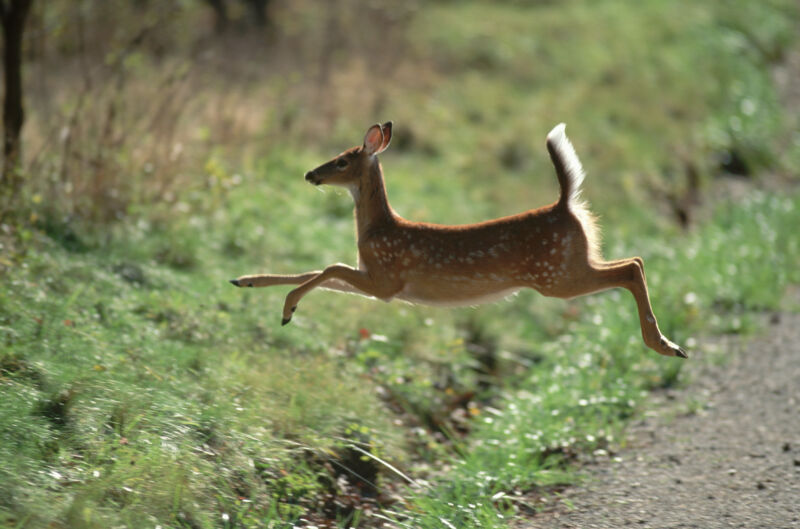
Earlier this year, researchers found that many wild deer in Michigan had antibodies that suggested the animals had been exposed to SARS-CoV-2, the virus that causes COVID-19. It was a significant cause for concern, as a large population of susceptible animals could act as a reservoir that allows the virus to spread back to humans.
At the time, however, uncertainties abounded. The study looked at only a small sample of the deer population of one state—we didn’t know how the animals were exposed, and we didn’t know whether the virus was actually spreading among wild deer. Since then, a few of the blanks have been filled in. Critically, deer-to-deer transmission has been observed in captivity. On Monday, a preprint of a new paper answered some more questions, showing that infection is widespread in a second state, driven both by its spread from humans and deer-to-deer transmission.
Overall, the news is not especially good, though we still don’t understand what risks it may pose to humans.
Virus hunting
There are still many unknowns about the spread of SARS-CoV-2 to deer and its transmission among them. We know that transmission to deer is possible, but we don’t have a strong sense of how often the virus makes the jump from humans to deer or whether it does so directly or via an intermediary species. Once infected, deer show few obvious symptoms, but the virus has a similar time course: detectable after four days and remaining detectable as long as three weeks after infection.
The team included members of Iowa’s Department of Natural Resources who were inspired by the findings in Michigan to see what was going on in their state. They partnered with a variety of academic researchers to test both wild deer and deer on game reserves, with many of the animals killed by hunters or cars. Their study began in April of 2020, but most of the 283 samples came after the hunting season started in September; things wrapped up in early January 2021.Advertisement
To an extent, sampling paralleled the initial course of the pandemic in Iowa, which saw its first spike in cases in April of 2020 before reaching a peak at the end of the year. All told, 94 of the deer (33 percent) tested positive over the course of the study. But that figure obscures some obvious changes over time.
In deer, at least, the virus wasn’t detected at all until after hunting season began, although the sampling rate in this period was too low to determine how significant this finding was. But the first positive deer were detected shortly after hunting season started, and the numbers rose considerably as cases in the human population spiked. By December, over 80 percent of the deer tested were positive for the virus.
How did that get here?
Sampling rates during the months of hunting season remained relatively steady, so that surge in cases appears to be real. But it’s not possible to tell how much of the contribution came from hunters being out among the deer and how much came from the presence of a large number of humans who were infected with the virus. Hunting could also change the behavior of the deer in a way that made it easier for them to spread it among themselves.
To help figure out what might be going on, the research team obtained genomic sequences from the virus in all of their samples, allowing them to track individual lineages of virus and compare the viruses in deer to those from the surrounding human population.
The research team found a dozen different SARS-CoV-2 lineages in the deer population. The most common of these was also the most common among the strains circulating in humans in Iowa at the same time. Beyond that, there were some parallels between the deer and human strains, but the authors caution that the results represent a small sample of both populations, since genome sequencing of humans wasn’t common at the time, either.
In any case, it’s clear that deer from the same location were almost always infected by the same variant, and in some cases, the genomes of the viruses were identical. This finding provides strong evidence that the virus spreads among deer in the wild. The fact that different locations saw different variants present suggests that the cases were the product of separate inter-species infection events. Thus, it seems that the virus can regularly spread from humans to deer.
Does that spread happen directly? It’s not possible to say, but the relatively short lag between the spike in human cases and the high levels of positivity in deer would seem to make an intermediate carrier species less likely.
While the virus doesn’t cause much in the way of obvious symptoms for deer, they become infectious by four days after infection, and the virus remains detectable for up to three weeks after infection.
What does this mean?
The big reason not to hit the panic button is that we’ve yet to determine whether the virus can move from deer back to humans. The hunters would seem to be at the greatest risk, but there’s no indication in this paper that their health was tracked following their involvement in the sampling.
Mark CarneyGovernor of the Bank of England, and former Governor of the Bank of Canada (born 1965)
GLASGOW, Scotland — Climate activist Greta Thunberg stormed out of an event at the U.N. Climate Change Conference on Wednesday afternoon, where officials and business leaders were discussing how to ensure that markets for trading carbon offsets actually achieve the purpose of reducing greenhouse gas emissions.
The Swedish teenager, who was in the audience at a panel discussion, left the venue saying, “Thanks for greenwashing,” after a moderator thanked her for attending the session.
When Thunberg said “greenwashing,” she was using an environmentalists’ term for an organization’s false portrayal of itself as environmentally friendly. Some activists contend that corporations and governments participating in the climate summit, also known as COP26, are guilty of just that, by paying lip service to combating climate change while continuing to use the fossil fuels that cause global warming.
Swedish activist Greta Thunberg leaves after attending a meeting at the U.N. Climate Change Conference in Glasgow, Scotland, on Wednesday. (Phil Noble/Reuters)
The panel discussion was called “High Integrity in the Voluntary Carbon Market,” with speakers including Mark Carney, vice chairman and head of impact investing at Brookfield Asset Management and a former governor of the Bank of England. Carbon offsets are credits for actions such as planting trees that are bought by polluters to compensate for emitting the gases that cause global warming, such as carbon dioxide.
Thunberg may have intended to take part in a protest of the event planned by Indigenous activists. However, the demonstration was foiled after many of the activists remained stuck outside the venue.
“Carbon offsetting violates Mother Earth and Father Sky and perpetuates the theft of Indigenous Peoples’ land and territories,” said Tom Goldtooth, executive director of the Indigenous Environmental Network, in a statement before the planned protest. “Indigenous Peoples have been protecting lands and forests for thousands of years, but carbon offsets are tearing us apart.”
A conference panel on Wednesday with (starting second from left) World Bank president David Malpass, Kenyan Finance Minister Ukur Yatani Kanacho, former Bank of England governor Mark Carney and IMF managing director Kristalina Georgieva. (Daniel Leal-Olivas/AFP via Getty Images)
Earlier on Wednesday, hundreds of protesters from the group Extinction Rebellion gathered in the center of Glasgow, just under 2 miles from the official conference venue, to show their concern over what one protester described as “false solutions” to the climate crisis.
Big whales eat 3 times as much as previously thought, which means killing them for food and blubber is even more harmful to the environment
Marianne GuenotWed, November 3, 2021, 9:01 AM·4 min read
Researchers near Antarctica interact with humpback whales.Duke University Marine Robotics and Remote Sensing under NOAA permit 1 4809 – 03 and ACA permits 2015 – 011 and 2020 – 016
Marine ecosystems were thrown out off-kilter by the mass hunting of big whales.
Whales’ krill consumption keeps ecosystems in balance, and a study found they eat more than thought.
The finding means that each whale is even more important than people realized.
Scientists have found that large whales eat at least three times as much as previously thought, a discovery which highlights their importance in keeping the oceans healthy.
An edge of the retreating Greenland Ice Sheet is viewed at ‘Point 660’, located 660 meters above sea level, on September 8, 2021 near Kangerlussuaq, Greenland. 2021 will mark one of the biggest ice melt years for Greenland in recorded history.
Greenland’s ice sheet, the biggest ice sheet in the world behind Antarctica, has melted so much in the past decade that global sea levels rose by 1 centimeter, and trends predict sea levels can rise nearly a foot higher by the end of the century.
Research published in thejournal Nature Communicationson Monday says 3.5 trillion tons of Greenland’s ice sheet melted from 2011 to 2020, which would be enough to flood all of New York City in 14,700 feet of water.
The ice sheet covers more than 656,000 square miles, and if it were to fully melt…
But it does say that “face coverings should be worn when sitting in theatre-style seating”.
That document is dated 24 October 2021.
However, the Prime Minister’s office has told Newsbeat it’s been sent a newer version of the rules, dated 29 October. These say that taking your mask off at your seat is allowed.
COP26 hasn’t responded to Newsbeat’s request to clarify what the rules are in respect to this specific situation.
Sir David Attenborough told us that he does not wish to comment.
The conference is being held in Scotland, which also has rules on wearing masks to help stop the spread of Covid.
Essentially, everyone over 12 has to wear one in most indoor public places.
What does Boris Johnson say?
A spokeswoman for the prime minister told Radio 1 Newsbeat he had followed the coronavirus rules at COP26 “throughout” and that those attending “are not required to wear a face mask when they are seated”.
Boris Johnson has faced backlash on social media since the photo came to light.
He told CNN he’s been wearing masks in confined spaces “with people I don’t normally talk to”.
“It’s up to people to take a judgement whether they’re at a reasonable distance from someone… that’s the approach we take.”
Is there more than meets the eye?
Viral social media moments often don’t tell the full story.
In another photo, taken in the same set of images, the PM can be seen wearing a mask while Sir David has removed his.
Image caption,Downing Street says the PM’s been following the conference’s rules on stopping the spread of Covid
And in a third image, neither of them are wearing a mask.
Image caption,Should we rely on one picture to tell the full story? Probably not
Joe Biden with John Kerry in Glasgow on Monday. The US was clearly piqued at how little Kerry’s diplomacy had done to extract deeper emissions cuts from leading carbon polluters. Photograph: Kevin Lamarque/Reuters
Joe Biden returned to the US in the pre-dawn gloom on Wednesday to a climate agenda still held in frustrating limbo by Congress, following his high-profile cameo at crunch UN climate talks in Scotland that was heavy on dire warnings but light on deep cuts to planet-heating emissions.
The US president had aimed to arrive in Glasgow for the Cop26 summit with historic climate legislation in hand, which he could use to brandish at world leaders who still harbor resentments over four turbulent years of Donald Trump, where the climate crisis was variously ignored and mocked.
Instead, the intransigence of Senator Joe Manchin, a centrist Democrat and leading beneficiary of fossil fuel industry largesse, has left the landmark climate bill pared back and not voted upon, its fate left uncertain throughout Biden’s trip.
In Glasgow, Biden vowed America will “lead by the power of our example”, but was the target of activist protests over oil and gas leases issued back home, while leaders of several major emitters either did not show up or failed to submit vastly improved emissions reduction plans.Advertisementhttps://27d4eb8e340bcbabd34986106d2047d4.safeframe.googlesyndication.com/safeframe/1-0-38/html/container.html
Biden ended his time in Scotland by ladling blame upon China for not taking the climate emergency seriously.
“The most important thing the president needed to do was reassure the rest of the world that the US is back in addressing this global crisis,” said Christy Goldfuss, an environment adviser to Barack Obama and now a policy expert at the Center for American Progress.
“But we have to have some humility, we have ground to make up. We can’t reclaim the mantle of leadership until the US can deliver on its commitments. Every Democrat, apart from one senator, supports climate action. That is untenable and everyone understands that.”
Biden has sought to play up the positives of his time at Cop26, where he has left negotiators to thrash out a deal aimed at averting disastrous global heating of beyond 1.5C. “I can’t think of any two days where more has been accomplished on climate,” he said.
The highlights include a global pledge, led by the US and European Union, to slash methane, a potent greenhouse gas, by 30% by 2030, based on last year’s levels. More than 100 countries, including six of the 10 largest emitters of methane, have signed on to the agreement to cut methane, which is spewed out by oil and gas drilling operations and agriculture and is about 80 times more powerful in trapping heat than carbon dioxide.
Biden backed this move with new regulations rolled out by the US Environment Protection Agency to cut methane emissions by about 75% from hundreds of thousands of oil and gas wells. “The pledge to cut methane is the single biggest and fastest bite out of today’s warming,” said Durwood Zaelke, president of the Institute for Governance and Sustainable Development.
There was also a sweeping accord, which Biden vowed to support with billions of dollars, to end deforestation within a decade. The pact encompasses 85% of the world’s forests, vital for biodiversity and to soak up excess carbon from the atmosphere, and is backed by Brazil, Russia and China, countries often reluctant to make such promises.
But the US was clearly piqued at how little the relentless diplomacy of John Kerry, Biden’s climate envoy, had done to extract deeper emissions cuts from leading carbon polluters. Neither Russia’s Vladimir Putin nor China’s Xi Jinping, who both offered barely improved new targets at the talks, traveled to Glasgow. Biden’s frustration bubbled over as he prepared to depart on Tuesday.
“The fact that China is trying assert a new role in the world as a world leader, not showing up? Come on,” Biden said. “It’s just a gigantic issue and they’ve walked away. How do you do that and claim to have any leadership now? Same with Putin in Russia: his tundra is burning. Literally his tundra is burning. He has serious, serious climate problems and he’s mum on his willingness to do anything.”
The blame placed at Cop upon China, which is now the world’s largest emitter of greenhouse gases, comes amid frayed US-China relations on several fronts. The Global Times, a newspaper run by China’s Communist party, said in an editorial that Washington’s attitude had made it “impossible for China to see any potential to have fair negotiation amid the tensions”.
Goldfuss said: “The blame game is not something the US should be really playing right now given we have so much work to do ourselves.”
The far-reaching legislation needs every Democratic vote to pass the Senate but West Virginia’s Manchin has questioned its scope, said it is filled with “gimmicks” and has already ensured that a centerpiece plan to phase out fossil fuels from the American electricity grid was axed from the bill.
Democrats continue to fret over the fate of the bill, with a vote that could take place as early as this week, with Biden saying he is “confident we will get it done”. But climate campaigners say the president could do more without the help of Congress to stem the flow of fossil fuels that are causing the climate crisis.
The opening week of Cop26 saw Biden’s administration announce it will sell off oil and gas drilling leases across 730,000 acres of the US west, with a further auction of 80m offshore acres of the Gulf of Mexico, an area larger than the UK, set to commence later this month. The International Energy Agency has said that no new fossil fuel projects can commence if the world is to keep to the agreed 1.5C warming limit.
“With all eyes on Glasgow this week, the Biden administration seems to be turning its back on reality and throwing climate leadership into the toilet,” said Jeremy Nichols, climate and energy program director for WildEarth Guardians.
Roughly a year since announcing it, McDonald’s is ready to test its first plant-based burger. Ahead of its trial launch in the US today, I tasted the collaboration between Beyond Meat and the Golden Arches; although the version here in the UK is entirely vegan, with pea-protein-based ‘cheese,’ a vegan sauce subbing in for mayo and even a vegan-friendly sesame-seed bun.
The US take uses a slice of American cheese and proper mayo — though you can customize your order to avoid these. The plant-based patty will also be cooked alongside meat-based products, making it not entirely vegan. Given the cheese included, however, McDonald’s USA is positioning it more like a substitute item for people looking to reduce their meat intake. But how does it taste? You’ll have to read on.
NVIDIA is tapping the potential of its own GPUs to do things beyond, well, graphics. Evolving from RTX Voice, which as the name implies, is a tool for upping your microphone skills, it quietly released Broadcast — a more comprehensive tool aimed squarely at streamers and content creators. Broadcast dabbles in both audio and video improvements, and James Trew has been testing it out. Expect to see his spin-off Twitch stream dedicated to the Atari Lynx very soon.
Washington (CNN)A USnuclear-powered submarinethat struck an underwater object in early October had hit an uncharted underwater mountain, an investigation found, forcing it to head from the South China Sea to Guam for repairs.The USS Connecticut had been operating in the contested waterway when it struck the object on October 2, but it was unclear at the time what it had hit.”The investigation determined USS CONNECTICUT grounded on an uncharted seamount while operating in international waters in the Indo-Pacific region,” a 7th Fleet spokesperson told CNN in a statement. US 7th Fleet operates in the Western Pacific and Indian oceans.
Though theSeawolf-class submarinesuffered some injuries to crew members and some damage, the Navy said the nuclear propulsion plant was not damaged in the accident. None of the injuries were life-threatening.