Here’s a good example of how NOT to photograph grizzly bears out in the wild. This video shows a man who was caught on camera wading into Brooks River in Alaska and getting too close to feeding grizzly bears in order to snap some smartphone selfies and photos.
A common piece of advice in photography is to “zoom with your feet,” or to get closer to your subject instead of relying on a longer focal length (i.e. “zooming in” with your lens). This is especially helpful when shooting with smartphone cameras that don’t offer much in the way of optical zoom.
But the National Park Service in the United States has strict guidelines for how close you can get to wildlife and where you can position yourself.
The man getting too close to grizzly bears for photos. Still frame from video by Explore.org.
Brooks Falls is famous as a popular location for watching salmon leap over the 6-foot-tall (1.8m) falls to reach their spawning grounds at Brooks Lake 1.5 miles (2.4km) upstream. During salmon spawning season between July and September, grizzly bears congregate at the falls to feast on the flying “fast food.”
The feeding frenzy is popular among photographers as a great spot to capture photos of bears snapping at salmon flying through the air.
A grizzly bear catching a salmon at Brooks Falls. Photo licensed from Depositphotos.
However, photographers are restricted to a dedicated platform set up to give visitors a great view while keeping them safe.
The viewing platform at Brooks Falls. Photo by NPS Photo/L. Law.
Upon seeing this man step into the water, viewers of the live cam feed contacted park rangers, who then quickly showed up at the scene and caught the man and two other individuals breaking the law by being in the closed area.
The National Park Service said it would be pressing charges against the three individuals, though it’s unclear whether those charges ever materialized.
“People need to recognize that these are wild brown [AKA grizzly] bears,” said Katmai National Park Superintendent Mark Sturm. “These visitors are lucky that they escaped the situation without injury. The possible consequences for the bears and themselves could have been disastrous.”
NPS guidelines in Katmai require visitors to stay at least 50 yards (46m) away from all bears at all times.
Frackers in America’s largest oil field are letting massive amounts of natural gas spill into the atmosphere. Scientists and activists are trying to find the leaks and get them plugged before they cook the planet further.
By Zachary R. Mider
LISTEN TO ARTICLE22:00
Five hundred miles above the Earth’s surface, the Copernicus Sentinel-5 Precursor, a satellite about the size of a pickup truck, has been circling the planet for four years, taking pictures of the atmosphere below. The satellite’s infrared sensor can see things humans can’t, and in 2019, Yuzhong Zhang, a postdoctoral fellow at Harvard, got a look at some of its first readings.
Zhang was interested in methane, an invisible, odorless gas. Although carbon dioxide from burning fossil fuels is the principal cause of global warming, methane has many times carbon’s warming power and is thought to be responsible for about a quarter of the increase in global temperatures caused by humans. When Zhang laid the satellite readings over a map of the U.S., the biggest concentration of the gas showed up as a red splotch over a 150-mile-wide swath of Texas and New Mexico.
The postdoc loaded the readings into a supercomputer to calculate what it would take to form that pattern. A few days later he had an answer. Beneath the splotch, Zhang discovered, 2.9 million metric tons of methane were pouring into the sky each year. By one measure, that cloud of gas is contributing as much to global warming as Florida—every power plant, motorboat, and minivan in the state.
▲ Gas spewing from an open thief hatch at a tank battery north of Big Spring, Texas, seen through a regular camera (left) and an infrared camera. COURTESY: SHARON WILSON
Zhang, now at Westlake University in Hangzhou, China, calls it the “Permian methane anomaly.” The anomaly lies directly atop the Permian Basin, one of the most bountiful oil-producing regions in the world. Wells there churn out less-profitable natural gas alongside petroleum, and natural gas is mostly methane. Zhang’s research demonstrated that a surprising amount of that gas, more than twice what the U.S. government has estimated, is just spilling into the air unburned. Imagine that someone turned all the knobs on a stove without lighting a flame. Now imagine 400,000 stoves scattered across the Southwest, hissing day and night, cooking nothing but the planet itself.
Identifying and plugging these leaks could do more to slow climate change than almost any other single measure. Unlike carbon, methane breaks down relatively quickly in the atmosphere. That means efforts to curtail it can pay off within a generation. According to one recent estimate, almost one-third of the warming expected in the next few decades could be avoided by reducing human-caused methane emissions, without having to invent new technology or cut consumption. Some of that would come from cleaning up other sources, such as landfills and cattle feedlots. (Cow burps are full of methane.) But oil and gas fields are the most obvious places to start, because they offer the biggest potential reductions at the cheapest cost.https://c21a93c923e08bea58a19d366837d761.safeframe.googlesyndication.com/safeframe/1-0-38/html/container.html
Only in the past few years has the urgency of the methane problem come into focus, partly because of new technology and scientific research that’s uncovering leaks from pipelines in Russia to old wells in West Virginia. The latest assessment, published on Aug. 9 by United Nations-backed scientists, says “strong, rapid, and sustained reductions” in these emissions are key to meeting climate goals. In the U.S., regulation hasn’t kept up. In many cases, energy producers and pipeline operators are free to spew methane into the air without running afoul of any law.
In lieu of regulation, nonprofit groups and activists are acting as self-appointed private eyes, running their own Permian monitoring programs and pressuring companies directly. Gas markets are responding, too. Last year a $7 billion contract to send Permian liquefied natural gas to France collapsed over concerns about the greenhouse gas footprint. Lenders and investors are also pushing for action. Now oil companies are launching their own drones, airplanes, and satellites in the service of mostly voluntary efforts to find the spills and stop them.
▲ Sharon Wilson points her infrared camera at a tank battery on the outskirts of Midland, Texas.▲ Burning unwanted gas in Lea County, N.M., in May.▲ Wilson studies a map of sites she plans to visit while on the road near Pecos, Texas.▲ The infrared camera shows gas escaping from a valve at a processing plant in Loving County, Texas.
▲ PHOTOGRAPHER: MARK FELIX/BLOOMBERG
It’s unclear how far private and voluntary actions will go. One obstacle is the sheer size of the Permian, a sparsely populated scrubland where spills from open hatches, equipment malfunctions, and the like can continue for days before anyone notices. Another is the jumble of companies and wells. Even the Sentinel-5P’s powerful sensor has trouble identifying individual leaks. Spills are so large and numerous that, seen from space, they merge into one indistinguishable mass.
Advances in extraction techniques, including horizontal drilling and fracking, had opened up reserves in previously inaccessible shale rock, helping to drive down global energy prices. That set off a hunt for prospects that could be profitable even if oil stayed cheap, and the Permian’s unusual geology stood out. Meanwhile, Congress ended a longtime ban on oil exports, benefiting basins that produce light sweet crude, which foreign refineries are better-equipped to handle. Money poured in from oil majors and private equity funds. More than half the nation’s drill rigs were mobilized. Drilling rights neared $100,000 an acre, and hotels in Midland, Texas, the commercial hub of the oil patch, started charging Manhattan prices.
The landscape was transformed. Clusters of cylindrical oil tanks appeared everywhere, along with rectangular ponds as big as football fields holding the water needed for fracking. Camps for thousands of itinerant workers were laid out with military precision.
A few days after the ban was lifted, on Christmas Eve 2015, drillers broke ground on a new well whose story is a microcosm of the Permian. State Pacific 55-T2-8X17, as the site is known, sits on a stretch of rangeland near the Pecos River in Texas’ Loving County (population 169). Two months later, it was complete: a wellhead and six storage tanks squatting on a rectangle of bare earth.
The money behind State Pacific came from BHP Group, an Australian mining colossus that spent big to drill faster than rivals. State Pacific alone brought forth 166,000 barrels of oil and other hydrocarbon liquids in its first year, as well as 620 million cubic feet of gas.
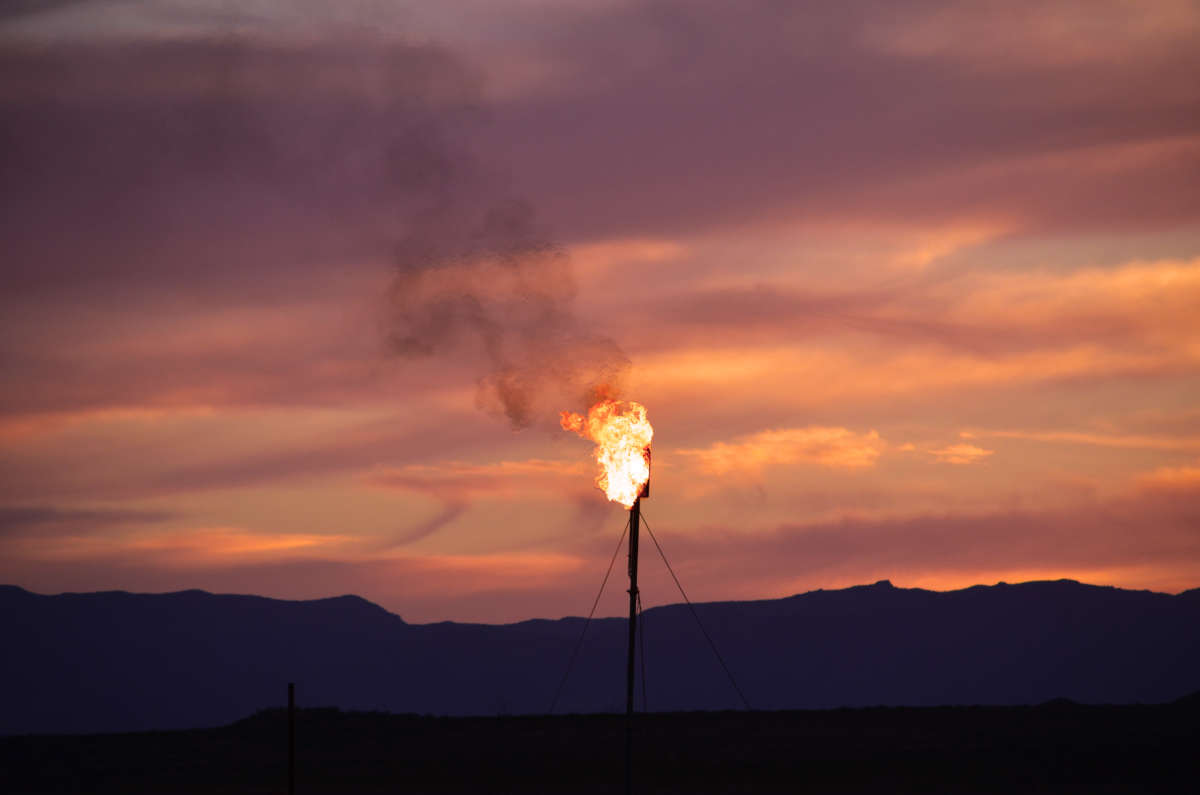
As companies such as BHP started chasing Permian crude, there wasn’t much of a plan for the gas that came up with it. Gas is difficult to store, and getting it to market requires a complex system of pipelines, compressors, and cryogenic processing plants. In the most lucrative parts of the field, including Loving County, that infrastructure was inadequate or nonexistent. With gas fetching so little that the price sometimes went negative, companies could save money by just burning it off rather than waiting for pipelines to be built. Across the region, hundreds of flares began to light up the sky each night. From space, the desert looked as bright as Albuquerque.
Even when producers could hook up to a pipeline, these lines were often congested and prone to interruptions. At BHP wells such as State Pacific, the problems were compounded by frequent breakdowns of the diesel compressors required to push gas into pipelines at about 1,000 pounds per square inch. The machines tended to fail if the temperature or system pressure rose too high. Since the sites were unmanned, outages would stretch for days. According to readings from a U.S. satellite that can spot individual flares at night, BHP burned gas frequently at State Pacific during its first three years in operation, torching off at least one-fourth of the gas produced.
Theoretically, flaring shouldn’t contribute much to the methane problem, because burning methane converts it to carbon dioxide—still a greenhouse gas, but a far less potent one. Of course, that’s only true if the flare works as intended.
Long before Zhang tallied the scale of the damage in the Permian, Sharon Wilson, an activist from Dallas, was driving across Texas with a $100,000 camera, hunting for leaks. Wilson works for the environmental advocacy group Earthworks, and her hardware makes methane show up inky black in photos.
If a satellite offers a godlike view of the region, Wilson can track individual plumes right to the source. In May, during one of her regular trips to West Texas, she was in the back of a rented GMC Yukon as an Earthworks colleague steered down a highway past freshly plowed cotton fields. In her lap, the camera, a FLIR GF320, was whirring softly, the sound of a cooling mechanism that keeps its guts colder than dry ice.
“Your faucet drips, that’s a leak,” Wilson said, her graying blond hair tucked under a baseball cap. “I hardly ever see a leak out here. I see a garden hose. A fire hose. A volcano.”
After each trip, Wilson uploads the most dramatic pictures to YouTube and emails them to state regulators—methane clouds pouring from broken valves, malfunctioning engines, and open hatches—hoping to pressure companies and government officials to clean things up.▲ Wilson scouts a flare stack releasing unburned methane along U.S. Highway 285 in Reeves County, Texas. PHOTOGRAPHER: MARK FELIX/BLOOMBERG
Wilson, 68, didn’t think much about the environment when she worked for an oil marketing company. That changed, she says, when she lived in the prairie country north of Fort Worth and saw fracking ruin the place. Now she calls company executives “gasholes” on Twitter and enjoys recounting stories of her run-ins with hostile oilfield workers, whom she always nicknames Jethro.
Some of the most common culprits Wilson has found are flare stacks. These are tall pipes crowned with burners designed to torch off unwanted gas. Wilson says they frequently malfunction—the flames go out, allowing a stream of invisible gas to jet into the air. To the naked eye, it’s impossible to tell anything’s amiss.
David Lyon had seen Wilson’s videos of misbehaving flare stacks, but he wasn’t sure what to make of them. Lyon, an Arkansas native, is the lead scientist for a massive Environmental Defense Fund research project in the Permian charting the pollution in unprecedented detail. Do flares really get snuffed out all that often, he wondered? He dispatched a contractor to fly over hundreds of randomly selected flare stacks in a helicopter to find out.
State Pacific was one of the first sites on the list. One sunny February day in 2020, the 20-foot-tall flare stack on the south end of the facility looked inert, with no flame visible. When the contractor pointed at it an infrared camera like the one Wilson uses, he saw a huge plume of black gas spewing from the stack and drifting off into the distance.▲ Natural gas flowing from an unlit flare stack at BP’s State Pacific 55-T2-8X17 well in Loving County, Texas, in February 2020. The images were captured by a helicopter surveyor hired by the Environmental Defense Fund. SOURCE: ENVIRONMENTAL DEFENSE FUND
State Pacific wasn’t the only one. Lyon found that 5% of stacks with gas flowing through them were unlit, and an additional 6% were only partially burning. If those rates are typical of the entire Permian, Lyon estimates, that alone could explain the origin of 300,000 metric tons of methane a year. “I’ll admit I was skeptical,” he says. “But then we get out there and see, yeah, it actually is that bad.”
Lyon’s work is the latest chapter in EDF’s decade-long effort to unlock the secrets of methane. In 2011, Steven Hamburg, the group’s chief scientist, took note of how cheap, abundant shale gas was reshaping the country’s energy mix, overtaking coal as the workhorse of the electric power industry. Since burning gas produces about half the carbon dioxide of burning coal, carbon emissions in the U.S. were dropping for the first time in a generation. That seemed, at first glance, like a lucky break for the environment.
But Hamburg wondered how much of that progress was an illusion. Release a ton of methane today, and over the next two decades it will warm the planet as much as about 80 tons of carbon. Only a small fraction of natural gas would have to spill from wellheads, plants, and pipelines to make it worse for the planet than coal, especially in the short term. Hamburg quizzed industry and government experts: How much was leaking? He concluded that no one really knew and that official U.S. Environmental Protection Agency estimates were little more than guesses. So in 2012, EDF undertook the biggest research project in its history. If the government wouldn’t figure out how much methane is leaking, Hamburg reasoned, let’s do it for them.
▲ Methane pouring from an unlit flare stack near a well north of Pecos, Texas.
▲ A malfunctioning flare stack along U.S. Highway 285 near Mentone, Texas.▲ COURTESY: SHARON WILSON
Six years, $18 million, and several dozen peer-reviewed papers later, Hamburg had his answer: The U.S. oil and gas industry was losing about 13 million metric tons a year, or 2.3% of gas production—60% more than the EPA was estimating. (The EPA has acknowledged that studies such as EDF’s can reveal flaws in its estimates, but it hasn’t yet adopted the group’s numbers.) That rate erases most of natural gas’s climate advantage over coal, especially in the short term, and highlights the urgency of getting methane under control. The bigger the leak, the bigger the payoff for plugging it.
With Lyon’s Permian Methane Analysis Project, EDF is moving beyond just counting molecules. The goal is to reveal whose equipment is leaking, and how much, and publish the findings to compel companies and regulators to take action. University researchers and contractors do the fieldwork, with sensor-laden vans and airplanes carrying methane detectors and stationary monitors mounted on mobile-phone towers. Think of the project as a thousand Sharon Wilsons, armed with the scientific method and more money.
“I HARDLY EVER SEE A LEAK OUT HERE. I SEE A GARDEN HOSE. A FIRE HOSE. A VOLCANO”
Lyon found his biggest spill last September. An airplane working for EDF picked up a large concentration of methane near a gas compression station south of Midland and circled back for a look. It found a huge cloud of gas jetting from a tank. EDF later calculated the size of the release at 12 tons of methane per hour. That’s about the same climate impact you would create if you started up every car in the state of Maine and left them all idling.
The plant’s owner, Targa Resources Corp., declined to comment to Bloomberg Businessweek, but it told state officials in an email that a wiring problem had caused one of the plant’s compressors to shut down. Pressure built up to dangerous levels, triggering a safety valve to release the gas. The company called it “not a foreseeable or avoidable occurrence” and said such mishaps are not uncommon across the Permian because pipelines are frequently running at capacity.
Given the scale of the Permian, the thousands of wells, tanks, flares, hatches, separators, compressors, and plants in use, unforeseeable and unavoidable things are happening all the time. “Things won’t work like they’re supposed to work on paper,” Lyon says. “It takes sometimes a while for people to realize that. There may even be disincentives for them to work. If they get bonuses based on how much oil they pump, then yeah, they’re incentivized to go as fast as possible and not worry about emissions.”▲ A full picture of methane emissions in Texas and New Mexico (pictured) remains a work in progress. PHOTOGRAPHER: MARK FELIX/BLOOMBERG
The contractor who found Lyon’s unlit flares is a 66-year-old former oilman named David Furry. Years ago, he pioneered the use of infrared cameras to find gas leaks, and he runs a small detection business catering mostly to oil and gas companies. Furry doesn’t consider himself an environmentalist, but he’s realistic about the scale of the pollution he’s documented. He estimates that about 1 in 5 sites he checks has some kind of emission.
One afternoon in May, in his office behind a shuttered gun shop in Early, Texas, Furry tucked a wad of Copenhagen Long Cut tobacco behind his lip and reflected on the future of the Permian. He’d recently gotten a call from a gas exporter wondering how much it would cost to check suppliers’ wells for leaks. That way the exporter could market “low-emissions” gas, akin to a fair-trade label on coffee.
“I was raised out there,” Furry said. “And you know, in the old days, when you had an oil spill, you’d throw a little dirt over it. Cover it up. Nowadays, things are different. But the thing about emissions is people can’t see ’em. They’re not thinking about emissions.” Furry tapped a finger to his temple. “The industry as a whole is going to have to be retrained to think emissions. And some are already starting. But not all.”
BP Plc, the former British Petroleum, has long positioned itself as more climate-conscious than its rivals, and it’s been at pains to improve its image in the U.S. since it caused a gargantuan oil spill in the Gulf of Mexico in 2010. BP acquired BHP’s assets in the Permian in 2018. When it assumed control the following year, the wells were flaring about 16% of the gas they produced, one of the highest rates in the basin. “We asked ourselves one question,” said David Lawler, the head of BP’s U.S. operations, in a blog post in April. “How can we do this differently?”https://c21a93c923e08bea58a19d366837d761.safeframe.googlesyndication.com/safeframe/1-0-38/html/container.html
Some changes came right away. BP began disclosing its flaring activity at State Pacific to the state and sought permits to flare there and at dozens of other wells—steps that BHP, like many operators in Texas, hadn’t bothered with. BHP said in a statement that it strove to limit flaring and emissions in the Permian and that it “sought appropriate permits.”
At the same time, BP began re-plumbing the operation to eliminate the need to flare. Rather than rely on those touchy machines at each well site, it started building centralized compression stations with more reliable electric motors. BP estimates that the project will cost more than $1 billion and will eventually pay for itself through the sale of gas that would otherwise be wasted. The effort has already reduced its flaring in the basin to less than 2% of production. In his blog post, Lawler said BP would end routine flaring at onshore U.S. operations completely by 2025.
Last October the company began installing devices across its Permian facilities that alert off-site employees if a flare isn’t working properly, according to Megan Baldino, a spokesperson. Such a device went in at State Pacific late last year.
While BP’s efforts in the Permian may be the most high-profile, almost every company of any size is announcing a plan to lower emissions and cut flaring. Some have renounced the practice of bringing wells online before a gas-gathering pipeline is in place and are rolling out costly monitoring programs. After testing eight technologies, Exxon Mobil Corp. said this year that it’s hiring a company that shoots lasers from an airplane to spot methane leaks.
▲ Warning signs in front of a processing plant outside Pecos, Texas. PHOTOGRAPHER: MARK FELIX/BLOOMBERG
In another era, oil producers could have safely ignored environmental critics such as Wilson and Lyon. But just a few months after the French gas deal was canceled, something even more shocking hit executive boardrooms: Exxon’s shareholders voted to replace three board members, handing a victory to critics who said the company wasn’t doing enough to prepare for a low-carbon future. Lyon talks frequently to Wall Street investors. They always ask the same question these days, he says: Who has their emissions under control, and who doesn’t?
Lyon’s answer is usually some version of “it depends.” He says the mess in the Permian can’t be blamed on a few bad actors, and for all the money EDF has spent there, it still doesn’t have a comprehensive picture. But one is coming into focus. A few weeks ago, Lyon dispatched an airplane with even fancier gear, a NASA-designed instrument that can snap pictures of methane plumes over a broad swath of the region with enough precision to identify the source. In 2022, EDF will launch its own $88 million satellite, capable of peering into oil fields around the world with hundreds of times the resolution of the Sentinel-5P.
Regulation is starting to catch up, though unevenly. While Texas hasn’t taken significant action on either flaring or methane, the New Mexico Environment Department, after consultation with EDF, is phasing in limits on both. A federal methane rule, which applied to a limited number of oil facilities, was restored this year after being gutted by the Trump administration. Now the EPA is crafting a rule that would apply to more wells.
Wilson has heard the companies’ promises, and she doesn’t buy them. She met Lyon once, at a congressional hearing in New Mexico in 2019 after he testified about how oil producers could tackle methane with frequent inspections and better equipment. “Incremental changes and all that,” she says. “I was like, ‘David, David. That shit doesn’t work. It does not work.’ ”
“AS LONG AS OIL AND GAS KEEPS EXPANDING, METHANE AND CO2 IS GOING TO GO HIGHER”
Oil companies have been promising to clean up their act for decades, she says, and in that time they just drilled more and polluted more. The only way to clean up the Permian, she says, is to stop drilling. “As long as oil and gas keeps expanding, methane and CO2 is going to go higher.”
Even taking the company pledges at face value, it’s hard to know how long they’ll last. Right now, producers are retrenching after years of frenzied drilling ended in a Covid-fueled slump. In this go-slow environment, it’s not so much of a sacrifice to try to end flaring or cut emissions. The question is what the industry will do when the next boom gets going, in the Permian or somewhere else, and there’s money to be made by moving fast. And while Wall Street is forcing large, publicly traded companies to take action on emissions, many private operators are still doing whatever they please. Some of the majors have found themselves in the curious position of calling for more aggressive regulation so their voluntary pledges don’t put them at a disadvantage.
In May, Lyon’s team published the latest findings from that network of sensors installed on mobile-phone towers throughout the basin. Methane emissions plunged in April 2020 as the pandemic put the world economy on ice. But by the end of last summer, levels were already as high as they were when the year began. The stoves in the desert had switched back on.
The plant-based meat industry is growing rapidly, and companies that have traditionally focused on fattening cows with grass, corn, soy and other crops are now trying to take beef out of the equation.
MARY LOUISE KELLY, HOST:
As environmentally conscious consumers try to reduce their carbon footprint, some are turning to fake meat as an alternative to methane-producing animals. But unlike, say, fake designer handbags or fake watches, fake meat costs way more than the real thing. Sally Herships and Darian Woods at The Indicator explore how the sausage is made – the fake sausage – to figure out why.
SALLY HERSHIPS, BYLINE: At my local Target here in Brooklyn, two Impossible Burger patties are about $11 a pound. That is about twice as much as real beef. Now, Darian, I know this is supposed to be a story about beef prices. But to understand why fake beef is so much more expensive, we are going to start with a chicken in Singapore.
DARIAN WOODS, BYLINE: I love it.
HERSHIPS: Meet Andre Menezes. One day, he was in Singapore, shopping at his grocery store for chicken.
ANDRE MENEZES: That day specifically, there was this freezer holding huge blocks of ice.
WOODS: At the time, Andre worked for one of the largest poultry exporters in the world. So it wasn’t that unusual that Andre had chicken on his mind. And he did a little price comparison.
MENEZES: A similar weight block of ice was the same price as my chicken.
HERSHIPS: Andre knew that the chicken staring up at him from the freezer had been shipped to Singapore all the way from Brazil. And he thought, how could a bag of ice be the same price as this chicken?
WOODS: You should know that Andre is an engineer, so he is really interested in efficiency. Raising chickens or any kind of livestock for meat can be really, really inefficient.
HERSHIPS: When you grow a chicken or a cow, there’s all this other stuff that consumers don’t want to buy for meat. We don’t want to eat feathers or bones or beaks. So last year, Andre left, and he co-founded his own company, TiNDLE – one that takes chicken out of the equation. Instead of feeding corn and soybeans to chickens and then selling those chickens to people, he figured he’d just skip the chicken step.
WOODS: Andre says there are a few main reasons that fake meat can be so much more expensive than the real thing. One of them is marketing.
MENEZES: No one needs to convince anyone to eat meat and that meat is good because, you know, we were born and raised – our parents are telling us that meat is good all the way.
WOODS: But plant-based meat is this whole new category, and it can be really hard to get consumers to try something new. And on top of that, veggie burgers had a bad reputation for years – like, kind of crunchy and brown, like old socks – which explains another big expense for new plant-based companies – research and development, like making protein from peas taste and look and smell like a burger.
MENEZES: So we mentioned Impossible few times. It bleeds, right? It tastes like beef. It smells like beef. It cooks like beef.
WOODS: Bloomberg says the market for plant-based meat is now exploding, and it could grow as large as $75 billion over the next decade. And if you’re thinking maybe lack of competition is keeping prices high, no. There’s a lengthy shopping list of huge corporations – Nestle, Tyson, Perdue, Smithfield, Hormel – all getting into the fake game. Andre says the big reason for the price difference is economies of scale.
MENEZES: Plant-based meats today in general – they only represent about 1.5% of the overall meat market. And that’s a huge disadvantage.
HERSHIPS: Companies are scaling up. And he says as climate change makes water more scarce and we need more sources of food, he says it’s going to drive the price of meat even higher. So a burger or a chicken nugget with the chicken or the cow taken out of the equation will just become that much cheaper.
The change comes as the world’s most populous country grapples with a demographic crisis.
A medical worker takes care of a newborn baby lying inside an incubator on February 11, 2021 in Jingzhou, China.Huang Zhigang / VCG via Getty ImagesAug. 21, 2021, 1:39 PM PDTByNicole AcevedoandThe Associated Press
China will allow married couples to legally have up to three children amid concerns that the number of working-age people in the world’s most populous country is falling too fast, consequently threatening its hopes of increased prosperity and global influence in the future.
The ceremonial legislature amended the Population and Family Planning Law on Friday as part of a decades-long effort by the ruling Communist Party to dictate the size of families in keeping with political directives.
Xinhua news agency, a Chinese state media organization, reported back in May thatthe law change had been approvedduring a Communist…
This summer, methane got a nickname that stuck. Climate scientists and policy analysts have been calling the greenhouse gas a “low-hanging fruit” for years, but the term seems to have caught on more broadly among world leaders, journalists and organizers, due in part to a major United Nations report on methane and the most dire Intergovernmental Panel on Climate Change assessment issued yet.
Methane is the second greatest contributor to the climate emergency after carbon dioxide, but unlike CO2, it only sticks around the atmosphere for about a decade. So cutting methane emissions drastically and immediately can have a sizable impact on keeping global warming below 1.5 degrees Celsius and thereby averting the most catastrophic impacts of climate change, such as global food shortage.
In total, the oil and gas industry is responsible for over one-third of methane emissions, some of which occur through flaring and venting: the practice of burning off, or releasing unwanted methane gas in the process of drilling, pumping, transporting and refining fossil fuels.
Get our free emails
Email
An August 19 report by Earthworks reveals that among the lowest of low-hanging fruits may be found in the Permian Basin, in West Texas, where up to 84 percent of producers are flaring without permits. Since fracking was commercialized a decade ago, the Permian Basin has exploded as the top oil-producing region in the U.S.
The report outlines how state regulators charged with keeping tabs on flaring, including the Railroad Commission of Texas (RRC), which issues flaring permits, and the Texas Commission on Environmental Quality (TCEQ), which oversees air quality, are doing nothing to stop producers observed to be dumping gas into the atmosphere. In other words, the Permian Basin is even more of a climate bomb — and a potential site of climate intervention — than environmentalists may have originally thought.
Texas is the top flarer of all U.S. states, according to federal data from 2019. But the practice is a problem far beyond the Lone Star State. A July study in Environmental Research Letters found that across the U.S., over half a million people live within three miles of a flare. Living near a flare is associated with 50 percent higher odds of premature birth. In addition to being a climate pollutant, methane, which seeps out of leaky flares, is also the primary precursor to the asthma-causing pollutant ground-level ozone.
Methane emissions have slid under the rug for years — in part because the gas is invisible to the human eye, but also because systems for monitoring emissions are less comprehensive and therefore more uncertain than for CO2. Sometimes, incomplete flaring leads to black smoke that is visible, also known as black carbon. But in recordings at oil and gas production sites without a special camera, you can also see a lot of sky.
The increased use of optical gas imaging (OGI) cameras in recent years has made it possible to watch dark plumes of otherwise unseen pollutants escape from inactive-looking infrastructure, like steel storage tanks and thin metal chimneys.
Sharon Wilson, a senior field advocate for Earthworks and co-author of the report on unpermitted flaring, is a certified optical gas imaging thermographer and has been busy capturing footage of oil and gas production sites around the U.S. since 2014.
It’s only when putting an OGI camera up to one’s face, Wilson told Truthout, that dark plumes of pollutants become visible, turning landscapes into what look like war zones. “If people could see with their naked eye what I see with my lens, there would never have been a fracking boom.”
According to the report, many flares are left unlit, which means they are seeping methane straight into the atmosphere, rather than burning it, which makes the release visible and at least converts the gas into less-potent carbon dioxide.
To assess flaring operations in the Permian, Wilson and co-author Jack McDonald pulled from two data sets. One was generated from Environmental Defense Fund helicopter flyovers using OGI cameras from the sky to capture flares in January, March and June of 2020. After ensuring the data was focused specifically on the area of the Permian Basin in Texas, rather than in New Mexico, the authors cross-referenced that data with permits logged in the RRC’s database.
If there was any overlap between a flare observed during flyovers and one for which a permit could be identified in the database, over any period, the authors gave the producer and regulators the benefit of the doubt, and counted that site as permitted. But ultimately, of the total 227 flares they ended up counting, a mere 35 sites had permits to flare every time they were observed to be doing so. Many companies were found to be flaring without ever obtaining a permit, including Diamondback Energy, Conoco and Shell.
In Texas, flaring permits are governed by a state administrative law known as Rule 32. Under the rule, flaring is only legal for the first 10 days of a new oil and gas operation. After that, the practice is illegal without a permit, except for during 24-hour emergency periods. But the law does not clearly define what conditions oil and gas companies need to justify a permit or emergency exemption.
As such, the operations that have received permits have essentially been rubber-stamped, the report suggests. Operators have applied for and received permits to flare for a host of nebulous reasons such as “inconsistent curtailments” or “economic conditions.” Still, the vast majority are unpermitted, the report suggests.
Earthworks visited one site known as the “Seattle Slew” 14 times with an optical gas camera, as is described in the report, and detected pollution every time — nine of which involved flaring specifically. The owner of the site, MDC, has never been issued a permit from the RRC, according to the analysis. Earthworks reported as much to the TCEQ.
According to correspondence Earthworks obtained via a public records request, the state agency did reach out to the company about the findings. “There is no way to estimate how much gas was vented, as we don’t measure our tank gas … since it isn’t sold to gas sales but instead sent to the combustor for incineration,” MDC replied. “Also, we don’t know for how long this gas was vented to the atmosphere.”
In spite of this response, the state agency did not issue any violations, Earthworks found. A TCEQ representative told Truthout that “compliance determinations were made based on a review of the completed questionnaires and other relevant data such as reported emission events and applicable permits or authorizations,” noting that the facility did have a permit covering other emissions, including volatile organic compounds, nitrous oxide and carbon.
Wilson says she’s documented numerous similar instances in which she’s reported emissions violations on the ground, such as at Diamondback’s Waler State Battery site, which regulators have all but shrugged off.
In response to the report, RRC Spokesperson Andrew Keese told Reuters, “A short-term observation of a flare from a flyover and absence of an explicit exception does not necessarily mean the observed flaring is illegal.”
In July, the RRC published data suggesting that the practice of flaring was declining across the state, dropping from 2.29 percent of all natural gas produced in June 2019, to 0.65 percent in May 2021. “Texas is seeing significantly reduced flaring rates as a result of improved technologies, infrastructure and regulatory processes,” RRC Chair Christi Craddick said in a statement.
McDonald, however, said that dealings with the two state agencies do not offer much assurance. “From what we can tell, this seems to be an issue broadly across Texas, with just this kind of systemic lack of will to go and get these permits.”
Without closely monitoring releases, or following up on violations, the agency’s data is a moot point. “Even if they are right that exempt flaring is exclusively the cause of the flaring, the RRC does not know how much flaring is happening,” McDonald said. “That means they are dramatically underestimating the amount of flaring that’s actually happening in the state because they aren’t able to account for all those exempt flares.”
As Clean Energy Wire has reported, oil and gas production in places like the Permian has expanded faster than infrastructure to transport it. Oil is still profitable, but gas prices are so low that it’s cheaper to burn it on the spot, or release it directly, than to pay to send it to markets.
The report concludes with a handful of actions state lawmakers and regulators could take to bring protocols in line with the regulatory agencies’ purported missions, including making all permitting data and enforcement actions publicly available online; updating Rule 32 such that it clearly identifies what justifications warrant a flaring permit or an emergency exemption; and creating an impartial panel free of oil and gas interests within the RRC to review all flaring permits.
But Wilson says real reform will also require action beyond state lines. “After over a decade, it’s pretty clear that Texas has no intention of enforcing any rules,” Wilson said, noting lawmakers’ and regulators’ conflicts of interest. The RRC’s Craddick, for instance, owns land with her father — a state congressman — that generated over $100,000 from natural gas production in 2019, according to TheTexas Tribune.
The Biden administration is likely to unveil a new methane rule in September. In anticipation, the RRC and TCEQ penned a letter to the Environmental Protection Agency (EPA) in July requesting minimal changes. “The TCEQ has a robust air permitting program. Air permits typically include fugitive monitoring programs and control of volatile organic compound emissions, which could include methane emissions since methane is not separated from [volatile organic compounds] prior to atmospheric release,” agency directors wrote. “Additional requirements to control and monitor methane specifically are burdensome to the regulated community, duplicative and are therefore unnecessary.”
Given that the EPA delegates how states must implement Clean Air Act regulations, Wilson says the moment warrants the strongest possible rule, such as one that would lead to slashing oil and gas methane emissions 65 percent by 2025. “If Biden is serious about taking action on the climate, the federal government will need to step in,” she said. “What they give, they can take away.”
Updated 4:02 AM ET, Sat August 21, 2021An aerial view of damage in the Bahamas from Hurricane Dorian on September 5, 2019.
(CNN)In the same week that Tropical Storm Fred caused catastrophic flooding in North Carolina, and Hurricane Grace made its second landfall in Mexico, Hurricane Henri is barreling toward New England, where it’s expected to be the first to make landfall there in 30 years.Hurricanes — also called tropical cyclones or typhoons outside North America — are enormous heat engines of wind and rain that feed on warm ocean water and moist air. And scientists say the climate crisis is making them more potent.The proportion of high-intensity hurricanes has increased due to warmer global temperatures, according to a UN climate report released earlier this month. Scientists have also found that the storms are more likely to stall and lead to devastating rainfall and they last longer after making landfall.
Interactive: Hurricanes are becoming more dangerous. Here’s why“We have good confidence that greenhouse warming increases the maximum wind intensity that tropical cyclones can achieve,” Jim Kossin, senior scientist with the Climate Service, an organization that provides climate risk modeling and analytics to governments and businesses, told CNN. “This, in turn, allows for the strongest hurricanes — which are the ones that create the most risk by far — to become even stronger.”
Scientists like Kossin have observed that, globally, a larger percentage of storms are reaching the highest categories — 3, 4 and 5 — in recent decades, a trend that’s expected to continue as global average temperature increases. They are also shifting closer to the poles, moving more slowly across land, growing wetter, and stalling in one location, Kossin found.
“There’s evidence that tropical cyclones are more likely to stall,” said Kossin, naming hurricanes Harvey, in 2017, Florence, in 2018, and Dorian, in 2019, as examples. Hurricane Harvey dumped more than 60 inches of rain on some parts of Texas, causing about $125 billion in damages, according to the National Hurricane Center, and killing more than 100 people.Evacuees wade down a submerged section of Interstate 610 in Houston after Hurricane Harvey in 2017 caused widespread flooding.”All of these were devastating to the places where they stalled,” he added. “The combination of slower movement and more rain falling out of them increases coastal and inland flooding risk tremendously.”
A 2020 study published in the journal Nature also found storms are moving farther inland than they did five decades ago. Hurricanes, which are fueled by warm ocean water, typically weaken after moving over land, but in recent years they have been raging longer after landfall. The study concludes that warmer sea surface temperatures are leading to a “slower decay” by increasing moisture that a hurricane carries.Enter your email to sign up for the Wonder Theory newsletter.close dialog
Want to stay updated on the latest space and science news?We’ve got you.Sign Me UpBy subscribing you agree to ourprivacy policy.And as storms like Henri makes landfall, torrential rain, damaging winds and storm surge become the most significant, often pernicious, threats. Storm surge, produced by wind blowing ocean water onshore is also expected to get worse over time due to stronger hurricane winds and climate change-fueled sea level rise, according to Kerry Emanuel, a professor of atmospheric science at the Massachusetts Institute of Technology.”It’s a very dangerous phenomenon,” he said. “And it’s responsible for a lot of the loss of life in the storms.”
Last year, the Trump administration announced that thegray wolfwould be removed from the list of animals protected by the Endangered Species Act. Before gray wolves were protected by the act, the species was considered near extinction after a combination of hunting, trapping, and loss of habitat decimated its numbers.
The Biden administration is now moving to uphold that decision, according tocourtdocuments filed Friday, despite concern from conservationists that it couldjeopardizethe recovery of the species.
Attorneys for the administration requested that a federal judge throw out a lawsuit from wildlife advocates that aims to restore Endangered Species Act protections for the animals, arguing that Trump’s 2020 rule, implemented by the U.S. Fish and Wildlife Service, “follows the law and is supported by the administrative record.”https://www.cbsnews.com/newsletters/widget/e879?v=cbfb55a18595c6934ce492132bcc0bc8&view=compact#tVPLbtswEPwVgmczlmS9bylSoLkUAZKe6iLgY5UQkUiBpKwaQf69S1lO3FyLXgx5d%2FYxs8NXasegrfG0faUgrQLaUqirhm7oQcOM%2F6QdRi4DBkbrdQRj8Np7COSLVUf6tqHBcfmizVNsov1Xw0UPirbBTbCh3AUte7iewrN1txj%2BSZXK8kwJYKLMgeVQKVZz0bC8K0tIswKarqS%2FPpV%2B5wPEYt7Db26U46TnDqdeAGN3KquSV7tOsrwpOf40ORNZXrIiLdM6rctyVyj6XnI3iRseIussyVKW1CxLSZK1WdYmxQfsQYc%2BgoRWYAhXgzbaI%2B0oBxHI3hMwigRLnhw%2Fktn2HXmeTEBRyOhsALmovCEK%2FKgDEGmNBGc86ZwdCOqrD9jQX0w8jrCobwKY8LhGMa%2FgoOU5je1egh0xrP0NHCKNeCj%2BdAYYmP0jDhwwjNeDbxpcVHHyUbcYuT%2FthtjJr6C11uGuuLQ%2BAJlBYA4nabmI3FWJgnonUFroWJpCxviuS1iSNWla52ldFc254HS4U%2FfJg1u7c4NDN7TXgw60zd%2BJ39vJyYW68CSujyDh8OJ3PQ%2BddcPpysIv1OK6jx8qePSwUdwdH%2BJkH5l6qQG1Xuj%2Blb1VS77aJUm1w9uLLEULNuhI0fGGdVXa1F3WiKIozlqtVNbhkSDwXk9DND6eudP9RToWIARMPAtmVXwqMtLWkvc%2FXI%2Fh5xBG3%2B63%2B%2B08z1dr4RU%2Buf02fu23i%2BFY9BNb%2FcQu%2FMSkwxcptR%2FYu4X229UB%2F3%2FCKsc%2FdXp7%2BwM%3D
The U.S. Forest Service announced Thursday that beginning on Aug. 22 it will close nine national forests from near Lake Tahoe at the Nevada border on the east all the way west to Six Rivers National Forest, which stretches north to the Oregon border and contains more than 1 million acres of land alone.
The Eldorado National Forest already had been closed because of the Caldor Fire, which gutted the Sierra Nevada town…
August 20, 2021Wisconsin’s February 2021 wolf hunt was the second-deadliest in the state’s history, with at least 218 wolves killed in less than three days, nearly double the quota allotment. John Pitcher/iStock.comIn every state where we’re working to protect wolves from trophy hunters and trappers, the political nature of the fight is obvious. But the tragic impacts of political gamesmanship involving wolves are especially evident in the controversy surrounding Wisconsin Natural Resources Board chair Frederick Prehn’s refusal to vacate his board seat after the expiration of his term on May 1. Wisconsin’s February 2021 wolf hunt was the second-deadliest in the state’s history, with at least 218 wolves killed in less than three days, nearly double the quota allotment. Prehn has admitted that his refusal to step down was partly rooted in his desire to influence the fall wolf hunting season



 An aerial view of damage in the Bahamas from Hurricane Dorian on September 5, 2019.
 Evacuees wade down a submerged section of Interstate 610 in Houston after Hurricane Harvey in 2017 caused widespread flooding.”All of these were devastating to the places where they stalled,” he added. “The combination of slower movement and more rain falling out of them increases coastal and inland flooding risk tremendously.”