Greenland mass ice-melting event is latest worrisome sign of climate crisis
David Knowles·Senior EditorThu, August 5, 2021, 1:29 PM·3 min read
In recent days, Greenland’s massive ice sheet has been melting at twice its average summer rate, shedding enough water to cover the entire state of Florida with 5 inches of water, research from Danish scientists shows.
Greenland’s ice sheet covers just over 660,000 square miles and is 5,000 feet thick in places, but since July 27 it has lost 9.37 billion tons of ice due to rising surface and water temperatures in the Arctic and a recent heat wave that sent temperatures close to 70 degrees.
Rivers of meltwater carve into the Greenland ice sheet near the Sermeq Avangnardleq glacier in western Greenland in August 2019. (Sean Gallup/Getty Images)
“This ice melt is accelerating and it’s going to be unbelievable over the next decade or two,” Harold Wanless, professor of geography and urban sustainability at the University of Miami, told Yahoo News. “We’re just at the beginning.”
Wanless, who has spent nearly six decades studying the geological impacts of rising seas on global coastlines since the last ice age, noted that mass melting events have been occurring with greater frequency over the past 20 years.
“In 2012, when Greenland had their first dramatic melt across the whole ice sheet, it was unexpected,” he said. “That wasn’t in the models for decades to have anything like that. Now that has become pretty commonplace.”
The Greenland ice sheet. (Martin Zwick/REDA&CO/Universal Images Group via Getty Images)
In the summer of 2013, Wanless traveled to Greenland and was shocked by what he saw.
“The top of the ice sheet was amazing. The top 3 feet of it was soft with vertical holes where the water was melting down through this ice,” he said. “I had a friend who went further onto the ice sheet with a military group and they got out of their helicopters and were halfway to their knees in slush. That’s just a very unhealthy ice sheet.”
While summer melting of Arctic ice is not new, warmer ocean water has sped up the rate. A recent study found that while the Earth lost an average of 760 billion tons of ice in the 1990s, that rate grew to more than 1.2 trillion tons in the 2010s.
“When you’re in a warming climate and the presence of ice, you have these pulses of rapid collapse of ice and that’s what we have to look forward to,” Wanless said. “We just started melting ice in about 1990, and we’re seeing this rapidly accelerate in both polar areas.”
A shutdown would have devastating global impacts and must not be allowed to happen, researchers sayDamian CarringtonEnvironment editor@dpcarringtonThu 5 Aug 2021 11.08 EDT
Such an event would have catastrophic consequences around the world, severely disrupting the rains that billions of people depend on for food in India, South America and West Africa; increasing storms and lowering temperatures in Europe; and pushing up the…
Published Thu, Aug 5 2021 3:52 PM EDTCory Stieg@CORYSTIEGShareWASHINGTON, DC – JULY 20: Dr. Anthony Fauci, Director of the National Institute of Allergy and Infectious Diseases, arrives to testify before the Senate Health, Education, Labor, and Pensions Committee at the Dirksen Senate Office Building on July 20, 2021 in Washington, DC. (Photo by Stefani Reynolds-Pool/Getty Images)Pool | Getty Images News | Getty Images
Dr. Anthony Fauci has a sobering prediction: “Things are going to get worse.”
The White House chief medical advisor made those remarks amid rising Covid cases nationwide, due largely to the virus’s newly dominant and more transmissible delta variant, during an interview with ABC’s “This Week” on Sunday. Though it’s tough to imagine a situation more dire than the country’s current surge, “we’re looking to some pain and suffering in the future because we’re seeing the cases go up,” Fauci said.https://25d11482c429ca9bf185a95aef4b5016.safeframe.googlesyndication.com/safeframe/1-0-38/html/container.html?n=0
The Covid pandemic brought tourism to a near-halt in Alaska last year. What will happen to the majestic humpback whale when cruise ships and visitors return in August?
Christine Gabriele sat at her desk at the Glacier Bay National Park headquarters in Gustavus, Alaska, and turned up the volume on her computer.
The sound of gurgling and bubbling water enveloped the room. The lull was occasionally punctuated by the hollow roar of a male harbour seal, seeking to impress potential mates.
Gabriele’s computer is at the end of a five-mile underwater cable that stretches into the frigid waters of the bay, a national preserve teeming with fish, birds, sea otters, dolphins, lovelorn seals and the area’s feature attraction – several hundred humpback whales, who migrate to Alaska from the waters around Hawaii during summer months.
What has been notable for the past 18 months was what she hadn’t heard nearly as much of – ships.
The Covid-19 pandemic brought all of that to a sudden halt. In 2019, more than 1.3 million people visited Alaska on cruise ships. In 2020, there were 48 – not even enough to fill a New York City subway car.
Overall marine traffic in Glacier Bay declined roughly 40%.
It takes about a dozen minutes of listening to the soothing hydrophone audio on a Thursday morning in late May to hear traces of human activity – in this case, the high-pitched whine of a small boat’s propeller.
According to research by Gabriele and Cornell University Professor Michelle Fournet, the level of manmade sound in Glacier Bay last year dropped sharply from 2018 levels, particularly at the lower frequencies generated by the massive cruise ship engines. Peak sound levels were down nearly half.
All this afforded researchers an unprecedented opportunity to study whale behaviour in the kind of quiet environment that hasn’t existed in the area for more than century.
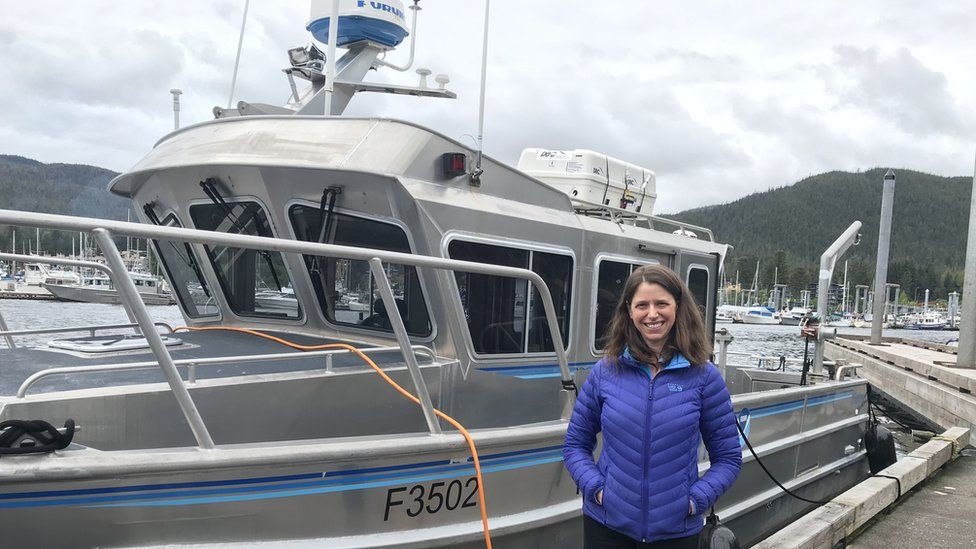
By analysing hydrophone data, and taking a small park service boat into Glacier Bay three times a week to photograph and identify whales, Gabriele has already noted changes.
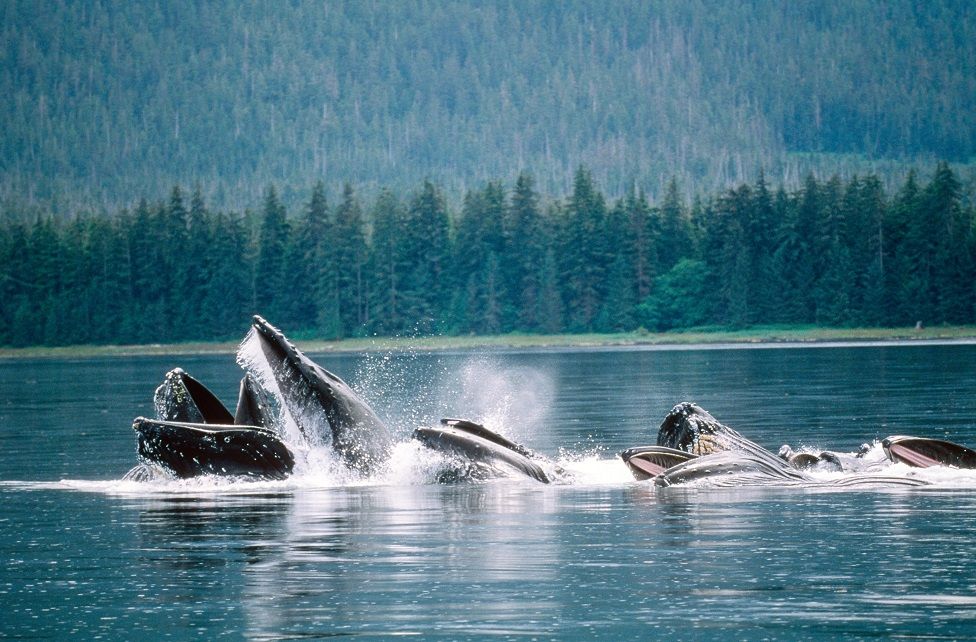
She compared whale activity in pre-pandemic times to human behaviour in a crowded bar. They talk louder, they stay closer together, and they keep the conversation simple.
Now, the humpbacks seem to be spreading out across larger swathes of the bay. Whales can hear each other over about 2.3km (1.4 miles), compared with pre-pandemic distances closer to 200m (650ft). That has allowed mothers to leave their calves to play while they swim out to feed. Some have been observed taking naps. And whale songs – the ghostly whoops and pops by which the creatures communicate – have become more varied.
image captionPre-pandemic, whales stayed close together
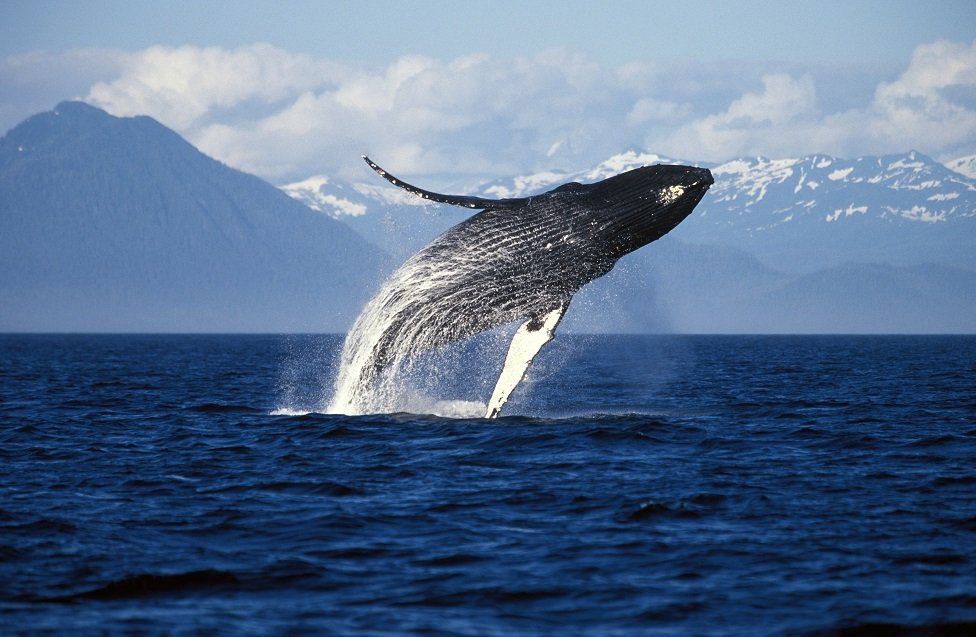
Out in the middle of Glacier Bay on a park service boat, it was easy to see why the area is such a tourist attraction. The jade-green water is surrounded on three sides by sheer cliffs, glacier-fed waterfalls and snow-capped peaks. The humpback whales themselves are majestic. They spray mist with an audible rush as they surface to breathe, then display their enormous triangular tails – each as unique as a fingerprint – before returning to the depths.
If visitors are lucky, they can witness a breach – a whale leaping out of the water in a remarkable display of cetacean acrobatics, before crashing back into the water. Only then is the creature’s remarkable size truly appreciable.
All this can be viewed from smaller whale boats or the luxurious cruise ships, where passengers dine on lavish meals as their floating hotels ply the deep waters of the bay right up to the edge of massive glaciers.
Gabriele acknowledged that the Covid lull in tourism was only temporary. She said she hoped her research – and long-standing efforts to regulate the ship traffic in Glacier Bay – will allow a balance to be struck between the environment and the human desire to witness, and be inspired by, nature’s grandeur.
If the whales were enjoying the relative calm and quiet, they were not the only ones.
“It used to be that you could just step outside your door and you were in quiet in nature,” said Karla Hart. But the tourism industry has put an end to that idyll.
Hart lives in Juneau, the state capital and de facto capital of the Alaskan cruise ship industry, about 50 miles from Glacier Bay as the seaplane flies.
During a typical tourist season – when cruise ships pull into port and disembark tens of thousands of passengers – sightseeing helicopters crossing over her house make conversations in her own home difficult. The lockdowns, she said, gave people a taste of what Juneau could be like.
“The giant pause that we had because of the pandemic really gave an opportunity for people to rethink what we have and what we need and want,” she said.
With tourism activity suspended in 2020, Hart and a few friends thought it would be a good time to gather signatures for ballot measures that would limit the days, times and sizes of cruise ships that could stop in Juneau when the pandemic subsides. That would mean quieter times in Juneau and in the whale-inhabited waters that surround it.
They called their effort “Cruise Control”.
image captionThere are around 70 craft in Juneau, and at peak operations they can carry as many as 100 passengers each
Hart’s efforts provoked a quick and forceful response from Juneau’s business community, which depends heavily on the money that tourist-laden cruise ships bring to the town.
Posters with the slogan “Protect Juneau’s Future”, urging residents not to sign the petitions, popped up in stores. They were plastered on walls and tucked in pizza delivery boxes. Employees at local shops were told by their managers that the proposals threatened their jobs, said Hart, and warned not to support them.
The business owners saw it differently – particularly given the timing of the effort, when shops and restaurants were shutting because of a lack of tourist dollars.
“These are people that should be supporting us, trying to lift us out of the hardest 15 months of my entire life,” said Laura Martinson, who owns Caribou Crossings, a gift shop across from Juneau’s cruise ship terminal. “Everyone should have a fair shot of being successful in their community, not just the people that have already done it and are retired and a little bit inconvenienced by the rest of us.”
In the end, Hart’s petition drive failed – she wouldn’t disclose by how many signatures she came up short – leaving Martinson and the rest of the Juneau business community hopeful that the return of the cruise ships will be their financial lifeline.
If the benefits – and hidden costs – of the cruise ship industry have been a source of contention and concern in Juneau, there has been rare unanimity on the other side of America.
At the US Capitol, Democrats and Republicans brokered a deal in May to allow foreign-flagged cruise ships to travel directly from Seattle to Alaska without a previously required stop in Canada, whose ports have been closed because of Covid restrictions.
When President Joe Biden signed the Alaska Tourism Restoration Act at a closed White House ceremony, Press Secretary Jen Psaki heralded it as an example of the “critical bipartisan work” Congress can do.
“The legislation is a positive in our view because it helps reinvigorate an industry that accounts for a great number of jobs in Alaska – jobs that have been on hold for the past year plus,” she said.
The move was one of the few bipartisan accomplishments of the early months of the Biden administration
Speaking to the BBC in Anchorage, Alaska Senator Dan Sullivan dismissed concerns from environmentalist groups about the cruise industry.
“They want this state to turn into a giant national park.” the Republican said. “We are always trying to balance environmental safeguards with the opportunity to grow our economy and employ our citizens – and it’s a balance we’re quite good at.”
With the legal hurdles out of the way, the major cruise ship lines have just started returning to Southeast Alaska for a shortened 2021 schedule. The first Royal Caribbean liner, the 2,580-passenger Serenade of the Sea, arrived in July. Holland America, Celebrity, Princess, Norwegian and Carnival are all scheduled for the weeks ahead – totalling tens of thousands of arriving tourists for the month of August.
Martinson, the Juneau gift shop owner, was planning how many balloons to put out for cruise visitors. For other businesses, the abbreviated tourist season may not be enough.
Holly Johnson owns a seaplane company that flies cruise visitors from downtown Juneau to a lodge near a massive glacier field. On a normal summer, she runs nine flights of 50 people each day. This year, she decided insurance costs and the risks of weather cancellations were too great to operate on an abbreviated schedule.
She says she’ll be back next year – but the shutdown will haunt her until then.
“Our economy was gone, our business that supports a year’s worth of employees and revenues was gone,” she said. “It was unimaginable.”
The whale watching boats will make a faster return. There are currently around 70 craft in Juneau, and at peak operations they can carry as many as 100 passengers each, with 10 to 15 boats gathering around a whale or whale group at any one time.
Although vessels are restricted from approaching to within 100 yards of the whales, the sheer number on the water means the humpbacks sometimes get closer. And additional, voluntary restrictions are just that – voluntary.
image captionPearson has been looking into the health of whales in Juneau
“It’s the classic tragedy of the commons,” says Heidi Pearson, a professor of marine biology at the University of Alaska Southeast, a few miles from Juneau. “I don’t want to deny anyone the chance to see a humpback whale, but I think it needs to be done carefully and sustainably.”
Pearson is conducting her own research into the health of whales around Juneau before, during and after the Covid-19 cruise pause. She is sampling and analysing the amount of the stress-induced chemical cortisol in their blood.
She plans to report her whale-stress findings in December, when they could serve as another data point to accompany Gabriele’s research into the Alaska marine sound environment. It has the potential of providing tangible evidence on the impact tourism has on whales – and, perhaps, a warning of the threat human activity may have on some of the largest mammals in the world.
“Tourism is important to Juneau’s economy, and we love to share this place with others,” she said. But, “it’s not good for anyone – the whales or the whale watching companies or the conservationists – if the whales feel too much pressure and they leave”.
By Frederik Pleitgen, Claudia Otto and Ramin Mostaghim, CNN Updated 1:32 PM EDT, Thu August 05, 2021
Tehran, Iran(CNN)Ebrahim Raisiwas inaugurated asIran’s next presidenton Thursday, signaling the start of a new harder-line era that could herald major shifts in the Islamic Republic’s policies at home and abroad.
After eight years of Hassan Rouhani’s moderate administration, Iran now turns to Raisi, an ultra-conservative judiciary chief whose views are fully in line with the thinking of the country’s powerful clergy andSupreme Leader Ayatollah Ali Khamenei, the final say on all major matters of state.
Raisi’s inauguration comes at a pivotal time, with Iran currently in indirect negotiations with the United States over how to revive the 2015 nuclear agreement. Raisi will also face the task of reviving his country’s economy, which has been battered in recent years by the previous US administration’s “maximum pressure” campaign…
The killing of red wolf 11768f was the beginning of the bad times for this country’s most critically endangered canid. It was mid-2015, and 11768F was a six-year-old matriarch with a mate and a large family. She’d already given birth several times before, and the evidence suggests she may have been caring for more newborns in the wet coastal forests that flourish near North Carolina’s Outer Banks. She and her family were supposed to be safe, thanks to the strong protections of the Endangered Species Act, which makes it a crime to harm or harass listed animals like red wolves. But then, in a foreshadowing of events to follow, the federal government issued her death warrant: It gave…
A heat wave in 2020 revealed a new source of methane emissions from the Arctic that could be “much more dangerous” than previously believed, according to a new German study.
The study, conducted by three geologists, found that a heat wave observed in 2020 unveiled a source of methane emissions “potentially in much higher amounts” from rock formations thawing in the Arctic permafrost.
According to The Washington Post, scientists have long been concerned about “the methane bomb,” a potentially disastrous amount of methane released from thawing wetlands in Siberia’s permafrost. The methane released from the wetlands is “microbial” and stems from the decay of soil and organic matter.
The methane emissions from the rock formations, however, come from thawing limestone that releases gases from below the permafrost that are “much more dangerous” than what was previously believed.
Permafrost typically traps methane, but as global temperatures rise, the permafrost melts and more of these trapped gases are released into the atmosphere.
Nikolaus Froitzheim, one of the scientists who conducted the study and a professor at the Institute of Geosciences at Germany’s University of Bonn, explained that he and two colleagues observed two “conspicuous elongated areas” of limestone in the Taymyr Peninsula around northern Siberia.
“We would have expected elevated methane in areas with wetlands,” Froitzheim said. “But these were not over wetlands but on limestone outcrops. There is very little soil in these. It was really a surprising signal from hard rock, not wetlands.”
Currently, the largest sources of methane that aren’t trapped in permafrost come from agriculture and leaks from hydraulic fracturing, according to the paper. But the revelation of a new source of methane is troubling —Froitzheim pointed out that it is unknown how much methane is to be expected from the limestone formations.
“The question is: how much will come, and we don’t really know,” Froitzheim said.
A heat wave in 2020 revealed a new source of methane emissions from the Arctic that could be “much more dangerous” than previously believed, according to a new German study.
The study, conducted by three geologists, found thata heat wave observed in 2020 unveiled a source of methane emissions“potentially in much higher amounts” from rock formations thawing in the Arctic permafrost.
According toThe Washington Post, scientistshave long been concerned about“the methane bomb,” a potentially disastrous amount of methane released from thawing wetlands in Siberia’s permafrost. The methane released from the wetlands is “microbial” and stems from the decay of soil and organic matter.
The methane emissions from the rock formations, however, come from thawing limestone that releases gases from below the permafrost that are “much more dangerous” than what was previously believed.


 WASHINGTON, DC – JULY 20: Dr. Anthony Fauci, Director of the National Institute of Allergy and Infectious Diseases, arrives to testify before the Senate Health, Education, Labor, and Pensions Committee at the Dirksen Senate Office Building on July 20, 2021 in Washington, DC. (Photo by Stefani Reynolds-Pool/Getty Images)Pool | Getty Images News | Getty Images