A federal judge has blocked a project in Nevada that would expand livestock grazing across 400 square miles of some of the highest priority sage-grouse habitat in the West.
US Judge Blocks Nevada Grazing; Sage Grouse Totals DwindlingMore
FILE – In this April 20, 2013, file photo, male greater sage grouse perform mating rituals for a female grouse, not pictured, on a lake outside Walden, Colo. A federal judge has blocked a Nevada project that would expand livestock grazing across 400 squares miles (1,036 square kilometers), of some of the highest priority sage-grouse habitat in the West and accused the government of deliberately misleading the public by underestimating damage the cattle could do to the land. (AP Photo/David Zalubowski, File)THE ASSOCIATED PRESS
Gas stovetops have become a proxy battleground for the future of the planet. Some cities are trying to cut down their greenhouse gas emissions by getting rid of gas hookups in new construction. But the natural gas industry isn’t going down without a fight.
Pro-gasmarketing campaignshave most successfully waged its war in the kitchen, promoting gas stoves as superior to electric ranges. That’s made it more difficult for cities like Seattle to pass mandates that would limit the use of gas in homes and buildings. What’s at stake in this fight is cities’ ability to cut down their greenhouse gas emissions.
Further complicating things, the gas industry has, for decades…
Updated 10:51 AM ET, Thu April 1, 2021Most of the X-ray activity was likely caused by the sun but the cause of some remains unexplained.
(CNN)Uranus is emitting X-rays, and scientists want to take a closer look.That’s the mysterious conclusion of a new study, which analyzed two visuals of the planet and discovered X-ray activity for the first time.Astronomers looked at snapshots of the planet taken by NASA’s Chandra Observatory in 2002 and 2017, noticing a clear detection of X-rays in the first observation and a possible flare in the second.The most likely cause for most of those X-rays is the sun; it is already known that both Jupiter and Saturn scatter X-ray light given off by the sun, and the research suggests Uranus does the same.But not all of the activity can be explained, and NASA has called for scientists to look…
Published April 01, 2021 2:25PMhttps://platform.twitter.com/widgets/tweet_button.0edc1ef9f8b82d9b79c6115bda79f63f.en.html#dnt=false&id=twitter-widget-1&lang=en&original_referer=http%3A%2F%2Fwww.gisborneherald.co.nz%2Flocal-news%2F20210401%2Fcall-for-hunters-to-put-safety-first-this-easter%2F&size=m&text=Call%20for%20hunters%20to%20put%20safety%20first%20this%20Easter%20%E2%80%93%20The%20Gisborne%20Herald&time=1617305725188&type=share&url=http%3A%2F%2Fwww.gisborneherald.co.nz%2Flocal-news%2F20210401%2Fcall-for-hunters-to-put-safety-first-this-easter%2Fhttps://www.facebook.com/plugins/share_button.php?app_id=&channel=https%3A%2F%2Fstaticxx.facebook.com%2Fx%2Fconnect%2Fxd_arbiter%2F%3Fversion%3D46%23cb%3Df221b29270835d%26domain%3Dwww.gisborneherald.co.nz%26origin%3Dhttp%253A%252F%252Fwww.gisborneherald.co.nz%252Ff9560ffe5caaac%26relation%3Dparent.parent&container_width=0&href=http%3A%2F%2Fwww.gisborneherald.co.nz%2Flocal-news%2F20210401%2Fcall-for-hunters-to-put-safety-first-this-easter%2F&layout=button_count&locale=en_US&sdk=joey
Deer hunters are being urged to take care during the peak of the roar this Easter weekend, when the spike in hunting activity leads to an increase in injuries.
Last year’s roar hunt was cancelled due to the Covid-19 Level 4 lockdown, and it’s predicted more hunters than ever will head to the hills this autumn chasing stags.
Department of Conservation (DoC) visitor safety manager Andy Roberts says each year during the roar there is a spike in hunting accidents, such as slips, trips, falls or firearm injuries.
Accident Compensation Corporation data show there were 435 hunting-related injury claims during the last roar in 2019 (March and April), up 31 percent on the same period in 2018.
“Because hunters haven’t been able to enjoy the roar for two years, we’re expecting to see a large number of people hunting on public conservation land over…
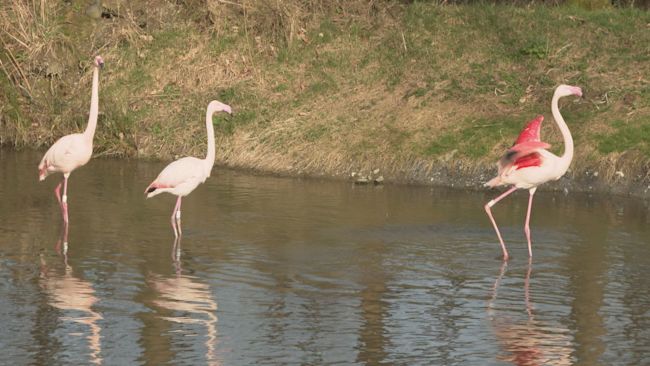
A flock of flamingos at a zoo in Cumbria have had their first taste of freedom after being kept inside for four months.
The 37 ‘Greater Flamingos’ at the Lake District Wildlife Park near Bassenthwaite were released after being cooped up since November, because of the threat of bird flu.
Since December last year, poultry keepers have been asked to keep their birds indoors to protect them against the virus, after a cases emerged across the UK.
The flamingos were allowed out of their indoor enclosure on Thursday morning, with one excited bird paving the way for others to join him in the park’s pond for the first bath in months.
Head keeper Richard Robinson said: “It’s fantastic. As part of my job I have the daily care of the flamingos.
“Having them shut in since mid-November, it was time they came out so thankfully, with the easing of the restrictions for the avian influenza, we were able to let them out today and it’s fantastic seeing them enjoy a bit of blue sky.”
The park is now gearing up to re-open to visitors later this month.
by: Molly Jirasek, Nexstar Media WirePosted: Apr 1, 2021 / 06:42 AM EDT / Updated: Apr 1, 2021 / 06:42 AM EDT
Photo provided by: U.S. Customs and Border Protection
NEW YORK (NewsNation Now) — A man from Guyana did not make it past John F. Kennedy (JFK) International Airport Sunday after 29 live finches were found in his baggage. The birds were hidden inside some colorful hair rollers.
Photo provided by: U.S. Customs and Border Protection
The 26-year-old was traveling from Georgetown, Guyana to New Jersey when U.S. Customs and Border Protection (CBP) discovered the finches during a secondary baggage examination. In a news release, CBP said he was not criminally charged, but will have to pay a $300 civil penalty. He was put on a plane back to Guyana, Monday.
The finches were quarantined and put in the care of the U.S. Department of Agriculture Veterinary Services.
Photo provided by: U.S. Customs and Border Protection
The reason federal agencies take swift action in situations like this is because of the risk of introducing the bird flu into the U.S. poultry industry.
The industry was dealt a big blow during a 2015 outbreak of Highly Pathogenic Avian Influenza (HPAI). According to the United States Department of Agriculture, more than 50 million chickens and turkeys in the U.S. died or were intentionally killed to stop the spread of the disease. They said that is about 12% of the country’s egg-laying population and 8% of the estimated turkeys raised for meat. As for the economic impact, losses were estimated at more than $1 billion.
CBP said during a regular day in 2020, they seized 3,091 prohibited plant, meat, animal byproducts, and soil, and intercepted 250 insect pests at U.S. ports of entry nationwide.
NewsNation reached out to CBP to ask why the man attempted to sneak the birds into the U.S. CBP could not say why the birds were being brought into the country, but previous news reports indicate finches have been smuggled and sold for bird singing competitions.
Photo provided by: U.S. Customs and Border Protection
On Monday, a federal judge in the District of Columbia ruled that the U.S. Fish and Wildlife Service can no longer withhold critical data on U.S. imports of hunting trophies and other wildlife parts and products from the public.Photo by Bill Gozansky/Alamy1.3KSHARES
Animals are on a winning streak. Over just the last two days, we’ve had four terrific victories in U.S. federal courts that pave the way for progress for millions of animals. These include wildlife in the United States and overseas most often targeted by trophy hunters, animals in the fur industry, and farm animals confined in cruel cages on factory farms.
These wins are important. Many of them confront policies made by federal and state agencies that are harmful to animals and the environment and force these agencies to act with greater transparency toward…
Trapping on public land is a signature away from being banned in New Mexico after hours of contentious debate and a narrow vote in the legislature.
Named “The Wildlife Conservation and Safety Act,” the bill was passed by one vote, 35-34, in the House when Rep. Susan Herrera finally gave in. It had been debated for more than three hours before the final vote,according to theAlbuquerque Journal. The bill passed the Senate, 23-16. It now awaits the approval or veto of Gov. Michelle Lujan Grisham (D).
If signed into law, it will go into effect April 2022 and prevent leghold, body-gripping and cage traps on public land. It also will ban snares and poison, other than for a few exceptions for pest control or research. It was…
The Tapanuli orangutan, the most endangered great ape species, is at a greater risk of extinction than previously thought because of rapid habitat loss and unsustainable hunting, according to a new scientific report published at the beginning of January.ByTrang Chu Minh | March 30, 2021
Recognized as a separate species only in 2017, the Tapanuli orangutans suffered a staggering 83 percent decline in just three generations, and retain a mere 2.7 percent of their original habitat occupied 130 years ago.
According to Erik Meijaard, lead author of therecent studyand founder of conservation groupBorneo Futures, if more than 1 percent of the adult population is extracted — that is killed, translocated or captured — from the wild every year, the species’s extinction is…
A protoplanet slammed into the Earth about 4.5 billion years ago, knocking loose a chunk of rock that would later become the moon. Now, scientists say that remnants of that protoplanet can still be found, lodged deep inside Earth, Science Magazine reported.
If remains of the protoplanet, known as Theia, did stick around after the impact, that may explain why two continent-size blobs of hot rock now lie in the Earth‘s mantle, one beneath Africa and the other under the Pacific Ocean. These massive blobs would stand about 100 times taller than Mount Everest, were they ever hauled up to Earth’s surface, Live Science previously reported.
Theia’s impact both formed the moon and transformed Earth’s surface into a roiling magma ocean, and some scientists theorize that the blobs formed as that ocean cooled and crystalized, Science reported. Others think the blobs contain Earth rocks that somehow escaped the effects of the collision and nestled, undisturbed for millions of years, near the planet’s center.
But last week, at the Lunar and Planetary Science Conference, Qian Yuan, a doctoral student in geodynamics at Arizona State University (ASU) Tempe, presented an alternate hypothesis.
He proposed that, after the moon-forming impact, dense material from Theia’s mantle descended deep beneath the Earth’s surface, accumulating into what we now know as “the blobs.” According to Yuan’s models, rocks 1.5% to 3.5% denser than Earth’s mantle would not mix into the surrounding rock. Rather, they would sink to the bottom of the mantle, near the inner core.
“This crazy idea is at least possible,” Yuan told Science.
A 2019 study, published in the journal Geochemistry, supports the idea that Theia’s mantle was denser than Earth’s — about 2% to 3.5% denser, Science reported. The study authors drew conclusions about Theia’s size and chemical composition based on an analysis of Apollo moon rocks, which contained a far higher ratio of light hydrogen to heavy hydrogen than Earth rocks, they found. (Light and heavy hydrogen differ by the number of neutrons in each atom’s nucleus.)
To supply the moon with so much light hydrogen, Theia must have been very large, nearly the size of Earth at the time of impact, and very dry, since water formed in interstellar space would contain a heavy form of hydrogen called deuterium, which Theia lacked, the authors concluded. Meanwhile, the interior of the hulking protoplanet would have held a dense, iron-rich mantle, Science reported.RELATED CONTENT
Per Yuan’s theory, while the lighter rocks hurtled into space to form the moon, chunks of the iron-rich mantle would have barreled down toward the Earth’s core in the wake of Theia’s impact, where they settled and formed the enigmatic blobs. “I think [the idea is] completely viable until someone tells me it’s not,” Edward Garnero, a seismologist at ASU Tempe who was not involved in the work, told Science.
However, not everyone’s convinced. You can read more about competing theories of how the blobs formed at Science Magazine.


 Most of the X-ray activity was likely caused by the sun but the cause of some remains unexplained.


 LARRY LAMSASHARE


