Aug 6 (Reuters) – The last fully intact ice shelf in the Canadian Arctic has collapsed, losing more than 40% of its area in just two days at the end of July, researchers said on Thursday.
The Milne Ice Shelf is at the fringe of Ellesmere Island, in the sparsely populated northern Canadian territory of Nunavut.
“Above normal air temperatures, offshore winds and open water in front of the ice shelf are all part of the recipe for ice shelf break up,” the Canadian Ice Service said on Twitter when it announced the loss on Sunday.
“Entire cities are that size. These are big pieces of ice,“ said Luke Copland, a glaciologist at the University of Ottawa who was part of the research team studying the Milne Ice…
Wed 5 Aug 2020 11.00 EDTLast modified on Wed 5 Aug 2020 11.18 EDT
Shares6,785
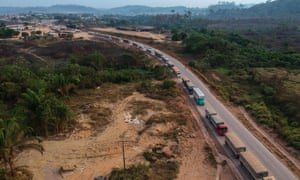
The BR163 highway in Moraes Almeida district in the Amazon rainforest, Brazil, September 2019. Photograph: Nelson Almeida/AFP via Getty Images
The human destruction of natural ecosystems increases the numbers of rats, bats and other animals that harbour diseases that can lead to pandemics such as Covid-19, a comprehensive analysis has found.
The research assessed nearly 7,000 animal communities on six continents and found that the conversion of wild places into farmland or settlements often wipes out larger species. It found that the damage benefits smaller, more adaptable creatures that also carry the most pathogens that can pass to humans.
The assessment found that the populations of animals hosting what are known as zoonotic diseases were up to 2.5 times bigger in degraded places, and that the proportion of species that carry these pathogens increased by up to 70% compared with in undamaged ecosystems.Advertisementhttps://tpc.googlesyndication.com/safeframe/1-0-37/html/container.html
Humans populations are being increasingly hit by diseases that originate in wild animals, such as HIV, Zika, Sars and Nipah virus. Since the coronavirus pandemic began, there have been a series of warnings from the UN and WHO that the world must tackle the cause of these outbreaks – the destruction of nature – and not just the health and economic symptoms.
In June, experts said the Covid-19 pandemic was an “SOS signal for the human enterprise”, while in April the world’s leading biodiversity experts said even more deadly disease outbreaks were likely unless nature was protected.
The new analysis is the first to show how the demolition of wild places, as the world’s population and consumption grows, leads to changes in animal populations that increase the risk of disease outbreaks. The research demonstrates that disease surveillance and healthcare needs to be ramped up in those areas where nature is being ravaged, the scientists said.
“As people go in and, for example, turn a forest into farmland, what they’re doing inadvertently is making it more likely for them to be in contact with an animal that carries disease,” said David Redding, of the ZSL Institute of Zoology in London, who was one of the research team. The work is published in the journal Nature.
Redding said the costs of disease were not being taken into account when deciding to convert natural ecosystems: “You’ve then got to spend a lot more money on hospitals and treatments.” A recent report estimated that just 2% of the costs of the Covid-19 crisis would be needed to help prevent future pandemics for a decade.
“The Covid-19 pandemic has awakened the world to the threat that zoonotic diseases pose to humans,” said Richard Ostfeld, at the Cary Institute of Ecosystem Studies, US, and Felicia Keesing at Bard College, US, in a commentary in Nature.
“With this recognition has come a widespread misperception that wild nature is the greatest source of zoonotic disease,” they said. “[This research] offers an important correction: the greatest zoonotic threats arise where natural areas have been converted to croplands, pastures and urban areas. The patterns the researchers detected were striking.”
The reason for species such as rodents and bats simultaneously thriving in ecosystems damaged by humans and also hosting the most pathogens is probably because they are small, mobile, adaptable and produce lots of offspring rapidly.
“The ultimate example is the brown rat,” Redding said. These fast-living species have an evolutionary strategy that favours large numbers of offspring ahead of a high survival rate for each one, which means they invest relatively little in their immune systems. “In other words, creatures that have rat-like life histories seem to be more tolerant of infections than do other creatures,” said Ostfeld and Keesing.
“In contrast, an elephant has a calf every couple of years,” said Redding. “It has to make sure that offspring survives, so it is born with a very strong and adaptive immune system.”
The analysis found that small, perching birds were also disease hosts that do well in habitats suffering from the impact of human activities. Such birds can be reservoirs of diseases such as West Nile virus and a type of chikungunya virus.
Humans have already affected more than half of the Earth’s habitable land. Prof Kate Jones, of the University College London, and also part of the research team, said: “As agricultural and urban lands are predicted to continue expanding in the coming decades, we should be strengthening disease surveillance and healthcare provision in those areas that are undergoing a lot of land disturbance, as they are increasingly likely to have animals that could be hosting harmful pathogens.”
260 Georgia school employees unable to work due to Covid-1902:22
(CNN)A 7-year-old African American boy has died of Covid-19 in Georgia, the youngest victim of the virus in the state, according to data compiled by the state health department.
The boy was from Chatham County on Georgia’s coast, and had no underlying health conditions.
“Every COVID-19 death we report is tragic, but to lose someone so young is especially heart-breaking,” Dr. Lawton Davis, the Health Director for the Coastal Health District, said in a statement.
“We know that older individuals and those with underlying conditions are at higher risk of complications, but this is a disease everyone should take seriously,” Davis said.
Wahkiakum County Engineer Paul Lacy and his wife, Daria were scheduled to be in Wahkiakum District Court on Wednesday morning for a preliminary hearing. The pair have been charged with 11 counts of animal cruelty in the second degree and two counts of transporting or confining a domestic animal in an unsafe manner in a case that brought Wahkiakum County Sheriff’s Office to their Skamokawa property multiple times over the course of several months in 2019.
A brief overview, according to reports from the Wahkiakum County Sheriff’s Office:
On May 2, 2019, WCSO received a complaint that several horses were loose in Skamokawa. When deputies responded, they found a small pig standing atop a larger decomposing pig carcass in a pig pen that was several inches deep in mud and feces. Nearby in a garage, they found several dogs standing shoulder to shoulder, unable to lay down in a kennel, along with a smaller cage containing more dogs. The dogs were without food and water. Two calves were found without water, and a dozen or more chicks were found without food or water.
On June 8, 2019, the WCSO received a report of possible animal cruelty at a property in Skamokawa.
A deputy found one horse up to its knees in mud and feces. There was an overturned water bucket nearby, and no feed. The horse had swollen knees and had lost patches of hair. Nearby in a horse area, he found four horses with untrimmed hooves and swollen knees. Several of the horses had ribs showing.
Paul Lacy said he had sold about 20 horses and still had about 18 remaining. He said it was not uncommon for horses to not get their hooves trimmed, stating that the Department of Natural Resources does not trim wild horses’ feet.
A witness provided photos of neglect, including a horse with visible ribs standing in a stall in mud up to its knees. A second photo showed a horse with overgrown hooves and visible ribs, and a third photo showed two horses with visible ribs.
On June 15, 2019, deputies and an animal control officer from Cowlitz County visited the Lacy home to inspect the animals. The animal control officer “found them to be in such bad conditions and health, according to her training and experience, that probable cause existed for Animal Cruelty.”
On June 18, 2019, deputies were told about an injured horse. A caller said she had witnessed people loading most of the horses onto a truck, but found a horse with a broken leg in a stall, bleeding out. Deputies responded. They found two horses in a muddy pen, one of which had clearly defined ribs, hips, and shoulder bones. Several pigs were in a large stall, laying in and wandering around in mud, feces, and bones. A horse with a leg injury was found deceased nearby, with what appeared to be a gunshot wound to the head.
On June 21, 2019, deputies returned to the farm. They found a horse with open wounds on its muzzle and face. Photographs were taken.
Paul Lacy said that the horse that had been euthanized had been buried in his back field, and that he had gotten rid of several dogs. He said that he did not want to get rid of any more, as he and his wife, Daria, planned to breed them to sell. He was advised that they would need a license.
Lacy was advised at that time that if he did not continue to improve the care of his current animals, he would be subject to criminal charges.
On June 24, 2019, Lacy said in a missive that he had reduced the number of horses from 18 to two, the number of dogs by five, the number of chickens by two, and the number of pigs by one, with a plan to auction three and harvest two.
On July 3, 2019, a neighbor reported that some of Lacy’s animals were on their property. The Lacys were given a warning. Deputies noted that the two remaining horses appeared to be in better condition, and that pigs were in a newly constructed pen with food and water available.
On December 15, 2019, a search warrant was served by the sheriff’s office in conjunction with the Cowlitz County Humane Society, which seized four pigs, one sow, five piglets, 15 sheep/goats, four ducks, four ducklings, one turkey, seven dogs, and 32 bird eggs in an incubator. Two dogs were found in a room, with evidence that they had attempted to gnaw and scratch their way out. The floor was smeared with feces, and there was no food or water. In the same room, they found a cage containing a duck and ducklings, the bottom of the cage full of liquid feces, resulting in a fetid odor. The animal control officer was heard to say that day that “this was one of the worst cases she has worked on.”
On December 19, they returned to collect the remaining animals, including 10 turkeys, 11 geese, 61 ducks, 42 chickens, one pack rat, and two pigeons. Every bird had a lice infestation, according to the report.
I was absolutely sickened by Aaron Raby and his self-serving attitude that he “hunts not for the kill but for the experience and adventure of the hunt.” If Raby really felt that way, then why kill? Why not shoot instead with just a camera? If he really knows…
VANCOUVER — A Metro Vancouver wildlife non-profit is offering a $1,000 reward for information after it says an illegal leg-hold trap was used to capture a skunk.
Critter Care Wildlife Society, an animal rehabilitation centre, says it found a three-month-old skunk on Sunday in Richmond, near Williams and No. 4 roads.
The society says the skunk’s injuries were so extensive that it was humanely euthanized.
“These traps do one thing, and one thing only: cause suffering,” said Lesley Fox, executive director of B.C.-based non-profit The Fur-Bearers, in a news release.
Ritchie came to the Tall Grass Prairie Preserve to find this beaver trap around a stranger’s foot (photo credit: Greg Ritchie).
A man intending on taking his dog for a walk in the Tall Grass Prairies Monday afternoon while he snapped some photos of flowers and bugs ended up rescuing a hiker from a beaver trap instead.
“I got to the preserve and there was a guy sitting on the ground behind a car trying to flag me down,” recalls Greg Ritchie. “At first, I thought he was just waving at me.”
The Tall Grass Prairie Preserve is located near Gardenton in the RM of Stuartburn (photo credit: Greg Ritchie).Ritchie approached the man and quickly realized the friendly wave was actually a plea for help: the man had a “conibear” beaver trap stuck around his foot. “It turns out he had…
In her book ‘For A Moment of Taste’, former PETA CEO Poorva Joshipura writes about how categorising an animal as ‘food’ changes our view of it. Until we see it being killed.
When I ate meat, if someone were to have asked me if I loved animals, I would have said an enthusiastic ‘yes!’ After all, I adored playing with dogs and cats I would come across, enjoyed feeding squirrels and birds with my grandmother and liked watching wildlife documentaries with my father.
However, eating animals requires someone ripping them from their families and butchering them—this is something everyone knows, even if they do not know the details of how it is done, and I knew that much too. Yet, I ate meat anyway. What allowed me to do so? What might allow others to do the same?
Scientists have been studying this conflict, between caring for animals and killing them to eat them. This phenomenon has been labelled ‘the meat paradox’ by University of Kent and Université Libre de Bruxelles researchers Steve Loughnan, Boyka Bratanova, and Elisa Puvia.
And we generally do care for animals. That’s why countries have laws protecting animals, why societies for the prevention of cruelty to animals (SPCAs) and other animal protection groups exist, why there was such national outrage when tigress Avni was killed, why the global horror when Cecil the lion and later his son Xanda were killed by trophy hunters in Zimbabwe, and it is likely why you are reading this book. In fact, many of us find what has to happen to animals to produce meat wrong, at least in principle, what little we may know about it, even if we eat meat.
A prank that was set up at a supermarket in Brazil, in which a man pretending to be a butcher offered samples of free fresh pork sausages to the store’s customers, proves this point. Shoppers would visit the counter, eat and admire the pork. Then, the butcher would offer to make more, but to do so he would bring out a live piglet and put the animal in a machine that appeared to instantly grind her up and turn her into fresh meat. In reality, another prankster was sitting in the machine safely collecting each baby pig. Although customers had just readily eaten pork, they were aghast when they thought a live pig was about to be killed. One woman spat out pork from her mouth, others pleaded with the butcher not to kill the young pig and even tried to physically stop him from doing so. None of them picked up another piece of the free fresh pork that they had eagerly eaten before seeing the live pig. If you were one of the customers, what would you have done?
Ranking Species on Worthiness of Moral Concern
While many of us are perturbed by the thought of slaughter of any animal, several studies found people who choose to eat animals are inclined to reject the thought that animals are capable of complex emotions and are likely to draw a further line between the emotional capacities of animals usually used for food (such as chickens) versus those who are not typically eaten by humans (like parrots). Both are birds, but the findings of these scientists indicate that people who eat meat are prone to believe parrots can feel more deeply than chickens, even though there’s no scientific support for such a view. Refusing to acknowledge animals, especially animals used for food, have the ability to experience deep emotions, appears to let many of us dismiss what happens to them in the production of food.
Through studies conducted by Loughnan and his colleague Brock Bastian of the University of Queensland, the pair describes how vegetarians tend to compare with meat eaters in thinking about the mental faculties of animals when told they will be killed. Vegetarians did not alter their view of that animal’s acumen when told an animal, such as a lamb, was set for slaughter. When meat eaters were told the same thing, it was found that they generally reduced their view of the animal’s mental abilities. This, the researchers surmise, may be a ‘defensive way’ to allow us to consume animals without much guilt or remorse.
Another experiment shows merely categorizing an animal as ‘food’ effects how most people perceive the animal’s rights. In this study, researchers introduced a tree kangaroo to participants—an animal the participating individuals were not familiar with. They were given general information about tree kangaroos and then some were told that the animals were for eating while others were not. Those individuals who were told the species was food considerably regarded tree kangaroos as less deserving of concern than the other participants.
Labelling an animal ‘friend’ has an effect too, but an opposite one—doing so tends to increase our respect for the friend species. This labelling of animals as ‘friend’ versus ‘food’ and the psychological effect it has on how we then view them is surely what helped me, when I consider it in hindsight, to simultaneously love animals like dogs and cats and eat animals like cows, chickens and pigs.
If this is the effect one study had on people’s minds, imagine the result of being told repeatedly, like we usually are from a young age, that certain animals are for ‘food’ by authority figures, like our parents, or members of our community or people we want to be accepted by, like our friends. What if these individuals would have instead categorized those same animals as ‘friend’? Would we have thought differently?
Today there are many vegetarians and vegans in the United States, but in the ’80s and early ’90s, the repeated messaging to me as a youngster from most people was speciesist: Animals like cows, sheep, pigs, chickens and fish merely existed to be eaten and animals like dogs and cats are friends. In other words, particular species are worthier of respect than other animals just by way of being. Indeed, though I happily ate what I considered to be the ‘food’ members of the animal kingdom, I would have eaten my own foot before I ate a dog. If we are raised in a meat-eating family, or if our families engage in rituals or customs that involve killing or eating certain animals, something similar is usually the repeated messaging we hear too.
This excerpt from A Moment of Taste by Poorva Joshipura has been published with permission from HarperCollins India.
You are reading this because you value good, intelligent and objective journalism. We thank you for your time and your trust.
You also know that the news media is facing an unprecedented crisis. It is likely that you are also hearing of the brutal layoffs and pay-cuts hitting the industry. There are many reasons why the media’s economics is broken. But a big one is that good people are not yet paying enough for good journalism.
We have a newsroom filled with talented young reporters. We also have the country’s most robust editing and fact-checking team, finest news photographers and video professionals. We are building India’s most ambitious and energetic news platform. And we aren’t even three yet.
At ThePrint, we invest in quality journalists. We pay them fairly and on time even in this difficult period. As you may have noticed, we do not flinch from spending whatever it takes to make sure our reporters reach where the story is. Our stellar coronavirus coverage is a good example. You can check some of it here.
This comes with a sizable cost. For us to continue bringing quality journalism, we need readers like you to pay for it. Because the advertising market is broken too.
If you think we deserve your support, do join us in this endeavour to strengthen fair, free, courageous, and questioning journalism, please click on the link below. Your support will define our journalism, and ThePrint’s future. It will take just a few seconds of your time.





 A leg-hold trap. (Critter Care Wildlife Society)


