Exposing the Big Game

Forget Hunters' Feeble Rationalizations and Trust Your Gut Feelings: Making Sport of Killing Is Not Healthy Human Behavior

Exposing the Big Game

‘They just pull up everything!’ Chinese fleet raises fears for Galápagos sea life

‘They just pull up everything!’ Chinese fleet raises fears for Galápagos sea life

Seascape: the state of our oceansGalápagos Islands

https://www.theguardian.com/environment/2020/aug/06/chinese-fleet-fishing-galapagos-islands-environment?fbclid=IwAR1m0ux_QLU-rqIe0Oo6lp1AtHvEq8KQWvMgLe8a7kjjm0NxXlgf0mkaXI0

A vast fishing armada off Ecuador’s biodiverse Pacific islands has stirred alarm over ‘indiscriminate’ fishing practicesSeascape: the state of our oceans is supported byAbout this content

Dan Collyns in Lima @yachay_dc

Thu 6 Aug 2020 05.30 EDTLast modified on Thu 6 Aug 2020 11.18 EDT

Shares3,875
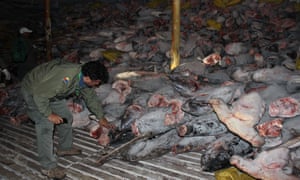
The Chinese reefer ship Fu Yuan Yu Leng 999 was intercepted inside the Galápagos marine reserve in 2017. It contained about 300 tonnes of mostly sharks, including protected species such as hammerhead and whale shark.
 The Chinese reefer ship Fu Yuan Yu Leng 999 was intercepted in the Galápagos marine reserve in 2017 with about 300 tonnes of mostly sharks, including protected species. Photograph: Archivo Parque Nacional Galápagos

Jonathan Green had been tracking a whale shark named Hope across the eastern Pacific for 280 days when the satellite transmissions from a GPS tag on her dorsal fin abruptly stopped.

It was not unusual for the GPS signal to go silent, even for weeks at a time, said Green, a scientist who has been studying the world’s largest fish for three decades in the unique marine ecosystem around the Galápagos Islands.
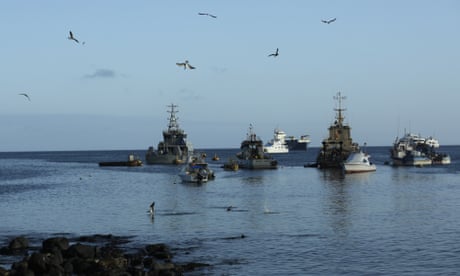
Alarm over discovery of hundreds of Chinese fishing vessels near Galápagos Islands

 Read more

But then he looked at satellite images in the area where Hope was last tracked – more than a thousand nautical miles west of the islands – and noticed the ocean was being patrolled by hundreds of Chinese fishing boats.

“I began to look into it and found that at the very end of her track she began to speed up,” said Green, co-founder and director of the Galápagos Whale Shark Project.

“It went from one knot to six or seven knots for the last 32 minutes – which is, of course, the speed of a fishing boat,” he said.

The fishing vessels that Green saw on the satellite images are believed to belong to an enormous Chinese-flagged fleet which Ecuadorian authorities last week warned was just outside the Galápagos Islands’ territorial waters.

“I don’t have proof but my hypothesis is that she was caught by vessels from the same fleet which is now situated to the south of the islands,” Green told the Guardian. She is the third GPS-tracked whale shark to have gone missing in the last decade, he added.

The Chinese fleet, numbering more than 200 vessels, is in international waters just outside a maritime border around the Galápagos Islands and also Ecuador’s coastal waters, said Norman Wray, the islands’ governor.
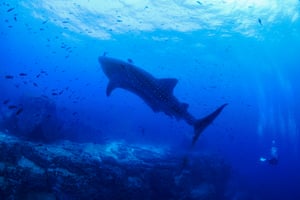
‘The Galápagos Marine Reserve is a place of very great productivity, high biomass but also biodiversity.’
 A female whale shark in the Galápagos archipelago. ‘The Galápagos Marine Reserve is a place of very great productivity, high biomass but also biodiversity.’ Photograph: Simon J Pierce

Advertisementhttps://14f0d057a0fb5668fabe1a9b748ad093.safeframe.googlesyndication.com/safeframe/1-0-37/html/container.html

Chinese fishing vessels come every year to the seas around the Galápagos, which were declared a Unesco world heritage site in 1978, but this year’s fleet is one of the largest seen in recent years. Of the 248 vessels, 243 are flagged to China including to companies with suspected records of illegal, unreported and unregulated, or IUU, fishing, according to research by C4ADS, a data analysis NGO.

The fleet includes fishing boats and refrigerated container – or reefer – ships to store enormous catches.

Transferring cargo between vessels is prohibited under international maritime law yet the Chinese flotilla has supply and storage ships along with longline and squid fishing boats.

“There are some fleets which don’t seem to abide by any regulations,” said Wray.

One captain of an Ecuadorian tuna boat saw the Chinese fishing boats up close in early July, before the end of the tuna season.

“They just pull up everything!” said the captain, who asked not to be named. “We are obliged to take a biologist aboard who checks our haul; if we catch a shark we have to put it back, but who controls them?”

He recalled navigating through the fleet at night, constantly changing course to avoid boats, as their lights illuminated the sea to attract squid to the surface.

“It was like looking at a city at night,” he said.https://interactive.guim.co.uk/uploader/embed/2020/08/galapagos_islands_map/giv-3902PwADw3d4ii3F/

The longline fishing boats had up to 500 lines, each with thousands of fishhooks, he estimated, and claimed that some of the vessels would turn off their automatic tracking systems to avoid detection, particularly when operating in protected areas.

Chinese fishing practices first caught the attention of Ecuador in 2017 when its navy seized the Chinese reefer Fu Yuan Yu Leng 999 within the Galápagos marine reserve. Inside its containers were 6,000 frozen sharks – including the endangered hammerhead shark and whale shark.

“It was a slaughterhouse,” said Green, describing the images of the cargo hold. “This kind of slaughter is going on on a massive scale in international waters and nobody is witnessing it.”

The seizure prompted protests outside the Chinese embassy in Quito; Ecuador fined the vessel $6m and the 20 Chinese crew-members were later jailed for up to four years for illegal fishing.

The arrival of the latest fleet has also stirred public outrage and a formal complaint by Ecuador as its navy is on alert for any incursion into Ecuadorian waters.

The Chinese embassy in Quito said that China was a “responsible fishing nation” with a “zero-tolerance” attitude towards illegal fishing. It had confirmed with Ecuador’s navy that all the Chinese fishing vessels were operating legally “and don’t represent a threat to anyone”, it said in a statement last month. On Thursday China announced a three-month fishing ban in the high seas west of the marine reserve, but it will not come into force until September.

Roque Sevilla, a former mayor of Quito, who is leading a team in charge of designing a “protection strategy” for the islands, said the fleet practices “indiscriminate fishing – regardless of species or age – which is causing a serious deterioration of the quality of fauna that we will have in our seas”.

Ecuador would establish a corridor of marine reserves with Pacific-facing neighbours Costa Rica, Panama and Colombia to seal off important areas of marine diversity, Sevilla told the Guardian.
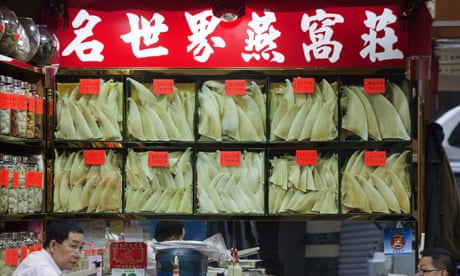
Shark finning: why the ocean’s most barbaric practice continues to boom

 Read more

Protecting the Cocos Ridge, an underwater mountain range which connects the Galápagos Islands to mainland Costa Rica, and the Carnegie Ridge which links the archipelago to Ecuador and continental South America, could close off more than 200,000 sq nautical miles of ocean otherwise vulnerable to industrial fishing, he said.

He added Ecuador had called for a diplomatic meeting with Chile, Peru, Colombia and Panama to present a formal protest against China.Advertisementhttps://tpc.googlesyndication.com/safeframe/1-0-37/html/container.html

“When the Galápagos’s protected area was first created it was cutting edge,” said Matt Rand, director of the Pew Bertarelli Ocean Legacy, “but compared to other newer marine protected areas Galápagos is now potentially lacking in size to protect the biodiversity.”

Milton Castillo, the Galápagos Islands’ representative for Ecuador’s human rights ombudsman’s office, said he had asked the prosecutor’s office to inspect the cargo holds of the Chinese ships based on the legal principle of the universal and extraterritorial protection of endangered species.

China’s distant-water fishing fleet is the biggest in the world, with nearly 17,000 vessels – 1,000 of which use “flags of convenience” and are registered in other countries, according to research by the Overseas Development Institute.https://www.youtube.com/embed/Uu5ka0lMZTo?embed_config=%7B%22relatedChannels%22%3A%5B%5D%2C%22adsConfig%22%3A%7B%22adTagParameters%22%3A%7B%22iu%22%3A%22%2F59666047%2Ftheguardian.com%2Fenvironment%2Farticle%2Fng%22%2C%22cust_params%22%3A%22sens%253Df%2526permutive%253D23527%252C24632%252C24663%252C24665%252C24670%252C24655%252C24668%252C26748%252C27872%252C28985%252C24672%252C30130%252C31470%252C24691%252C24675%252C24693%252C33392%252C27631%252C27638%252C29800%252C33143%252C24659%252C24645%252C24630%252C28165%252C24628%252C24641%252C24667%252C24674%252C24689%252C30377%252C27564%252C24606%252C24661%252C25367%252C26822%252C25471%252C26749%252C37344%252C37434%252C43272%2526pv%253Dkdjeomwyvw417kzfu7lw%2526bp%253Ddesktop%2526si%253Df%2526ab%253DSignInGateMainVariant-main-variant-1%252CdotcomRenderingControl-control%252ColdTlsSupportDeprecationControl-control%2526fr%253D10-15%2526cc%253DUS%2526s%253Denvironment%2526rp%253Ddotcom-platform%2526dcre%253Df%2526inskin%253Df%2526urlkw%253Dchinese%252Cfleet%252Cfishing%252Cgalapagos%252Cislands%252Cenvironment%2526rdp%253Df%2526consent_tcfv2%253Dna%2526cmp_interaction%253Dna%2526se%253Dseascape-the-state-of-our-oceans%2526ct%253Darticle%2526co%253Ddan-collyns%2526url%253D%25252Fenvironment%25252F2020%25252Faug%25252F06%25252Fchinese-fleet-fishing-galapagos-islands-environment%2526br%253Df%2526su%253D2%252C3%252C4%252C5%2526edition%253Dus%2526tn%253Dfeatures%2526p%253Dng%2526k%253Dasia-pacific%252Cworld%252Cecuador%252Cchina%252Cfish%252Cenvironment%252Camericas%252Cgalapagos-islands%2526sh%253Dhttps%25253A%25252F%25252Fgu.com%25252Fp%25252Feehna%2526pa%253Dt%22%7D%7D%7D&enablejsapi=1&origin=https%3A%2F%2Fwww.theguardian.com&widgetid=1Play Video0:51 Footage shows Chinese fleet vessels transferring cargo in seas near Galápagos – video

The fleet often fishes in the territorial waters of low-income countries, the report said, having depleted fish stocks in domestic waters.

Green said the “explosion of life” created by the confluence of cold and warm ocean currents around the Galápagos Islands is exactly why the Chinese armada is hovering around the archipelago’s waters.

“The Galápagos marine reserve is a place of very great productivity, high biomass but also biodiversity,” he said. The longline fishing technique used by the fleet catch big fish like tuna, but also sharks, rays, turtles and marine mammals like sea lions and dolphins, he added.

“This is not fishing any more, it is simply destroying the resources of our oceans,” Green said. “We should ask whether any nation on this planet has the right to destroy what is common ground.”

A vast fishing armada off Ecuador’s biodiverse Pacific islands has stirred alarm over ‘indiscriminate’ fishing practicesSeascape: the state of our oceans is supported byAbout this content

Dan Collyns in Lima @yachay_dc

Thu 6 Aug 2020 05.30 EDTLast modified on Thu 6 Aug 2020 11.18 EDT

Shares3,875

The Chinese reefer ship Fu Yuan Yu Leng 999 was intercepted inside the Galápagos marine reserve in 2017. It contained about 300 tonnes of mostly sharks, including protected species such as hammerhead and whale shark.
 The Chinese reefer ship Fu Yuan Yu Leng 999 was intercepted in the Galápagos marine reserve in 2017 with about 300 tonnes of mostly sharks, including protected species. Photograph: Archivo Parque Nacional Galápagos

Jonathan Green had been tracking a whale shark named Hope across the eastern Pacific for 280 days when the satellite transmissions from a GPS tag on her dorsal fin abruptly stopped.

It was not unusual for the GPS signal to go silent, even for weeks at a time, said Green, a scientist who has been studying the world’s largest fish for three decades in the unique marine ecosystem around the Galápagos Islands.

Alarm over discovery of hundreds of Chinese fishing vessels near Galápagos Islands

 Read more

But then he looked at satellite images in the area where Hope was last tracked – more than a thousand nautical miles west of the islands – and noticed the ocean was being patrolled by hundreds of Chinese fishing boats.

“I began to look into it and found that at the very end of her track she began to speed up,” said Green, co-founder and director of the Galápagos Whale Shark Project.

“It went from one knot to six or seven knots for the last 32 minutes – which is, of course, the speed of a fishing boat,” he said.

The fishing vessels that Green saw on the satellite images are believed to belong to an enormous Chinese-flagged fleet which Ecuadorian authorities last week warned was just outside the Galápagos Islands’ territorial waters.

“I don’t have proof but my hypothesis is that she was caught by vessels from the same fleet which is now situated to the south of the islands,” Green told the Guardian. She is the third GPS-tracked whale shark to have gone missing in the last decade, he added.

The Chinese fleet, numbering more than 200 vessels, is in international waters just outside a maritime border around the Galápagos Islands and also Ecuador’s coastal waters, said Norman Wray, the islands’ governor.

‘The Galápagos Marine Reserve is a place of very great productivity, high biomass but also biodiversity.’
 A female whale shark in the Galápagos archipelago. ‘The Galápagos Marine Reserve is a place of very great productivity, high biomass but also biodiversity.’ Photograph: Simon J Pierce

Advertisementhttps://14f0d057a0fb5668fabe1a9b748ad093.safeframe.googlesyndication.com/safeframe/1-0-37/html/container.html

Chinese fishing vessels come every year to the seas around the Galápagos, which were declared a Unesco world heritage site in 1978, but this year’s fleet is one of the largest seen in recent years. Of the 248 vessels, 243 are flagged to China including to companies with suspected records of illegal, unreported and unregulated, or IUU, fishing, according to research by C4ADS, a data analysis NGO.

The fleet includes fishing boats and refrigerated container – or reefer – ships to store enormous catches.

Transferring cargo between vessels is prohibited under international maritime law yet the Chinese flotilla has supply and storage ships along with longline and squid fishing boats.

“There are some fleets which don’t seem to abide by any regulations,” said Wray.

One captain of an Ecuadorian tuna boat saw the Chinese fishing boats up close in early July, before the end of the tuna season.

“They just pull up everything!” said the captain, who asked not to be named. “We are obliged to take a biologist aboard who checks our haul; if we catch a shark we have to put it back, but who controls them?”

He recalled navigating through the fleet at night, constantly changing course to avoid boats, as their lights illuminated the sea to attract squid to the surface.

“It was like looking at a city at night,” he said.https://interactive.guim.co.uk/uploader/embed/2020/08/galapagos_islands_map/giv-3902PwADw3d4ii3F/

The longline fishing boats had up to 500 lines, each with thousands of fishhooks, he estimated, and claimed that some of the vessels would turn off their automatic tracking systems to avoid detection, particularly when operating in protected areas.

Chinese fishing practices first caught the attention of Ecuador in 2017 when its navy seized the Chinese reefer Fu Yuan Yu Leng 999 within the Galápagos marine reserve. Inside its containers were 6,000 frozen sharks – including the endangered hammerhead shark and whale shark.

“It was a slaughterhouse,” said Green, describing the images of the cargo hold. “This kind of slaughter is going on on a massive scale in international waters and nobody is witnessing it.”

The seizure prompted protests outside the Chinese embassy in Quito; Ecuador fined the vessel $6m and the 20 Chinese crew-members were later jailed for up to four years for illegal fishing.

The arrival of the latest fleet has also stirred public outrage and a formal complaint by Ecuador as its navy is on alert for any incursion into Ecuadorian waters.

The Chinese embassy in Quito said that China was a “responsible fishing nation” with a “zero-tolerance” attitude towards illegal fishing. It had confirmed with Ecuador’s navy that all the Chinese fishing vessels were operating legally “and don’t represent a threat to anyone”, it said in a statement last month. On Thursday China announced a three-month fishing ban in the high seas west of the marine reserve, but it will not come into force until September.

Roque Sevilla, a former mayor of Quito, who is leading a team in charge of designing a “protection strategy” for the islands, said the fleet practices “indiscriminate fishing – regardless of species or age – which is causing a serious deterioration of the quality of fauna that we will have in our seas”.

Ecuador would establish a corridor of marine reserves with Pacific-facing neighbours Costa Rica, Panama and Colombia to seal off important areas of marine diversity, Sevilla told the Guardian.

Shark finning: why the ocean’s most barbaric practice continues to boom

 Read more

Protecting the Cocos Ridge, an underwater mountain range which connects the Galápagos Islands to mainland Costa Rica, and the Carnegie Ridge which links the archipelago to Ecuador and continental South America, could close off more than 200,000 sq nautical miles of ocean otherwise vulnerable to industrial fishing, he said.

He added Ecuador had called for a diplomatic meeting with Chile, Peru, Colombia and Panama to present a formal protest against China.Advertisementhttps://tpc.googlesyndication.com/safeframe/1-0-37/html/container.html

“When the Galápagos’s protected area was first created it was cutting edge,” said Matt Rand, director of the Pew Bertarelli Ocean Legacy, “but compared to other newer marine protected areas Galápagos is now potentially lacking in size to protect the biodiversity.”

Milton Castillo, the Galápagos Islands’ representative for Ecuador’s human rights ombudsman’s office, said he had asked the prosecutor’s office to inspect the cargo holds of the Chinese ships based on the legal principle of the universal and extraterritorial protection of endangered species.

China’s distant-water fishing fleet is the biggest in the world, with nearly 17,000 vessels – 1,000 of which use “flags of convenience” and are registered in other countries, according to research by the Overseas Development Institute.https://www.youtube.com/embed/Uu5ka0lMZTo?embed_config=%7B%22relatedChannels%22%3A%5B%5D%2C%22adsConfig%22%3A%7B%22adTagParameters%22%3A%7B%22iu%22%3A%22%2F59666047%2Ftheguardian.com%2Fenvironment%2Farticle%2Fng%22%2C%22cust_params%22%3A%22sens%253Df%2526permutive%253D23527%252C24632%252C24663%252C24665%252C24670%252C24655%252C24668%252C26748%252C27872%252C28985%252C24672%252C30130%252C31470%252C24691%252C24675%252C24693%252C33392%252C27631%252C27638%252C29800%252C33143%252C24659%252C24645%252C24630%252C28165%252C24628%252C24641%252C24667%252C24674%252C24689%252C30377%252C27564%252C24606%252C24661%252C25367%252C26822%252C25471%252C26749%252C37344%252C37434%252C43272%2526pv%253Dkdjeomwyvw417kzfu7lw%2526bp%253Ddesktop%2526si%253Df%2526ab%253DSignInGateMainVariant-main-variant-1%252CdotcomRenderingControl-control%252ColdTlsSupportDeprecationControl-control%2526fr%253D10-15%2526cc%253DUS%2526s%253Denvironment%2526rp%253Ddotcom-platform%2526dcre%253Df%2526inskin%253Df%2526urlkw%253Dchinese%252Cfleet%252Cfishing%252Cgalapagos%252Cislands%252Cenvironment%2526rdp%253Df%2526consent_tcfv2%253Dna%2526cmp_interaction%253Dna%2526se%253Dseascape-the-state-of-our-oceans%2526ct%253Darticle%2526co%253Ddan-collyns%2526url%253D%25252Fenvironment%25252F2020%25252Faug%25252F06%25252Fchinese-fleet-fishing-galapagos-islands-environment%2526br%253Df%2526su%253D2%252C3%252C4%252C5%2526edition%253Dus%2526tn%253Dfeatures%2526p%253Dng%2526k%253Dasia-pacific%252Cworld%252Cecuador%252Cchina%252Cfish%252Cenvironment%252Camericas%252Cgalapagos-islands%2526sh%253Dhttps%25253A%25252F%25252Fgu.com%25252Fp%25252Feehna%2526pa%253Dt%22%7D%7D%7D&enablejsapi=1&origin=https%3A%2F%2Fwww.theguardian.com&widgetid=1Play Video0:51 Footage shows Chinese fleet vessels transferring cargo in seas near Galápagos – video

The fleet often fishes in the territorial waters of low-income countries, the report said, having depleted fish stocks in domestic waters.

Green said the “explosion of life” created by the confluence of cold and warm ocean currents around the Galápagos Islands is exactly why the Chinese armada is hovering around the archipelago’s waters.

“The Galápagos marine reserve is a place of very great productivity, high biomass but also biodiversity,” he said. The longline fishing technique used by the fleet catch big fish like tuna, but also sharks, rays, turtles and marine mammals like sea lions and dolphins, he added.

“This is not fishing any more, it is simply destroying the resources of our oceans,” Green said. “We should ask whether any nation on this planet has the right to destroy what is common ground.”

Seal-eating killer whales accumulate large amounts of harmful pollutants

Exposing the Big Game's avatarThe Extinction Chronicles

Seal-eating killer whales accumulate large amounts of harmful pollutants
Some killer whales along the Norwegian coast eat seals, and these seal-eating whales are really polluted. Credit: Norwegian Orca Survey

Research of killer whales in the southern Atlantic ocean and Mediterranean have shown that their blubber contains high levels of pollutants called PCBs, whilst killer whales found along the Norwegian coast have been assumed to be healthy and at low risk from pollution. This is because when researchers took samples from nine Norwegian killer whales in 2002, they found lower levels of pollutants than other populations.

But now, a new study has shown that killer whales along the Norwegian coast also eat seals, and these seal-eating whales are really polluted. They have up to four times the levels of the pollutant PCB in their blubber than other whales in the population that just eat fish, and levels of mercury in…

View original post 1,866 more words

China strengthens protection, management, of Pangolins

Exposing the Big Game's avatarThe Extinction Chronicles

: Aug 06 09:05AM -0400

1 July 2020

China

The NFGA has issued a new notice on “strengthening the protection and
management of pangolins” following the species is uplisted to first-class
state protection. However, it is worth noting that the legal trade of
pangolin is still maintained under the strengthened measures, therefore the
demand on medicinal use, which has driven the trafficking of pangolins,
persists. The notice includes:

1. Increase the sense of urgency for pangolin protection.
2. Implement habitat protection based on the findings of an ongoing
population survey regarding the wild population of pangolins in China.
Patrolling will be increased to ensure poachers or habitat destructors will
be severely punished. Any special request on collecting pangolins for
scientific research requires approvals from the provincial forestry
department.
3. Strengthen enforcement. There will be stronger coordination between
departments, such as police, market regulators, internet regulators,
transportation surveillance and customs, to…

View original post 129 more words

Europe’s double-standards on saving elephants


The EU’s new Green Deal strategy offers ‘guidance’ to African countries but does nothing to stop Europe’s own ivory market, Roseiw Awori writes
 
1 hour ago
 
Reuters
 
As part of its plans to be the first net zero emissions, zero pollution continent by 2050, the EU published its Biodiversity Strategy for 2030, personally championed by First Executive Vice-President Timmermans, on 20th May.
 
It proposes among other issues “… a further tightening of the rules on EU ivory trade” while nonetheless maintaining a thriving ivory market itself.
 
Double Standards
 
“A further tightening of the rules …” is hardly progress.
 
Under the Juncker Commission, which left office on 30th November 2019, significant strides were being made to close the loopholes in the EU’s ivory trade.
 
The Von der Leyen “Green Deal” Commission has, however, demonstrated scant political will to maintain – let alone increase – that momentum.
It is this type of double standard that we can no longer stand for.
 
“We are tired of these lectures that constantly come from the North, telling us how to manage our spaces while they ignore the implications of their actions. Frankly, the EU has failed to read the mood across the world,” says Dr Winnie Kiiru, Senior Technical Advisor for the Elephant Protection Initiative Foundation (EPI), an organisation comprising of 21 African countries working to secure the protection of African elephants.
 
As an elephant biologist for the past 20 years, Kiiru has fought for the ban of ivory across the world and is not impressed by the EU’s double standards. “Countries that had thriving markets such as China and the US have gone ahead to ban ivory trade – it seems very odd that the EU won’t follow suit.”
 
Beginning around 2007, a wave of poaching for ivory devastated populations of savanna and forest elephants across Africa. The total numbers of savanna elephants decreased by 30% between 2007 and 2015, while forest elephants were hit even harder.
 
In some countries, elephant populations declined by over 50% in under 10 years. If current poaching levels continue, elephants may be extinct in the wild within the decade – and this will be thanks in no small measure to the EU’s ivory market, among the largest in the world.
 
Poaching of African elephants continues unabated. The fight for countries to shut down the international ivory trade has borne some fruit with key nations such as the USA, UK and China responding to global pressure and closing their domestic ivory markets.
 
This action has been accompanied by a decrease in poaching within some parts of Africa, primarily in East Africa. However, in other regions, notably West, Central and Southern Africa, the poaching trend has not declined.
 
If anything, poaching levels are increasing in new hotspots, as major global ivory markets have remained open, notably those of Japan and the European Union.
 
This makes the EU’s Biodiversity Strategy, as part of the highly ambitious Green Deal suite of policy initiatives all the more extraordinary.
 
Aiming to provide ‘guidance’ to African countries on steps to take in order to maintain and improve our biodiversity, it is supremely ironic that the EU’s ivory market is effectively a key contributor of the destruction of Africa’s natural heritage.
 
Laundering ‘legal’ ivory into the illegal market. It is all the more surprising to note this somewhat misguided act of charity has no roots within the EU.
 
The European Commission continues to maintain that the EU’s ivory market deals only with old ivory stocks and has no influence on current poaching levels.
 
Yet, recent studies have shown that ivory pieces can be aged and made to seem older than they actually are. Limiting the trade to small ivory pieces is also no solution, as carving operations have now been established in elephant range states.
 
This ongoing consumption of ivory puts the safety of the African elephants at great risk because, by giving ivory a value it prolongs demand, which maintains the push for supply.
 
Until the EU shuts down its domestic market, ivory will continue to be laundered into European markets under the guise of being ‘old or small stock’.
 
“The EU needs to appreciate the role of any African market in increasing the cost of law enforcement in African countries and destroying livelihoods. Furthermore, their strategy will be impossible to realize in Africa until they shut down their ivory markets,” Kiiru maintains.
 
Critically, ivory has no value within Africa; it is only countries outside that continue to clamour for it and by so doing fuel poaching across the continent.
 
And so, however good the intentions were in writing the EU Biodiversity Strategy, I am reminded of a song my mother would sing: “Sweep your yard before you come and sweep mine”. This is precisely what the EU needs to do.
 
The time for decisive action is now. Overall, the importance of healthy elephant populations is to increase and help support our African biodiversity, and they are part of our cultural heritage.
 
We cannot afford to lose them for the sake of demand by foreigners in Europe and elsewhere for trinkets.
 
Again it remains clear, the EU needs to re-examine its so-called ‘role’
in promoting global biodiversity; here in Africa, what it does in reality is continue to endanger African elephants.
 
Rosie Awori is the director of the Pan African Wildlife Conservation Network
 
https://www.independent.co.uk/voices/campaigns/GiantsClub/europe-doublestandards-saving-elephants-a9657081.html

Scientists Attribute Record-Shattering Siberian Heat and Wildfires to Climate Change

Exposing the Big Game's avatarThe Extinction Chronicles

A decade of brutal Arctic heat waves increased emissions from fires and permafrost, melted heat-reflecting sea ice and pushed the High North climate toward collapse.

BY BOB BERWYN, INSIDECLIMATE NEWS

JUL 15, 2020

Scientists Attribute Record-Shattering Siberian Heat and Wildfires to Climate Change

A view of a forest fire in central Yakutia from a helicopter. Credit: Yevgeny SofroneyevTASS via Getty Images

Siberia’s scorching, 100-degree temperature record made headlines in late June, but it was just the latest spike in a decade of historic heat waves across the Arctic that also set records for wildfires, thawing permafrost and melting sea ice. Such extremes, scientists said, show that Arctic warming is accelerating to outpace all but the most dire climate projections.

Intensifying warming in the Arctic trickles down to the rest of the world, melting Greenland’s ice to raise sea levels and flood coastal communities. It also shifts the paths of storms

View original post 2,547 more words

Court case to stop 80 000 sheep being exported:7 questions with Al Mawashi South Africa

Exposing the Big Game's avatarExposing the Big Game

https://www.news24.com/news24/analysis/court-case-to-stop-80-000-sheep-being-exported-7-questions-with-al-mawashi-south-africa-20200803

<https://www.news24.com/>

– The NSPCA has turned to the courts to stop a shipment of more than 80
000 sheep from the Eastern Cape to Kuwait.
– The NSPCA believes the animals are being ill-treated and go through
unnecessary harm before reaching their destination.
– The exporting company Al Mawashi South Africa has, however, dismissed
the allegations.

——————————

The National Council of SPCAs (NSPCA) has turned to the court to stop a
shipment of more than 80 000 sheep from the Eastern Cape to Kuwait this
month, citing animal abuse concerns.

The exporting company, Al Mawashi South Africa, has, however, dismissed the
allegations, saying it went above and beyond what animal welfare standards
required.

It said both ethically, in terms of religious laws in Middle Eastern
countries, and commercially, to reduce animal mortalities, it did not make
sense to ill-treat the animals.

*News24 spoke to Al Mawashi South…

View original post 1,565 more words

Court case to stop 80 000 sheep being exported:7 questions with Al Mawashi South Africa

https://www.news24.com/news24/analysis/court-case-to-stop-80-000-sheep-being-exported-7-questions-with-al-mawashi-south-africa-20200803

<https://www.news24.com/>

– The NSPCA has turned to the courts to stop a shipment of more than 80
000 sheep from the Eastern Cape to Kuwait.
– The NSPCA believes the animals are being ill-treated and go through
unnecessary harm before reaching their destination.
– The exporting company Al Mawashi South Africa has, however, dismissed
the allegations.

——————————

The National Council of SPCAs (NSPCA) has turned to the court to stop a
shipment of more than 80 000 sheep from the Eastern Cape to Kuwait this
month, citing animal abuse concerns.

The exporting company, Al Mawashi South Africa, has, however, dismissed the
allegations, saying it went above and beyond what animal welfare standards
required.

It said both ethically, in terms of religious laws in Middle Eastern
countries, and commercially, to reduce animal mortalities, it did not make
sense to ill-treat the animals.

*News24 spoke to Al Mawashi South Africa’s managing director, Ilyaas Ally,
about the export of live sheep, why the sheep are not ill-treated as
alleged, and the economic impact the industry has on South Africa. *

How long has the sheep trade between the Eastern Cape and Kuwait taken
place, and how many have thus far been transported?

The live export of animals from South Africa to the Middle East started in
2019 – it is legal in South Africa, we strictly follow World Organisation
for Animal Health (OIE) guidelines, and we exceed on animal welfare
standards.

In 2019, the South African affiliate of KLTT, Al Mawashi South Africa, was
established and we began exporting from South Africa in 2019.

Our first shipment was in October 2019. In March 2020, we undertook a
second shipment. The excellent mortality rates we achieve onboard vessels
during shipments is below sheep mortality rates on South African farms and
feedlots – a testimony that live exports is being done in a humane way.

The demand by Middle Eastern countries is firstly for live animals based on
consumer preference for freshly slaughtered meat and not chilled or frozen
meat, and secondly for cultural reasons involving religious sacrifice.

Concerns have been raised over the condition these sheep are kept in the
container’s ships such as sheep living in animal manure, and high mortality
rates. Do you agree with these concerns?

We disagree with these views, and deny these allegations.

We need to firstly clarify, sheep are not kept in “containers” but in
feedlot pens, similar to pens on terrestrial feedlots. Importantly, visuals
and footage used by animal rights and welfare groups circulated to media
and the public is not a true reflection of live exports from South Africa
to the Middle East. Visual and footage involves exporters from other
countries, and are in no way related to conditions on board our vessels.

There is a general lack of understanding and unwillingness to understand
the live export industry on the part of animal rights and welfare groups,
and this being exploited to sensationalise live exports and to paint it in
a negative light.
Concerning claims of excessive animal manure: We add straw to vessel floors
to assist the absorption of urine and faeces, if necessary. Sheep manure is
dry. It gets trampled down to create a firm pad underfoot for animals. This
same basic management principle of terrestrial feedlots applies for
livestock carrier vessel feedlot pens. This must also be viewed against the
OIE regulations governing the transportation of animals by sea. The OIE
regulations and guidelines require that vessels are only cleaned and
disinfected before and after voyages. Based on the further development of
OIE regulations by exporting countries such as Australia, the use of water
to clean out pens during shipments can create stress for animals and unsafe
slippery surface conditions.

It is well-accepted that the mortality rate is an important indication on
the health and welfare of animals. Between our two shipments, we achieved
an average mortality rate of 0.15% with the mortality rate of the October
shipment standing at 0.17%, and March shipment was 0.14%. To put this into
perspective: South African sheep farmers benchmark themselves to achieve a
mortality rate of 3 to 3.5% on farms and feedlots.

Do you believe the sheep go through any unnecessary pain in the process?

We believe animals are being treated in a humane way and that animal
cruelty, as alleged by animal welfare and rights groups, is mitigated in
responsible ways. Ethically and commercially it will not make any sense for
us to compromise animal health and welfare. Commercially, we need to try
and reduce animal mortalities. Ethically, we are strictly governed by the
religious laws of Middle Eastern countries.

We need to also state that countries that are ranked higher than South
Africa by the Animal Protection Index (API) permit live exportation of
animals on ships. These countries include Canada, Australia, the United
Kingdom, the EU, Denmark and the USA, for example.

Animal welfare groups are misleading South Africans by stating that live
exports are banned in New Zealand. This is misleading and incorrect. In
fact, this morning, it was reported that the largest livestock vessel in
the world docked in the Timaru district in New Zealand to load 14 000
cattle to be exported to China.
<https://i.stuff.co.nz/timaru-herald/news/122322319/worlds-largest-livestock-carrier-docks-in-timaru>

Do you agree with concerns that the conditions the sheep are exported in
create ideal conditions for disease to spread?

The claim that sheep exports create conditions for diseases to spread is
completely false.
In fact, animal rights and welfare groups frequently omit all the stringent
biosecurity measures that are a legal requirement from countries importing
sheep. In this regard, sheep undergo a strict 30-day biosecurity quarantine
before going on the export journey from South Africa to the Middle East. As
noted by role players in red meat and agriculture, South Africa’s red meat
industry adheres to strict biosecurity, hygiene and vaccine requirements.

Before any exportation of animals may take place from South African shores,
the South African government must inspect animals, the feedlot and vessels
to provide a health certificate indicating a clean bill of health for
animals, and compliance of the vessel.

This provides, on the one hand, the importing country with the necessary
guarantees that animals are disease-free, and, on the other hand, to the
export country that animal welfare standards and animal safety during the
voyages are achieved through the vessel and vessel systems.

The South African government must inspect animals to provide a health
certificate indicating a clean bill of health. This is to indicate that
animals are disease-free, and this is done for every shipment undertaken by
Al Mawashi South Africa.

The summer trade between Kuwait and Australia was reportedly stopped due to
bad conditions for the sheep. Is it correct therefore to say that Al
Mawashi moved the trade to South Africa to make up the shortfall?

This assumption is incorrect. KLTT, Al Mawashi South Africa’s parent
company, was approached by the South African government. The establishment
of the South African live exports industry is a result of an outwards trade
mission to the Middle East by the South African government in 2018 by the
Eastern Cape Development Corporation (ECDC), an economic development and
investment agency for the Eastern Cape province of South Africa. We were
approached by the South African government, and not the other way around.

It is also important to note that our parent company has established supply
chains across the world.
It is arguably incorrect for animal rights and welfare groups to
characterise equatorial shipping routes as unsafe or unsuitable from a
welfare perspective, whether that is at all times or for the northern
summer. There is variability between seasons and within each region in any
given month. Historic data shows that mortality rates for equatorial
voyages remain low and essentially unchanged for much of the northern
summer and, overall, transport by ship often has comparable or better
welfare outcomes than on the farm.

Sophisticated tools can be used to predict and avoid weather extremes along
equatorial shipping routes. Livestock are adept at thermoregulation and
coping with increased heat and humidity.

Live exports are legal and permitted in Australia and have not been banned,
however, restrictions are in place prohibiting trade during northern
hemisphere summers.

However, Australia’s federal government recently provided an exemption
during its northern hemisphere export ban. During this shipment, a
mortality rate of 0.08% was recorded, and as a result farmers and exporters
believe that the northern summers ban should be reevaluated.
<https://www.farmweekly.com.au/story/6824596/low-mortality-rate-from-live-export-journey/>

<https://www.farmweekly.com.au/story/6824596/low-mortality-rate-from-live-export-journey/>In
fact, an exemption was granted and withstood a challenge by animal rights
groups in the Federal Court of Australia shows that the Australian approach
is still for the government department to assess each proposed voyage on
its merits, including during the northern summer.

What is the economic impact of the sheep trade to Kuwait for South Africa,
and Eastern Cape farmers, and what would it mean to them if the trade is
halted?

Live exports are critical to improve the trade balance of sheep meat.
During 2018, South Africa imported approximately 4 000 ton of ovine (sheep
and goat) meat and exported only 600 ton. The live exports will assist in
reducing the negative trade balance in terms of ovine meat, and also
contribute to the overall South African trade balance.

The new market of live exports will also create increased demand,
especially during the current economic downturn due to Covid-19, and helps
to stabilise the local lamb prices as local demand for lamb is expected to
decrease with the economic slowdown since lamb is a luxury product.
The off-take agreements we offered to emerging red meat producers assist in
reducing their economic production risks as they are sure of a market and
price while they are still producing the lambs. The producers thus have the
financial means, due to the off-take agreements, to ensure a constant feed
supply for their animals even during times of drought.

In the event where live exports can continue, and the quantities increased,
previous sheep producers who started to farm with cattle and/or game due to
the high associated risks of sheep farming and low prices, will be
incentivise to return to sheep production and our national herd that
decreased from 29 million in 1999 to 22 million in 2019 (reduction of 24%)
will be increase again.

The Worst-Case Scenario for Global Warming Tracks Closely With Actual Emissions

Exposing the Big Game's avatarThe Extinction Chronicles

With scientists divided between hope and despair, a new study finds that the model projecting warming of 4.3 degrees Celsius is “actually the best choice.”

A piece of the Perito Moreno glacier, part of the Southern Patagonian Ice Field, breaks off and crashes into lake Argentina in the Los Glaciares National Park on April 5, 2019 in Santa Cruz province, Argentina. Credit: David Silverman/Getty Images

A piece of the Perito Moreno glacier, part of the Southern Patagonian Ice Field, breaks off and crashes into lake Argentina in the Los Glaciares National Park on April 5, 2019 in Santa Cruz province, Argentina. Credit: David Silverman/Getty Images

When scientists in the early 2000s developed a set of standardized scenarios to show how accumulating greenhouse gas concentrations in the atmosphere will affect the climate, they were trying to create a framework for understanding how human decisions will affect the trajectory of global warming.

The scenarios help define the possible effects on climate change—how we can limit the worst impacts by curbing greenhouse gas emissions quickly, or suffer the horrific outcome of unchecked fossil fuel burning.

View original post 986 more words

Kenai: A wildlife refuge in name only?

Exposing the Big Game's avatarCommittee to Abolish Sport Hunting Blog

Kenai: A wildlife refuge in name only?
© Getty Images

Alaska’s Kenai National Wildlife Refuge has weathered many storms in the last 80 years. Its 2 million acres of forests and wetlands southeast of Anchorage are regularly wracked by natural cataclysms such as fires that can dwarf Lower 48 events. Our organizations have fought for years to protect this amazing refuge and its wildlife populations, but now a human-made disaster is in the works.

The U.S. Fish and Wildlife Service (FWS), the federal agency responsible for overseeing these lands, has ignored its science and caved to D.C. political appointees and the Alaska Department of Fish and Game (ADFG). A proposed regulation will completely alter the Kenai National Wildlife Refuge Hunting and trapping framework…

View original post 686 more words

2020 governor’s pheasant hunting opener canceled

Exposing the Big Game's avatarCommittee to Abolish Sport Hunting Blog

Josh Skluzacek
Updated: August 04, 2020 01:32 PM
Created: August 04, 2020 01:17 PM

Gov. Tim Walz announced Tuesday that the 2020 Minnesota Governor’s Pheasant Hunting Opener has been canceled.

The event was supposed to be in Fairmont and will instead be held there in 2021.

The event’s cancellation is a precaution amid the COVID-19 pandemic.

Still, Walz said he plans to enjoy pheasant hunting and encouraged Minnesotans to do the same when the season opens on Oct. 10 and runs until Jan. 3, 2021.

“Thank you to the Fairmont community, along with our partners Explore Minnesota and the Department of Natural Resources, for their work planning this annual rite of fall in Minnesota,” Walz said. “While our event together must be postponed, I still plan to enjoy the 2020 pheasant hunting season. I’ll be practicing safe social distancing, staying in small groups, and not traveling…

View original post 80 more words