China continues reforms in wake of coronavirus crisis: confirms dogs are pets not meat; Wuhan, Beijing ban eating wildlife

 June 04, 2020
HSUS:

In recent months, China has made rapid progress toward quashing its infamous wildlife and dog meat trades. Last week, we got more good news on this front: China officially confirmed that dogs are pets and are not livestock for eating; and Wuhan, where the novel coronavirus is believed to have originated, prohibited residents from consuming all wildlife. ​

The declaration that dogs are companions and not livestock, first proposed in April, comes just weeks ahead of the Yulin dog meat festival, which begins June 21st, and where thousands of dogs and cats are killed for their meat each year. We hope this new development will lead to authorities in Yulin reining in—and even putting a complete stop to—this terrible event.

We also hope the declaration will lead China to act swiftly to end the dog and cat meat trade wherever it exists in the nation. Most people in China do not eat dog and cat meat, and animals who end up in this trade are often stolen pets who meet a gruesome end.

Unfortunately, the final livestock list issued by China’s Ministry of Agriculture and Rural Affairs does include some wild animals, including foxes, raccoon dogs and mink, who suffer immensely in the fur trade. Keeping these animals in close, confined conditions has been known to increase the risk of zoonotic disease spread. We call on China to reconsider this decision and ensure that all wild animals are kept off the livestock list, and to ban the fur trade as well, if it truly wants to rebrand itself as a nation that cares about global human health and animal welfare.

Wuhan’s ban on eating wild animals now brings up to four the total number of Chinese cities that have announced similar bans. In April, the city of Shenzhen first banned the eating of wildlife and included dogs and cats in its ban. Last week, the city announced a free program for microchipping all of the city’s 220,000 dogs to encourage responsible pet ownership and stop the stealing of dogs for the meat trade. Also last month, the city of Zhuhai adopted a ban on wildlife and dog and meat consumption and the nation’s capital city, Beijing, banned the eating of wildlife.

But while the bans in these other cities are permanent, the ban in Wuhan will only be in place for five years. We are calling on Wuhan to make its ban permanent, because science and history have shown that these markets present great health risk to humans and they need to be closed down in China and elsewhere around the globe where they exist.

We also urge China, which announced a temporary nationwide ban on wildlife consumption in February, to make that ban permanent.

Last month we reported that several provinces in mainland China, including Hunan and Jiangxi, are offering wildlife farmers a buy-out to move away from breeding wild animals for food and transition to alternative livelihoods such as growing fruit, vegetables, tea plants or herbs for traditional Chinese medicine. This plan is similar to the one we have implemented in South Korea, where we have been successfully transitioning farmers out of the dog meat trade and into more humane livelihoods for six years now.

The developments in China are being accelerated by the coronavirus crisis, but they are truly heartening for our Humane Society International team which, along with local partners on the ground, has been sowing the seeds for this transformation in attitudes and practice for years now. We have contributed to public education, met with government officials, assisted with the rescue of dogs and cats bound for slaughter, and brought global attention to China’s dog meat trade by focusing media attention on events like Yulin where companion animals suffer so terribly each year. We have also shone the spotlight on the wildlife trade, which has led to some species of wild animals, including pangolins and tigers, being pushed to the brink of extinction.

The coronavirus pandemic has shown us that treating animals cruelly can result in disaster for humans, and there hasn’t been a better time to recognize the harm these practices cause and to root them out. The momentum in China shows signs of growing even stronger: at the just concluded annual session of the National People’s Congress, delegates to the national legislature submitted several proposals to outlaw animal cruelty, shut down the wildlife trade, outlaw dog meat trade, ban the online transmission of animal cruelty images and videos and end animal performances. All of this is very promising, and we applaud the nation for moving forward on this important path that will benefit both its people and its animals for generations to come.

The post China continues reforms in wake of coronavirus crisis: confirms dogs are pets not meat; Wuhan, Beijing ban eating wildlife appeared first on A Humane World.

Related Stories

SHARE THIS ARTICLE

As states reopen and protests rage, the coronavirus lays the foundation for a nasty second wave of infections this fall

Exposing the Big Game's avatarThe Extinction Chronicles

KEY POINTS
  • As states push forward with plans to ease restrictions and as protests over the death of George Floyd engulf the nation, a slow burn of infection through the summer could lead to a massive resurgence this fall.
  • The protests now consuming the country will contribute to even greater spread of the virus, a dozen epidemiologists and public health specialists told CNBC.
  • “It’s heartbreaking on a number of levels, for sure from the infectious diseases and epidemiology levels,” said Dr. Katie Passaretti
Protesters holding a giant banner reading GEORGE FLOYD outside the Barclays Center.
Hundreds of protesters made their way toward Barclays Center in Brooklyn to demonstrate against police brutality, May 29, 2020.
Erik McGregor | Getty Images

The U.S. is heading for a nasty second wave of Covid-19 infections this fall as the coronavirus circulates while protests rage across the nation over George Floyd’s death and…

View original post 1,052 more words

Dr. Anthony Fauci says there’s a chance coronavirus vaccine may not provide immunity for very long

Exposing the Big Game's avatarThe Extinction Chronicles

KEY POINTS
  • White House health advisor Dr. Anthony Fauci said he worries about the “durability” of a potential coronavirus vaccine, saying there’s a chance it may not provide long-term immunity.
  • If Covid-19 acts like other coronaviruses, “it likely isn’t going to be a long duration of immunity,” Fauci, director of the National Institute of Allergy and Infectious Diseases, told JAMA Editor Howard Bauchner.
Dr. Anthony Fauci speaking during the U.S. Senate committee on Health, Education, Labor and Pensions hearing on May 12th, 2020.
CNBC

White House health advisor Dr. Anthony Fauci said he worries about the “durability” of a potential coronavirus vaccine, saying there’s a chance it may not provide long-term immunity.

If Covid-19 acts like other coronaviruses, “it likely isn’t going to be a long duration of immunity,” Fauci, director of the National Institute of Allergy and Infectious Diseases, said during an interview Tuesday evening with JAMA…

View original post 457 more words

Coronavirus: Sex workers fear for their future

Escort Estelle Lucas stands in her bedroom with her eyes cast downImage copyrightESTELLE LUCAS
Image captionEstelle Lucas has lost nearly all her income during the coronavirus outbreak

With social distancing rules in place and strip clubs and brothels closed, sex workers around the world have seen their incomes disappear almost overnight as a result of the coronavirus pandemic. Fearing for their livelihoods, as well as their health, some are offering services online to keep their business going, while others are turning to charities for help.

Estelle Lucas has worked as an escort for the past 10 years in Melbourne, carefully building relationships with her clients. But the spread of Covid-19 and the need for social distancing has prompted a ban on sex work, leaving her worried those efforts will go to waste.

“It’s fair to say that if I’m not working for six months, a lot of people are going to forget me,” she says.

“I can’t contact my clients and just have a conversation with them. That doesn’t work in my industry. We need to build intimacy and that’s just not possible in the current environment.”

Before the coronavirus outbreak, Estelle says she was earning an above-average income, and had hoped to soon pay off the mortgage on her home in Melbourne’s inner suburbs.

Now nearly all her income has been lost. She has tried to adapt by moving her business online, but says that cannot replace physical contact.

Sex worker Estelle Lucas sits on her bed looking at her smartphoneImage copyrightESTELLE LUCAS
Image captionEstelle Lucas has organised an online support group to help other sex workers during the crisis

“Unfortunately, there are things that can’t be translated,” she says. “I have made efforts to go online but not everyone is tech savvy. Some of my clients don’t even really know how to use a smartphone.”

While the regional government has outlined a clear roadmap to reopening restaurants and cafes, there has been no plan for the sex industry. That uncertainty, coupled with the many unknowns surrounding the virus itself, has left many sex workers with deep anxiety.

“I’m scared that all my work will come back to zero and I will just have to start hustling like I did when I first started out,” Estelle says. She also fears for her clients’ health. “Are they even going to be there?” she says. “There’s a lot of nervous energy going around.”

Financial assistance from the Australian government is available to those who have lost their income because of the Covid-19 crisis, but to qualify for the payments workers need to be able to show they have been paying tax – something that unregistered sex workers including migrants and trans people, often won’t be able to do.

It’s a problem facing sex workers in dozens of countries around the world, according to Teela Sanders, a criminology professor at the University of Leicester.

“Governments have been very good at providing social protection for the majority of people, particularly self-employed people, but sex workers are not included,” she says.

That’s left sex worker collectives and advocacy groups calling for members of the public to donate to emergency funds.

So far, an online appeal by the Las Vegas Sex Worker Collective has raised $19,300 (£15,680) while a campaign by a coalition of support groups in Italy has raised almost €21,700 (£19,500).

“These have been a real lifeline to sex workers for immediate bill paying, access to food etc,” says Prof Sanders.

Some sex workers have been forced to continue working, risking hefty fines or exposure to the virus.

Media captionThe BBC investigation revealed some brothels were still trading

“In developing countries, sex workers are often the main breadwinner for the whole family, for their siblings, their children and their grandparents. So this affects the whole extended family,” Prof Sanders says.

Niki Adams from the English Collective of Prostitutes echoes that view. She told the BBC most sex workers in the UK are mothers and if they are continuing to work, it is because they are desperate for money.

But some sex workers find themselves unable to keep working – even if they would choose to.

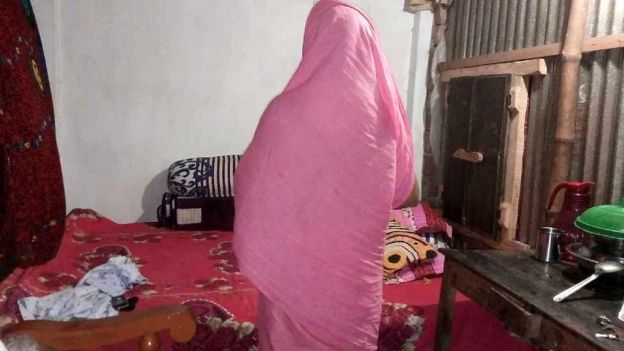
In Daulatdia brothel in Bangladesh, police guard the entrance, preventing customers from entering.

"Nazma"
Image caption“Nazma” says even if the brothel were open, she would be scared to see clients in case they had the virus

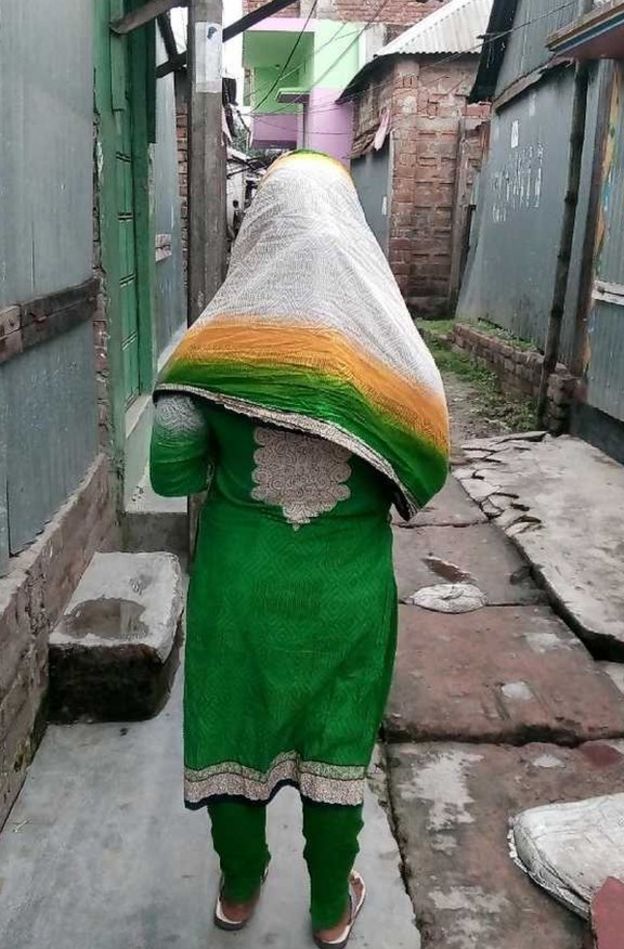
It is one of the world’s biggest brothels, a shanty town made up of tin sheds and narrow alleyways that is home to 1,300 women and their 400 children.

The brothel has been closed since March, leaving many of the women struggling to buy essential items and relying on donations from charities.

“We cannot work now, so we don’t have any income, which is scary,” says “Nazma”, who didn’t want to give her real name.

Nazma supports three children who live with her sister back in her village. She came to the brothel 30 years ago when she was just seven. Although she needs money, she worries about the dangers of working during the pandemic.

“Even if we could work, people’s lives are at risk from the virus. We’d be scared to go to bed with our clients anyway, as we don’t know who is affected,” she says.

Daulatdia sits on the banks of the Padma River, near a major ferry terminal. It is the main transport hub that connects the Bangladeshi capital Dhaka with the country’s southern districts.

A sex worker in the alleyways of Bangladesh's Daulatdia brothel.
Image captionSome 1,300 women live in the shanty town brothel, which is now closed for business

Prior to the coronavirus outbreak, thousands of truck drivers would pass through the area every day, delivering agricultural products and other goods to Dhaka.

Many of the women and children who live in the brothel are victims of trafficking.

“A lot of them who were kidnapped as children were sold there,” says Srabanti Huda, a lawyer and human rights activist based in Dhaka.

While the Bangladeshi government and local aid organisations have delivered some emergency funds to the women, Srabanti says it hasn’t been enough and some women received nothing at all.

“The amount of donations they’ve received from the government does not even cover a packet of powdered milk for the children,” she says.

In early May, Srabanti organised a private aid delivery, distributing packets of basic supplies for each of the 1,300 women registered at the brothel.

“There was one woman who said she has not been able to get her insulin or diabetic medications for over a month,” Srabanti says. “Another said she has not been able to buy her blood pressure medications since the lockdown started two months ago.”

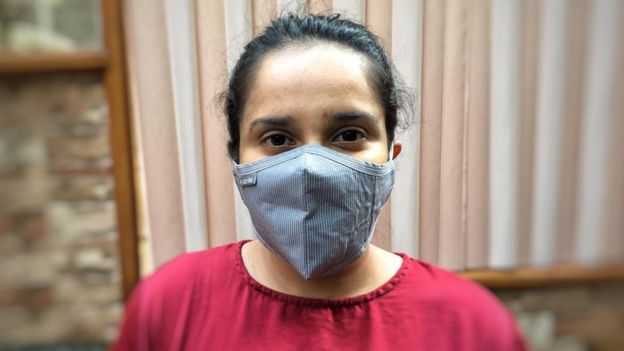
Activist and aid worker Srabanti Huda wearing a face mask
Image captionSrabanti Huda organised an emergency aid delivery to Daulatdia brothel in Bangladesh

Reduced access to healthcare services is an issue facing sex workers globally, according to Prof Sanders. The problem is particularly acute in areas where there is high demand for regular antiviral drugs from those living with HIV.

“There’s been real issues around access,” she says.

Prof Sanders is working with a team in Nairobi to develop an “Uber-style” app that will enable sex workers to order medication using their phones and have it delivered.

“It’s sent directly to them via a mode of transport rather than the person coming into the clinic,” she says.

Back in Daulatdia brothel, another sex worker who didn’t want to be named is returning from a trip to see her daughter, who lives in a nearby home for the children of sex workers.

Even when the brothel reopens, it will take a long time for the industry to recover, she says.

“People are afraid if they come to us, they might get infected,” she says. “We are afraid too. We might get infected from them. This fear of getting infected will come up all the time.”

Additional reporting by Salman Saeed.

Banner image reading 'more about coronavirus'

Australian researchers set record for carbon dioxide capture

Exposing the Big Game's avatarThe Extinction Chronicles

carbon dioxide
Credit: CC0 Public Domain

Researchers from Monash University and the CSIRO have set a record for carbon dioxide capture and storage (CCS) using technology that resembles a sponge filled with tiny magnets.

Using a Metal Organic Frameworks (MOFs) nanocomposite that can be regenerated with remarkable speed and low energy cost, researchers have developed sponge-like technology that can capture carbon dioxide from a number of sources, even directly from air.

The magnetic sponge is used to remove carbon dioxide using the same techniques as induction cooktops using one-third of the energy than any other reported method.

Associate Professor Matthew Hill (CSIRO and Department of Chemical Engineering, Monash University) and Dr. Muhammad Munir Sadiq (Department of Chemical Engineering, Monash University) led this research.

In the study, published in Cell Reports Physical Science, researchers designed a unique adsorbent material called M-74 CPT@PTMSP that delivered a…

View original post 317 more words

The Impacts of Climate Change and the Trump Administration’s Anti-Environmental Agenda in New Mexico

Rising temperatures associated with global warming have worsened drought conditions and intensified water shortages for the Navajo Nation in Thoreau, New Mexico, June 2019.

Getty/Spencer PlattRising temperatures associated with global warming have worsened drought conditions and intensified water shortages for the Navajo Nation in Thoreau, New Mexico, June 2019.

Just in the past three years, the Trump administration has attempted to roll back at least 95 environmental rules and regulations to the detriment of the environment and Americans’ public health. Moreover, the administration refuses to act to mitigate the effects of climate change—instead loosening requirements for polluters emitting the greenhouse gases that fuel the climate crisis. This dangerous agenda is affecting the lives of Americans across all 50 states.

Between 2017 and 2019, New Mexico experienced one drought and two severe storms.  The damages of each event led to losses of at least $1 billion.

Impacts of climate change

Extreme weather

Temperature

Impacts of the Trump administration’s anti-environmental policies

Climate

  • In March 2020, the Trump administration announced its final rule to overturn Obama-era fuel efficiency standards for cars. These weakened fuel standards will lead to higher greenhouse gas and particulate matter emissions and will cost New Mexico residents $215 million
  • The Permian Basin—the largest oil- and gas-producing area in the United States, stretching across parts of New Mexico and Texas—was found to be emitting methane at three times the national rate. Methane is responsible for one-quarter of greenhouse gas-driven global warming. In August 2019, the Trump administration proposed rolling back methane limits at oil and gas operations like those in the Permian Basin.
  • The Trump administration is attempting to gut climate considerations from major infrastructure projects by eliminating the “cumulative impact” requirement of the National Environmental Policy Act. This is concerning because New Mexico’s economy relies heavily on its agriculture, tourism, and outdoor recreation industries—all of which are highly dependent on climate and weather conditions.
    • Agriculture: Agriculture and food processing accounted for more than $10 billion of New Mexico’s gross state product and supported more than 50,000 jobs in 2012.
    • Tourism: In 2018, tourism in New Mexico generated nearly $10 billion in economic impact and supported more than 94,000 jobs.
    • Outdoor recreation: The outdoor recreation industry in New Mexico generates 99,000 direct jobs and nearly $10 billion in consumer spending.

Air quality

  • Mercury emissions in New Mexico decreased by nearly 84 percent from 2011 to 2017, yet the Trump administration just undermined limits on the amount of mercury and other toxic emissions that are allowed from power plants.

The Fast, Cheap and Scary Way to Cool the Planet

Risky Climate

Blocking sunlight with technology is feasible—it’s only a matter of time until someone tries it.

geoengineering-CMS-1
Illustration: Jonathan Djob Nkondo for Bloomberg Green

Congratulations. You’ve done everything humanly ­possible to cut carbon dioxide—to zero. But what if even that won’t be enough?

It’s one of the most uncomfortable realizations in climate research. Inertia in the climate system implies that even if emissions stopped, temperatures and especially sea levels would continue to rise for a long time. The logical conclusion leads almost immediately to the specter of solar geoengineering, an attempt to use technology to reflect a portion of sunlight back into space. The principle behind solar geoengineering is simple enough. With less sunshine coming through the atmo­sphere, the planet would invariably cool—and fast. At least temporarily. There’s even a natural analogue: the eruption of Mount Pinatubo in the Philippines. In June 1992—ironically, the same time as the pivotal Rio de Janeiro Earth Summit—global average temperatures were about 0.5C cooler than they would have been without all the ash and sulfur dioxide, SO₂, catapulted into the lower stratosphere by the volcano a year prior.

Alas, the millions of tons of gunk from Mount Pinatubo soon fell out of the stratosphere, temperatures shot back up—and they’ve been increasing since.

That leads to another thought experiment. What if some entity, be it an international body or a lone ­nation, decided to use large-scale tech to re-create the cooling effects of a volcanic eruption? The engineering would be straightforward: release SO₂ near the equator about 20 kilometers (12.4 miles) up into the stratosphere. The SO₂ would turn into tiny reflective sulfate particles that would spread around the globe within weeks and linger for months. A bit of sunlight would be reflected away, and everything down below would be cooled.

This is the premise of solar geo­engineering via stratospheric aerosols. It’s fast. Unlike cutting CO₂, adding SO₂ cools the Earth within weeks, not decades. It’s powerful. Millions of tons of SO₂ could help offset the global warming effects of hundreds of billions of tons of CO₂. It’s also highly imperfect and risky. It’s akin to adding one type of pollution (SO₂) to help counter the effects of another pollutant (CO₂). Think of it as an experimental drug taken in a pandemic. It might show promise, but watch out for unknown side effects.

In fact, SO₂ is a harmful pollutant. Burning fossil fuels releases tens of millions of tons of SO₂ into the lower atmosphere, killing about 4 million people each year through heart disease, stroke, and lung cancer. The resulting acid rain kills trees and melts medieval cathedrals. If all SO₂ emissions were to stop overnight, it would be a boon to human health but a setback for global warming because it cools the planet. Average global temperatures would rise by at least 0.5C—an eruption of Mount Pinatubo in reverse.

It was precisely this thought experiment that led to a resurgence in solar geoengineering research. Too little is known to actually do solar geo­engineering now, and research funding is less than $20 million a year. By ­comparison, the federal government alone spends more than $2 billion on climate research, according to the U.S. Global Change Research Program. Of the few dozen climate scientists actively engaged in the research, most focus on computer models. Only a handful are conducting lab experiments. A Harvard group is working on an experimental balloon platform, as well as on alternatives to SO₂. Calcium carbonate has shown promise in models and the lab. (I was until last year the founding co-­director of Harvard’s Solar Geoengineering Research Program.) Much more research is needed to make anything akin to an informed deployment decision, and any process of moving toward deployment will be messy.

Solar geoengineering is potentially so powerful that one actor might be able to lower temperatures for the globe. It’s only a matter of time before pressure will increase to do just that, regardless of how fast the world slashes CO₂ emissions. With more frequent extreme heat and weather, it’s not hard to foresee conditions miserable enough to make an attempt at a little relief seem worth the risk to some. Limited research is already making one thing clear: Solar geoengineering isn’t only technically feasible, it’s a bargain. Next to the trillions in costs from unmitigated climate change, and even the expense of cutting CO₂, solar geoengineering costs practically nothing. If anything, it’s too cheap. A program that releases SO₂ to decrease average temperatures by about 0.1C would cost less than $5 billion per year. This should prompt the world to prepare for its inevitability. Dozens of countries have both the capacity and possible motivation. The operative word is “when,” not “if.”

Covid-19 patients evacuated as Mumbai braces for worst storm to hit city in 70 years

Exposing the Big Game's avatarThe Extinction Chronicles

Tropical Cyclone Nisarga would be the strongest cyclone to hit Mumbai since 1948.
Tropical Cyclone Nisarga would be the strongest cyclone to hit Mumbai since 1948. CNN Weather

https://www.cnn.com/world/live-news/coronavirus-pandemic-06-03-20-intl/h_4ebad693f81837b61c9f78b765d4ca9e

Coronavirus patients were among more than 100,000 people evacuated from low-lying coastal areas in India’s western states as a cyclone advanced toward Mumbai in Maharashtra today.

Cyclone Nisarga made landfall at around 1 p.m. local time (3:30 a.m. ET) with wind speeds of up to 110 kph (68 mph), according to the Indian Meteorological Department (IMD).

The cyclone, which formed in the Arabian sea on Tuesday morning, hit Alibag town, south of Mumbai.

Cyclones in that part of the country are relatively rare — Mumbai, India’s financial center and home to 18 million people, was last hit by a major storm in 1948.

The arrival of Cyclone Nisarga today comes as Maharashtra grapples with India’s worst coronavirus outbreak. Hospitals are struggling to treat an…

View original post 58 more words

The fight against Covid-19 should also be the fight against tobacco

Smoking kills more than 8 million people a year, according to the World Health Organization.
Smoking kills more than 8 million people a year, according to the World Health Organization. Valery Sharifulin/TASS/Getty Images

Editor’s Note: Kelly Henning is the director of public health at Bloomberg Philanthropies. The views expressed in this commentary are her own. 

Protecting people from the dangers of tobacco products — and holding tobacco companies accountable for their global actions — is a critical component in the fight against Covid-19.

Smokers are more likely than non-smokers to develop severe complications with Covid-19, according to a review of studies by public health experts convened by the World Health Organization. And, a new study of 169 hospitals in Asia, Europe and North America found that smokers have nearly double the likelihood of in-hospital death than non-smokers.

But just as important, tobacco use — a pandemic in its own right — is costly to individual smokers and to society. Smoking kills more than 8 million people a year, mainly in low- and middle-income countries. These deaths are preventable and come mostly from cancer, heart disease, stroke, chronic lung disease and diabetes — conditions that also contribute to high rates of Covid-19 mortality. The human price is exacerbated by the economic toll in health care costs and lost productivity costs that reaches $1.4 trillion annually worldwide.

We’ll be better able to fight this pandemic, and future ones, if we commit ourselves to improving the world’s health. Helping smokers quit will reduce the amount of people with underlying conditions that could make them more susceptible to Covid-19 and other infections. At the same time, to adequately fund efforts to fight coronavirus and prepare for unknown health emergencies to come, we must lower health care costs for households and health care systems and shift our economy away from production and purchase of harmful products, such as tobacco.

https://www.cnn.com/world/live-news/coronavirus-pandemic-06-03-20-intl/h_4ebad693f81837b61c9f78b765d4ca9e

Twitter shuts down white nationalist group posing as Antifa after Donald Trump Jr. shares its tweet

The president’s eldest son had shared the fake account’s tweets and accused leftists of domestic terrorism


1.7K


8.6K


8
IGOR DERYS

https://www.salon.com/2020/06/02/twitter-shuts-down-white-nationalist-group-posing-as-antifa-after-donald-trump-jr-shares-its-tweet/

JUNE 3, 2020 1:40AM (UTC)
Twitter shut down a fake Antifa account after linking it to the white nationalist group Identity Evropa, the company announced Monday.

A Twitter spokesperson told CNN that an account claiming to belong to a national Antifa organization was shut down after it called for violence at protests over police brutality. Antifa, short for anti-fascist, is not a centralized organization but rather a political protest movement made up of small autonomous groups and individuals.

“This account violated our platform manipulation and spam policy, specifically the creation of fake accounts,” the spokesperson said in a statement. “We took action after the account sent a tweet inciting violence and broke the Twitter Rules.”

The move came after the account called for violence in residential areas.

“Tonight’s the night, Comrades,” the newly-created account tweeted Sunday. “Tonight we say ‘F**k The City’ and we move into the residential areas… the white hoods…. and we take what’s ours.”

The social network linked the fake account to Identity Evropa, which the Southern Poverty Law Center has classified as a white nationalist hate group.

A Twitter spokesperson told CNN that the company has taken action against fake accounts linked to Identity Evrope in the past, as well.

Sunday’s tweet was shared by Donald Trump Jr. on Instagram, who cited it as alleged evidence to support his father’s claim that Antifa is a domestic terror group, even though it is an affiliation rather than a centralized organization.

“Absolutely insane,” Don Jr. wrote. “Just remember what ANTIFA really is. A Terrorist Organization! They’re not even pretending anymore.”

Matthew Conroy@MattConroy24

Wasn’t @DonaldJTrumpJr pushing fake “antifa” accounts recently?!? Oh right, that was yesterday. https://twitter.com/sahilkapur/status/1267626627967725570 …

View image on Twitter
Sahil Kapur

✔@sahilkapur

NEWS: A Twitter account claiming to belong to a national “antifa” organization and pushing violent rhetoric related to ongoing protests has been linked to the white nationalist group Identity Evropa, according to a Twitter spokesperson. https://www.nbcnews.com/tech/security/twitter-takes-down-washington-protest-disinformation-bot-behavior-n1221456 …

37 people are talking about this

The post was later removed after Twitter shut down the account.

The fake account was created as President Donald Trump tweeted that he would label Antifa a domestic terror group, though experts say such a move would be unconstitutional. It would also be impossible, since there is no centralized Antifa organization, though some local chapters affiliated with the movement are well-organized.

Attorney General William Barr also blamed Antifa for inciting violence. State officials have said they found extremists from the left as well as white supremacists stoking violence amid protests over the death of George Floyd. However, the president has insisted there was no white supremacist involvement.

“It’s ANTIFA and the Radical Left,” he tweeted on Saturday. “Don’t lay the blame on others!”

But the FBI found that white supremacist groups urged followers to engage in violence two days after Floyd’s death, Politico reported.

A memo from the Department of Homeland Security, citing the FBI, revealed that “a white supremacist extremist Telegram channel incited followers to engage in violence and start the ‘boogaloo’ — a term used by some violent extremists to refer to the start of a second Civil War — by shooting in a crowd.”

The FBI also has evidence that “suspected anarchist extremists and militia extremists allegedly planned to storm and burn the Minnesota state Capitol,” the memo said.

Though the memo did not specify, Politico noted that “anarchist extremists” appears to refer to left-wing extremists, while “militia extremists” refers to those on the far-right.

:

“The truth is, nobody really knows,” he told NBC News. “There’s been a lot of videotape taken by demonstrators of people who are very suspicious, who really did start breaking windows. There have been other photographs of cars with no license plates. Very suspicious behavior.”

Extremism experts said there was evidence of a wide range of participants.

“We’re going to see a diversity of fringe malefactors,” Brian Levin, who heads the Center for the Study of Hate and Extremism at California State University at San Bernardino, told The New York Times. “We know for a fact there have been far-right agitators both online and at these rallies, as well as far-left.”