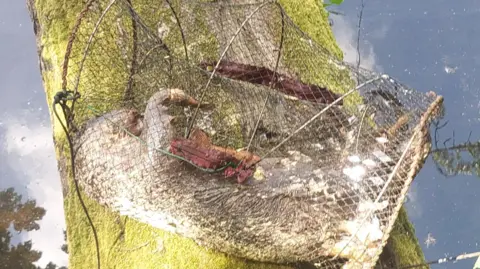
The “beautiful creature” met its end in an illegal crayfish trap, said police
An illegal crayfish trap placed in a pond in Derbyshire has killed an otter.
The owner of the pond in Hartshorne, near Swadlincote, had no knowledge that the trap had been set, said Derbyshire Police’s Rural Crime Team.
The trap snared and killed an adult female, said officers who on Monday appealed for anyone with information to come forward.
Sharing an image of the dead animal, a spokesperson for the team said: “This is the damage that can be caused to precious wildlife when illegal and unauthorised trapping practices are used.”
Coverage of bird flu should not be limited only to what’s happening in birds, cows and humans. Reporters can also start looking at local angles on environmental contributors to this current public health issue and to pandemics broadly.
The fact that bird flu has already spread to so many different species means the virus has many opportunities to evolve, a precursor to a pandemic. Unlike previous outbreaks of H5N1 in poultry, cows and wild animals — which have eventually fizzled out — this one appears to be here to stay.
The wildlife trade is a major driver of spillover; the longer an animal has been in trade, the more pathogens it shares with people. For every nine years that an animal has been traded internationally, it shares one additional pathogen with humans. Areas with high outbreak likelihoods are characterized by high chicken and duck densities, high population density, high road density and favorable climate factors. If your reporting area includes intensive chicken farming and processing, it’s worth asking questions about how bird flu is affecting local veterinary health, public health precautions, and economies.
“People in high-risk areas (intensive farms, farms at the edge of forests or water bodies, cattle fairs where cattle mingle with swine and birds, etc.) should avoid direct contact with sick or dead birds and livestock waste,” Debapriyo Chakraborty, Ph.D., a senior postdoctoral researcher at the University of Montpellier in France and an expert on influenza ecology and evolution, wrote in an email. “Proper protective measures, such as wearing masks and gloves, should be taken when handling animals. Pet owners should keep cats indoors, as they are susceptible to H5N1 and can act as vectors. Increased public awareness and early reporting of sick animals can help contain outbreaks. Simple biosecurity measures can significantly reduce the risk of spillover events.”
Such measures include protecting livestock from contact with wild birds (especially waterfowl) and their droppings; managing flows of animals to minimize transmission of any pathogens; wearing a mask when mucking out pens; having a designated pair of boots for livestock care that is kept outside the home and periodically sanitized; and wearing gloves when in close contact with animals.
These simple protocols can make a big difference, but they are individualistic. Regional biosecurity protocols are lacking in the United States as well as other countries and could help focus attention on major regional risks. For example, in areas with high poultry farm density and thus higher spillover risk, more stringent biosecurity and testing could be incentivized or required.
Vaccination
Some European countries, including France, have begun to vaccinate poultry farms for avian flu. But the United States does not vaccinate poultry livestock, largely because of outdated trade agreements enacted before molecular testing for infections was widely available. Dairy cows that test positive for bird flu cannot be traded across state or country borders; however, since this testing is optional and the disease isn’t lethal in cows, many farmers aren’t incentivized to test their herds.
“Missing epidemiological data in dairy cattle makes it hard to track transmission,” says Chakraborty. “H5N1 is not a reportable disease in mammals, leading to inadequate testing. Unlike poultry farms, dairy farms are not required to depopulate infected herds (probably causing silent transmission). These factors hinder containment efforts.”
Right now, vaccination is not considered necessary for small-scale, backyard poultry flocks. However, backyard flocks do need to be in a covered area protected from wild birds and their droppings. Owners should follow the simple biosecurity measures mentioned earlier.
Wild bird populations can’t feasibly be vaccinated. “There’s no oral vaccine that can be administered en masse to the wildlife (particularly the birds — the viral source),” says Chakraborty. “Also, these vaccines [that are available] reduce disease burden but do not prevent infection. This factor, when combined with influenza’s natural capability of rapid evolution, leads to immune escape and renders vaccines ineffective over time (as has been the case in France, for example).”
Warning signs
Bird flu is a serious infection in cats and is often fatal. Over the past year, dead cats on farms have been an important signal that dairy cattle were infected, pointing to the lack of other surveillance measures and the need for broader milk testing. Considering that transmission from cats to humans was documented in February, it’s important to keep cats away from areas with poultry, wild waterfowl or cattle, both to protect pets and their owners — and to prevent opportunities for the virus to evolve to infect humans more easily.
“The bottom line is that we need to increase global cooperation in surveillance, vaccine updates, and policy adjustments in cattle biosecurity for vaccines to be truly effective in stopping the spread,” says Chakraborty. The inadequacy of current data collection efforts, which Tara Haelle and I covered in an earlier post, leaves plenty of knowledge gaps that can be highlighted or even filled by intrepid local and regional reporting.
Many dairy-producing states are not participating in the voluntary milk testing program for bird flu. Talk to farmers about their frustrations with the response and how the outbreak is affecting their business and animals. Because avian flu is fatal in poultry but not in dairy cows, farmers of different livestock will have different perspectives.
We know cases are being missed — in wild birds, wild mammals, cows, sheep, pets and humans (especially farm workers and veterinarians). Can you find them?