Sue Mitchell fears bird flu is behind the death of several swans at Oulton Broad
A wildlife enthusiast is concerned bird flu could be behind the deaths of several swans near an inland waterway and testing needs to be carried out.
At least four carcasses have been found at Oulton Broad near Lowestoft, Suffolk, over the past three weeks, which Sue Mitchell feared could be a result of the disease.
She reported the birds to the Department for Environment, Food and Rural Affairs (Defra), but it had not been able to get to the birds.
East Suffolk Council told the BBC its teams would collect them and inform Defra afterwards.
“They said they would collect it and test it, or at least the first one, but it hasn’t happened,” Ms Mitchell said.
However, she was told that due to the location of the birds close to the water, Defra’s teams would be unable to access them.
She was instead encouraged to contact the council, but feared if the birds were not collected and had died of bird flu, it could spread to others.
“They need to take action; they ask the public to report it,” she said.
“There’s people having their whole flocks of chickens culled because of bird flu and then we’ve got these instances here and nobody is acting at all.”
Paul Rice said he had counted 72 swans at Oulton Broad this year compared to last year’s 50
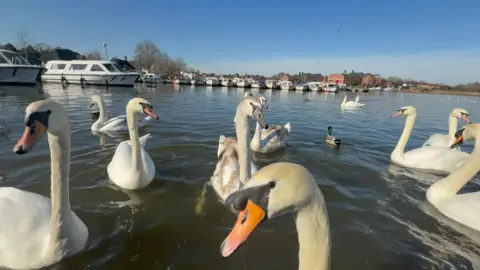
Paul Rice is the yacht station manager for the council at Oulton Broad and said the swan population numbers had recently increased.
He was aware of the reports, but had not received any request “to deal with them in the way we normally would with bird flu” and could not comment on their cause of death without tests.
“The swans that I’ve seen, especially the ones in this area which we see on a regular basis, look as healthy as I’ve ever seen them,” he said.
East Suffolk Council said it was handling the carcasses
Advertisement
A council spokesperson said: “East Suffolk Services will collect the [remaining] swan carcass. This is in hand. Once collected Defra will be informed.”
When approached for comment Defra pointed out its Animal and Plant Health Agency (APHA) carried out year-round surveillance of dead wild birds submitted via public reports and warden patrols, but not all dead birds would be collected.
APHA also publishes a weekly report on bird flu findings in wild birds and members of the public are encouraged to report dead wild birds either online or by calling Defra’s helpline.
The tall, slender grey birds are making their annual spring migration to northern breeding grounds. Experts say the virus could become a larger problem if it gets passed to endangered whooping cranes
Migrating sandhill cranes stop to rest and refuel in the Midwest as they make the long journey northward to their breeding grounds. U.S. Fish and Wildlife Service
The tall, slender grey birds are in the middle of their spring migration. They’re heading north to breeding grounds in Alaska, Canada and eastern Siberia. As they make the annual journey, the birds stop to rest and refuel in various places throughout the Midwest, including Indiana.
In recent weeks, biologists with the Indiana Department of Natural Resources have counted hundreds of dead sandhill cranes statewide. At least 500 of the birds were found dead in Jackson County, in the south-central part of the state, in early January.
Since then, as the birds have continued to fly northward, deaths have been reported in other parts of Indiana. And 1,500 deaths is likely an underestimate, officials say.
“This year they brought avian influenza with them and it just ripped through the population very quickly,” Eli Fleace, a biologist with the Indiana Department of Natural Resources, tells the Post-Tribune.
The birds are dying from the H5N1 strain of avian influenza, which has been wreaking havoc on America’s poultry industry and, in turn, driving egg prices to rise. The deadly pathogen has also been wiping out wild birds, including more than 5,000 snow geese in eastern Pennsylvania in January.Report This Ad
Wild birds—especially those that migrate in large flocks—are particularly susceptible to the highly contagious strain. Biologists are hopeful the deaths will slow this spring, since the virus tends to peak during the fall and winter.
“Humans really can’t do much in a single season,” Fleace tells the Post-Tribune. “You can’t ask [the birds] to isolate from each other.”
Meanwhile, volunteers in northwest Indiana are doing what they can to help stop the spread. Donning masks and gloves, they’re gathering as many sandhill crane carcasses as they can from frozen lakes and shorelines. Acting on the advice of biologists, they’re double-bagging the carcasses in trash bags and disposing of them in a rented dumpster; they’re also sanitizing any equipment they use to pick up the bodies.
“I decided someone’s got to do something about it and pick up these birds,” says Sean Leone, a resident of Upper Fish Lake in northwest Indiana, to WSBT’s Cicily Porter. “So, I started getting volunteers together and asking people if they’d like to donate bags or gloves or whatever to help, you know, bring you into the community and everybody helps chip in and do their part.”
An estimated 650,000 sandhill cranes live in North America, and their population is increasing, according to the American Bird Conservancy. But their close relatives, whooping cranes, are much less abundant: Around 800 of those endangered birds are still in existence.Report This Ad
Whooping cranes often share habitats with sandhill cranes, as well as other waterfowl. Experts are concerned about the spread of H5N1 between the different species.
“If [the virus] gets into a small number of [whooping cranes], that’s a large percentage of the population,” says Diana Boon, director of conservation medicine for the International Crane Foundation, to USA Today’s Trevor Hughes and Dinah Voyles Pulver.
Biologists in central Nebraska are also following the recent sandhill crane deaths closely. Hundreds of thousands of the birds—roughly 80 percent of the total population—spend several weeks resting and fattening up near the Platte River in February, March and April. So far, no sick or dead cranes have been reported in Nebraska.
“We’re preparing for the worst, but hoping for the best,” says Bethany Ostrom, a biologist with the nonprofit Crane Trust in Wood River, Nebraska, to KETV’s Andrew Ozaki. “The cranes aren’t magically, like, immune to this. And so that’s pretty concerning with how big of congregations we get here.”Report This Ad
Wildlife biologists across the country are asking members of the public to report any sick or dead animals. The overall risk of infection is low for humans, but 70 people in the U.S. have contracted the virus since 2022. In January, the country reported its first human death from H5N1 bird flu.
Grizzly bears once roamed across the western United States, but relentless hunting and trapping over the past few centuries nearly wiped them out. Thanks to decades of protection under the Endangered Species Act (ESA), these iconic bears have begun to recover and regain their rightful, ecologically critical place in North American ecosystems.
Some good news for grizzly bears: In January, the U.S. Fish and Wildlife Service (USFWS) rejected efforts by Wyoming and Montana to strip grizzlies of ESA protections so more could be killed. Instead, USFWS proposed regulations to keep grizzlies listed as a threatened species across Idaho, Montana, Washington, and Wyoming—a significant step in the right direction.
But here’s the bad news: The current proposal would remove ESA protections for grizzlies outside Idaho, Montana, Washington, and Wyoming—which would spell disaster for bears that migrate through and live in other states. Worse yet, the plan would make it easier for ranchers and landowners to kill grizzlies—undoing years of progress toward their recovery. Adding to the uncertainty, public hearings on the proposal were canceled under the new administration, and there’s a real danger that the stronger protections could be reversed while the harmful provisions remain. Grizzlies need your voice now.
Please submit a comment by March 17 telling FWS to stand firm and protect grizzly bears! Speak Up for Grizzly Bears!The full proposal from the Fish and Wildlife Service is available here.
To submit a comment:Go to http://www.regulations.gov docket number: FWS-R6-ES-2024-0186 here.Click on the “Submit a Public Comment” button in the upper left corner and draft your comment using these talking points (please personalize your comment for greater impact).Submit your public comment before March 17, 2025!



:focal(500x333:501x334)/https://tf-cmsv2-smithsonianmag-media.s3.amazonaws.com/filer_public/47/89/47897f9c-de70-4221-ae2e-287d68eab786/natdiglib_18314_large.jpg)

