BAN SWAN HUNTING
Reply


FOX NewsFollow
1.6M Followers
Story by Michael Dorgan
• 7h • 3 min read
bringing Kiev to what could be its biggest test since
Loaded: 22.89%Pause

Current Time 0:10
/
Duration 2:11Quality SettingsCaptionsFullscreen

NATO members debate whether to allow Ukraine to use Western weapons on Russian soilUnmute
0
Asenior ally of Russian President Vladimir Putin says Russia is not bluffing about using tactical nuclear weapons against Ukraine and warned that the conflict could spill over into other countries.
Dmitry Medvedev, the deputy chair of the Security Council of Russia, made the comments after President Biden quietly authorized Kyiv to launch U.S.-supplied weapons at military targets just over the border in Russia that are supporting an offensive against the northeastern Ukrainian city of Kharkiv.
“This is, alas, neither intimidation nor bluffing,” Medvedev said Friday, speaking on the potential to use strategic nuclear weapons, per Reuters.
UKRAINE SEEKS TO STRIKE RUSSIAN TARGETS WITH WESTERN WEAPONS, ZELENSKYY SAYS

Dmitry Medvedev, a senior ally of Russian President Vladimir Putin, right, says Russia is not bluffing about using tactical nuclear weapons against Ukraine and warned that the conflict could spill over into other countries. President Biden, left, quietly authorized Kyiv to launch U.S.-supplied weapons at military targets just over the border. Getty Images© Photo by Alex Wong/Getty Images | Photo by Mikhail Svetlov/Getty Images
Russia has been using staging locations just across the border to enable its attacks against Ukraine and Biden has given Ukraine the go-ahead to use American weaponry to hit back at Russian forces hitting them or preparing to hit them. Germany has also backed the move.
The White House says the policy is limited and prohibits the use of army tactical missile systems (ATACMS) or long-range strikes inside Russia.
LendingTreeHow To Borrow From Your Home Without Touching Your Mortgage
In March, the U.S. quietly delivered long-range ATACMS to Ukraine for the first time – which the Ukrainians have since deployed against Russian military forces inside Ukraine.
Medvedev said Friday that “Russia regards all long-range weapons used by Ukraine as already being directly controlled by servicemen from NATO countries.”
“This is no military assistance, this is participation in a war against us. And such actions could well become a casus belli (an act that provokes a war),” Medvedev said Friday, per Reuters.
Medvedev, who served as Russian president from 2008 and 2012, said that the West’s ongoing support of Ukraine could lead to an escalation of the 27-month-old full-scale invasion.
“The current military conflict with the West is developing according to the worst possible scenario. There is a constant escalation when it comes to the firepower of NATO weapons being used. Therefore, nobody today can rule out the conflict’s transition to its final stage,” Medvedev said.
KYIV’S FORCES ARE UP AGAINST A CONCERTED RUSSIAN PUSH IN EASTERN UKRAINE, A MILITARY OFFICIAL SAYS

Dmitry Medvedev, the deputy chair of the Security Council of Russia, speaks during an interview with Russian media at a residence outside Moscow, Russia, on March 23, 2023. Reuters© Reuters
The comments come as depleted Ukrainian troops are losing ground in the war – and just weeks after the U.S. agreed to send an extra $60 billion in aid to the war-torn country. In the border region of Kharkiv, Ukraine has endured a Russian onslaught this month that has stretched Kyiv’s outgunned and outmanned forces.
LendingTreeHow To Borrow From Your Home Without Touching Your Mortgage
The White House says that Russia’s forward progress has stalled and that Russia will not be able to capture Kharkiv.
Russia has only moved forward by a few kilometers and its forces are under relentless barrage by the Ukrainians and suffering at an extraordinary cost, the White House tells Fox News.
Ukrainian President Volodymyr Zelenskyy said Friday that it’s only a matter of time before Ukraine utilizes the Western weaponry to strike Russian territory.
The developments and threats of escalation came just weeks after Gen. Charles Brown, the Chairman of the Joint Chiefs of Staff, said NATO military trainers will eventually be sent to Ukraine, according to a report in the New York Times.
Ukrainian officials have asked their U.S. and NATO counterparts to help train 150,000 new recruits closer to the front line for faster deployment, per the report. 
HOME VALUATIONSInstantly Check The Value Of Your Home (It May Be Worth More Than You Think
Rep. Eli Crane, R-Ariz., told Fox News Digital at the time that deploying military trainers would lead to a wider war in the region.
Friday’s comments by Medvedev are not the first time he has taken a hardline stance against the West. In January, he warned the U.K. that putting boots on the ground in Ukraine would amount to a declaration of war against Russia.

Ukrainian President Volodymyr Zelenskyy, left, greets Secretary of State Antony Blinken, right, prior to their meeting in Kyiv on May 14, 2024. AP Newsroom© AP Newsroom
In January, he also raised the prospect of nuclear war, warning NATO allies that a defeat for Russia in Ukraine could provoke a nuclear war.
“The loss of a nuclear power in a conventional war can provoke the beginning of a nuclear war,” he said in a Telegram post.
“Nuclear powers have [never] lost major conflicts on which their fate depends,” the Kremlin official added.
Fox News’ Jennifer Griffin, as well as Reuters and The Associated Press contributed to this report.
Original article source: Russia not ‘bluffing’ with nuclear threats as Biden greenlights limited military strikes, Medvedev says

MetroFollow
484.5K Followers
Story by Sam Corbishley
• 8h • 9 min read
An all-out nuclear war could wipe out hundreds of millions of people around the world within the space of just a few hours.
The huge flash of blinding light when a nuclear bomb detonates is ‘like bringing a piece of the sun down to the ground’. Everything within the miles-wide firestorm is instantly incinerated.
Travel OregonExperience Oregon this Spring with Our Local Guides
Those spared annihilation in the initial blast would then face being poisoned to death by the radioactive fallout or noxious smog billowing from burning cities and industrial areas.
The consequences of nuclear war on the world’s climate make for even more terrifying reading. Smoke from the fires would block out the sun, reducing its warming rays by up to 70% and plunging the world into a new horror – nuclear winter.
Brian Toon, professor of atmospheric and oceanic sciences at the University of Colorado Boulder, is one of the pioneers of nuclear winter research.
1 / 8


Putin’s mountain palace that houses a ‘nuke bunker’ ravaged by mystery fire©Provided by Metro
A Siberian palace said to be Putin’s unofficial residence has been partly destroyed by a devastating fire. The blaze levelled an entire building at the lavish compound in Russia’s Altai Republic, a sparsely inhabited mountainous region home to a large minority of indigenous nomadic animal herders. The main structure appeared to escape the worst of the flames, although officials have not confirmed whether it also suffered damage (Picture: East2West News)See more
He spoke to Metro about nuclear winter theory and why his warnings about it stretching back 40 years are still just as valid today.
What is nuclear winter?
Nuclear winter theory first caught the world’s attention in 1983 when one of the its most famous scientists, Carl Sagan, published an article asking ‘Would nuclear war be the end of the world?’.
 Related video: How the U.S. maintains absolute nuclear deterrence (Interesting Engineering)
From 1940 to 1966, the US invested at least
Loaded: 5.04%Play
Current Time 0:13
/
Duration 13:52Quality SettingsCaptionsFullscreen

How the U.S. maintains absolute nuclear deterrenceUnmute
0
More videos
In it, he wrote that ‘in a nuclear exchange more than a billion people would instantly be killed, but the long term consequences could be much worse’.
Sagan and some of his students, including Prof Toon, along with meteorologists subsequently set out in horrifying detail what those consequences would be.
They found the thick black smoke billowing from burning cities and industrial areas would rise high up into the stratosphere and block out the sun’s light.

Brian Toon is professor of atmospheric and oceanic sciences at the University of Colorado Boulder (Picture: Edwina Hay)© Provided by Metro
The ensuing cold, dry and dark would send temperatures plummeting below zero and condemn billions more people to starvation with the collapse of agriculture.
The idea of mutually-assured destruction – if country A attacks country B, the retaliation by country B would render any first strike suicidal – has helped prevent nuclear war in the decades since.
Travel OregonExperience Oregon this Spring with Our Local Guides
But subsequent research also suggests it would be suicidal for country A to launch a first strike regardless of whether country B responds due to the climate changes caused by the smoke.
Faced with the poisoned apocalyptic world that would await any survivors of a full-scale nuclear war, former Soviet leader Nikita Khrushchev said: ‘The living will envy the dead.’
Would London be safe if World War III broke out?
If you live in any big city across Europe or North America it’s safe to assume there is at least one nuclear bomb aimed at you right now.
Russia has around 2,000 strategic deployed nuclear weapons. The US has roughly the same.
Between them they have around 500 cities with more than 100,000 people – that’s eight nuclear bombs for each one.
‘It only takes one of those weapons to destroy a city with 100,000 people typically,’ Prof Toon says. ‘It’s overkill.
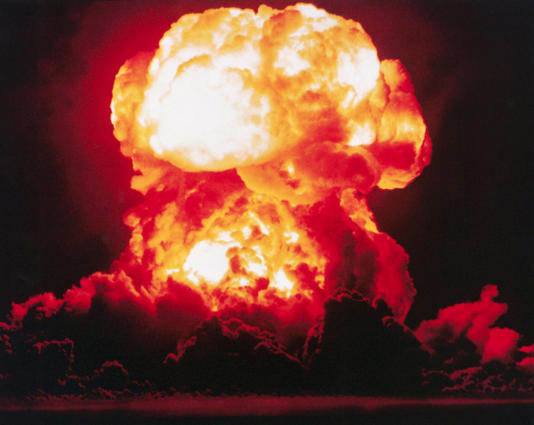
One nuclear bomb is enough to destroy a city of 100,000 people (Picture: Corbis via Getty Images)© Provided by Metro
‘If there’s a war between the US and Russia, Europe is going to be attacked, and it’s going to be attacked by nuclear weapons. It’s going to be attacked by a lot of nuclear weapons.’
He went on: ‘I recently looked at targets in Europe and I found about 650 military targets in Europe. Britain has them all over the place.’
Travel OregonVisit Oregon this Spring with Our Local Guides
The explosion from a nuclear bomb ‘is a lot like bringing a piece of the sun down to the ground’, Prof Toon says.
‘The bomb goes off, and there’s this huge energy release that creates an expanding fireball which is very hot. It’s initially in the millions of degrees but then soon reaches the temperature of the sun.
‘A typical nuclear weapon will destroy about a hundred square kilometres where it goes off, and most of that destruction occurs from the fires.
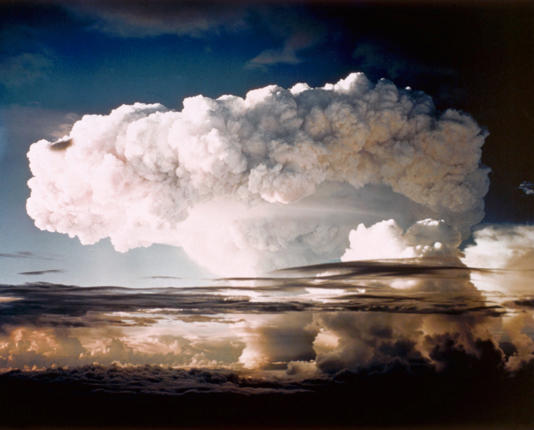
The mushroom cloud from Ivy Mike, one of the largest nuclear blasts ever (Picture: Corbis via Getty Images)© Provided by Metro
‘That’s what did the destruction in Hiroshima, for example, was fire. If you look at pictures of Hiroshima, there’s just rubble on the ground. A few standing concrete buildings still left.
‘And that damage was mostly from the fires.
‘In fact, for Hiroshima, the fires probably released a thousand times as much energy as the bomb itself, so they were very destructive.’
The blazes ignited by a nuclear bomb blast ‘are not normal fires’, Prof Toon says, adding: ‘It’s not just a little tiny place that is set on fire in an area – it could be 100 square kilometres – and a fire that big is going to have a smoke line that goes into the upper atmosphere.’
Not long before Prof Toon and his colleagues began their research it was discovered that an asteroid collision was responsible for killing the dinosaurs 66 million years ago.
There is a thin line of sediment left from the asteroid collision all over the planet.
‘That layer contains debris and rocks left from the asteroid,’ Prof Toon says. ‘Most of those look like little spheres that are about the size of a grain of sand.
‘They obviously were heated because they’re a spherical piece of rock, so we think the asteroid was vaporised when it hit the ground because of the huge energy release, which is the equivalent of a hundred million nuclear weapons going off.
‘It blew these little rock spheres all over the planet and when they re-entered the atmosphere they got hot because they were moving very fast and the friction with the air heated them up to a thousand or two thousand degrees centigrade.
With the thousands and thousands of molten rocks raining down, the sky would have looked like a sheet of lava, Prof Toon says.
‘If you want to experience what the dinosaurs felt you can go down to the grocery store and buy a turkey, open up your oven and turn it to broil, then throw the turkey in there,’ he goes on.
‘That layer contains not just rock from Mexico and the asteroid, it also contains soot and smoke from the fire.
‘So you can see this 66 million-year-old debris left from the fire. And the amount of material there is so great that you had to burn everything on the surface of the earth.
‘That was all discovered in the early 1980s, and so we thought would this be similar to what would happen after a nuclear war when you get all these fires going in cities?’
Back during the height of the Cold War, it was believed that any nuclear conflict was winnable.
But the modelling data suggested the opposite – for all sides and even some with no involvement in the conflict whatsoever.
The United States has a launch on warning policy of nuclear weapon retaliation.
That means a retaliatory strike is launched upon warning of an enemy attack – it does not wait to absorb it.
Consequently, the US president is left with a desperately small window of time in which to decide how that retaliation will play out.
In her terrifying yet exhilarating book ‘Nuclear War: A Scenario’, award-winning investigative journalist and author Annie Jacobsen recounts Ronald Regan’s lament in his memoirs.
He wrote: ‘’Six minutes to decide how to respond to a blip on a radar scope and decide whether to release Armageddon! How could anyone apply reason to a time like that?’
Six minutes to weigh up the lives of millions, possibly billions of people.
‘The idea that we’re only a few hours away from the end of the world, that’s quite accurate in certain circumstances,’ Prof Toon says.
‘If you have a war between the United States and Russia and Europe and then possibly China, the amount of smoke there is so great that the sunlight has diminished to about 20% of normal over the planet,’ Prof Toon explains.
‘And these calculations with these climate models, the temperature falls below freezing.
‘So if you’re in a place like Ukraine, which is the bread basket of Europe, or Iowa, which is the bread basket of the US, the temperatures in those places fall below freezing within a few weeks of the war and stay below freezing continuously every day for a couple of years.
‘The actual minimum temperatures occur in about the third and fourth year, and it takes close to a decade to get back to normal temperatures.
‘You’re not going to grow anything at the temperatures below freezing every day for a couple of years. So there won’t be any food coming from the Middle Latitudes and that will create mass starvation.’
Ominously, he adds: ‘Starving doesn’t mean hungry – starving means dead.’
Prof Toon’s research has shown you might survive a nuclear war fought mainly in the northern hemisphere by living in Argentina, Australia or New Zealand.
Each are large food exporting countries, suggesting they would all be able to produce enough food to feed their current populations in the event all international trade in food were to collapse.
Even the worst case scenario in terms of smoke-induced climate change would be lessened there due to their locations in the southern hemisphere and being surrounded by large oceans.
Meanwhile, in the USA, Russia and China more than 90% of the populations there would perish from starvation.
Prof Toon helped coin the term self-assured destruction, arguing that the climate changes triggered by smoke from a nuclear first strike would be so damaging to food and water supplies, along with infrastructure breakdown, that starvation would occur in the attacking country as well as the nation targeted and countless others outside the combat zone.
Findings by he and his colleagues – backed by those of a team of Soviet scientists – helped persuade Mikhail Gorbachev and Ronald Reagan to reduce the number of warheads in 1986.
‘Both Gorbachev and Reagan said that their science communities told them that if they had a nuclear war, that it was going to kill everybody on the planet mostly,’ he says.
‘So, Reagan and Gorbachev agreed to get rid of nuclear weapons, delivery systems from short – range missile in Europe, and a build-down of nuclear weapons started to occur.
‘There were 70,000 nuclear weapons, now there’s around 10,000.’
The US and Russia are not the only countries capable to wreaking climate havoc with nuclear war.
Each of the nuclear states – including the UK – with the exception of North Korea has enough firepower to alter the global climate.
‘I was called by somebody in the early 2000s because India and Pakistan had tested nuclear weapons and threatened each other for years over Kashmir,’ Prof Toon says.
‘The reporter asked what would happen if they had a nuclear war?’
He now regrets answering in haste that he believed it unlikely any consequences would stretch beyond those two countries.
Prof Toon went back and conducted simulations on a potential India-Pakistan conflict involving the use of roughly half their nuclear arsenals – 50 Hiroshima-size weapons.
‘Our best estimate at the moment is that if they used about half their arsenals they would kill something like 50 to 150 million people in India and Pakistan, and between one and two billion people over the rest of the planet,’ he added.
‘And the people over the rest of the planet would die because of nuclear winter.’

The current number of warheads per nuclear armed nation (Picture: Metro.co.uk)© Provided by Metro
In 2018, Prof Toon gave a TED Talk titled ‘I’ve studied nuclear war for 35 years – you should be worried’.
Just before Russia waged war on Ukraine it had got around four million views. It now has nearly nine million.
Prof Toon says the comments have gone from ‘how can you study nuclear war for 35 years when there hasn’t been one?’ to ‘I’ve studied nuclear war for an hour and I’m worried about it’.
‘There is a lot of concern over Donald Trump. When he left office a lot of people worried he might blow something up for the fun of it. It’s an open question as to how rational Donald Trump is.
‘But I don’t see any reason why he would start a nuclear war. Even he would realise that the response would be pretty bad.
‘So I think it’s most likely that it would start because of an accident and a misunderstanding between the two countries involved.
‘We’re in a heightened state of awareness right at this minute and we have been here for the last year or so.
‘There could be some kind of accident that occurs somewhere that could blow up and escalate.’
Prof Toon says protest and letting politicians know how they feel is the way to get them to change.
‘That’s the only way it is going to go anywhere, is if people worldwide demand their politicians do something,’ he adds.
‘In democracies that’s practical. In Russia at the moment that’s probably very difficult to protest against nuclear weapons, so it varies across the world what you can do.
‘But people should attempt to make their politicians aware of this problem and do whatever they can to get them to do something about it.’
It worked with the Nuclear Test Ban Treaty in 1963 and again with Gorbachev and Reagan in 1986.
As they said in their joint statement: ‘Nuclear war cannot be won and must never be fought.’
MAY 30, 20242:10 PM ET
HEARD ON MORNING EDITION
By
Carmel WrothLISTEN· 2:36
2-Minute ListenPLAYLIST

A farmworker was infected with bird flu from a dairy cow, the third human case in the recent outbreak.
Rich Pedroncelli/AP
Updated 3:10 p.m. ET
Michigan’s health department announced Thursday a human case of bird flu in a dairy worker. It’s the third human case reported to date in the current U.S. avian flu outbreak among dairy cows.
Unlike the previous two cases which only involved eye infection, this patient has respiratory symptoms, according to a statement from Dr. Natasha Bagdasarian, chief medical executive with the Michigan health department. The patient had direct exposure to an infected cow and wasn’t wearing any personal protective equipment.
“This tells us that direct exposure to infected livestock poses a risk to humans,” said Bagdasarian.
Sponsor Message
The Centers for Disease Control and Prevention said in a statement that its labs tested a sample from the Michigan patient and confirmed it was H5N1 bird flu. The patient had flu-like symptoms, including a cough and eye discomfort. The patient was treated with antivirals and is isolating at home. No other workers or household contacts of the patient have gotten sick so far.
The CDC said that risk to the general public remains low. Like the other two recent cases, this infection came from direct exposure to an infected animal. “There is no indication of person-to-person spread of A(H5N1) viruses at this time,” according to the CDC.
The CDC is monitoring data from influenza surveillance systems, and said “there has been no sign of unusual influenza activity in people.”
Nonetheless, scientists following the outbreak say this human case is troubling development.
“Our concerns about this outbreak are coming true,” says Dr. Rick Bright, a virologist and the former head of the Biomedical Advanced Research and Development Authority (BARDA). “The longer the U.S. allows this outbreak to continue, without appropriate measures to stop it, without conducting testing in cows and people, more people will be at increased risk for exposure and infection.”
Sponsor Message
Bright says it’s a problem that there’s not better sharing of bird flu data in the U.S., and there’s not more testing and precautions to prevent spread. He warns this will lead to more humans infected by animals. And that could eventually lead the virus to adapt itself to spread among humans. “This virus will find a way to transfer more efficiently among humans. This is what happens with a virus like this,” he told NPR.
Both the CDC and Michigan health officials emphasized the importance of protecting farm workers from possible exposure.
Michigan Department of Agriculture and Rural Development director Tim Boring said his department is offering support to dairy farms in need of protective gear. “Proper use of personal protective equipment is the best tool we have to protect farm workers.”
Will Stone contributed to this report.
By Heather Chen, Hanako Montgomery and Moeri Karasawa, CNN
9 minute read
https://www.cnn.com/2024/05/30/asia/japan-whaling-mothership-kangei-maru-intl-hnk/index.html
Published 5:00 PM EDT, Thu May 30, 2024

The Kangei Maru is seen docked at Port Shimonoseki in Yamaguchi Prefecture on March 29, 2024. Tosei Kisanuki/The Yomiuri Shimbun/APHong Kong/TokyoCNN —
Wearing a toy whale hat, whale tie and a whale motif shirt, Hideki Tokoro spends much of his days thinking about the world’s largest mammals. But he doesn’t want to protect them. He wants to hunt them.
To do that his company Kyodo Senpaku has built and launched a brand-new whaling $48 million “mothership” – the Kangei Maru.
“We are proud of catching whales and are very proud of this ship which will allow us to begin offshore mothership-style whaling this year,” Tokoro told reporters as he escorted them around the 370-foot, 9,300-ton vessel that set sail last Saturday for an eight-month tour of the country’s northern waters.

Kyodo Senpaku’s president Hideko Tokoro, wearing a toy whale hat, speaks to the media on board the Kangei Maru vessel in Tokyo harbor on 23 May, 2024. Hanako Montgomery/CNN
The new ship replaces the Nisshin Maru, the infamous whaling factory vessel dubbed by activists as a “floating slaughterhouse” that was decommissioned in 2020 after more than 30 years of service, during which it frequently clashed with anti-whaling activists.
The Kangei Maru is bigger and faster than its predecessor, the company says, and is equipped with state-of-the-art drones able to travel a reported 100 kilometers (62 miles) to allow crews of smaller boats to quickly locate and kill whales.
But activists say the ship’s high-powered features, including a cruising range of 13,000 kilometers (more than 8,000 miles) and its ability to sail for up to 60 days, suggests that Japan is setting its sights on whales far beyond its northern waters.
“Japan has never given up on its whaling ambitions,” veteran anti-whaling activist Paul Watson told CNN. “The only purpose of a vessel like that is so it can travel long distances to the Southern Ocean to hunt whales, (and) what the whalers are doing right now is really just a test run. They are testing out the new ship in their waters.”
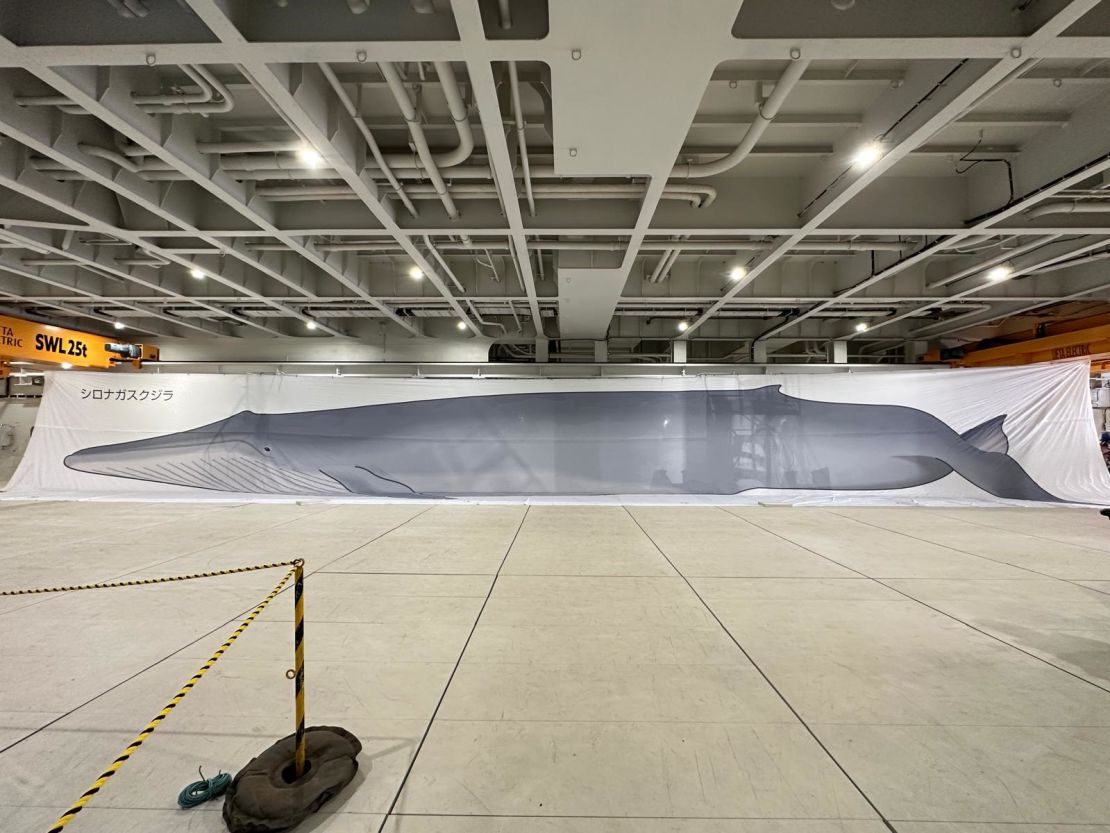
A life-size banner depicting what looks like an adult fin whale hung over a chopping area the size of at least two basketball courts. Hanako Montgomery/CNN

The ship will have enough storage to freeze up to 2,000 tons of whale meat. Daisuke Urakami/The Yomiuri Shimbun/AP
The Kangei Maru boasts a slipway large enough to haul 85-foot whales from the sea that leads to an indoor flensing deck the size of two basketball courts.
There, workers will strip away the blubber before cutting up the whale flesh on enormous cutting boards, before vacuum-packing and storing the meat in 40 industrial freezers, ready for sale.
“Whales are at the top of the food chain. They compete with humans by eating marine creatures that should be feeding other fish,” Tokoro said on the tour.
Enter your email to subscribe to the CNN Five Things Newsletter.

You give us five minutes, we’ll give you five things you must know for the day.Sign Me Up
By subscribing you agree to our
“We need to cull whales to keep the balance of the ecosystem – it’s our job and mission to protect oceans for the future.” He also told CNN that most of the ship’s catch would be killed “almost instantly” by cannons at sea. “We aim for perfection, but some of them may suffer. In such cases, we will use a rifle to finish the job.”
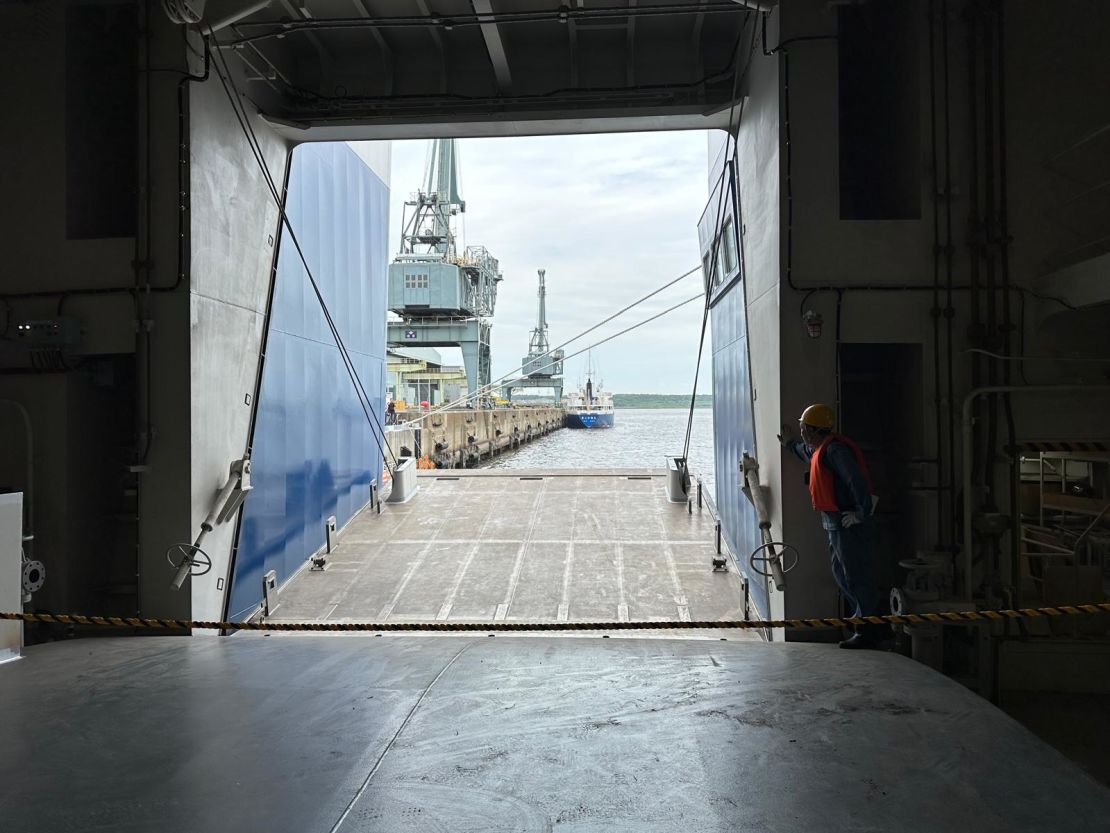
The slipway of the Kangei Maru, where whales will be hauled on board for processing. Hanako Montgomery/CNN
Besides objecting to the slaughter one of the ocean’s most majestic creatures, marine conservation groups and scientists have highlighted the important role which whales play in helping to tackle the climate crisis through sequestering and storing planet-heating carbon emissions.
“Whales are not just consumers in ocean eco-systems – they recycle a ton of nutrients into the environment which helps stimulate plant-life growth,” said marine ecologist Ari Friedlaender, also rejecting pro-whaling arguments that commercial hunts could be “sustainable.”

“Humans have a very long history of killing whales and have not done a good job of being able to sustainably harvest animals,” he said. “There is no way to sustainably harvest a wild animal like that.”
Commercial whaling was banned in 1986 under a moratorium by the International Whaling Commission (IWC) after whale populations were almost driven to extinction by humans.
Japan is one of three countries – along with Norway and Iceland – that continues to hunt whales, and officials argue that the industry is an important part of its culture and history – and also provides food security.
Iceland, which has fiercely defended commercial whaling, said it would end whaling in 2024, citing falling demand for whale meat as well as “high operation costs and little proof of any economic advantage.”
Commercial whaling continues in Norway, which experts say has quietly become the world’s leading whaling nation – killing more whales than Japan and Iceland combined.
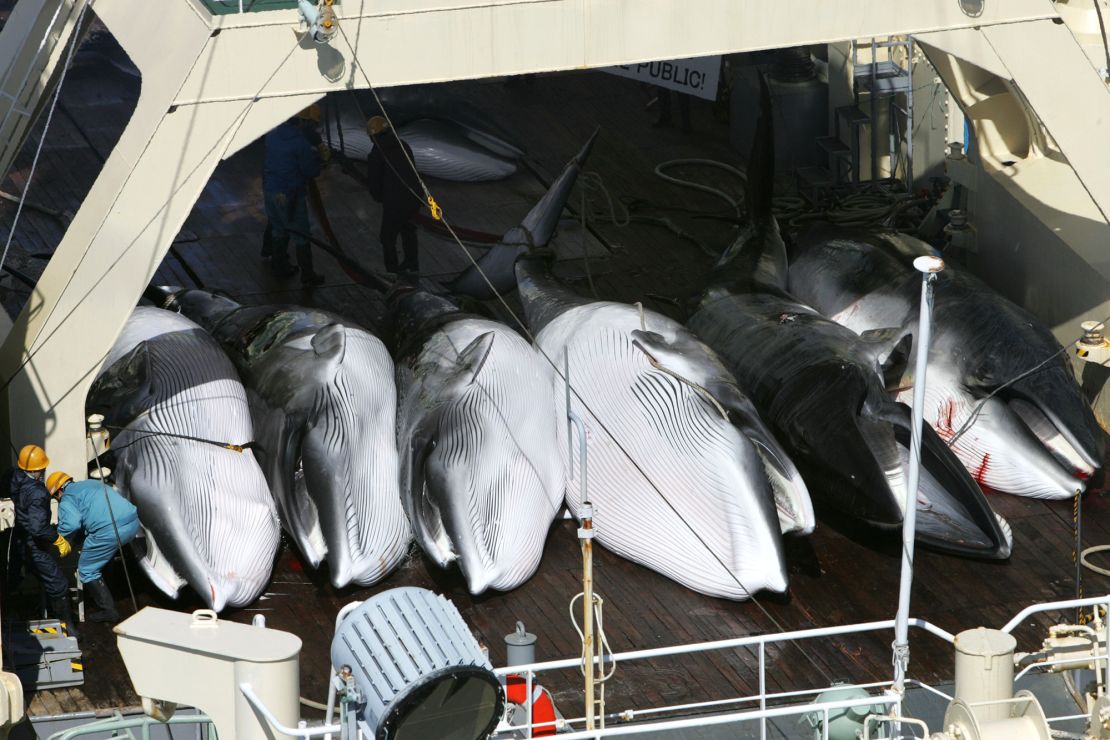
Dead minke whales on the deck of Japan’s Nisshin Maru factory whaler ship in 2015. Sutton Hibbert/Shutterstock
For decades, Japan has justified whaling under the guise of “scientific research.”
In 2018, it tried one last time to persuade the IWC to allow it to resume commercial whaling – and failed. So, it withdrew from the body and resumed commercial whaling months later, in defiance of international criticism.
“Japan is no longer party to the International Convention for the Regulation of Whaling and can argue that it is no longer bound by provisions and constraints,” Donald Rothwell, an international law professor at the Australian National University (ANU), told CNN.
“Within its waters, it has the absolute authority to control the management of living resources – and that includes whales.”
Under Japanese law, three species of whale are permitted to be hunted in its territorial waters and exclusive economic zones – endangered sei whales and threatened minke whales and Bryde’s whales, with endangered fin whales set to be added to kill lists.
“Whales are important food resources and should be sustainably utilized based on scientific evidence,” said government spokesperson Yoshimasa Hayashi this month, as he announced a proposal to hunt fin whales, the second-largest species of whales after blue whales.
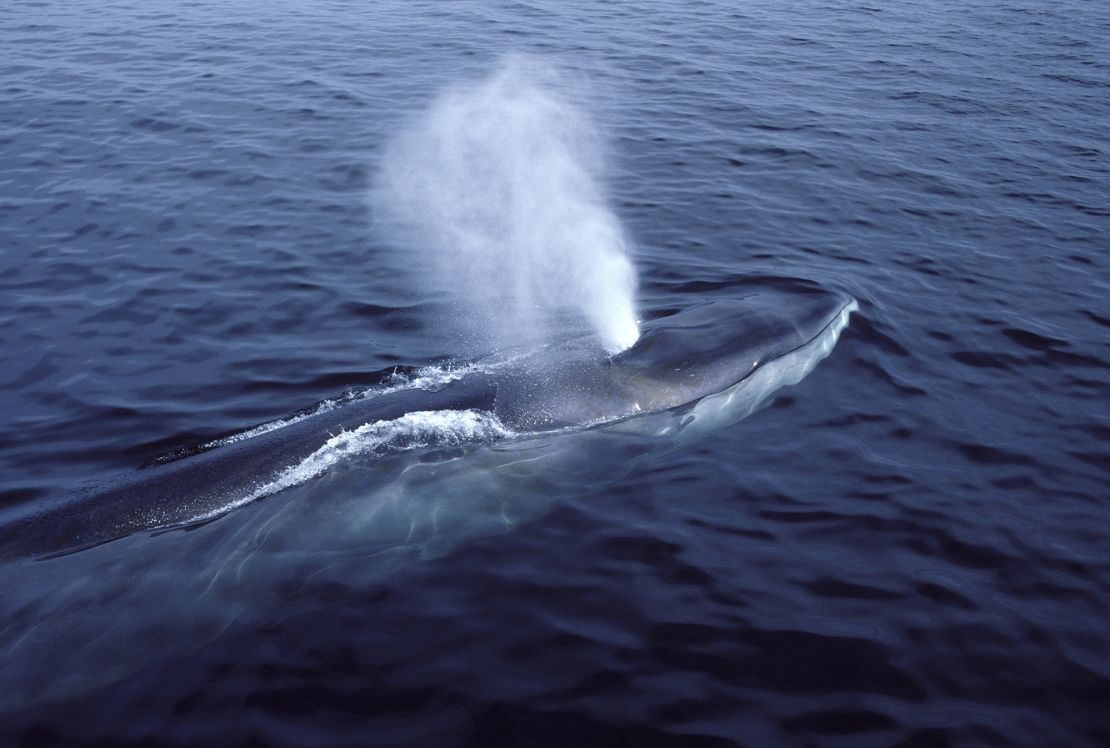
A fin whale in the Gulf of Maine, North Atlantic Ocean. Francois Gohier/VW Pics/Universal Images Group/Getty Images
The World Cetacean Alliance (WCA) marine conservation group said that whale watching in Japan was “a far more successful industry” than harvesting whale meat.
“Commercial whaling in the 21st century is unjustifiable,” it said. “The whaling industry in Japan recognizes that it is a challenge to increase whale meat consumption and there is currently no market,” WCA said.
“So why keep slaughtering these wonderful and intelligent animals?”
Tokoro ruled out whale watching. “We will not switch to whale watching but eating whale meat while watching whales might be quite a nice touch,” he told CNN.
Over the years, Kyodo Senpaku has launched aggressive public relation campaigns to promote whale meat and win over new generations of young diners.
Tokoro says he eats whale meat every day.
“Whale meat is not only delicious, it’s good for you,” Tokoro told reporters during the tour of his ship, as he talked up the purported “health benefits” of eating whale, claiming that the meat could cure hair loss and cancer.
“I can definitely say whale meat and rice is a really good (combination) for Japanese people. There is no doubt about that, much better than beef and bun.”

RELATED ARTICLEJapanese firm puts whale meat on sale in vending machines
Last year Tokoro, again wearing his whale hat, launched controversial whale meat vending machines, offering whale sashimi, whale steak and whale bacon.
The company has also sponsored influencers from countries such as Russia, Thailand and South Korea – hosting them at a local izakaya in Osaka, where they sampled dishes like whale sashimi and skewers and encouraging them to take the message back to their followers that whale meat was delicious and acceptable.
Japan may have a long and storied history of whaling dating back to the Edo period in the 1600s, but experts say whale meat consumption only really peaked after World War II – when food sources, especially protein, were scarce.
Today, whale meat is now considered more of a “luxury” dish, said Nobuhiro Kishigami, a professor at the National Museum of Ethnology, one of the country’s largest research institutes.
“The fact is that there is little interest in whaling and whale meat among Japanese people as a whole,” Kishigami told CNN. “Most young people, especially the majority that live in cities, do not know or care much about whaling and its history and remain indifferent.”
The same goes for dolphin meat, he added. “It’s just a sign of the times. But if we were asked to stop eating blue fin tuna, there would be a huge uproar. We would react very badly to that.”
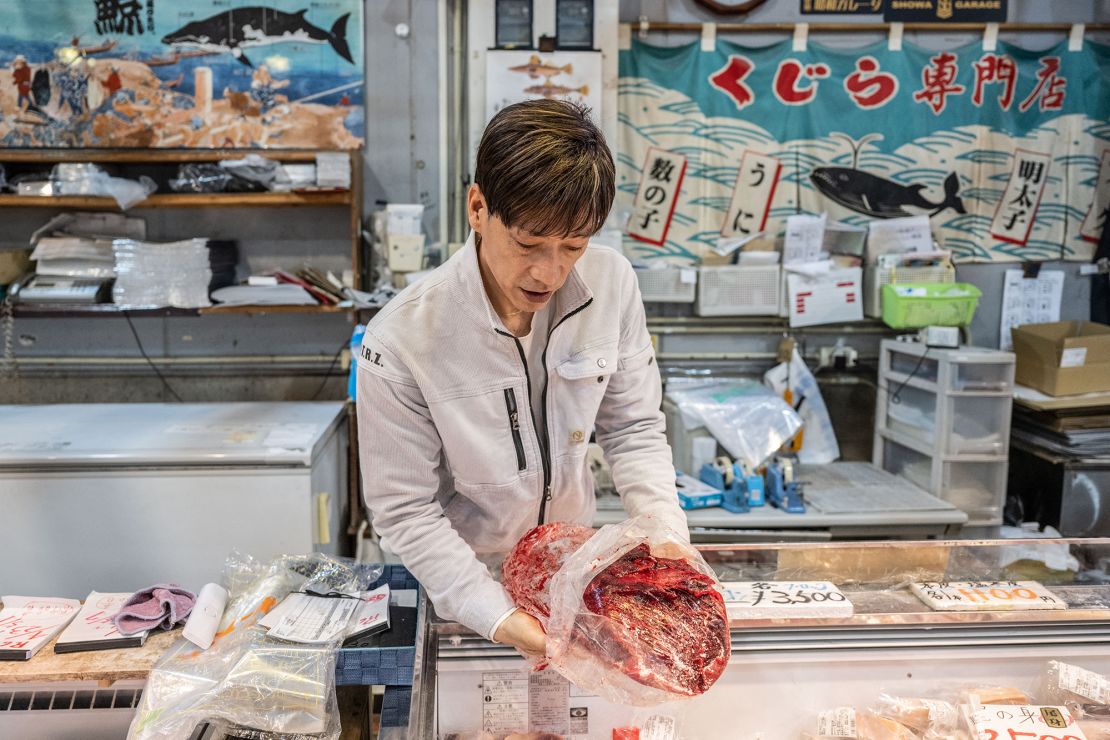
The owner of a whale meat shop shows a block of whale meat at the Karato fish market in Shimonoseki city. Yuichi Yamazaki/AFP/Getty Images
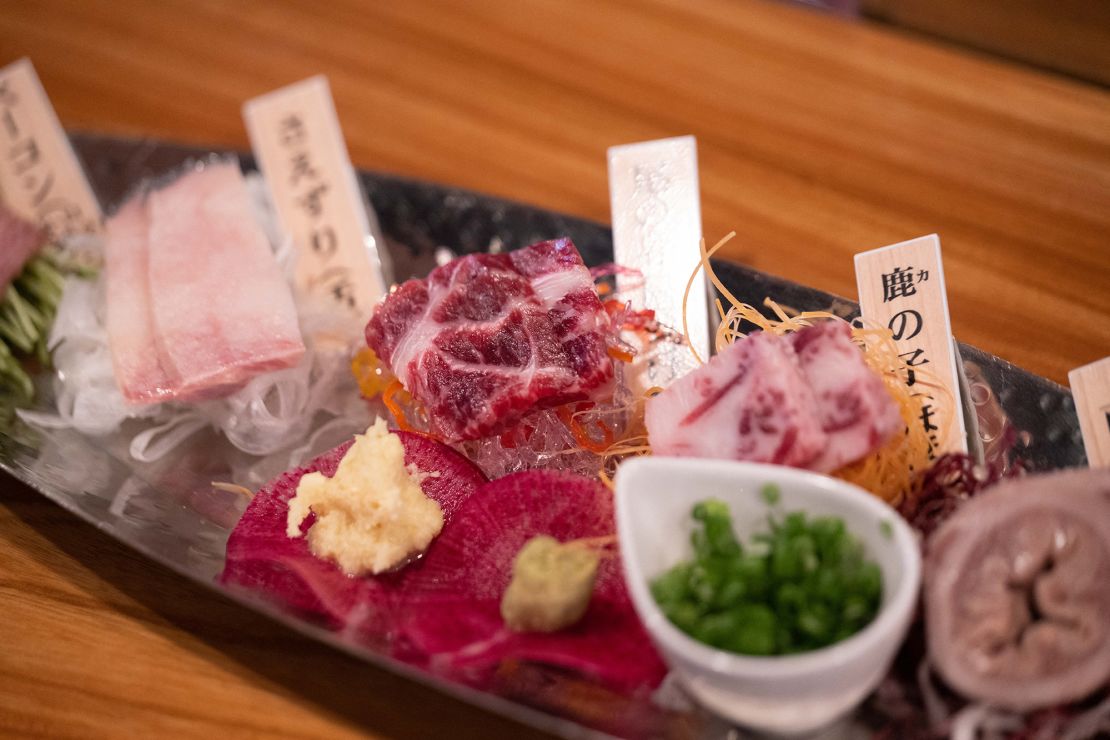
This picture taken on May 20, 2024 shows whale meat sashimi at a ‘Nisshinmaru’ whale meat restaurant in Shimonoseki city, Yamaguchi prefecture. Yuichi Yamazaki/AFP/Getty Images
Japan’s fisheries ministry estimates that between 1,000 and 2,000 tons of whale meat are consumed annually in the country, compared to average annual totals of more than 230,000 tons during the 1960s.
“There is still certainly a market (for whale meat in Japan) but market size and production volume have shrunk dramatically,” economics professor Mitsuhiro Kishimoto from the Shimonoseki City University told CNN, noting that several major whaling companies had since withdrawn from the trade.
“The demand for whale blubber disappeared after the discovery of oil and petroleum products, so many countries stopped whaling and with international regulations, the number of caught whales decreased and as a result, whale meat production decreased while beef, pork and chicken became more popular,” he said.
Scientists have also expressed concern about the risks of consuming whale meat, with studies pointing to high levels of mercury found in whale and dolphin meat, which could prove dangerous to consumers – especially pregnant women and young children.
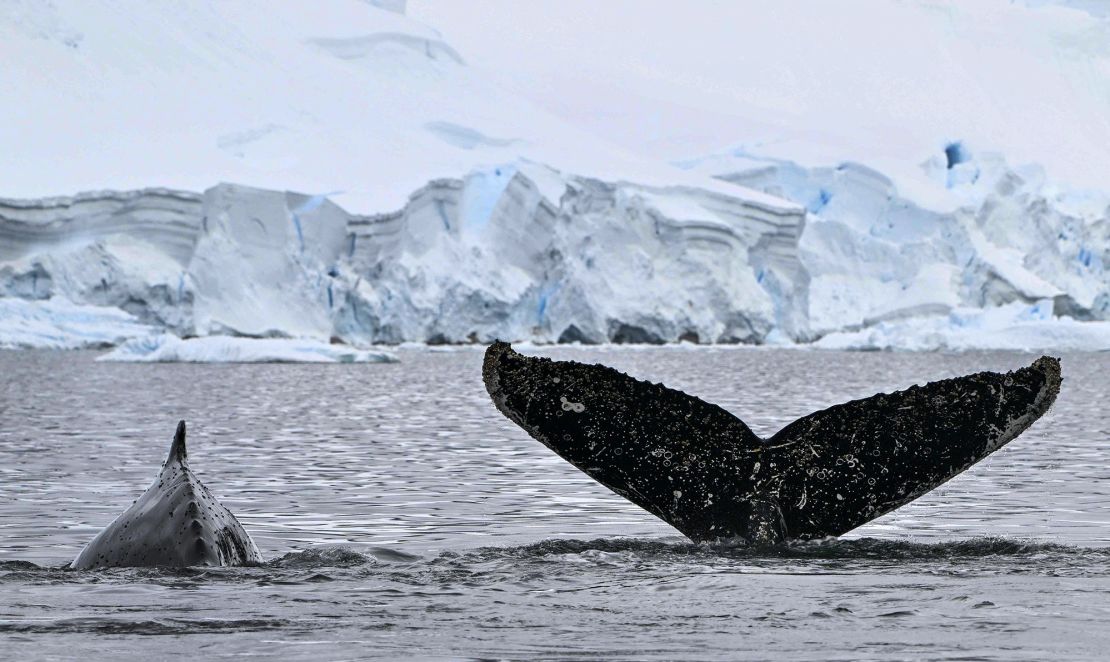
A pod of Humpback whales pictured at the Gerlache Strait in Antarctica on January 19, 2024. Juan Barreto/AFP/Getty Images
Located in deep waters surrounding the entire continent of Antarctica, the Southern Ocean Whale Sanctuary hosts dozens of whale species including humpbacks, blue whales and fin whales.
It was established by the IWC in 1994 to protect whale species after centuries of hunting, but until 2019 Japan took regular trips to the region to hunt for self-stated “scientific research” purposes.
Japanese whalers killed 333 minke whales in the Southern Ocean in 2018/2019, according to the IWC, before abandoning the region after it left the international body.
Takaaki Sakamoto, director of the Whaling Affairs Office in Japan’s Fisheries Agency, told CNN that Japan sent ships to the Antarctic last year to collect numbers and skin surface samples, but those expeditions did not involve killing whales. He said they planned to return this year to do the same.
Tokoro told CNN that the Kangei Maru is not planning on killing whales beyond Japanese waters because it doesn’t make economic sense.
“Commercial whaling is not profitable,” he said. “It will take 50 days to get to the Antarctic and back and we are not confident we can make a profit by paying the wages of employees and fuel for 50 days. However, I will go only when the government orders me to go … Until then, I will not go commercial whaling at all.”

The Bandero, a former Japanese fisheries vessel that anti-whaling activists will use to take on Japanese whalers, if they return to the Antarctic. Captain Paul Watson Foundation
But activists aren’t convinced.
“Given the ship’s long-range capabilities and drones, and recent announcements from Japan’s fisheries ministry that it is keen to start hunting fin whales, we believe there is a high likelihood that Japanese whalers will return to the Southern Ocean,” said James Anderson, activist and founder of the Whale Defense Agency (WDA).
“The Southern Ocean is a critical habitat for many whale species that provides a safe haven for breeding and feeding … protecting it is more important than ever due to the increasing threats posed by climate change and illegal whaling.”
Rothwell, from ANU, said that if Japan looks to kill whales beyond its territorial waters, it can expect an international response.
“It would immediately trigger global interest and action about the conservation and protection of whales, especially in waters sanctioned by the IWC as a whale sanctuary,” Rothwell said.
Watson, the veteran anti-whaling activist, told CNN he’s prepared to mount a physical response – with a former Japanese fisheries patrol vessel he’s acquired in anticipation of Japanese whalers returning to the Antarctic by the end of the year.
“It’s called the Southern Ocean Whale Sanctuary for a reason – you don’t kill whales there,” Watson said.
“We want to be able to track them down and intercept them like we’ve done before – and we are more than prepared to do it again.”
USA TODAY
1:25
1:56
https://imasdk.googleapis.com/js/core/bridge3.643.0_en.html#goog_1691996810
Bird flu outbreaks have continued across the U.S. as officials work to keep the spread at bay.
While the outbreak likely began amongst chicken flocks and spread to dairy cows, reports of the virus infecting other animals have come out of several states. Two cases of the virus appearing in people have been reported despite ongoing testing, said the Centers for Disease Control (CDC), and their symptoms were relieved by simple over-the-counter flu medication.
Commercial farming facilities have taken to destroying infected flocks in an attempt to quell the ongoing spread. Even so, a new large-scale infection was reported in Iowa this week, impacting millions of egg-laying chickens.
Bird flu updates:CDC unveils dashboard to track bird flu as virus spreads among dairy farms
An outbreak of bird flu was detected in Iowa on Tuesday in a commercial flock of 4.2 million chickens, according to the state Department of Agriculture.
The egg-laying flock, located in Sioux County, will be culled to prevent further spread. Since 2022, about 22.9 million birds from backyard flocks and commercial facilities have been destroyed to keep the virus at bay in Iowa, the nation’s top egg producer, according to USDA data.
Is it safe to eat runny eggs amid the bird flu outbreak? Here’s what the experts say.Bird flu outbreak is an ‘evolving situation.’ Here’s what to know about symptoms, spread.Human case of bird flu detected in Texas after outbreak of virus among cattleCal-Maine Foods, largest producer of eggs in US, finds bird flu in chickens at Texas plant

Besides the unusual spread to dairy cows in recent months, bird flu has been detected in other animals, including barn cats that were found dead at infected facilities. And now it’s been found in alpacas.
The US Department of Agriculture’s National Veterinary Services Laboratories said Tuesday that a group of alpacas tested positive on May 16 on a farm in Idaho where poultry had previously tested positive and been destroyed.
https://cm.usatoday.com/article-body/inline-desktop_032624_USATBAU24
This is the first known infection in alpacas, said the USDA.
Bird flu testing:Farmworkers face high-risk exposures to bird flu, but testing isn’t reaching them
Bird flu, or avian flu, is a contagious infection that spreads among wild birds and can infect domestic poultry and other animal species. The virus does not often spread to humans but sporadic infections have been reported. There are several strains all belonging to influenza A-type viruses.
The most common subtypes that may affect humans are A (H5N1), A (H7N9) and A (H9N2), according to the Cleveland Clinic. In humans, symptoms can resemble a typical flu but may advance into more serious respiratory symptoms.

In birds, avian flu is highly contagious and cases can range in severity from mild to highly deadly. Infected birds shed the viruses in their saliva, nasal secretions and feces, meaning other birds can contract the virus through contact with those fluids directly or via contact with a contaminated surface.
The CDC has documented two cases of human bird flu infections in 2024, one in a Michigan dairy farm worker and one in a dairy farm worker from Texas. Both infected people showed only symptoms of conjunctivitis, or pink eye.
The virus has been found in sick dairy cattle in at least 67 herds in nine states, according to the U.S. Center for Disease Control and Prevention. That includes four herds in South Dakota but none in Iowa.
By
Published on May 28, 2024
Trending VideosClose this video player
https://imasdk.googleapis.com/js/core/bridge3.643.0_en.html#goog_1653117235
0 of 2 minutes, 4 secondsVolume 0%
:max_bytes(150000):strip_icc():format(webp)/GettyImages-73129495-596a7f675f9b582c357279a2.jpg)
By Jared Strong
Avian influenza that is very transmissible and lethal for domestic birds has been detected in a flock of 4.2 million egg-laying chickens in Sioux County, according to the Iowa Department of Agriculture and Land Stewardship.
It is the first confirmation of highly pathogenic avian influenza in a commercial or backyard poultry flock this year in Iowa. IDALS reported it Tuesday.
Entire flocks are culled — and their carcasses isolated — to prevent the spread of the virus to other flocks.
The virus outbreak has been ongoing since early 2022 and is primarily driven by migrating birds, which can be contagious without showing symptoms.
Latest developments on avian flu virus in dairy cattle
In the past month, Minnesota is the only neighboring state of Iowa that has had infected flocks, according to the U.S. Department of Agriculture. Five of those confirmations happened about two weeks ago. They included four commercial turkey operations and one commercial egg-layer flock that totaled about 1.5 million birds.
Minnesota has had more than three times the number of infected flocks compared with Iowa since the start of the outbreak, but Iowa has had about three times the total number of affected birds because of its large egg-laying operations. It is the top egg-producing state.
A total of more than 23 million birds in 52 flocks have been culled in Iowa since early 2022 because of the infections. The Sioux County flock is the state’s third-largest affected in that time. Two others in Buena Vista and Osceola counties had more than 5 million birds apiece.
IDALS recommends that poultry and dairy operations take additional precautions to limit the potential for new infections.
HPAI losses cross 5 million in May, USDA says
The virus has been found in sick dairy cattle in at least 67 herds in nine states, according to the U.S. Center for Disease Control and Prevention. That includes four herds in South Dakota but none in Iowa.
The first cattle infections happened in Texas and were confirmed in March. Cows typically recover from infection in 10 to 14 days, but the virus is often fatal for poultry.
Federal officials have said eggs and milk in the commercial food supply are safe to consume. They have warned against drinking unpasteurized cow milk.
Iowa Capital Dispatch is part of States Newsroom, a network of news bureaus supported by grants and a coalition of donors as a 501c(3) public charity. Iowa Capital Dispatch maintains editorial independence. Contact Editor Kathie Obradovich