Tag Archives: Canada geese
Please Sign Petition to Stop Wildlife “Services” From Killing Canada Geese
The members of the 2014 interlocal agreement to kill geese include Bellevue, Kent, Kirkland, Mountlake Terrace, Port of Seattle – Seattle-Tacoma International Airport, Renton, Seattle Parks and Recreation, SeaTac, Tacoma Metro Parks, Tukwila, Woodinville, and the University of Washington.
Ask New York Officials to Stop Massacring Geese!
U.S. Department of Agriculture (USDA) documents reveal that more than 3,650 geese in the vicinity of New York City airports were rounded up and killed by the agency in the past five years alone, yet it has not recommended humane controls to prevent more birds from flying in and taking up residence. Consequently, the city is caught in a vicious, expensive, and endless killing cycle (which guarantees continued funding for the USDA), and despite an intense public outcry, another annual massacre is apparently proceeding. Helpless molting and flightless birds will again be snatched up, forced into crates, and trucked to slaughter—a terrifying ordeal for any wild animal but especially for a sensitive “prey” species. Such measures also tear families apart and leave orphaned young at great risk. Your voice is desperately needed!
Please urge New York City officials to stop contracting with the USDA to have geese killed and instead employ tried-and-true humane control measures. And then forward this e-mail widely!
Polite comments can be directed to:
• Mindy Tarlow
Director, Mayor’s Office of Operations
New York City
mtarlow@cityhall.nyc.gov
• Patrick J. Foye
Executive Director
Port Authority of New York & New Jersey
pfoye@panynj.gov
Petition: Don’t kill Cornwall’s Canada geese!
Sign Petition here: https://www.change.org/petitions/randy-clark-don-t-kill-cornwall-s-canada-geese
Don’t kill Cornwall’s Canada geese!
Last summer, USDA Wildlife Services contracted with Cornwall Town Board to kill local geese. They killed approximately 139 in the area – 14 at Rings Pond in Cornwall, 70 in Cornwall-on-Hudson, an adjoining village, and 55 in another Cornwall area. Local residents and animal advocates were devastated and outraged.
As a result of pressure from animal advocates, the Town formed a “Geese Committee” to suggest non-lethal methods of geese control, yet astonishingly the Town Board recently dissolved the Committee with no explanation and no commitment to using non-lethal methods. Local residents are VERY concerned that the Town will hire the USDA to kill the geese by brutally capturing them and sending them to a slaughterhouse as they did last year! This is unacceptable!
PLEASE URGE THE BOARD NOT TO KILL THE GEESE!
Canada geese are beautiful, intelligent birds who mate for life, fiercely protect their eggs and young, and display loyalty for other members of their flock. The methods that USDA Wildlife Services uses to kill geese are controversial and widely understood to be grossly inhumane – during the hottest months of the year flightless geese and goslings are corralled, packed into turkey crates and transported to slaughterhouses or gas chambers.
Killing the geese is not effective – countless examples have demonstrated that roundups and slaughters only clear the area temporarily, as other geese eventually repopulate the vacant desirable habitat.
The unfortunate plan to slaughter geese can be avoided by making a commitment of simple steps, such as cleaning up the grass with machines that pick up goose droppings, and making landscape modifications which hamper access to the pond and prevent geese from colonizing the pond’s surrounding area.
There is no scientific basis that geese dropping pose a threat to human health. Killing the geese is counter to public opinion, not how the residents of Cornwall, NY want tax dollars spent, and a horrid example for children to whom we wish to teach tolerance and co-existence with wildlife.
Killing geese and other birds has proven to be an ineffective approach to preventing collisions with airplanes. “I have not seen where [culling] has been effective as a long-term solution,” said Jim Hall, chairman of the National Transportation Safety Board under the Clinton administration. Ron Merritt, a biologist and former Chief for the Air Force’s Bird Aircraft Strike Hazard Team agrees, adding, “Killing 1,000 geese really isn’t going to do anything. If you kill them, nature will fill that vacuum and a new species will pop up in its place.”
Feeding the goose meat to food pantries is not acceptable – it is a ruse designed to spin an act of needless killing into an act of charity, and doing so puts human health at risk. Meat from slaughtered geese has been delivered to food banks with a warning label from the NYS Health Department that it should not be consumed more than twice per month because it may have been exposed to environmental contaminants.
There is no scientific basis that geese dropping pose a threat to human health. Killing the geese is counter to public opinion, not how the residents of Cornwall want tax dollars spent, and a horrid example for children to whom we teach tolerance and co-existence with wildlife. Cleaning goose poop is more humane, and more effective.
PLEASE CONTACT THE TOWN BOARD IN CORNWALL AND URGE THEM TO USE NON-LETHAL METHODS OF GEESE CONTROL. DO NOT LET THE GEESE BE KILLED BY THE USDA AS THEY WERE LAST YEAR DURING MOLTING SEASON. THE BOARD HAS BEEN PRESENTED WITH NUMEROUS WAYS TO CONTROL THE POPULATION – KILLING THEM IS NOT AN OPTION!
Randy Clark, Supervisor: rclark@cornwallny.gov (845) 534-3760
James McGee: mcgeeatlarge@gmail.com
Elizabeth Longinott: elonginott@gmail.com
Helen Bunt: hbunt1@verizon.net
Peter Russell: prussell556@gmail.com
J. Kerry McGuinness: jkerrymcg@aol.com
Cornwall Town Hall Workshop Meeting:
TUES, JUNE 3 – 7pm
Cornwall Town Hall
183 Main St
Cornwall, NY 12518
For further info, contact
Elaine Sloan
(917) 364-6904
In the Words of Farley Mowat
The world has suffered another great loss with the death of author, naturalist and avid animal advocate, Farley Mowat. I never had the opportunity to meet him, but I do feel extremely fortunate to have received an endorsement for my book from him, just two short years before his passing.
He didn’t use the internet, so I sent a manuscript to his assistant, who had to hand deliver it (presumably on snowshoes) to him at his place in eastern Canada. This is what he had her send back to me, which now holds a special place on the back cover of the book:
“Robertson’s new book could be titled The Big and Dirty Game, because that’s what it is about — the dirty, bloody business of killing other animals for sport and fun. Fun? Sure, that’s what the Sportsmen say . . but read about it for yourself . . .” ~ Farley Mowat, Author of Never Cry Wolf and A Whale for the Killing
One of Farley Mowat’s many classic books, A Whale for the Killing, written in1972, was an autobiographical account of his moving to Newfoundland because of his love for the land and the sea, only to find himself at odds with herring fishermen who made sport of shooting at an 80-ton fin whale trapped in a lagoon by the tide. Although he had started off thinking folks around there were a quaint and pleasant lot, he grew increasingly bitter over the attitudes of so many of the locals who, in turn, resented him for “interfering” by trying to save the stranded leviathan.
Mr. Mowat writes, “My journal notes reflect my sense of bewilderment and loss. ‘…they’re essentially good people. I know that, but what sickens me is their simple failure to resist the impulse of savagery…they seem to be just as capable of being utterly loathsome as the bastards from the cities with their high-powered rifles and telescopic sights and their mindless compulsion to slaughter everything alive, from squirrels to elephants…I admired them so much because I saw them as a natural people, living in at least some degree of harmony with the natural world. Now they seem nauseatingly anxious to renounce all that and throw themselves into the stinking quagmire of our society which has perverted everything natural within itself, and is now busy destroying everything natural outside itself. How can they be so bloody stupid? How could I have been so bloody stupid?’”
Farley Mowat ends the chapter with another line I can well relate to: “I had withdrawn my compassion from them…now I bestowed it all upon the whale.”
And Farley Mowat writes here of the wrongheadedness of hunting intelligent animals, such as geese, in his foreword to Captain Paul Watson’s book Ocean Warrior:
“Almost all young children have a natural affinity for other animals, an attitude which seems to be endemic in young creatures of whatever species. I was no exception. As a child I fearlessly and happily consorted with frogs, snakes, chickens, squirrels and whatever else came my way.
“When I was a boy growing up on the Saskatchewan prairies, that feeling of affinity persisted—but it became perverted. Under my father’s tutelage I was taught to be a hunter; taught that “communion with nature” could be achieved over the barrel of a gun; taught that killing wild animals for sport establishes a mystic bond, “an ancient pact” between them and us.
“I learned first how to handle a BB gun, then a .22 rifle and finally a shotgun. With these I killed “vermin”—sparrows, gophers, crows and hawks. Having served that bloody apprenticeship, I began killing “game”—prairie chicken, ruffed grouse, and ducks. By the time I was fourteen, I had been fully indoctrinated with the sportsman’s view of wildlife as objects to be exploited for pleasure.
“Then I experienced a revelation.
“On a November day in 1935, my father and I were crouched in a muddy pit at the edge of a prairie slough, waiting for daybreak.
“The dawn, when it came at last, was grey and sombre. The sky lightened so imperceptibly that we could hardly detect the coming of the morning. We strained out eyes into swirling snow squalls. We flexed numb fingers in our shooting gloves.
“And then the dawn was pierced by the sonorous cries of seemingly endless flocks of geese that cam drifting, wraithlike, overhead. They were flying low that day. Snow Geese, startling white of breast, with jet-black wingtips, beat past while flocks of piebald wavies kept station at their flanks. An immense V of Canadas came close behind. As the rush of air through their great pinions sounded in our ears, we jumped up and fired. The sound of the shots seemed puny, and was lost at once in the immensity of wind and wings.
“One goose fell, appearing gigantic in the tenuous light as it spiralled sharply down. It struck the water a hundred yards from shore and I saw that it had only been winged. It swam off into the growing storm, its neck outstreched, calling…calling…calling after the fast-disappearing flock.
“Driving home to Saskatoon that night I felt a sick repugnance for what we had done, but what was of far greater import, I was experiencing a poignant but indefinable sense of loss. I felt, although I could not then have expressed it in words, as if I had glimpsed another and quite magical world—a world of oneness—and had been denied entry into it through my own stupidity.
“I never hunted for sport again.”
Shut Off That TV, It’s a Beautiful Day Out
While most Americans were glued to their TV sets, cheering or shouting at their favorite
overpaid players in the Super Bowl–refusing to budge during the manipulative, high-tech commercials except to urinate or grab another beer, I was outside enjoying the unseasonably warm day (and secretly praying for snow).
On our daily walk to the river, my wife and I and our dog “Honey” were treated first to the sight of a pair of ravens driving an eagle out of the area. The eagle must have inadvertently flown over the ravens’ former and future nesting site, and they wanted to make it clear that though they weren’t guarding any eggs just yet, that forested hillside was off-limits until further notice.
In addition to the usual mergansers and herons fishing the river, we saw a seal stick his head above the waterline to get his bearings. Seals are a fairly rare sight here on this tidal tributary of the Columbia, twenty miles upstream from the ocean, but no doubt the winter smelt run was making his efforts worthwhile.
Next, upwards of a thousand cackling Canada geese, in four or five formations of a few hundred or so apiece, crossed loudly overhead. Uninterested in fish, they were instead searching for greener pastures and a safe place to bed for the evening.
These are just a few of the wonders going on while humans are spending their valuable yet limited time on this Earth with their ball game.
The Guns of Mid-Winter
When I wrote my book, Exposing the Big Game, its subtitle, Living Targets of a Dying Sport, was appropriate. But like so many things in this rapidly changing world, by the time the book came out, that subtitle was becoming obsolete. Now, in the second decade of the 21st century, the sport of blasting birds, murdering deer, culling coyotes and plunking at prairie dogs—in a word, hunting—is seeing a seemingly inexplicable resurgence.
Lately we’re seeing longer hunting seasons on everything from elk to geese to wolves, with more new or expanded “specialty” hunts like archery, crossbow, spear (and probably soon, poison blow gun) in states across the country, than at any time in recent memory. Meanwhile, more Americans are taking up arms against the animals and wearing so much camo—the full-time fashion statement of the cruel and unusual—that it’s starting to look ordinary and even, yuppified.
So, when did cruel become the new cool and evil the new everyday? Are the recruiting efforts of the Safari Club and the NRA finally striking a cord? Did the staged “reality” show “Survivor” lead to the absurdly popular thespian cable spin-offs like, “Call of the Wildman,” “Duck Dynasty” and a nasty host of others? Is “art” imitating life, or is life imitating “art?” Did the author of the Time Magazine article, “America’s Pest Problem: It’s Time to Cull the Herd,” ratchet up the call for even more animal extermination?
Whatever the reason, I don’t remember ever hearing so many shotguns and rifles blasting away during the last week of January. By the sound of the gunfire, coupled with the unseasonably dry and warm weather here in the Pacific Northwest, you’d swear it was early autumn.
TRUE cost of the season’s must have fur-trimmed Canada Goose coat
‘Chilling cruelty, unspeakable suffering and corporate denial’: the TRUE cost of the season’s must have fur-trimmed Canada Goose coat
By Laura Collins 23 January 2014
They have made America their new frontier, forging into the US clothing market to become one of the season’s most recognisable brands with sales of Canada Goose outerwear expected to top $30million this year alone.
In a high profile year in the States, Kate Upton has appeared on the front of Sports Illustrated in one of their fur trimmed, down jackets and nothing much else.
It isn’t the only firm to market such coats, yet Canada Goose has rapidly established itself as the label of choice for the well-known and the well-heeled braving the frigid weather blown in on the polar vortex.
But today MailOnline can reveal that allegations of chilling cruelty and unspeakable animal suffering have been repeatedly levelled at this family business turned multimillion dollar concern.
Scroll down for video
The real cost of a $600 coat: Campaigners claim the coyotes that are trapped and skinned for their fur to trim the hoods of Canada Goose coats can be in pain for days. It is unclear whether these images are from Canada Goose trappers but the firm does use the same leg holds
Exhausted, alone and all out of fight, this Coyote awaits its inevitable fate having been caught in a trap by its right hind leg
According to animal rights activists, behind every fur trimmed hood and down stuffed coat is a brutal reality of Coyotes trapped and left to suffer in the wilderness.
Many of today’s ethically aware consumers would never dream of buying a full length fur. But in an odd quirk of the current trend for this style of garment those same shoppers pull on a coyote trimmed coat without a moment’s concern for the origins of that little flurry of fur.
Lindsay Rajt, Director of Campaigns for People for the Ethical Treatment of Animals (PETA) said: ‘Canada Goose uses exclusively Coyote fur on the trim of their coats and those animals are trapped in a way that is just inherently cruel.’
According to a spokesperson for the firm: ‘The trapping of fur-bearing animals is strictly regulated by the provincial and territorial wildlife departments in Canada.
‘We purchase coyote furs from certified Canadian trappers, never from fur farms or endangered animals.
Kate Upton going ‘Polar Bare’ on the cover of Sports Illustrated’s 2013 Swimsuit edition, wearing a smile, a white Canada Goose parka and not much else
But PETA has dismissed the standards as ‘window dressing.’
Mr Rajt said: ‘The company’s reference to AIHTS standards is meaningless and a way of placating and silencing people with valid concerns.
‘Leg hold traps are still legal in Canada. Mother animals will chew off their limbs in order to get back to their young. The trapped animal might be there for days before the trapper comes and finds them, they are frightened and starving and in pain during that time. And then they’re bludgeoned or strangled to death or shot.’
A trapped Coyote howls in pain, its right forepaw held tight in the jaws of a leg hold trap – legal under the AIHTS but cruel according to PETA
Trapped Coyotes can struggle to get free for days until the hunter returns to check his traps. Mother animals separated from their young attempt to chew off their own limbs in a bid for freedom
Ms Rajt revealed that PETA is this week appealing to Canada Goose to abandon their use of fur in favour of synthetic alternatives and to dump their use of real down stuffing.
She said: ‘PETA is reaching out to Canada Goose to urge the company to switch to innovative, synthetic fur like their top competitor Helly Hansen, which has been fur-free for many years.
‘Additionally, we are asking that Canada Goose dump down and opt for revolutionary synthetic technology like the one recently developed by The North Face – Thermoball, which mimics down but offers superior versality.’
Ms Rajt claimed: ‘We have been trying to meet with this company, we’ve been trying to engage with them since 2006.
‘The CEO originally agreed to meet with us in 2008 to discuss trapping policies and methods but just never confirmed that meeting and then failed to make himself available to any of our follow ups.
‘It is a challenging company for us to work with.’
Meg Ryan pictured last month in New York’s West Village. Canada Goose’s concerted effort to win the US market has seen it become a celebrity brand of choice
Andrew Garfield and girlfriend Emma Stone in their Canada Goose parkas on a shopping trip in New York
Actress Clare Danes wearing her Canada Goose parka with its distinctive Coyote trim while braving the New York chill
But according to a spokesperson for the company: ‘We’ve corresponded with PETA on numerous occasions and it quickly became evident that they were not interested in a constructive conversation.’
Canada Goose was founded in 1957 and has enjoyed remarkable success and rapid growth across the past decade when it started marketing it’s ‘truly Canadian’ ethos to Europe.
PETA Director of Campaigns, Lindsay Rajt, on Canada Goose’s refusal to meet
Today the company employs more than 1000 people and sells its products in more than 50 countries across the world.
It continues to manufacture its coats in Toronto and Winnipeg but recently opened its first US Headquarters in Denver, Colorado. Last year it became the official sponsor of the Sundance Film Festival and US Equity firm, Bain, recently bought a majority stake in the hitherto entirely Canadian enterprise.
Real fur real suffering: Canada Goose President Dani Reese flanked by his company’s distinctive outerwear. He says the company uses Coyote fur ‘because it works’
The extreme weather outerwear is manufactured in Toronto and Winnipeg though US Equity firm, Bain, now owns a majority stakehold
Founded in 1957 the family company Canada Goose now employs more than 1000 people and sells its garments in more than 50 countries
Canada Goose President Danni Reiss is very clear in his assessment of the importance of the US market to his brand. He said, ‘The States is a market with one of the greatest potentials in the world. The US is growing faster than the overall company.’
Speaking in a corporate video Mr Reiss explained: ‘We use Coyote fur for a number of reasons. Number one, Coyote fur works – it’s functional, it provides warmth around the face in a way no synthetic fabric can. It does that in the coldest places on earth and it is important to realise that sometimes urban centres and cities can feel like the coldest places on earth.’
Coyote fur doesn’t freeze, doesn’t hold moisture, retains heat and is biodegradable.
Ms Rajt dismissed the necessity of real fur saying: ‘They actually do have some faux fur trim products and there’s a market for that. There’s no reason why they couldn’t switch completely.’
A spokesperson for Canada Goose said: ‘We understand PETA’s concerns and we respect the right of people to choose not to wear fur, however, we know PETA does not respect our ethical, responsible use of fur so further conversation won’t be productive.’
But Ms Rajt insisted: ‘I just don’t believe that half the people wearing these coats understand what’s really involved in the making of them. And I just don’t believe that they would make that same choice if it was an informed one.
Read more: http://www.dailymail.co.uk/news/article-2544075/Revealed-Chilling-cruelty-unspeakable-suffering-corporate-denial-Is-TRUE-cost-seasons-Canada-Goose-coat.html#ixzz2rYL8KOiR Follow us: @MailOnline on Twitter | DailyMail on Facebook
Duck Dynasty guns? Yep, but will new product line actually revive hunting?
By Patrik Jonsson, Staff writer / January 3, 2014
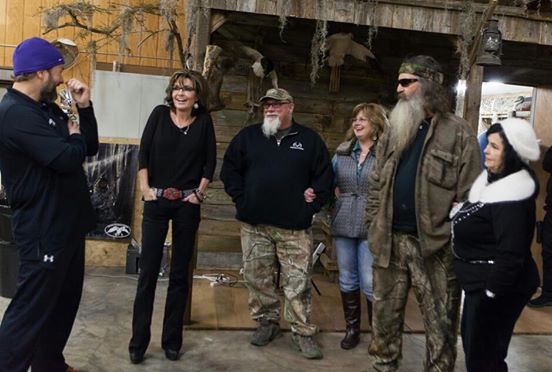
Just about everyone in America now knows that Phil Robertson and the “Duck Dynasty” clan are a rare breed, indeed. But even as the bayou-based reality TV family has morphed into a marketing and cultural commodity – note its new line of Mossberg shotguns and rifles – there’s another angle to ponder: Until now, hunters like Phil Robertson had actually been disappearing from America’s duck-dotted wetlands.
“Duck Dyasty,” a show about a band of self-described rednecks and their kin straddling the gulf between rural values and fabulous wealth – built to a TV viewership crescendo this past summer, during its fourth season. It captured even broader attention more recently when Mr. Robertson, the clan patriarch, became embroiled in a corporate spat with A&E executives over his views, expressed to a GQ reporter, that homosexuality is a sin like bestiality, and that homosexuals are akin to drunkards and terrorists.
The Robertsons’ subsequent decision to break away from their TV licensing to sign the Mossberg shotgun deal independently – not to mention the multitude of TV and newspaper stories about the “Dynasty” clan’s red-state attitudes and values – speaks to what some call redneck commoditization. That’s an appeal to primarily white Southern fundamentalist Christians that has translated into financial (some $450 million in merchandise sold in less than two years), as well as cultural and political, payoff.
Also see: https://exposingthebiggame.wordpress.com/2014/01/05/duck-dynastys-evil-is-spreading/
Duck Dynasty’s Evil is Spreading
Some folks may be wondering why we let ourselves get worked up over a stupid faux “reality” TV show like Duck Dynasty; what harm are they doing by showing their hairy mugs for money and attention (and a lot of both). Well, I’ll tell you what’s wrong with it: their idiocy seems to be catching.
In all the years I’ve lived by this waterfowl wintering area, people have been respectful of the No Hunting Access sign. Now you find spent shotgun shells along the road overlooking the bay–a sure sign that bozo Robertson wanna-bes are shooting out at ducks who take refuge in the calm waters there.
And just today a boat full of duck hunters motored their boat through a flock of 100
trumpeter swans, driving them across the river to an island infested with hunters shooting from their duck blinds.
It only takes a few boneheads to ruin it for everyone–especially if they have their own TV show.