Wildlife Refuges, Not Hunters’ Playgrounds

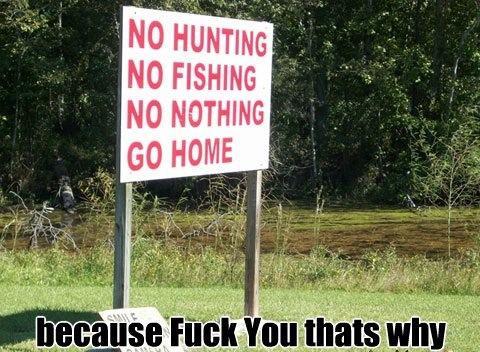
nohuntsign

October 16th, 2013 by Anja Heister

Once again, the U.S. Fish and Wildlife Service (USFWS) wants to turn even more wildlife refuges into playgrounds for hunters and other “consumptive users” of wild animals.

The U.S. National Wildlife Refuge System includes 550 national wildlife refuges, thousands of waterfowl protection areas and four marine national monuments, totaling more than 150 million acres. Despite being called “refuges”, more than half of all national wildlife refuges are already open to hunters, trappers and anglers.

Consumptive users also have millions of acres of public and private lands outside the refuge system available to them to pursue their frivolous and violent activities of “recreational” trophy hunting and fishing, and trapping for fur. They should not be allowed in refuges, which often are the last remaining places for animal species already struggling for survival.

Furthermore, as the USFWS’s own 2011 survey has shown, wildlife watchers have already well outpaced and outspent wildlife killing interests. Wildlife watchers are a growing economic force, and their overwhelming preference to see living animals needs to be considered and respected.

Wildlife refuges, as the name indicates, should be true sanctuaries for wild animals where they are sheltered from the killing spree that surrounds them.

What You Can Do:

Please copy and paste the comment below to the USFWS and tell them that hunting, trapping and fishing should not be allowed in national wildlife refuges at all.

Please follow these steps to send your comment to the USFWS:

http://www.idausa.org/wildlife-refuges-hunters-playgrounds/

Stop Lion Trophy Hunting

01bfb39948b2f313b238ba43f926ea25

The lion population in Africa is being reduced at an alarming rate – 50 years ago there were 450,000 lions. Today as little as 20,000 remain. Lion Trophy Hunting, especially Canned Lion Hunting (where lions are shot in cages) are largely responsible for the dwindling lion population.

For the right price you can shoot a beautiful male lion, a lioness with cubs or even a lion cub – and this is done while they are in a cage and defenseless.

Canned Lion Hunting is not illegal in South Africa. The SA government also refuses to stop the issue of Lion Hunting permits or to at least limit the number of permits issued.

Sign the petition: https://secure.avaaz.org/en/petition/Stop_Lion_Trophy_Hunting/?dOrYHdb

Sea otter return boosts ailing seagrass in California

[Proof that nature can take care of her own, if only we’d step aside and let her…]

Sea otter return boosts ailing seagrass in California

By Suzi Gage BBC News

sea otter ecology A sea otter enjoys a crab in California, and helps seagrass in the process.

The return of sea otters to an estuary on the central Californian coast has significantly improved the health of seagrass, new research has found.

Seagrass was deemed to be heading for extinction in this region before the otters returned.

But scientists found that the animals triggered a chain reaction of events that boosted the water-dwelling plants.

The research is published in the journal, PNAS.

The urbanisation of California has led to a huge increase in nutrient pollution in coastal waters, from increasing use of nitrogen-rich fertilizers.

Continue reading the main story

“Start Quote

It’s almost like these sea otters are fighting the effects of poor water quality”

End Quote Brent Hughes University of California

This is said to be the reason for the dieback of seagrass, which has also been declining worldwide.

This research suggests that the hunting to near-extinction of sea otters in the late 19th and early 20th Century may have exacerbated the problem, and conversely that their reintroduction is helping revive ailing seagrass populations, even in the face of hugely nutrient-rich water.

Links in the chain

The researchers assessed seagrass levels over the past 50 years in the Elkhorn Slough in Monterey Bay, and mapped their increases and declines.

They looked at a variety of changes that may have affected the grass, but the only factor that really matched the changes in seagrass was sea otter numbers.

They theorised that sea otters were eating the crabs which prey upon small invertebrates in the water.

These invertebrates eat a type of algae which blooms when there are more nutrients in the soil. It grows on the leaves of the seagrass, shading them from sunlight and causing them to die back.

This is quite a complex cascade of effects, so the researchers tested out their theory by comparing similar estuaries with and without sea otters, and by doing experiments in the lab, and in the field.

These experiments, which included putting cages that sea otters either could or couldn’t access, down on the seagrass, confirmed their hypothesis.

otters Sea otters have been responsible for improving the health of the seagrass in these estuaries.

Brent Hughes, lead author of the study, said: “This estuary is part of one of the most polluted systems in the entire world, but you can still get this healthy thriving habitat, and it’s all because of the sea otters.

“So it’s almost like these sea otters are fighting the effects of poor water quality.”

Hughes described seagrass as “the canary in the coalmine” in terms of predicting levels of nutrient pollution in the water.

Foundation species

It also acts as a nursery habitat for many species of fish and it uses CO2 from sea water and the atmosphere, thus potentially helping with climate change.

Not only that, but it acts as protection to the stability of the shoreline.

Hughes said: “It’s what we call a foundation species, like kelp forest, salt marsh or coral reef. The major problem from a global perspective is that seagrass is declining worldwide. And one of the major drivers of this decline has been nutrient inputs from anthropogenic sources, via agriculture or urban runoff.”

These findings are of particular interest at the moment, as a ban on sea otters moving along the coast to southern California was lifted last year. The ban was in place as there was a fear the sea otters would impinge on fisheries in the area.

Hughes told BBC news: “That’s important because there’s a lot of these kind of degraded estuaries in southern California because of all the urban runoff from places like Los Angeles and San Diego.

“Coastal managers will now have a better sense of what’s going to happen when sea otters move in to their systems.

“There’s a huge potential benefit to sea otters returning to these estuaries, and in to these seagrass beds that might be threatened.”

Where Will We Be in Y3K?

With several important issues on deck to blog about, the spring winds blew a tree over our power lines and we spent the afternoon back in the relative Stone Age, huddled next to an outside window, straining to read printed pages by what natural light the stormy day had to offer. I decided to do some spring cleaning and throw out anything I hadn’t read or in some other way utilized in the last decade or so. Just as the power came back on I came upon the following letter I wrote after reading Richard Leakey’s book, The Sixth Extinction. This letter, which is as relevant today as when I wrote it (except that there are now 7 billion people instead of 6), was published on January 10, 2000 in the Seattle Post Intelligencer:

Ina fit of arrogant optimism bolstered by surviving the Y2K non-crisis, many are asking, “Where will we be in Y3K?” Perhaps a more pressing question is,” Which species would be able to survive another 1,000 years of mankind’s reign of terror?”

Forget computer malfunctions, power outages or other inconveniences. The new millennium finds us in the midst of a mass extinction unrivaled since a giant asteroid struck Earth 65 million years ago. Unfortunately, Bruce Willis can’t bail us out of the impending Armageddon by simply blasting a menacing death-rock to smithereens.

Our species, one in 1,413,000, is out to prove that it doesn’t take an asteroid strike to unravel life’s intricate diversity. In doing so, humans are on a collision course with destiny. We are eradicating 30,000 species per year—120,000 times the natural extinction rate of one every four years.

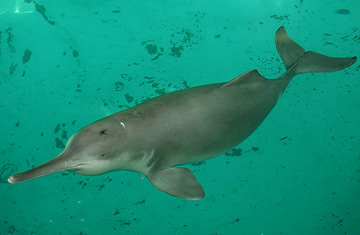
A recent annual survey by the Chinese government found so few of their nationally celebrated, freshwater white dolphins remaining in the Yangtze River that on Dec. 29 they were written off as living relics of an extinct species. China and India now boast more than 1 billion each of a human population that is 6 billion strong and growing. Comparing those figures with the billion inhabitants on the entire planet in 1600, any game manager would clearly see a species out of balance.

As Richard Leakey, the renowned paleoanthropologist warns, “Dominant as no other species has been in the history of life on Earth, Homo sapiens is in the throes of causing a major biological crisis, a mass extinction…And we may also be among the living dead.”

Where will we be in another millennium? Will a future Bruce Willis save us from ourselves? Or will we have gone the way of the dinosaur and the Yangtze white dolphin?

360_yangtze_dolphin_0810

Be the Wind

Upon awakening from a fitful sleep after a cold, windy night, it occurred to me that birds must have to keep an unconscious death-grip on the branch they’re perched on to hold their place until morning. It must be second nature to them; part of what makes them who they are.
Next the thought came to me that a bird’s nighttime death-grip on a perch is analogous to the death-grip “sportsmen’s” groups, “game” departments and the livestock industry have on our wildlife. Like a trembling bird, fearful for its future, animal exploiters must be afraid that if they loosen their grip, they’ll be blown away.

Well, they’re right.

It’s high time we be the wind that finally breaks loose their death-grip on wildlife once and for all, and for the good of all.

Text and Wildlife Photography ©Jim Robertson, 2013. All Rights Reserved

Text and Wildlife Photography ©Jim Robertson, 2013. All Rights Reserved

Wolf-Murder by Numbers

Here are the totals of wolves murdered in the tri-state area, not including those who were victims of our taxpayer-funded assassins—the hit men from the federal “Wildlife Services” agency. (Note: all three of these states share a border with Yellowstone National Park)…

Latest Posted Idaho Wolf Hunt Kill total (current season): 169
Latest Posted Idaho Wolf Trapping Kill total (current season): 76
Final Posted Montana Wolf Hunt Kill Total (most recent season) 128
Final Posted Montana Wolf Trapping Kill total (most recent season): 97
Wyoming Wolf Kill Total (current season): 74 (Note: as of March 1st Wyoming’s season has been extended indefinitely)
Regional Total Reported Killed This Season: 544
Regional Total Reported Killed Since Delisting: 1,089

Meanwhile, a new National Park Service report for 2011 shows that the 3,394,326 visitors to Yellowstone spent $332,975,000 in communities surrounding the park. This spending supported 5,041 jobs in the local area.

(Michigan State University conducted this visitors’ spending analysis for the NPS. The report includes information for visitor spending at individual parks and by state. It can be downloaded at http://www.nature.nps.gov/socialscience/products.cfm#MGM click on Economic Benefits to Local Communities from National Park Visitation 2011.)

Needless to say, most people who visit national parks want to see the wildlife unmolested. They are not there to hunt; the money they spend reflects their strong interest in the quiet enjoyment of nature. Pro-hunting factions like to boast about the money their bloodsport brings to local communities. I don’t know if anyone has taken a survey on how much those kill-happy cowboys add to the communities around Yellowstone, but you can bet your boots it’s nowhere near $332,975,000.
One thing I know for sure is that the number of dollars spent by Yellowstone visitors is going to drop as the wildlife they went there to see continues to disappear.

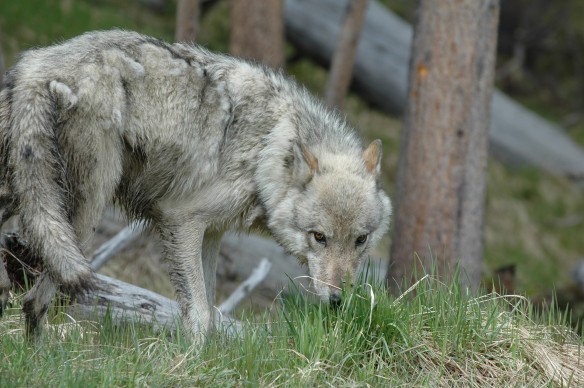
Yellowstone wolf photo ©Jim Robertson. All Rights Reserved

Yellowstone wolf photo ©Jim Robertson. All Rights Reserved

Hope for a Humane and Environmentally Sane Future

The following is my review of a new book published by Earth Books

Often, over the years, I’ve thought about taking on the task of chronicling the ways in which humankind is destroying the Earth, and how we need to change to survive as a species. Now, equally sensing the dire need for such a book, long-time animal activist, Will Anderson, has risen to the challenge with his new book, This is Hope: Green Vegans and the New Human Ecology.

I have to admit, the title, This is Hope, sounded to me like it could be almost, well, overly-hopeful. But in fact the book takes a hard, realistic look at where we’re headed if we don’t make some major changes in our destructive ways, our eating habits and our view of non-human animals as commodities. For instance, Anderson doesn’t buy into the increasingly popular fallacy that hunting can somehow be sustainable in this rapidly growing human world. Not only does he take on hunting, and those groups who promote it, he employs the term “neo-predation” for the myriad of ways in which the modern world disrupts biodiversity—to the peril of all who share the Earth.

And the author does not fall prey to the politically correct notion that human overpopulation is an overstated myth. Instead we learn that as environmentally-conscious, green vegans who truly want to see a future for all life on the planet, addressing and reversing our overpopulation is a must.

If we are willing to embrace Will Anderson’s prescription for a “new human ecology,” there truly could be hope for the future. As Anderson puts it, “The new human ecology can be the transformation of human behavior all of Earth has waited for.” Some of the positive results he foresees from this transformation include:

• Vast landscapes subjected to grazing and growing food for livestock are released from animal agriculture.
• Some of that land will be banked and rotated with other croplands. Soil erosion and pollution are sharply reduced. Sustainably grown, organic food becomes more reliably available.
• Conceivably, fewer people on Earth and the efficiency of botanical agriculture will allow lower food prices and raise food availability.
• We will reduce our greenhouse gas emissions immediately by 18% to 51%.
• Other human pressures on ecosystems decrease and allow them to trend toward recovery.
• Vegan diets will create better human health. This should result in lower health care costs.
• We stop the intentional impregnation of billions of domesticated individuals from other species, the torment of their enslavement and denial of their innate needs, and their early, violent deaths.
• The science and implementation of wildlife and habitat management is transformed…control by the small minority of people who hunt, fish and trap is ended.
• Livestock fences will be removed. Wild herds of indigenous wildlife can reoccupy habitat and have room to migrate long distances. Ecosystem keystone species like black-tailed prairie dogs will not be cruelly persecuted on behalf of animal agriculture.
• There are no new ghost nets, those fishing nets that break away from vessels, drift with oceanic currents, and continue to trap fish, turtles, marine birds, and marine mammals.
• We stop bottom trawling that destroys sea bed marine ecosystems. Since vegan human ecology does not require fish, it ends the trashing of millions of tons of unwanted bycatch (non-targeted species), eliminates shark-finning that is decimating shark populations, stops the killing of octopi, and ends the drowning of dolphins and turtles.
• We finally create a moral code of behavior that is based upon biocentric innate value; it is more consistently applied to all individuals of all species and ecosystems.

Photograph ©Jim Robertson

Photograph ©Jim Robertson

Sunday Go-a-Huntin’ Day

Living near prime wildlife habitat means that at any given moment you might get to see Vs of migratory ducks or cackling Canada geese flying right overhead. If you’re lucky, trumpeter swans might be among the waterfowl feeding and calling in the nearby estuary. And wood ducks or hooded mergansers might pay your inland pond a visit while searching for a quiet place to nest.
The down side of living near a natural wonderland? Being awakened Sunday morning at first light by the repeated volley of shotgun blasts, as though all-out war has been declared on all things avian (as is currently happening this morning). The Elmers out there (no doubt dressed in the latest expensive camo-pattern—a fashion statement apparently meant to impress the other Elmers out there) must be reveling in the fact that the dense morning fog allows them to “sneak” (in their loud outboard motor boats) up close enough to the flocks so that a large number of birds will end up dead, winged or otherwise wounded when they stand up and spray lead.

Duck hunting is the ultimate betrayal. It happens well into the winter, long after about other any hunting season is over, when the birds are congregated in flocks on their wintering grounds. And it happens often on lands supposedly set aside as wildlife “refuges.” Pro-kill groups like Ducks Unlimited (DU—an acronym, or perhaps an abbreviation for “duh”) insist that they have the animals’ best interests in mind. But when it comes right down to it, all they really want to preserve land for is to have a playground for killing (just listen to them scream if you try to propose a refuge closed to hunting).

Interestingly, they always seem to choose Sunday as their special day for bird killing. It’s no secret that most American hunters count themselves as good Christians. In choosing to hunt in lieu of church this time of year, they must feel closest to their gods in the killing fields.

How is this any different than a follower of Santeria sacrificing chickens? Both practices are equally bloody and violent. And the practice of Sunday go-a-duck-huntin’ probably claims more victims.
DSC_0098

This Christmas, Show the Hunters that You Care

Judging by the frost on the grass and the ice on the birdbath, it’s time to start thinking about Christmas shopping. This year, your gifts can make a statement—they can show the hunters that you care.

Now don’t get me wrong, I don’t mean you should show hunters that you care about them—no, quite the opposite—I mean you can show the hunters that you care about wildlife. And what better way than purchasing a pro-wildlife/anti-hunting book, like Exposing the Big Game: Living Targets of a Dying Sport?

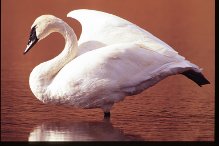
There’s a common misconception that hunters are the only ones who “care” about wild animals. For example, when I brought some of my framed wildlife photos (such as the trumpeter swan seen here) to a small-town art gallery, the owner said, “Well, you might be able to sell them to a hunter…” My first reaction was an under-the breath “What the hell?” quickly followed by a resolute, “Never mind, I’m not hanging them here.”

I don’t know if it’s a sign of the self-absorbed, economocentric times we live in, but it seems Black Friday is garnering more attention than Thanksgiving these days. Across the country, you’ll find headlines like, “2 seriously hurt as driver plows through crowd of shoppers,” “Massachusetts bargain hunter took home TV, left tot” or “Earlier Black Friday kicks off shopping season.”

That last article reports: “This year’s Black Friday shoppers were split into two distinct groups: those who wanted to fall into a turkey-induced slumber and those who’d rather shop instead.” I’m guessing (hoping, really) that readers of this blog fall into still another category altogether.

The article goes on to say: “Stores typically open in the wee hours of the morning on the day after Thanksgiving that’s named Black Friday because of retail folklore that it’s when merchants turn a profit for the year. But after testing how shoppers would respond to earlier hours last year, stores such as Target and Toys R Us this year opened as early as Thanksgiving evening. That created two separate waves of shoppers.

Lori Chandler, 54, and her husband, Sam, 55, were a part of the early group. By the time they reached the Wal-Mart in Greenville, S.C. early Friday, they had already hit several stores, including Target and Best Buy. In fact, they had been shopping since midnight.

‘It’s a tradition,’ Lori said as she looked at some toys she bought for her four grandchildren….”

I’m sure you get the idea.

You’re probably not the type to camp out in front of Wal-Mart for the best deals on Asian sweatshop-produced, future landfill-clogging plastic trinkets, or you wouldn’t be here reading this post. But don’t worry, you won’t have to stand in line and risk being “plowed through” by some crazed shopper driving a Humvee or lose your “tot” in a crowded superstore while attempting to purchase Exposing the Big Game. You can order copies online from the comfort of your own home. If you’re not a fan of Amazon or Barnes and Noble, feel free to email me at exposingthebiggame@gmail.com for signed copies sent directly to your doorstep. Or you can ask your local “brick and mortar” bookstore (which is more than likely on the verge of going out of business) to order in a copy or copies for you. And of course, Exposing the Big Game is also available in e-book form.

There are around a butcher’s dozen new pro-hunting books on the market this year, while Exposing the Big Game is the only anti-hunting book to come out in decades, and the only one still in print. Don’t let the hunters think you’re indifferent about this issue. Together we can put an end to the absurd misconception that they’re the only ones interested in wildlife. While we don’t have the kind of financial support that the hunting industry gets from the NRA or the Safari Club, here’s our chance to show them that we’re the ones with the passion!