Exposing the Big Game

Forget Hunters' Feeble Rationalizations and Trust Your Gut Feelings: Making Sport of Killing Is Not Healthy Human Behavior

Exposing the Big Game

Washington rancher shot wolf thinking it may be dog

A recently released report describes Washington’s second case of a rancher lawfully shooting a wolf attacking cattle

Don JenkinsCapital Press

A Washington rancher who killed a wolf in October told investigators that he thought he might have been shooting a dog, according to a Department of Fish and Wildlife report.

The rancher found the carcass, realized it was a wolf and called authorities. WDFW investigators concluded the shooting was justified because the wolf, an adult female, was chasing a calf.

The shooting, Oct. 27 near the Canadian border in Ferry County, was Washington’s second case of a rancher lawfully killing a wolf under the state’s “caught-in-the-act” law.

WDFW released a redacted copy of the investigative report in response to a public records request from the Capital Press. The name of the ranchers, a man and woman, were withheld by the department and were referred to in the report as “Producer M” and “Producer F.”

The shooting was not an isolated event in northern Ferry County as ranchers moved cattle from public grazing grounds to private pastures in the fall. Within two weeks of the shooting, at least two other calves were attacked by wolves fewer than 3 miles away.

The shooting and depredations occurred outside the range of any documented pack, according to WDFW. Ferry County rancher Arron Scotten, whose cattle were not involved in the incidents, said there had been signs of wolves in the area that fall.

“I think it was all one group that was there,” said Scotten, who was contracted by WDFW as a range rider to look for wolves and patrol around cattle.

“You ended up with (pack) members right there and cattle right there,” he said. “I’m not sure what really could have been done differently.”

The shooting occurred in the late afternoon as the man and woman were hauling cattle from a grazing allotment to a large fenced pasture. The woman told an investigator that she saw what she thought was a bear chasing a calf in the pasture.

Since she had a tag to harvest a bear, the woman aimed a rifle, looked through the scope, saw it wasn’t a bear and handed the gun to the man, who saw a dark-colored canine and shot, according to the report.

The animal went down, got up, veered from the calf and tumbled downhill. “Producer M said they had been seeing a large black/brown domestic dog running loose in the area recently, and they thought it might have been that dog as it looked similar to it from their location,” the WDFW report states.

The ranchers did not find any dead or injured cattle. The cattle were bunched near the pasture’s entrance. WDFW investigators said the wolf was shot once and that the evidence at the scene matched the ranchers’ description of events.

A separate livestock producer in the area reported an injured calf Nov. 2. Another calf was found dead Nov. 8. Scotten said range-rider patrols, particularly at night, were increased.

WDFW also ruled that a ranch employee was justified in shooting a wolf June 30 in Stevens County.

Washington law allows shooting one wolf attacking livestock. The law applies in the eastern one-third of Washington, where wolves are not federally protected. Under state law, illegally shooting a wolf is a gross misdemeanor and punishable by up to one year in jail and a $5,000 fine.


Coyote hunter accidentally shot to death by neighbor, deputies say

http://www.wsoctv.com/news/local/coyote-hunter-accidentally-shot-in-alexander-county/703214724

By: Dave Faherty

Updated: 

Deputies said the victim, Seth Marsh, was in a wooded area along Ed Burgess Road near Highway 16, just north of Taylorsville, when he was shot with an AR-15.

(Seth Marsh)

Officials said Marsh was using an electronic coyote caller and set up on the ground near a tree when a neighbor heard the caller and fired two rounds at what he believed was a coyote, striking Marsh twice in the chest.

Authorities said the neighbor immediately ran over to help Marsh and called 911.

Marsh died a short time later at a hospital in Wilkes County.

Officials said Marsh was wearing camouflage when he was shot. Authorities said he was also wearing an orange hat, but a hooded sweatshirt was covering it.

Investigators seized the neighbor’s weapon and returned to the location of the shooting Tuesday to canvas the area with metal detectors.


Wildlife officers said the accidental shooting is a reminder about the importance of gun safety.

“Whenever you point a weapon and pull that trigger, know where that bullet is going before you aim and shoot,” Sheriff Chris Bowman said.

“We’re looking at, ‘Did the suspect identify the target, or did he just shoot at movement?'” Chad Starbuck, with the North Carolina Wildlife Resources Commission, said.

Deputies said Marsh, a father of two young children, was a preacher at a church in the northern part of the county.

“It’s sad to say that he will not see his little boy play sports or get to see his daughter walk down the aisle one day,” church member Coy Pearson said.

Deputies said they are hoping to wrap up the investigation by Wednesday and meet with the district attorney to determine if any charges are warranted in the case.

NC hunter using a coyote call is shot by another man


http://wncn.com/2018/02/19/nc-hunter-using-a-coyote-call-is-shot-by-another-man-sheriff-says/

Published: 

TAYLORSVILLE, N.C. (WBTV) — A man was shot Monday evening in what Alexander County investigators are saying may have been a hunting accident.

MORE NEWS: Animal control officials receiving worried calls about coyotes in Orange County

The incident happened just after 6 p.m. in a wooded area along Ed Burgess Road, which is off of Highway 16 north of Taylorsville.

A man hunting coyotes used a coyote call. Another man nearby heard the call, got a rifle and shot toward the sound.

The man hunting was hit by the gunfire. He was taken to an area hospital.

As of 8 p.m., there was no word on his condition.

Deputies said they were investigating to make sure the evidence matched up with the story.

No names or possible charges have been released.

France to let wolf population grow despite farmers’ fears

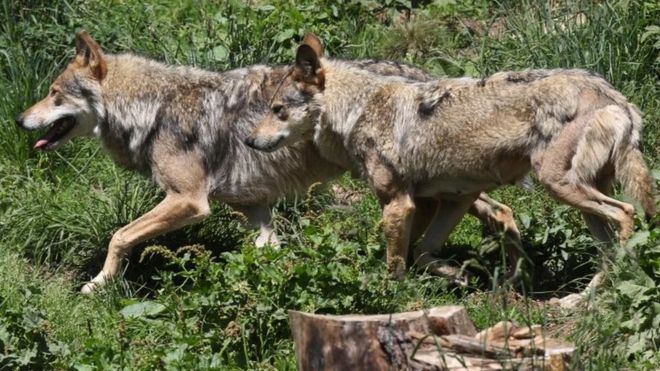
Wolves in Les Angles, south-western France. File photoImage copyrightAFP/GETTY IMAGES
Image captionAfter being wiped out by hunters in the 1930s, wolves returned to France in the 1990s

France is to allow the wolf population to grow from about 360 now to 500 by 2023, despite protests from farmers worried about their livestock.

A new plan announced by the government represents a rise of nearly 40% in the wolf population.

After being eradicated by hunters in the 1930s, the wolf made its way back into France from Italy in the 1990s.

Wolves are listed as a protected species by the Bern Convention that France has signed up to.

Animal rights groups had been pushing for a more radical proposal and accused ministers of lacking political courage.

In a gesture to farmers, the government said that hunters in France would still be allowed to cull 40 wolves this year, the same as in 2017. Up to 10% of the wolf population could be culled every year from 2019, and that proportion could rise to 12% if more frequent wolf attacks were registered.

Almost 12,000 sheep were killed by wolves in France in 2017 and the government has come under strong pressure from farmers in French regions – particularly in the Alps and the Pyrenees.

“We place trust in all of the stakeholders and local lawmakers to calm the debate and enable co-existence over the long-term,” Agriculture Minister Stephane Travert and Environment Minister Nicolas Hulot said in a joint statement.

The new plan also envisages that livestock owners will be able to apply for state funds to protect their animals from wolves.

France is not the only Western European country witnessing the return of the wolf.

Last month a wolf was spotted in the Flanders region of northern Belgium for the first time in over a century.

There were an estimated 60 wolf packs living in Germany in 2017, a rise of some 15% on the previous year.

Animals are using Colorado’s wildlife crossings, reducing collisions, CDOT says

PUBLISHED:  | UPDATED: 
A herd of deer walk through a wildlife crossing in the snow.
Colorado Department of Transportation, supplied

A herd of deer walk through a wildlife crossing in the snow.

Wildlife bridges and underpasses led to a dramatic decline in animal-related car crashes, …

For full story, visit:

Animals are using Colorado’s wildlife crossings, reducing collisions, CDOT says


It’s Hard to Be Ethically Consistent While Tap-Dancing on Eggshells

My objection to hunting, trapping and seal clubbing is colorblind as well as culture-blind. I oppose cruelty to animals, no matter who is doing the shooting, trapping or clubbing. A victim doesn’t suffer any less because of the ethnicity or cultural beliefs of their executioner. An animal’s right to a life, free from harm, trumps anyone’s right to exploit or kill them.

Over the weekend I received the following question, which I’ll attempt to answer below…

Q:

Dear Mr. Robertson,

I was wondering your opinion on the subject of animal rights vs. the rights of indigenous people. What do you think about hunting by Native American tribes, or the hunting of seals by the Inuit? Also, of course, the various other tribes around the world that have their culture based off of hunting. What do you think about their participation in hunting, trapping, etc?

A:

Hmmm, one of those questions…one of those I-wouldn’t-touch-that-with-a-ten-foot-pole kind of questions. Do I risk being called a hypocrite, or “culturally elite?” I could spend all day tip-toeing around this—tap-dancing on egg shells—but here’s an answer just off the top of my head:

My objection to hunting, trapping and seal clubbing is colorblind as well as culture-blind. I oppose cruelty to animals, no matter who is doing the shooting, trapping or clubbing. A victim doesn’t suffer any less because of the ethnicity or cultural beliefs of their executioner. An animal’s right to a life, free from harm, trumps anyone’s right to exploit or kill them (unless someone is literally starving to death and has no other options, which is not the case for most who hunt, trap, club seals, harpoon whales or trade in bushmeat).

Why oppose the Japanese or the Faeroese for slaughtering dolphins or pilot whales and not the Makah for killing grey whales, or even the Inuit for hunting bowhead whales? We’re all part of the species, Homo sapiens, and our ancestors all used to live by hunting and trapping. For better or worse, we’re all moving forward technologically, so there’s no reason we shouldn’t all move forward in our treatment of non-human animals.

That’s my humble opinion, anyway. It might not be popular, but it’s ethically consistent.

Text and Wildlife Photography© Jim Robertson

Text and Wildlife Photography© Jim Robertson

Sport of fur trapping helps with the beaver problem

This week I want to explore a different sport than one that involves around a ball: the sport of trapping.

The first question that many might ask is trapping a sport? Yes, it is a sport that is licensed and regulated by the Kentucky Department of Fish and Wildlife in the same manner that they regulate bass fishing or deer hunting.

However, trapping as a sport, like many hunting activities, is in a serious decline and this is having an impact on our local beaver population.

Animal trapping or trapping is defined as the use of a device to remotely catch an animal. My focus is on the topic of fur trapping, which has become a hot topic in the western Kentucky coalfields.

From a historical perspective trapping was done for a variety of reasons including for food, fur trade, hunting, pest control and wildlife management. Trapping in this portion of the state includes trapping animals such as beavers, coyotes, bobcats, mink and muskrats.

Historically trappers in Kentucky hunt for two primary reasons: 1) the fur and 2) control the nuisance of certain animals such as the nuisance trapping we now see for coyotes here in Hopkins and Webster counties.

Locally, fur trapping hit a revival in late November and early December in Hopkins County under the leadership of Frank Williams, the Second District Commission member for the Kentucky Department of Fish and Wildlife.

Williams recently noted in a speech to the Madisonville Lions Club, “I was getting a tremendous amount of complaints from property owners, farmers and other individuals of the tremendous damage that beavers were doing in Western Kentucky, particularly in Hopkins and Muhlenberg counties.”

Williams pointed out that the beaver population has exploded in our area and that there was a tremendous amount of damage to county roads, crop land and timber.

In fact, the Hopkins County Road Department estimated over a three-year period it has spent over $100,000 in replacement of gravel and grade work due to beaver damage.

With this tremendous damage occurring, Williams solicited the help of the United Trappers of Kentucky. This group is a statewide sportsmen’s organization of Kentucky fur trappers whose primary goal is the enhancement of trapping as a sport.

Unfortunately, trapping as a sport has been in tremendous decline. In the late 1980s there were over 4,000 licensed trappers in Kentucky.

Williams noted, “Currently we are selling about 2,200 trapping licenses a year but we estimate only about 500 active trappers.”

After Williams called, the United Trappers of Kentucky under the leadership of President Chet Hayes and Vice President Steven Rickard assembled a group of volunteers to come to Hopkins and Muhlenberg counties. Because of the success in beaver trapping here the group will go to Union County this March.

During the period of Nov. 26-28, 2017, the United Trappers of Kentucky harvested 186 beavers and Hopkins County Fiscal Court employees harvested another 20 for 206 trapped beavers.

Williams and the local road department, farmers and property owners were very pleased and it is hoped that this will spur some interest in fur trappers returning next year.

Williams noted the crux of the problem of an exploding beaver population is based upon the price of beaver pelt.

Williams stated, “A beaver pelt today will sell for between $10 to $12 whereas 20, 25 years ago it sold for $35 to $50.”

There is still a market in Russia for beaver pelt but it has declined.

In fact, the market for other fur has also declined, with raccoons averaging $5 a pelt, muskrat about $3 a pelt and the once very expensive mink is now about $8 a pelt as most minks that are used in mink furs are today grown in mink farms in Israel.

The decline in the price for the pelts along with the general decline in hunting has caused a tremendous decline in fur trappers and therefore led to many of the problems we are seeing today with beavers.

Williams has a basic solution to the beaver problem stating, “We need to have a subsidized program of some manner to encourage fur trapping as a sport and have fur trapping come back as a popular sport. If there are trappers out there, they will control the beavers and in the long run this will help road departments, taxpayers, crop owners and timber land owners.”

Whether we live in a city or in rural parts of western Kentucky beavers and fur trapping can have an economic impact on us.

Bear expert: flooded dens a threat to bears, not people

Bear expert: flooded dens a threat to bears, not people

Brandon Wade | AP | BDN
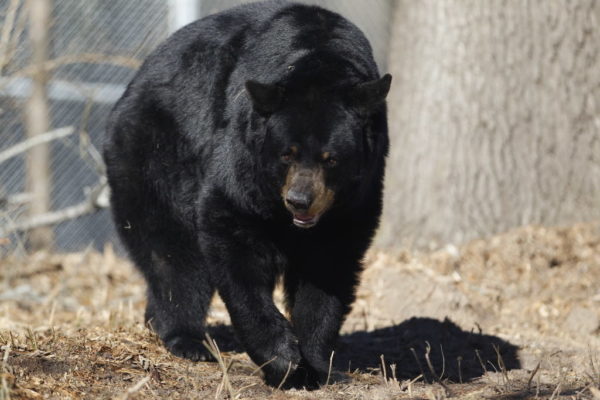
File photo of a black bear that was relocated to an animal sanctuary in Texas, courtesy of the Humane Society of the United States.
By Callie Ferguson • 

The bear that mauled a puppy in Dedham last week apparently was one of several forced from its den because January was unusually rainy, according to Maine bear experts.

The bears were flooded out of their winter hibernation spots, said Jennifer Vashon, the biologist who oversees the state’s bear program within the Department of Inland Fisheries and Wildlife.

Last week’s bear-human conflict was the first such weather-related encounter that Vashon can recall. But, she said, having more bears become active early in the year does not put Mainers at much of a risk of running into one of them.

The bear versus dog tangle likely occurred because the dog disturbed a young bear that had recently relocated near a busy roadway and hadn’t fallen back into a deep hibernation, Game Warden Shannon Fish said.

Vashon agreed that the scuffle was a “freak coincidence.”

“I don’t see any reason that the weather is going to cause an increase in encounters between bears and people,” she said.

Heavy flooding from rain occurred earlier than usual, Vashon said. But if early-winter flooding becomes the norm because of climate change, it’s bears that will have to adapt, not people. Bears would gradually become more likely to establish their dens on higher ground, she said.

Last week’s mauling occured when 29-year-old Dustin Gray and his puppy, Clover, unwittingly stumbled upon a bear den in the woods just off of Route 1A in Dedham. Gray said he fought the bear off. Clover is now recovering from puncture wounds.

Near the place the conflict occurred, Fish found a small cave that looked like it had briefly housed a small bear. That led him to conclude the bear had recently moved out of a flooded den.

The National Weather Service does not record rainfall totals for Dedham, but Bangor received 5.53 inches in January, nearly double the its average for the first month of the year. That rain, combined with snow melt, caused widespread flooding, according to NWS meteorologist Mark Bloomer.

Vashon’s colleague, biologist Randy Cross, checked on five dens in a research area affected by the flooding and found that the bears in four dens had already left, she said.

When their dens flood, bears don’t roam around looking for food — or people, whom they tend to shy away from. Instead, they try to find somewhere nearby to resume hibernation, she said.

But, usually, that happens in rainy March — not January. And Vashon said that early-winter flooding could endanger newborn bears.

Cubs are born in January and cannot easily withstand flooding because they are tiny, hairless and vulnerable, she said. But by March cubs are five-pound “furballs” better equipped to cope, she said.

Vashon won’t know until the spring, when the state checks its cub counts, if last month’s heavy rains cost the lives of any newborns, she said.

“But this one year, there’s probably no reason to be concerned,” she said.

Climate change has made January rains more common, a trend that is likely to continue, according to Sean Birkel, a University of Maine climatologist.

But, Vashon said, that just means mother bears will seek out higher ground.

“Bears learn,” she said.

Wildlife advocate’s dog snared by trap

https://www.abqjournal.com/1134793/wildlife-advocates-dog-snared-by-trap.html?utm_source=abqjournal.com&utm_medium=sidebar+-+popular+posts+-+default&utm_campaign=popular+posts

Copyright © 2018 Albuquerque Journal

A New Mexico woman and wildlife advocate who works to ban trapping recently encountered a steel foothold trap up close and personal while walking in the Cibola National Forest.

Mary Katherine Ray of Winston said she was walking her two leashed dogs on Tuesday, along a game trail they frequently use in the San Mateo Mountains, when her shepherd mix, Greta, began to scream in pain.

“Until you’ve heard it, it is unimaginable,” said Ray, who works with the Rio Grande chapter of the Sierra Club.

She quickly realized Greta’s left front paw was caught in a trap.

Ray is the wildlife chairwoman for the club and routinely teaches people how to release traps should their pets be caught, so she knew what to do.

She threw her jacket over Greta to protect herself but still received a few bites from the panicked dog.

After pushing down – hard – on the release levers on both sides of the trap, Greta was free.

The foot-hold trap that snared Mary Katherine Ray’s dog.

Ray said Greta limped for a few hours and has since recovered, but the incident has left her shaken.

“I can’t imagine people who are just out hiking, not knowing what I do about traps,” she said.

She said a game warden she informed about the incident inspected the trap and told her there was nothing illegal about it.

Trapping of foxes, badgers, weasels, ringtails and bobcats is legal on public lands from Nov. 1 to March 15.

The trap was placed in the middle of the game trail, but that’s legal, because it’s not an official walking trail on any map.

It was also farther than the required 25 yards from any public road.

“Until March 15, I’m going to be staying inside,” Ray said.

Ray said she also carries a pair of cable cutters in case one of her dogs is caught in a snare, another legal means of catching fur-bearers.

Mary Katherine Ray was walking in Cibola National Forest when one of her dogs stepped on a foot-hold trap. (Courtesy of Mary Katherine Ray)

Last month, a man found himself in hot water after releasing a trapped fox near Placitas and nursing it back to health.

A bill to make trapping and poisoning animals on public lands illegal was introduced in the state’s 2017 legislative session, but it died in committee.

According to the New Mexico Department of Game and Fish, nearly 5,000 protected fur-bearers, including beavers, foxes, badgers and raccoons, were harvested during the 2016-2017 season.

Trappers are permitted through Game and Fish, which did not respond to requests for comment.

Man shot dead during wild boar hunt in the Var

https://www.connexionfrance.com/French-news/Man-shot-dead-during-wild-boar-hunt-in-the-Var

The two men were out hunting with rifles when the incident happened (photo for illustration only)

A man in his late 60s has been shot dead during a wild boar hunt gone wrong near Toulon in the Var.

The man, who lived in the Toulouse area and was reportedly taking part in the hunt at Solliès-Ville, received a bullet to the chest the morning of Saturday February 17, according to the prosecutor of the République, Bernard Marchal, speaking to local newspaper Var-Matin.

Another man who was also taking part in the hunt has been taken into custody for investigation after the incident, but no-one has yet been charged, and the sequence of events is yet to be confirmed.

According to early reports from the gendarmerie de La-Valette-du-Var, one of the hunters fired three shots at a boar, apparently without hitting it, from his position in a watchtower to one side of the hunting area.

Wanting to warn his hunting mate, who was reportedly stationed in another watchtower a few hundred metres away, the man called out but heard no reply, and so went to look for him.

He then reportedly found the man lying on the ground, with his rifle at his side.

The shooter, another man in his 60s, was taken into custody but released a day later, and claims that he only ever shot at the “defined angles” allowed in the hunting area.

Investigators are this morning (Sunday February 18) set to use lasers to research the angles of the shots made, alongside research on the ground next to the dead man’s watchtower, in an attempt to judge how he fell, as well as find the bullet that killed him.

An autopsy on the dead man is expected early next week.

The man’s death is only the latest in a number of tragedies seen during animal hunts in recent months; in September 2017, a 13-year-old boy was accidentally shot dead by his grandfather on a hunting trip, and a 57-year-old man was killed on a hunt in the Alpes-Maritimes, while in November, a man who acted as a hunt beater – helping to flush out stag for others to hunt – was gored by a young stag.